Wasps!

Last week, I received a copy of Heather Holm’s book on wasps – her latest masterwork. I can’t recommend it highly enough. I actually got the book as a thank you gift for giving a presentation, but I was planning to buy it anyway.

Wasps have an undeserved bad reputation among some people. It’s probably because when people think of wasps, they envision one of the relatively few species that aggressively defend their nests (the nerve!) when others, including humans, get too close. Dismissing all wasps because of a few aggressive ones is kind of like giving up on Mexican food because you don’t like cilantro.

Paper wasps are one of the notorious wasp species that will certainly sting you if they feel you’re threatening their nest. They’re also one of a minority of wasp species that has a eusocial structure with a queen and workers with specialized jobs. This male (males don’t sting, by the way) has milkweed pollinia all over its feet after feeding on milkweed nectar.

In reality, it’s estimated there are more than 100,000 wasp species in the world; many more, by the way, than the estimated 20,000 species of bees. As with bees, most wasp species have a solitary lifestyle, in which a single female builds a nest, lays eggs, and provides food for them by herself. Many wasps are pollinators, but they are much more than that. While parents might be nectar feeders, the babies are carnivores. As a result, most wasps hunt down invertebrates for their larvae to eat, making them incredibly important regulators of insect and spider populations. Holm explains that wasps are the evolutionary ancestors of bees. Bees just gave up carnivory and focused solely on feeding nectar and pollen to their kids.

The five-banded Thynnid Wasp is a great example of a wasp we can all get behind. Females go out at night and dig down to scarab beetle larvae (white grubs) in the soil. How do they find the grubs? I have no idea. Anyway, the wasp stings (paralyzes) the grub and lays an egg on it so her larva has plenty of food after hatching. During the day, the female feeds on flower nectar and/or sleeps. Males (like these shown) often congregate on plants overnight, but aren’t aggressive (don’t have stingers). They just hang out together after a long day of nectar feeding and female chasing.

I’ve long been fascinated by wasps, and have tried to learn what I can, but I’ve mostly had to do so by hunting down scattered bits of information. Holm’s book brings together a wealth of knowledge into one place. In fact, the first thirty pages of her book packs in so much material, I’ve already read it several times – not because it’s poorly written, but because I wanted to absorb it all. She goes through the various categories of wasps and talks about their nesting and hunting strategies, diet selection, and much more. I learned, for example, that some wasps use vibration (like a jackhammer) to excavate nest tunnels. Others carry soil and water separately and then mix them together when constructing aboveground mud nests.

I’m not sure, but I think this might be a wasp in the genus Isodontia? Maybe Isodontia mexicana, the Mexican Grass-carrying wasp, based on the description in Holm’s book.

After the terrific introductory chapters, Holm then moves into the main chapters of the books, in which she details the descriptions and lives of several hundred wasps. That’s only a small selection of North America’s wasps, of course, but it covers many of the common species most of us will see around us. The book focuses mainly on aculeate wasps (narrow waisted wasps) because, I assume, doing any more would make the book too heavy to lift. It’s a hefty book as is, but not in a way anyone could complain about.

One of the delightful discoveries I made through Holm’s book is that many wasp names are basically short stories that include both physical description and life history of the creature. Examples: Half-belted Blue-black Spider Wasp; Smoky-winged Beetle Bandit Wasp; Robust Katydid-hunting Wasp; Foggy Treehopper-hunting Sand Wasp. If you learn the name, you’ve already got a pretty good idea of what it looks like and what kind of prey it feeds to its kids!

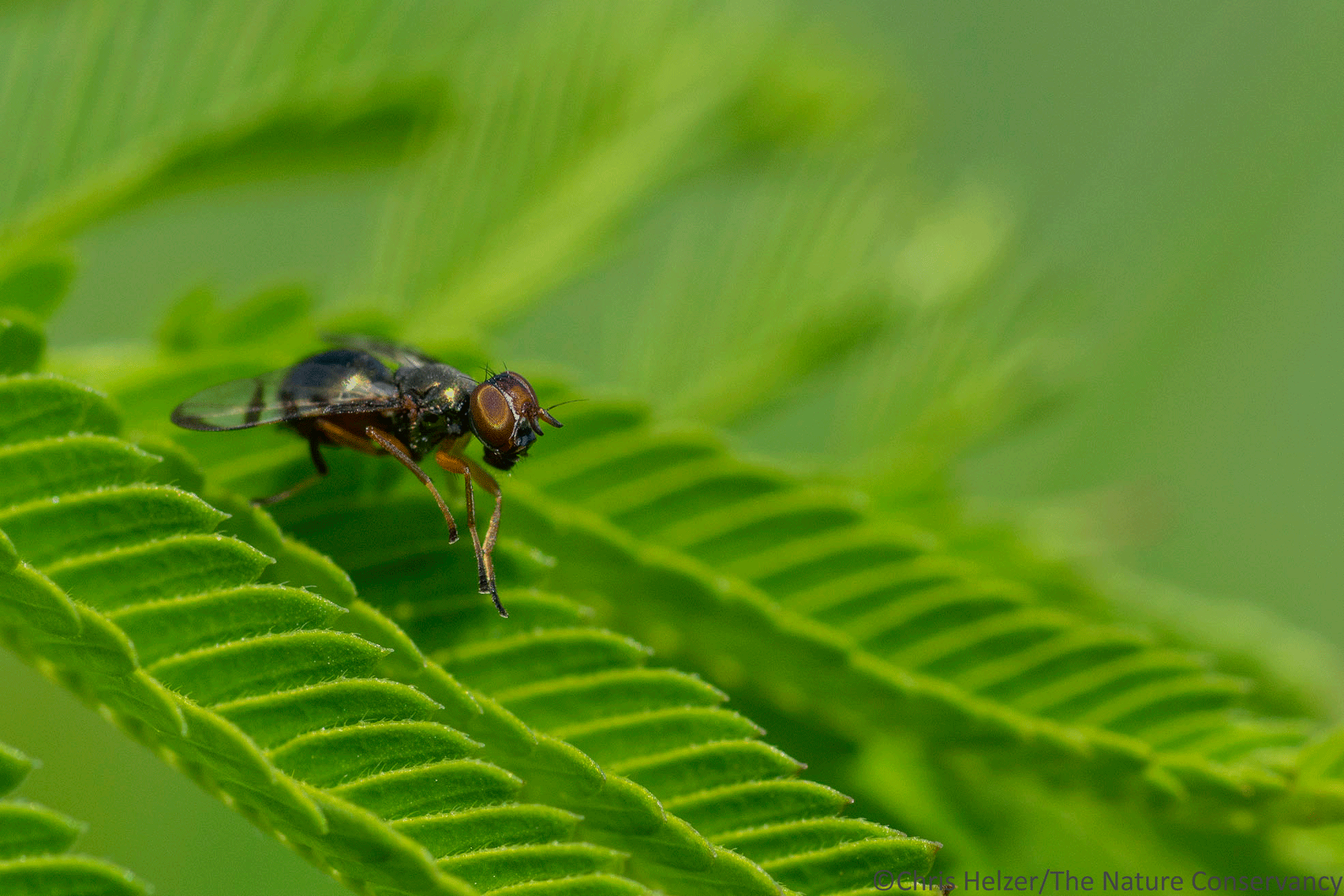
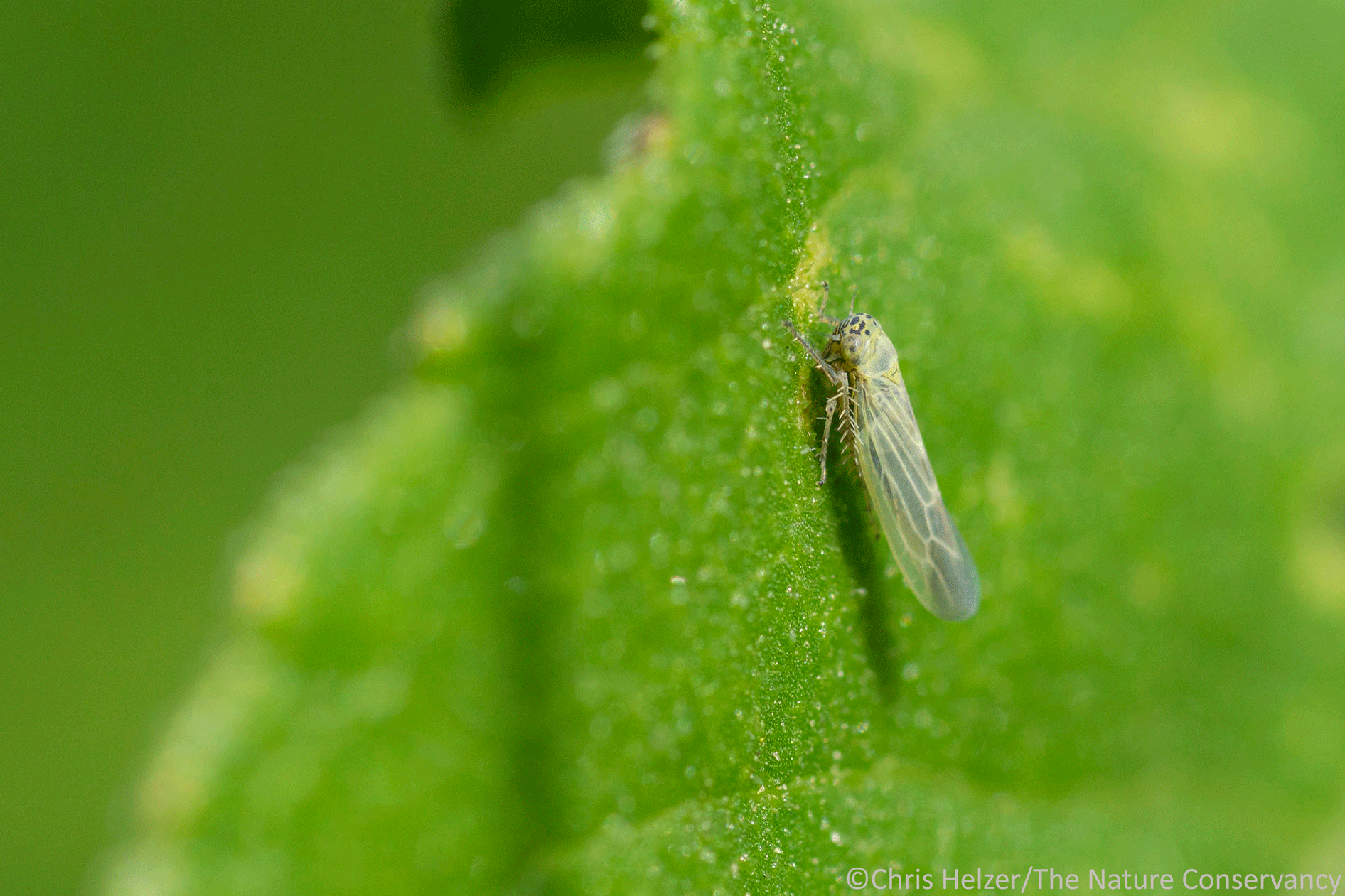
I don’t know this one, and I’m not even 100% sure it’s a wasp and not a bee. The line between the two is pretty blurry sometimes.
Someone (probably Mike Arduser) once identified this wasp as being in the genus Aphilanthops and I’m not going to argue.
This looks a lot like the Common Blue Mud Wasp (Chalybion californicum) in Holm’s book, but I remember it being bigger than that when I saw it on this yucca pod. It sure is a gorgeous color, though, isn’t it?

After supper over the weekend, I grabbed the book before the kids had left the table, and offered to randomly open it and tell them about whatever wasp species was on that page. The kids were skeptical, but by the time I finished reading about the Wood-boring Mason Wasp (Euodynerus foraminatus) and the way it brings paralyzed caterpillars to its larvae inside a tree stump, they were willing to hear about another one. Then I told them about cuckoo wasps, which wait for other wasps to leave their nest hole and then sneak in and lay their own eggs inside. They are the cowbirds of the wasp world! I could tell the kids were fascinated by the way they were slowly backing out of the room…

Come on, look at that face… Don’t you want to get to know this fascinating creature and all its kin? of course you do.

Look, I don’t really do book reviews on this blog, and I’ve turned down a number of requests to do so. I was not asked to write anything about this particular book – I just couldn’t contain my excitement about finding such a tremendous resource on a group of insects I’ve always wanted to learn more about. Buy the book or don’t – it doesn’t affect me one way or the other. I can tell you, though, you won’t be disappointed if you do. And if you don’t, how will you learn about the Eastern Ant-Queen Kidnapper Wasp?

Photos of the Week – March 12, 2021

I don’t know why I keep trying. There’s just something about wildlife photography that lures me in. Sitting in a small blind, concealed from wild animals you’d never otherwise get close to, and coming home with fantastic photos and a good story to boot? Sign me up!

Except it never works that way for me. I build a blind, lie uncomfortably in it for hours, and nothing comes near. I nap, I work on my laptop, I listen to podcasts – all of which I could do more effectively and enjoyably in a more comfortable setting. And for what? Nothing.

This week, I sat in two different uncomfortable blinds, waiting for sandhill cranes that never materialized. The first was along the edge of the Platte River. I army crawled to the blind in the darkness last Saturday morning. It is in a spot that frequently has thousands of roosting sandhill cranes. The river levels looked great for crane roosting too – exposed sand all over the place, including near the bank where my blind was hidden. As I entered the blind, though, and took my first look at the river, it was clear this wasn’t going to work out. First of all, I could see the river – all of it – an nice view, unobstructed by any birds. Upstream, I could see the vague white of a horde of snow geese, but just as I was trying to decide if I was going to stay or go, the horde lifted noisily into the sky and left. I left too.

Look how well my blind is hidden! (click to see a bigger version of the photo) Fat lot of good it will do…
The inside of my blind during my most recent fruitless wait for wildlife.

My second blind is along the edge of a small creek where we’ve been seeing sandhill cranes hang out during the day. We’ve known for years that they use the creek, but don’t really know much about what they’re doing there or why they choose to do it in a wooded area that is so different from the open treeless sites where they normally hang out. My brain told me the way to figure it out would be to hide in a small uncomfortable blind and watch them. My brain is stupid.

I’ve made two attempts to use that blind in the last week. The first time, I had to retreat during my approach because there were cranes in front of the blind. The second time, I got in and sat there for three and half hours while nothing happened. Will I try again? Probably. Did I mention my stupid brain?

Here’s the thing, though. When I stick to my lane as a naturalist and photographer and just look for interesting stories among invertebrates and flowers, I have great luck. This week alone, while getting skunked by sandhill cranes, I found and photographed two great insects without working hard at all.

The first was in my yard. After getting home from not photographing cranes from my blind, I wandered back to our prairie garden to see what might be moving around in the warm sunshine. There were several different insect species around, but the most abundant was a bunch of false milkweed bugs (Lygaeus turcicus). In fact, they were so abundant, I spent a minute trying to count how many were in a square foot and got over 20. Many of them were mating with each other, while others were just crawling in and out of the stems and leaf litter. A few seemed to be feeding on something. I wondered what they were eating.

False milkweed bug (Lygaeus turcicus) in my prairie garden. Nikon 105mm macro lens. ISO 400, 1/250 sec at f/14.

Lying on my belly in the warm sun (comfortably) and hoping, as always, my neighbors weren’t watching me, I inched close enough to a few bugs to get photos. Many of them spotted me and ran away, but that was fine – there were plenty more around. I even managed to get a few good photos of one holding and feeding (through its long proboscis) on a seed.

Using a combination of experience and context clues, I figured out that the bug was feeding on the seed of a false sunflower seed. That made sense since this was happening in the part of our garden where we have a lot of false sunflowers and the plants drop a lot of seeds. I glanced around and saw a few other bugs with the same kind of seeds. Later, I looked online and learned that false sunflower seeds are a favorite food of false milkweed bugs. An irony, of sorts, since it is one unfairly named species eating another. (It’s not the fault of either the bug or the plant that an uncreative person named them after another similar-looking species that happened to have been named first.)

A false milkweed bug feeding on a false sunflower (Helianthus helianthoides) seed. Nikon 105mm macro lens. ISO 320, 1/200 sec at f/14.

My second success came while on a hike with Kate and Sarah, our Hubbard Fellows. We were exploring the sandy hills along one of our Platte River Prairie hiking trails and stopped at a small area of bare ground. I was going to point out some interesting aspects of the exposed soil. Instead, we all got to enjoy a great look at one of the most colorful insects in the state – the festive tiger beetle.

Festive tiger beetle (Cicindela scutellaris) eating a caterpillar (leaving the head for last). Nikon 105mm macro lens. ISO 400, 1/250 sec at f/14.

The beetle was very accommodating and sat nicely for photos. I figured that was because it was eating something, but even after it finished its meal, it hung around for a few more minutes. Maybe it was feeling satiated and happy? Or just warming itself in the sun? Either way, the presence of three people staring at it didn’t seem to bother it at all.

At the time, I couldn’t quite tell what the beetle’s sand-covered prey item was, but when I got home and looked closely at the images, I saw it was a caterpillar. I’ve never seen a tiger beetle eat a caterpillar before – I’ve always thought of them as catching faster prey. It makes sense, though. Why chase after fast prey when there’s a big ol’ slow-moving enchilada right there?

Festive tiger beetle (Cicindela scutellaris). Nikon 105mm macro lens. ISO 500, 1/250 sec at f/16.

The lesson here, of course, is that I can get good photos and see interesting things when I do what I do best – wander around in prairies with my eyes looking down. It’s only when my brain talks me into trying to be a wildlife photographer that things go badly. You’d think I’d learn. Instead, I’ll probably try to find some time next week to squeeze myself into my uncomfortable blinds again. Stupid brain…