Years ago, I wrote a blog post comparing prairie restoration to the rebuilding of a city after a major disaster. I was making the point that our objective with prairie restoration shouldn’t be to create something that looked like it used to or even like the prairie next door. Instead, we should focus on restoring function to a landscape that had been fragmented and thus degraded. I ended the post with this sentence, “After all, we’re not building for the past, we’re building for the future.”
I still stand by that, though my thoughts continue to evolve as I learn more about the challenges facing prairies in today’s landscape. In most places, prairies exist as small and isolated fragments where species and their communities are fighting to survive threats invasive species and other major challenges. Because the fragmentation of their landscape, many of those species are fighting without the hope of reinforcements from elsewhere. They’re simply fighting with the troops and ammunition they have on hand.
The rapidly changing climate adds additional stress to those troops by changing the battle conditions – often favoring the enemies. Many of us have placed hope in the idea that the genetic diversity within species in local prairies will be enough to allow them to adapt and keep fighting. That’s a big assumption. What if they’re not equipped to survive a long-term shift in temperature and precipitation conditions?
If restoration is supposed to bolster the function of fragmented landscapes, how can we best design strategies that decrease stress on isolated prairies and facilitate their need to adapt to changing climate? For a long time, most of us have stressed the importance of using locally-harvested seed to ensure the plants we grow in restored sites will be adapted to those sites. In the face of climate change, some have wondered if we should go further afield and gather seeds from places that have the kind of climate that is projected for our restoration sites.
That ‘climate matching’ strategy has some obvious flaws. If we venture southward, for example, to find plants living under the climate conditions we think will prevail in our restoration sites, those plants will likely to be adapted to different soil types, soil textures, and photoperiods. Plus, what if today’s climate models are wrong and the future climate is different from current projections?
And yet. The climate is changing and those isolated armies are already struggling. If we’re going to provide them with reinforcements and help re-connect currently isolated sites, we want to make sure we recruit the best soldiers we can. Harvesting local seed just brings in more of the same local genetics we already have. Climate matching might bring in genetics that won’t fit local conditions. What do we do?
Fortunately, a team of ecologists led by The Nature Conservancy’s Marissa Ahlering is conducting some experiments that might help solve the conundrum. Over the last 2 years, they have begun studying the concept of a ‘regional admixture’ approach to prairie restoration seed mixes. Below, I interview Marissa about the research and what it might mean for the future of prairie restoration.
.
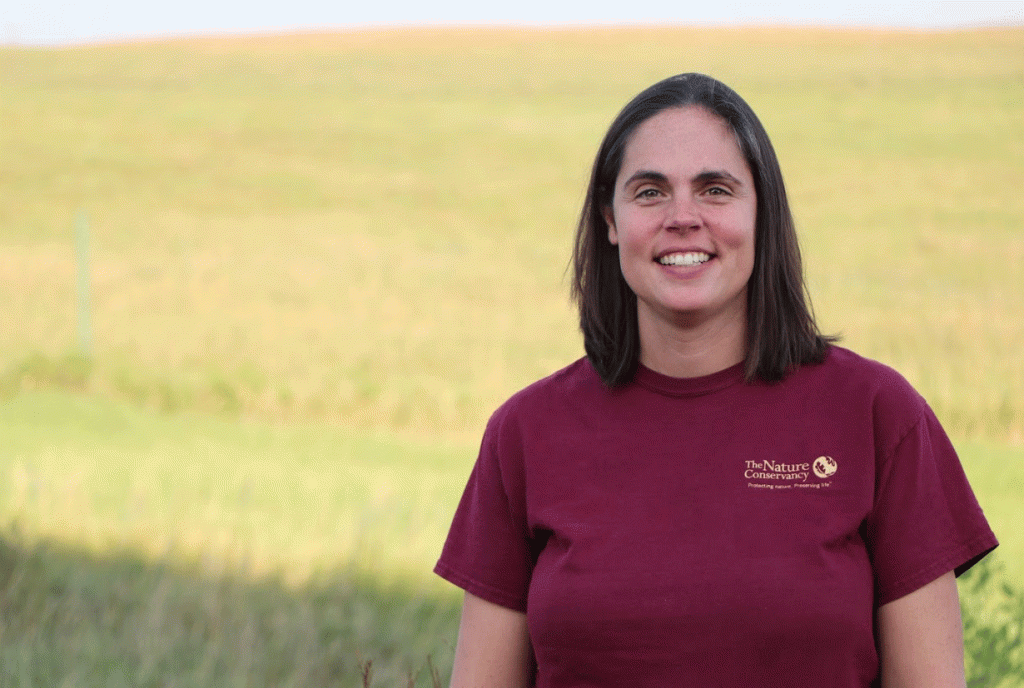
PE: First, can you briefly describe your position with The Nature Conservancy?
MA: I am the Lead Prairie Ecologist in Minnesota, North Dakota and South Dakota. The simplest way to explain my job is that I bring science to bear on our grassland conservation issues for the region. Sometimes that means taking the science that exists and applying it to our conservation challenges and sometimes that means collaborating with others to do the science that is needed to fill our knowledge gaps so that we can move our conservation work forward faster.
PE: What do we know about the amount of genetic diversity within plant species living in prairie fragments? Is it a pretty sure bet that those species are underequipped to deal with climate change?
MA: Honestly, not a lot. Information on genetic diversity and adaptive capacity is lacking for nearly all our native plant species. Work has been done with a very small handful of common prairie plants (e.g., switchgrass, big bluestem, purple prairie clover, and Echinacea angustifolia). For these species, more genetic diversity was found within populations than between populations, and populations closer together are more similar than populations farther apart. This is typical for species with large geographic distributions. Most of this work has been done using parts of the DNA that are not important for the functioning of the plant, so it is somewhat unclear what this means for the adaptive capacity of these species. Genetic techniques can now consider variability across the entire genome and look at parts of the plant’s DNA that might have relevance to characteristics that will help the plant survive better or produce more seeds. In short, there is still a lot to learn, but based on some general principles of population biology and ecology, there are reasons to be concerned.
Prairie loss and fragmentation have disrupted the population biology of plant species to varying degrees across the Great Plains. Plants maintain genetic diversity with gene flow, and gene flow happens through the exchange of pollen and the movement of seeds. Dispersal patterns for both pollen and seeds have been disrupted by this prairie loss. The now isolated patches of prairie can no longer exchange pollen or seeds and, therefore, genes. However, most of the plants in our prairies are long-lived individuals. Why does this matter? The persistence of long-lived individuals could mask or delay the eventual impact of reduced seed and pollen dispersal.
I certainly don’t think it is a sure bet that prairie plant species are ill-equipped to deal with climate change, and I also think we can use some general knowledge about population genetics, population dynamics, and life history characteristics to identify populations or species that might be more at risk. Factors that are likely to predict which species will be at risk of reduced genetic diversity, fitness, or adaptive capacity are degree of isolation, population size, mating strategy, and possibly dispersal strategy. For small, isolated sites it is a pretty sure bet that dispersal of new individuals/genes into the site is going to be much more limited. From studies in many other species and ecosystems, we know that generally reduced population sizes decrease genetic diversity. Plants have many different mating systems, and there is some evidence that species that have to mate with other individuals are more prone to genetic diversity loss. Finally, there is also some evidence that insect pollinated species are less likely than wind pollinated species to have gene flow among isolated populations.
PE: What is the ‘regional admixture’ approach and the case for testing it?
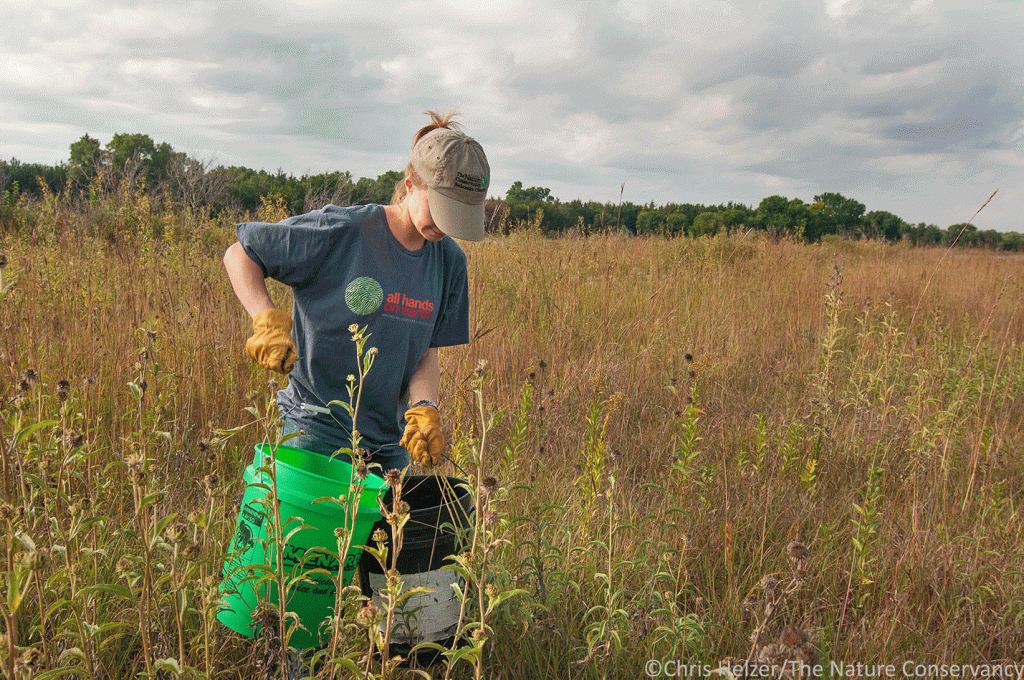
MA: Good question. These terms get used in many different ways. Seed sourcing strategies vary by how far seed comes from and number of different sources used. On one end of the spectrum is a strictly local single source strategy, and on the other end would be a predictive strategy where seed is obtained from sources currently experiencing future conditions. Depending on the models used, predictive sourcing, sometimes called climate-matching, may require seed from fairly long distances. A regional admixture approach falls somewhere between these two extremes. Our approach to this has been mixing seed from multiple geographically close and/or intermediate distances from the restoration site. For our current project, we did not use a specific distance cutoff, but seed was obtained from sites ~5-50 miles from the restoration site. This approach tries to account for local adaptation while increasing adaptive potential.
All seed sourcing strategies have tradeoffs in their risks and benefits. On the strictly local end of the spectrum, it is highly likely seed will be adapted to the current conditions of the site. However, the risk of reduced genetic diversity and adaptive potential is higher, as well as the risk of inbreeding depression. Inbreeding depression occurs when closely related individuals mate resulting in decreased genetic diversity and reduced seed production or plant survival. When fragmentation reduces population sizes, this can alter mating patterns and increase the relatedness of nearby individuals. The current status of inbreeding depression in remnant plant populations is largely unknown. It has been detected for small, isolated populations of Echinacea angustifolia, and decreased survival and/or offspring from inbreeding depression is a well-documented phenomena.
On the predictive sourcing end of the spectrum or sourcing from many different distances from the restoration site, the benefit is high adaptive potential and ability to deal with future conditions. However, the risks here are threefold. The first is if future conditions do not yet occur at the restoration site, initial establishment might be challenging. The second is that environmental factors might be quite different between sites very far apart, which could lead to maladaptation. The last is the risk of outbreeding depression. Outbreeding depression is essentially the opposite of inbreeding depression, when plants produced from the mating of two distantly related individuals have reduced seed production or survival. Contrary to inbreeding depression though, the results of outbreeding are not always negative. Sometimes when distantly related individuals mate their offspring actually do better than their parents. This can especially be true if the parents come from populations with low genetic diversity that is already experiencing inbreeding depression. The challenge with outbreeding is that both outcomes (positive and negative) have been observed in various species and situations so generalizations about the effects of outbreeding are difficult.
We chose a regional admixture approach to balance the benefits and risks. The approach of mixing multiple seed sources locally or regionally captures some of the benefits of local adaptation, increases adaptive potential, and reduces the greatest risks of outbreeding by not sourcing seed from too far from the restoration site. The negative consequences of inbreeding depression are clear while the negative outcomes for outbreeding are less certain, and we reduce the risk of outbreeding depression by not sourcing seed from long-distances.
PE: Is this something you think others should be using now or do you see it more as an experiment and suggest people should wait for the results of your work before implementing it at a large scale?
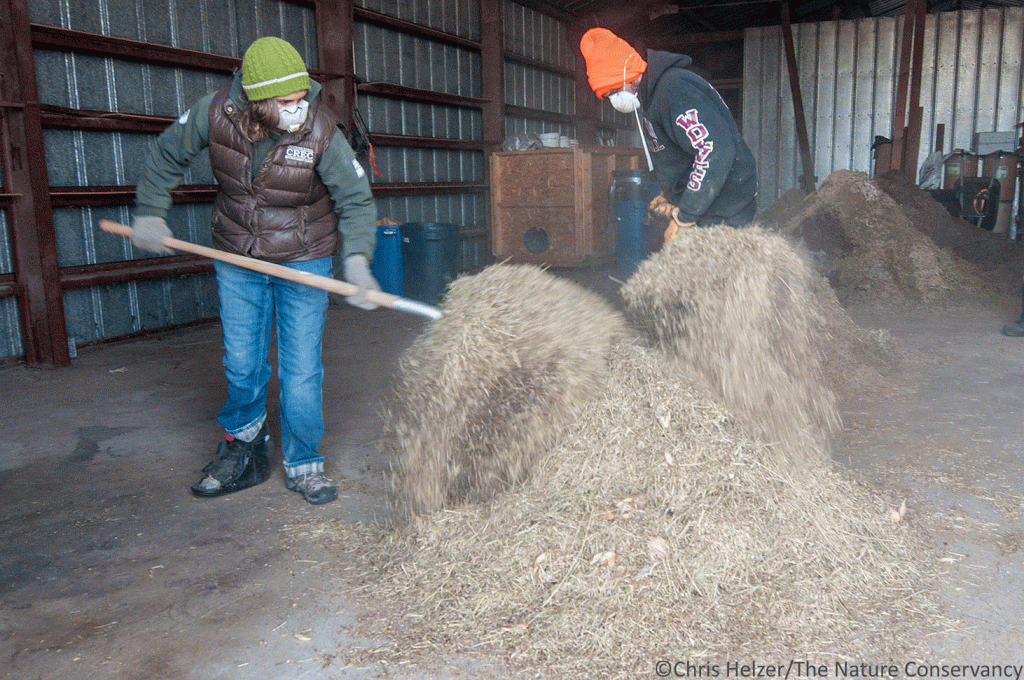
MA: This approach has been widely recommended in the scientific literature. We have now implemented it across over 900 acres of TNC restorations in Minnesota and the Dakotas. We did set up test plots to evaluate the success of this approach. Obtaining seed from many different sources for all species in a seed mix is extra work in an already time-intensive process, and we wanted to evaluate the impact on outcomes. However, the results from this study won’t come for many years and the effects of climate change and habitat loss are being felt by our prairies now.
I think people need to weigh the pros and cons of the different seed sourcing strategies for themselves and their restoration context. The plea I will make is to make sure you consider the pros and cons of your business as usual seed sourcing strategies as well. All of our actions have risks and benefits, including the use of locally-harvested seed from the site right next to your restoration. Strictly local seed is not without its own drawbacks and risks, and those should be considered alongside the risks and benefits of a new approach.
PE: What else do you want people to know about what you’re working on and what it means?
MA: Connectivity and maintaining large population sizes are generally considered to be the key for species to maintain genetic diversity. In places where connectivity and large populations still exist, mixing of seed sources is likely less of a concern, but in these settings, restoration itself is probably less needed as a conservation strategy. In the fragmented landscapes with limited connectivity where we are doing most of our restoration work, the issues around loss of genetic diversity and the need to boost adaptive capacity in restorations is greater. We are currently using this regional admixture approach to balance the tradeoff between inbreeding and outbreeding depression while increasing genetic diversity and adaptive capacity. Where we ultimately need to get to in the Great Plains is climate informed seed transfer guidelines that incorporate both local adaptation to current condition and adaptive capacity for the rapid pace of climate change. The genomic, modeling, and spatial ecology tools exist to achieve this. We just need to put them to work.
PE: Thanks, Marissa, for all of this thought-provoking information. If anyone would like further information, check out the links below:
Short video on the Prairie DNA project Marissa describes above.