Hubbard Fellowship Blog – Dat Discovers Western Nebraska Backpacking

This year’s Hubbard Fellows are nearing their final stretch with us. Dat has been a joy to work with this year. Coming from the east coast, he has thrown himself enthusiastically into the Great Plains, working hard to become familiar with both the ecosystems and the landscape in general. He has grown tremendously as a prairie land steward and contributed significantly to our conservation work in a variety of ways. Stay tuned for results of a research project he conducted to evaluate our wetland restoration efforts. In the meantime, this latest post is an example of Dat’s eager exploration of the Great Plains. All photos were taken by Dat.

If you google “backpacking in Nebraska”, there aren’t many resources available on the topic. Most of the results are short hikes that can be done in a few hours, with no options for primitive camping or water sources. Usual backpacking trips have reviews and ratings, guides, maps – I found nothing. I desperately wanted to go backpacking and explore Nebraska and the fact that I couldn’t easily find any information made me even hungrier. After a good amount digging and some help, I found an opportunity in the Panhandle of the state. 

Driving into Fort Robinson State Park, escarpments cut through the landscape. Many years of erosion carve the landscape, and continue to do so. Down the gravel road, past all the trailheads and Johnson Lake, hides the National Forest – Soldier Creek Wilderness. This area used to be a sprawling Ponderosa Pine Forest, before a large wildfire wreaked havoc on the landscape in 1989. The area is mostly grassland now, but the pine trees are slowly recovering. Right before entering the campground and wilderness area, a shallow stream flows across the road – passable only with the toughest and most durable of vehicles. I was able to pass in my trusty Honda CRV without difficulty.

The Trooper Trail + Boots and Saddle Trail are two adjacent trails that combine to be roughly 18 miles – the perfect distance for a backpacking trip. I planned my trip to be two days and one night of backpacking. When I arrived at the trailhead parking lot, it was clear I wasn’t the only one eager to explore. As hinted by the name, horses and their riders often frequent these trails. The trailhead parking lot was filled with horse trailers as several people were preparing their horses for adventure.

My journey started at the Middle Fork Trailhead and gradually led me counterclockwise on the Trooper Trail. The trail starts with a short ascent through and above the pine trees. To a view of canyons and rolling hills that dominate Trooper Trail for the next several miles. For most of the trail, I was on top of the ridge staring into the canyons and across miles of wilderness. Across the landscape, scattered burnt and fallen trees are accompanied by pockets of young Ponderosa Pine trees, hinting at the future generation of this recovering forest.

Ponderosa pine.
Trail marker post.

There’s a distinctive charm to autumn in grasslands. I couldn’t help but stop often to look around at the mixture of senescing grasses, seasonal foliage, and shorter shrubs added to the crisp autumn air. Coming from the vibrant autumns of the East Coast, I was amazed at the subtle yet beautiful grace of autumn in the grasslands.

Autumn color.

The few miles after the cattle stock tank were my favorite. A short stretch of hiking along the top of a narrow ridge offers an inspiring view of the grasslands, recovering pines, and cottonwoods. Cottonwoods overwhelmingly colored the landscape as I descended into the lowlands and hiked along the streams. The yellow and orange hues of the cottonwoods complimented the dark greens of the pines and mixed hues of the grasses. As the sun slowly sunk below the rolling hills, I set up camp near the peaceful trickle of the surrounding creeks and prepared for the second half of my journey.

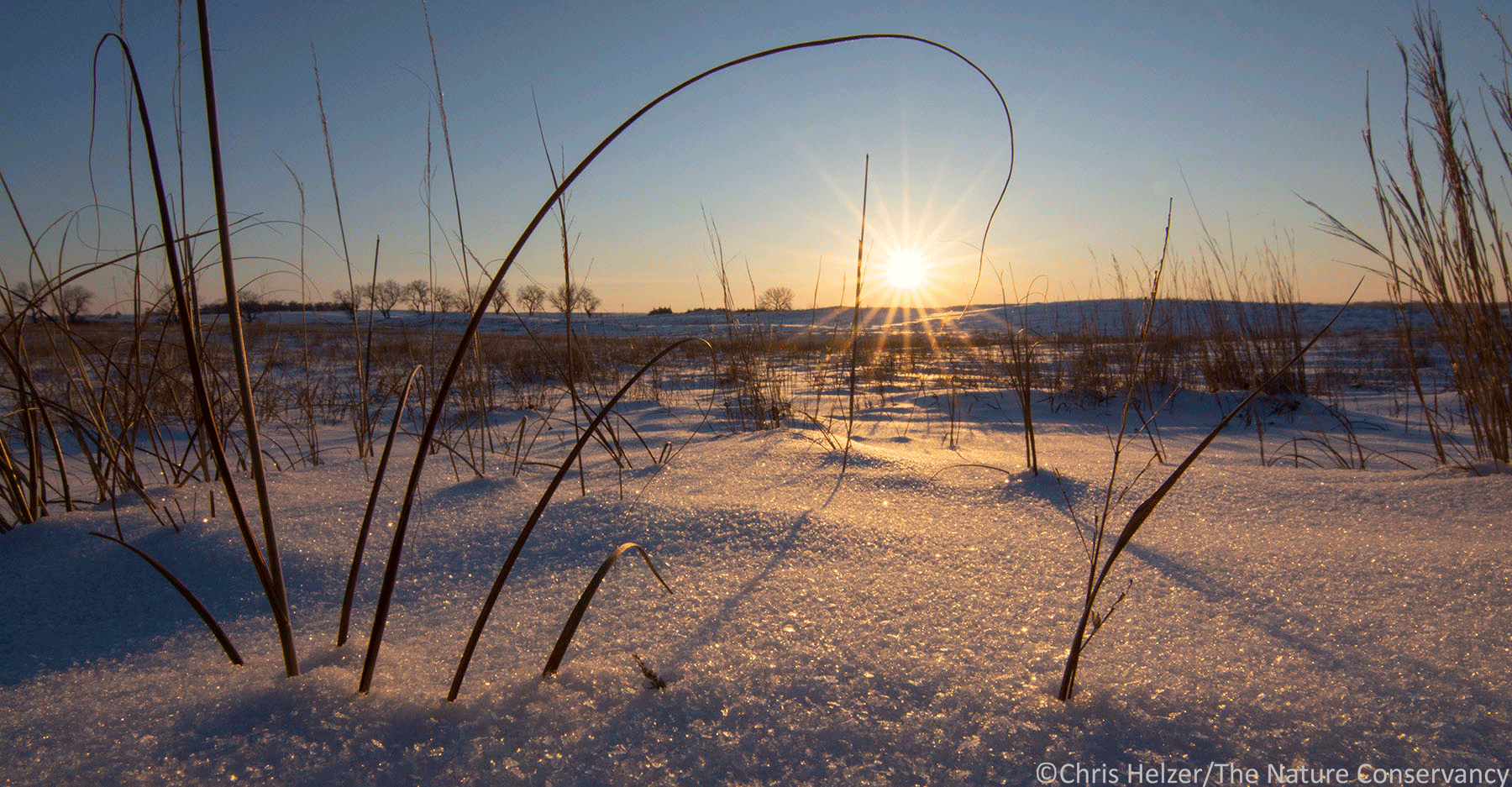
When I woke up the next morning, I was pleasantly surprised by the soft blanket of white that painted the ground and frosted the trees. I packed up camp and eventually made my way to the South Fork Trailhead. Now back at the campground, I proceeded counterclockwise along the Boots and Saddle Trail so I could see the Trooper Trail from the opposite direction. The first mile or so of this trail had several narrow stream crossings with the widest one right at the start of the trail. Inspired by my outlandish dream of becoming an Olympic long jumper or really just someone who could touch a basketball rim, I “elegantly” clambered my way across each crossing. Once I was out of the lowlands, I returned to the top of the world with rolling hills and valleys extending far beyond what I could see.

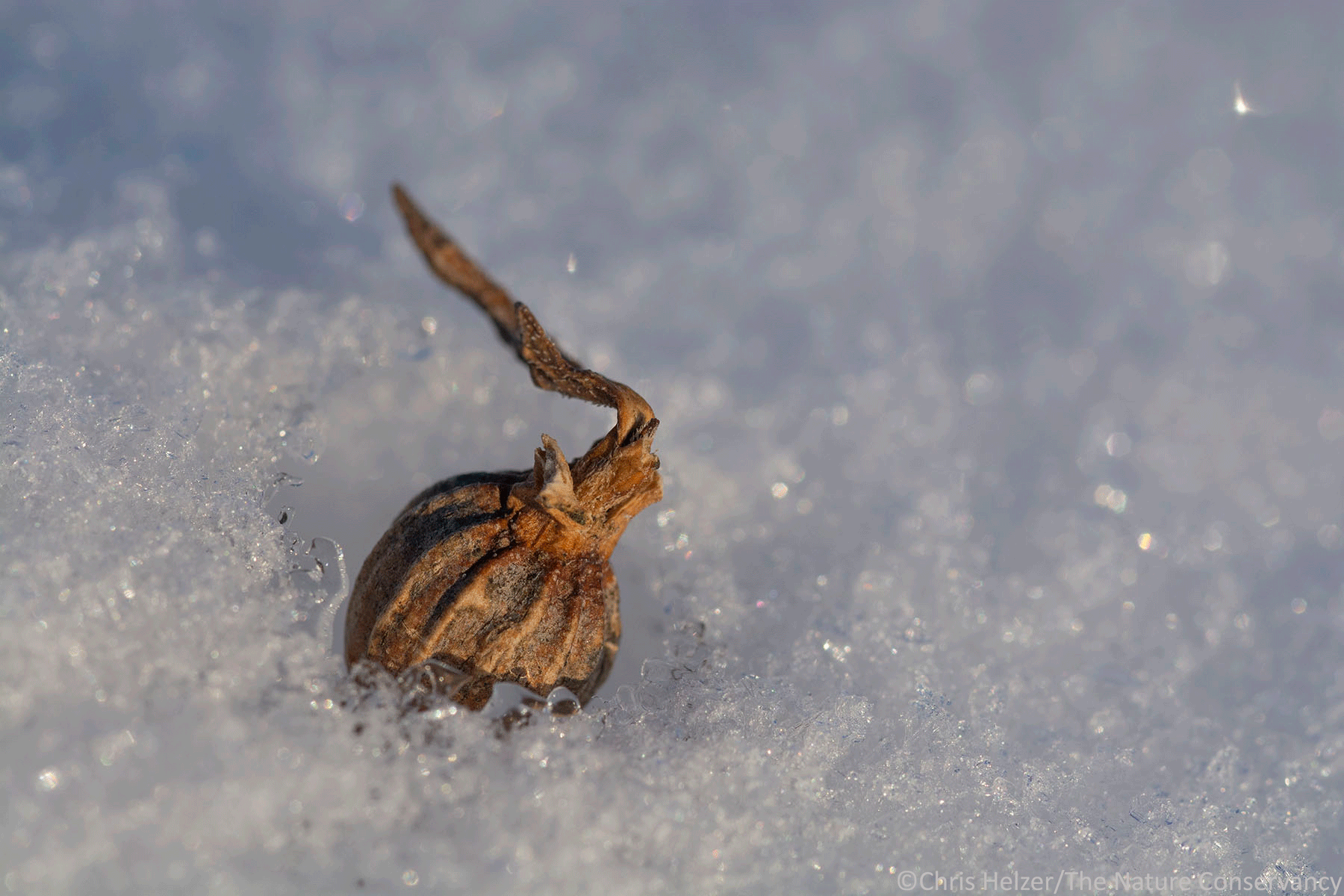
Overnight snow.
Stream crossing.

Wooden posts are the trail markers. It’s important to always be on the lookout for these posts, especially on the Trooper Trail, because sometimes the “trail” ends up being a cattle path or vehicle 2-track. The Boots and Saddle Trail, to me at least, seems to have more hoofed traffic so the path is clearer. I’ll admit that I lost the path several times but was able to find wooden markers to guide my way back.

When I made it back to my car, I was disappointed that the trip was over, but elated that I had this opportunity to backpack and explore this part of Nebraska. I find something oddly liberating about leaving everything behind and carrying just the essentials on my back for a few days. This experience was especially liberating because I got to explore a place not often visited by others. Nebraska certainly offers these escapes and I’m excited to keep finding more.

My route with map (there are real maps located at the South Fork Trailhead) –

1) Start at the Middle Fork Trailhead and take a left to go on Trooper Trail going counterclockwise

2) 2.5 miles to intersection and 5.1 miles to windmill stock tank – dominated by rolling hills

3) Rolling hills continue for another mile or so before switching to steeper canyons

4) Mile 7-10 lowlands, cottonwoods, and creeks – perfect place to find a place to camp since it’s flat and close to water

5) Back at the South Fork Trailhead (at this point you can restock or switch out whatever gear at your vehicle, stop completely, or keep going)

6) Continue on to the Boots and Saddle Trail going counterclockwise (sneakily hidden east of the campsite by the Middle Fork Trailhead)

7) Cross several creek crossings for next mile or so

8) Ascend to the top of the hills, rolling hills for most of the Boots and Saddles Trail (in my opinion steeper than the Trooper Trail)

9) Another good camping spot I would recommend is near the first stream crossing closest to the intersection between the 2 trails – flat areas near pine trees

9) Reach the intersection between the two trails, 2.5 miles until the Middle Fork Trailhead

Photos of the Week – November 5, 2020

I’m sure I wasn’t the only one looking for a distraction this week. I was lucky to have the chance to help with some prescribed burning at the Niobrara Valley Preserve. The combination of that site and that activity provided a great way for me to escape my own brain. I still didn’t sleep very well, but I got through the days…

A volunteer firefighter got some experience while working on a backing fire early on day one.

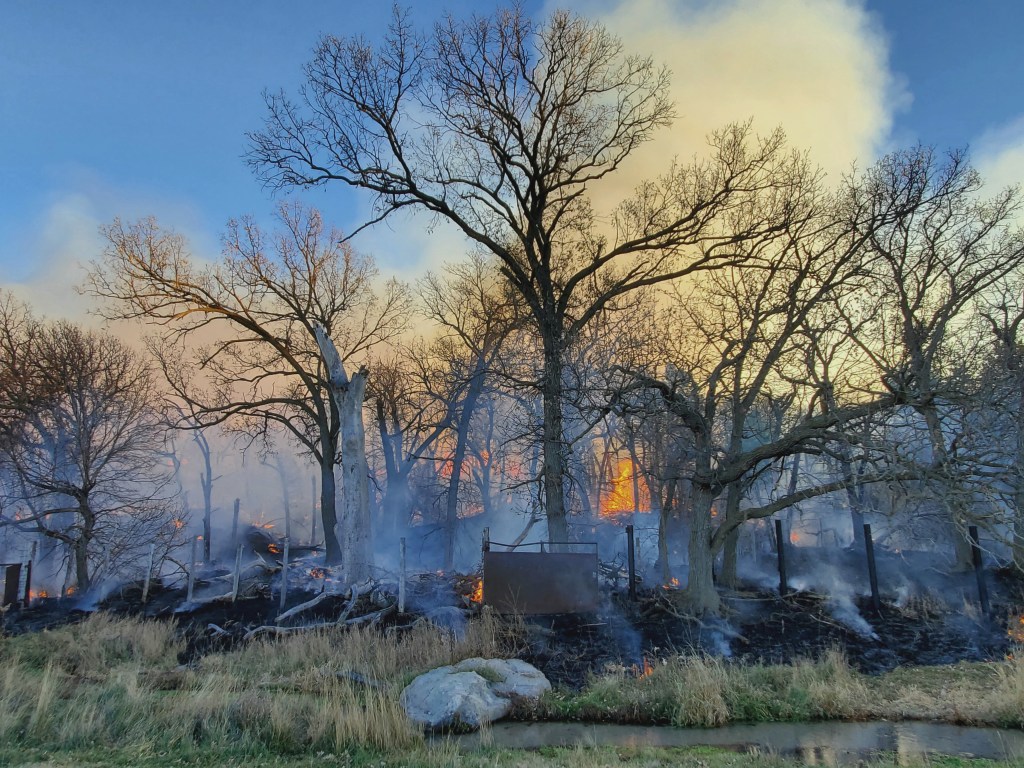
Chad Bladow, The Nature Conservancy’s Fire Manager organized and led two prescribed burns that totaled over 1000 acres and three miles of grassland/woodland along the south side of the Niobrara River. Over several years, staff and contractors have been cutting and piling eastern red cedar trees that survived the 2012 wildfire. One of the objectives of this fire was to clean up the piles and downed wood from that work. We also wanted to kill additional trees that had shown up since cutting operations or that were missed because of size or location (on steep slopes, etc.). In addition, opening up the understory habitat of the wooded areas will have multiple benefits for wildlife habitat and the vigor/diversity of the plants growing beneath the trees.

Two igniters were lighting the flanking fires (working into the wind) on the first day’s burn, accompanied by several vehicles – including a giant tanker from the local fire department.

On day one, we burned out a two mile unit that had Sandhills prairie on the south edge and the river on the north. It took the majority of the day, but burned very well with low humidity, warm temperatures, and light winds. Ignition was completed before sundown, but the fire burned (at a much lower intensity) through the night within the center of the unit. The next morning, we did some quick checks of the perimeter to make sure there was no risk of the remaining smoldering trees causing a fire outside the boundaries. Then we started burning the second unit.

As the sun went down, fire was still winding its way through the wooded slopes.
Grassy knobs in the woodland burned fairly cleanly, but the fire effects were more spotty on steeper north-facing slopes.
An aerial view (drone) showing the Preserve headquarters and the first day’s burn unit. You can see an igniter moving right to left at the bottom right corner of the image.
Here is the first day’s burn unit a day later. There was some lingering smoke, but by and large, most of the unit had burned itself out overnight. The Preserve headquarters can barely be seen near the top of the photo.
This is a cell phone photo I took on the morning of the second day while doing some early morning mop up of smoking trees near the edge of the first day’s fire.

Not only did we achieve our ecological objectives for the fire, it was also a great partnership-building experience, with crew members representing several organizations, including state and federal agencies, private conservation groups, a local prescribed fire group, and the local fire department. Coordinating all those people, while following strict COVID-19 safety protocols, was no mean feat, but it all came together beautifully – as did the fires themselves.

Fire backing through grass and trees.
We don’t think fire will have much long-term impact on the abundant smooth sumac (Rhus glabra) on the property, even though it definitely put some heat on those plants.
Many of the eastern red cedar trees (Juniperus virginiana) in the area had been cut and piled, but some of the remaining trees went up during this fire. (The cedar skeletons nearby are from the 2012 wildfire.)
Nelson Winkel walking through the smoke on day 2.
As the fire in the upland grasslands of the second day’s burn unit came together, it made an impressive smoke plume.
At the end of the second day of fire, the crew gathered to discuss, learn, and celebrate.

Prescribed fire is a lot of work, but it’s also very rewarding when it’s over. Normally, when I’m leading burns, I feel a lot of stress between the time the fire is ignited and when it’s extinguished. However, when I’m just a part of the crew – as I was this week – I can pull back a little and enjoy the experience more. That was really helpful this time around since adding more stress to my life was not what I was looking for.

Hey – no matter whether your favored candidate(s) win or lose, please be kind to yourselves and each other. Regardless of the result, it’s clear we have a lot of major divisions to heal. Please do what you can to help with that, but don’t forget to step away when you need to sink into whatever distractions allow you to maintain your own mental health. Be well, friends.