Photos of the Week – October 9, 2020

Good grief – I left for one week in the mountains and when I came back the prairies around here had gone nearly dormant! It was apparently warmer at high elevation in Colorado last week than it was here in the Nebraska prairies, and that cold weather here seems to have accelerated the end of the growing season. There’s very little left for flowers, and insects are getting much harder to find too. As a photographer, this is the time of year I try not to feel panicked about how long it’s going to be before I see flowers and ‘bugs’ again…

I had a couple brief periods of prairie time this week, and did manage to find a few insects still moving around (and some that weren’t). Here is a selection of photos from my first week back in the prairie. The first batch is from The Nature Conservancy’s Platte River Prairies:

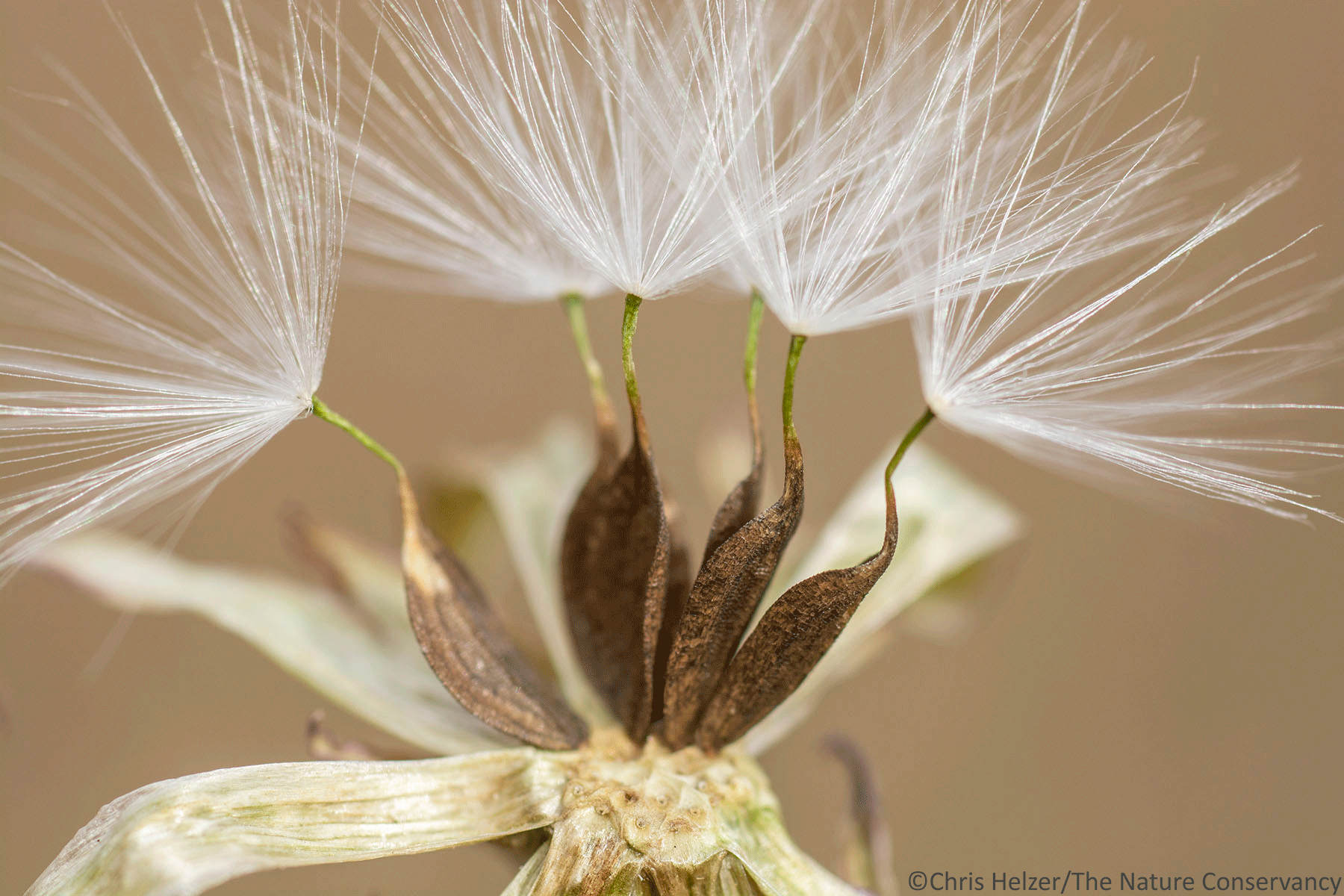
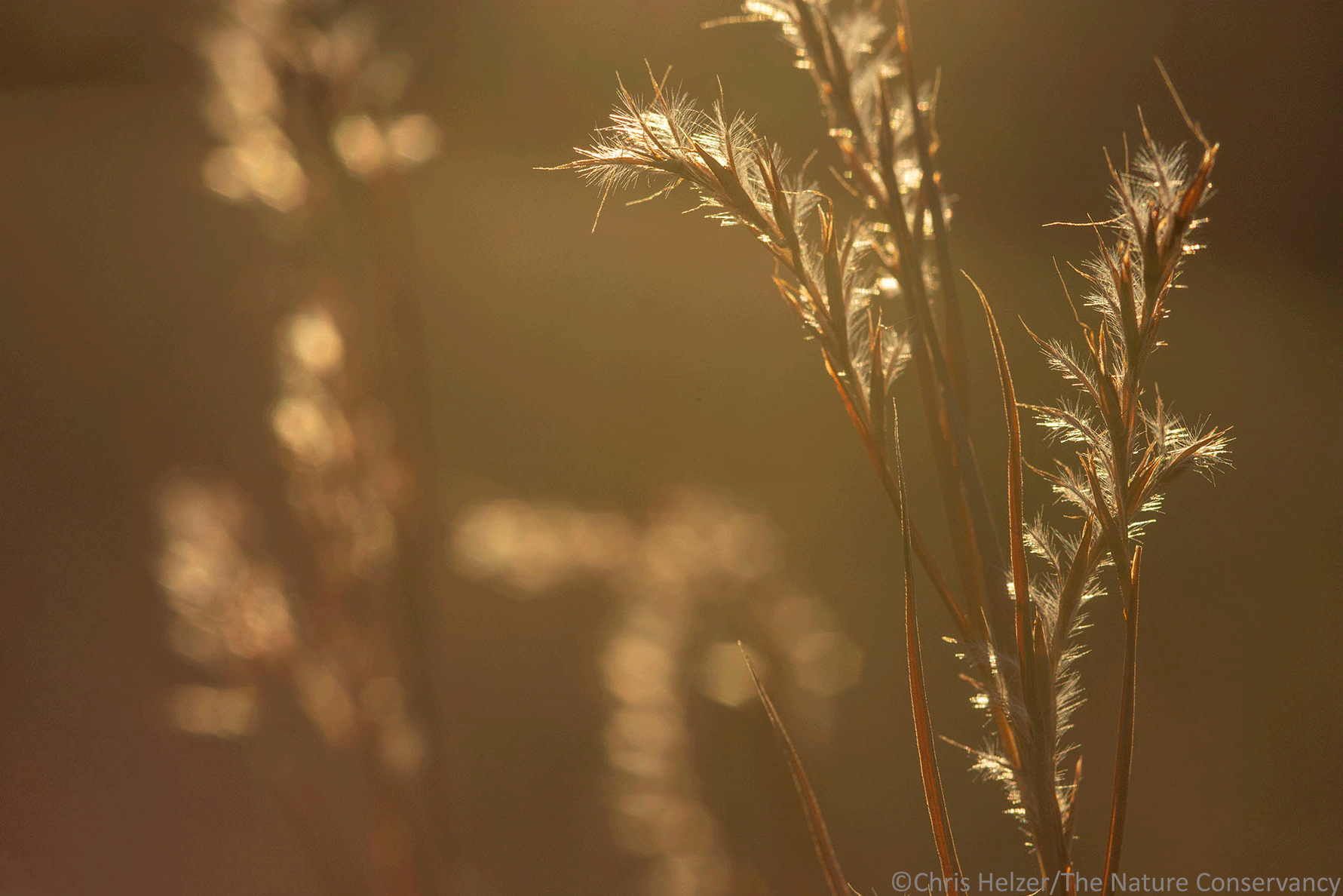
Milkweed seed at the Platte River Prairies. Nikon 105mm macro lens. ISO 320, f/20, 1/100 sec.
Lacewing on milkweed pod. Platte River Prairies. Nikon 105mm macro lens. ISO 320, f/20, 1/100 sec.
Tree cricket on tall thistle (Cirsium altissimum). Platte River Prairies. Nikon 105mm macro lens. ISO 320, f/13, 1/250 sec.
Stink bug on tall thistle. Platte River Prairies Nikon 105mm macro lens. ISO 320, f/16, 1/100 sec.
Grasshopper on milkweed pod. Platte River Prairies. Nikon 105mm macro lens. ISO 320, f/16, 1/200 sec.
Banded argiope spider (Argiope trifasciata). Platte River Prairies. Nikon 105mm macro lens. ISO 320, f/8, 1/320 sec.

Yesterday, I took a quick trip to our family prairie to check on the grazing situation and make final decisions about how and when to end the grazing season. I saw even fewer insects moving around than I did on the Platte, but the fall colors were still vibrant and attractive. It was also my first opportunity to re-visit the site since seeing all the weird climbing/dying caterpillars a few weeks ago.

Coralberry (Symphoricarpus orbiculatus) at our family prairie yesterday. Nikon 105mm macro lens. ISO 320, f/13, 1/320 sec.
False boneset (Brickellia eupatoroides) at our family prairie. Can you see the caterpillar? I almost missed it. You can click on the image for a larger version. Nikon 10.5mm fish eye lens. ISO 320, f/22, 1/100 sec.
Now can you see the caterpillar? Nikon 10.5mm fish eye lens. ISO 320, f/18, 1/80 sec.
Boneset flower moth caterpillar (Schinia grandimedia). Nikon 105mm macro lens. ISO 320, f/18, 1/80 sec.

I almost missed finding the boneset flower moth caterpillar, but it finally caught my eye as I was playing with my fish eye lens and the false boneset it was feeding on. I didn’t know what it was at the time, but found it on Bugguide.net later. Apparently, it’s a specialist feeder on false boneset, so it wasn’t just an accident that it was on that plant! It better hurry up and finish eating before we get another cold snap…

There were many fewer Virginian tiger moth caterpillars high in the vegetation on this visit, and I didn’t see any alive. When I started looking closely, I was able to find quite a few dead ones, in varying stages of desiccation. I’d hoped to come back out and grab a few live/dying ones after my last visit, and see if I could figure out what was controlling/killing them, but vacation prep and travel got in the way. Maybe next year. I guess it’s ok to have active mysteries in my life – keeps me coming back to learn!

Dead and desiccated Virginian tiger moth caterpillar. Nikon 105mm macro lens. ISO 320, f/11, 1/400 sec.
Another one… Nikon 105mm macro lens. ISO 320, f/11, 1/500 sec.

I wish you all well in these turbulent times. My trip to the mountains was a welcome escape from the news cycle and people in general. It’s been a little difficult to readjust to life again, now that we’re back. My visits, albeit brief, to a couple prairies this week helped a lot. I hope each of you can find similar solace in your lives.

Photos of the (Last) Week

Last Friday morning, Kim and I were backpacking up a steep slope on the Blue Lakes Trail in the San Juan Mountains of Colorado. We’d spent two days doing short day hikes and getting acclimated to the elevation, but now were embarking upon an overnight trip as part of the ultimate goal of our trip – climbing to the the top of Mount Sneffels. Kim had done extensive research and had these last two days well-planned. We were going to backpack up to Upper Blue Lake and camp at about 11,700 feet, leaving us in good position for the remaining ascent (with day packs only) to the top of the 14,150 foot peak on Saturday morning.

Aspens on a south-facing slope along the Oak Creek Trail west of Ouray, Colorado – from one of our two day hikes prior to our overnight backpacking trip. Tokina 11-20mm lens @20mm. ISO 200, f/22, 1/60 sec.

As we hiked up the trail, we met and had a short conversation with a couple other backpackers on their way down. They said they’d camped at the lower lake and that it was beautiful. We asked if they’d been up to the upper lake too and they said, “yes, but it’s not as nice as the lower lake.”

“You wouldn’t want to camp at the upper lake,” they said, “there’s nothing up there but tundra.”

Kim and I shared a quick look and then politely thanked the backpackers and continued out trek. What those other backpackers didn’t understand is that their idea of “nothing there” was exactly what we were hoping for.

…But let me back up a little. This post is taking the place of the usual ‘Photos of the Week’ post I missed last week because Kim and I were on vacation. As I said above, we spent our first couple days taking short hikes to get used to the elevation. Because I’m married to someone nearly 10 years younger than me who runs about 25 miles a week, those ‘short’ acclimation day hikes ended up covering 18 miles in two days. Yeesh.

Hiking the Bear Creek National Recreation Trail along a very narrow path cut by miners long ago. Tokina 11-20mm lens @12mm. ISO 320, f/22, 1/80 sec.

Fortunately, Kim was pretty kind about pretending my ‘photo stops’ weren’t just excuses for me to bend over and pant loudly for several minutes until I could resume stumbling up the trail behind her. There were a few times when I think she needed to catch her breath too, but it was usually me who called for a stop.

Despite the wheezing caused by a combination of age, fitness and elevation, those first couple hikes were fantastic. Portions of the trails cut through dense woodland, where I couldn’t help thinking about the likelihood of catastrophic fire, given the number of dead and downed trees and the current drought conditions. However, we also planned our routes so we’d be out in the open quite a bit – either traversing south-facing grassy slopes with scattered aspen or above tree line altogether. While hiking the wonderful Bear Creek National Recreation Trail, we admired a high steep ridge covered in grass and made the decision to leave the trail and climb 1,000 feet to the rocky ridgetop. It took a while, but was definitely worth the effort.

Kim peering up at the second half of our impromptu climb up a steep grassy ridge along the Bear Creek National Recreation Trail. We were in a four point stance most of the way up, and were grateful for the thick bunchgrass, which provided helpful handholds. Tokina 11-20mm lens @11mm. ISO 320, f/13, 1/320 sec.
Kim on the way down the grassy ridge. Tokina 11-20mm lens @15mm. ISO 320, f/18, 1/200 sec.
Bear Creek. along the Bear Creek National Recreation Trail. Tokina 11-20mm lens @14mm. ISO 320, f/18, 1/125 sec.

After two days of day hikes and hotel stays, we set out on the main event of the trip. Kim had her heart set on reaching the summit of Mount Sneffels and I was happy to go along with her. We wanted to camp within a reasonable distance of the peak to shorten our ascent, so that’s why we decided upon the Upper Blue Lake as our campsite. The fact that it was high above treeline (and not favored by most others, apparently) was a bonus, especially since the forecast called for pleasant weather. It turned out to be everything we’d hoped for.

This Colorado chipmunk thought it was going to steal food from my backpack (it didn’t get to) during a stop on the Blue Lakes trail. Nikon 18-300mm lens @300mm. ISO 250, f/9, 1/500 sec.
This is a view of the Lower Blue Lake, which we bypassed as a camping spot in favor of the treeless and more isolated Upper Blue Lake. Tokina 11-20mm lens @11mm. ISO 400, f/14, 1/100 sec.

When we finally reached the upper lake, there was some traffic – people hiking up to see it from below, as well as some people coming back from climbing Sneffels. No one else appeared to be planning to camp, though, and after we set our tent up out of the way, we watched the others warily, hoping we’d be the only ones to stay. I got nervous when I saw a group of backpackers approaching from far below us, but they decided to camp at the middle lake, which worked out well for all of us.

The Upper blue Lake (with the peak of Mount Sneffels in the background on the left.) We camped over a small hill from the lake off the right side of this photo. This is a panorama created from 7 photos with the Tokina 11-20mm lens.
This is the stream flowing out of the Upper Blue Lake into the Middle Blue Lake below. Tokina 11-20mm lens @11mm. ISO 400, f/18, 1/200 sec.

I spent quite a bit of time sitting quietly in the middle of several pika colonies near the lake, letting them get used to me and eventually getting a couple decent photos. One of those colonies was right by our tent, so we listened to their calls while we ate supper. Suddenly, a gray fox appeared and meandered through the pika colony within 30 yards of us. It nosed around, but didn’t seem to find anything worth stopping for. I can’t imagine a fox would have much luck catching a pika in those rock piles, but the chipmunks and voles we also saw are probably easier prey.

This pika got pretty comfortable with my presence after I sat still for about 10 minutes. Nikon 18-300mm lens @300mm. ISO 400, f/8, 1/1000 sec.
Our tent, with Mount Sneffels in the background. Tokina 11-20mm lens @11mm. ISO 400, f/18, 1/100 sec.

After the sun went down, but before the moon appeared over the mountain ridge, I played around with photographing our tent and some of the scenery around us. Then, I woke up well before sunrise on Saturday morning and wandered around in the light of the nearly-full moon, until it got light enough to eat breakfast and prepare for our ascent.

Kim was in the tent with a flashlight while I was outside trying to capture stars and the glow of the rising moon to the east (left side of this photo). The very top of the ridge behind the tent was catching light from the moon. Tokina 11-20mm lens @11mm. ISO 640, f/2.8, 10 sec.
I woke up early on Saturday morning and wandered around a little. Here, the tent and Mount Sneffels are both illuminated by the moon. Tokina 11-20mm lens @11mm. ISO 640, f/2.8, 6 sec.
Early morning moon over Upper Blue Lake. Tokina 11-20mm lens @13mm. ISO 640, f/3.2, 5 sec.

Soon after sunrise, but before we actually saw the sun, Kim and I struck out toward the mountain. We had to first climb 1,000 feet to the top of the Blue Lakes Pass – you know, just to get our blood pumping… That took us to about 13,000 feet, leaving about 1,200 more feet of climbing. That last stretch, though, was not anything like the narrow switchback trails to the pass. It was a lot of scrambling and climbing over boulders and up steep slopes.

Looking down from the middle of our climb up Mount Sneffels. The lake on the right is Middle Blue Lake. Tokina 11-20mm lens @11mm. ISO 500, f/22, 1/200 sec.
Mountain ridges and haze/smoke off to the east of the top of Mount Sneffels. Nikon 18-300mm lens @220mm. ISO 500, f/13, 1/1600 sec.

Kim was having a great time. I was doing ok, but the elevation really started to get to me as we continued to climb. By the time we got above about 13,500 feet, I was getting a little light-headed and my stomach wasn’t right. At that point, though, it was a lot harder to go down than up. Once we reached the summit, we were planning to descend through a steep boulder field, where footing could be tricky, but there wasn’t the risk of falling straight down like there was where we were climbing. I gritted my teeth, forced myself to be very conscious of every movement, and kept going up.

The climb to the summit of Mount Sneffels got pretty steep…. Much of the ascent was actual climbing, rather than a distinct trail. This is a cell phone photo because I didn’t feel good about trying to pull my other camera out of its bag while holding on to a rock.
Here’s Kim making the final ridge ascent to the summit of Mount Sneffels. (Can you she was having a great time?) Tokina 11-20mm lens @11mm. ISO 500, f/13, 1/1250 sec.

We did eventually reach the summit and the view was absolutely spectacular. Since I wasn’t feeling great, I didn’t get to appreciate it as much as I would have liked, but I was aware enough to notice that everyone else we met on the way up (and down) was considerably younger than me. That made me feel a little better about myself. I then started to feel physically better as we started descending and eventually got back to a more reasonable (?) 12,000 feet or so. We packed up the tent and trekked the four miles back down to the trailhead (5,000 feet below the peak of Mount Sneffels).

I’m clearly a prairie person, and don’t expect to change. I like living at a nice tame 1,800 feet above sea level where a big hill is a hundred feet high. However, I also do enjoy getting up in the mountains now and then, just for a change of pace. I’m not a big fan of hiking through trees where I can’t see past the firs, pines, and spruces, but if I can find places where the view opens up, I’m happy. Aspens in full golden color are pretty sweet, too. I’ll probably let Kim talk me into going back again next year…