
I was featured on a podcast episode that came out today. I’ve enjoyed being a guest on quite a few podcasts, but I think this one might have produced the best synthesis of many of my thoughts on prairie management. If you’re interested in listening to it, check out the Wild Ag Podcast on your favorite app or click here.

Speaking of prairie management, as I was preparing a presentation on the topic last week, I came across an aerial photo I’d taken a couple years ago at our Platte River Prairies. The image does a great job of illustrating what habitat heterogeneity can look like across one management unit.
Variation in available habitat conditions (habitat heterogeneity) can be created by many factors. Some of those factors are unrelated to our actions as land managers. Topography, soil texture, and soil moisture, for example, all have big influences on what plant species can grow in a particular place. The same conditions can also drive the height and density of plants – high/dry/south facing slopes will have much shorter/sparser vegetation than low-lying/moist valleys, for example.
In the photo shown above, that influence can be seen in at least a couple ways. First, in the foreground of the photo, there are yellow stripes created by concentrations of blooming perennial sunflowers and goldenrods. Those plants are spread throughout the site, but are most lush and abundantly flowering in soils laid down by old river channels hundreds/thousands of years ago when this part of the prairie was part of the active Platte River.
Similarly, in the top part of the photo, you can see a broad slough that looks slightly darker than the surrounding vegetation. That slough is also an old river channel and has not only different soils, but is also lower in elevation and closer to groundwater, which helps determine both the plant species growing there and the height and vigor of those plants.
The management history of this site also plays a big role in the available habitat today. The top portion of the photo is unplowed (remnant) prairie, though it had some years of chronic overgrazing that decreased its plant diversity before The Nature Conservancy acquired it. We’ve replenished some of that lost plant diversity by overseeding missing species, but the plant community is still not what it was. On the other hand, it does have a very strong native sedge community and a pretty nice set of early season wildflowers that aren’t in the portion of prairie shown at the bottom of the photo.
That area shown in the lower portion of the photo was in row crops for years before being planted (not by us) back to grassland with a few wildflower species. Since then, it has increased in plant diversity, but no botanist would mistake it for an unplowed remnant prairie. It provides excellent habitat for many animal species, but has obvious differences from the adjacent remnant site.
Finally, the most dramatic variation in vegetation structure at the time this photo was taken was driven by recent management actions taken by Platte River Prairies manager Cody Miller and others. The entire prairie shown in the photo had cattle on it during the year of the photo (and in prior years). However, the grazing pressure across the site was very uneven, driven by prescribed burning.
In 2023, a spring fire was conducted in the area shown in the foreground, and a late July burn took place near the top right of the photo. When the 2023 growing season started, cattle focused most of their grazing in the recent spring burn, keeping that vegetation short and allowing plants elsewhere to grow tall. After the smaller August burn took place, cattle shifted some of their grazing there, reducing grazing pressure on the spring burn – which is partly why the sunflowers are blooming so abundantly. If you’re interested, you can read more about that summer fire and see more photos of it here and here.
Meanwhile, most of the remainder of the site had lots of tall vegetation and relatively thick thatch (accumulated dry vegetation from previous years’ growth) because it hadn’t been burned recently and had recovered from previous grazing bouts.
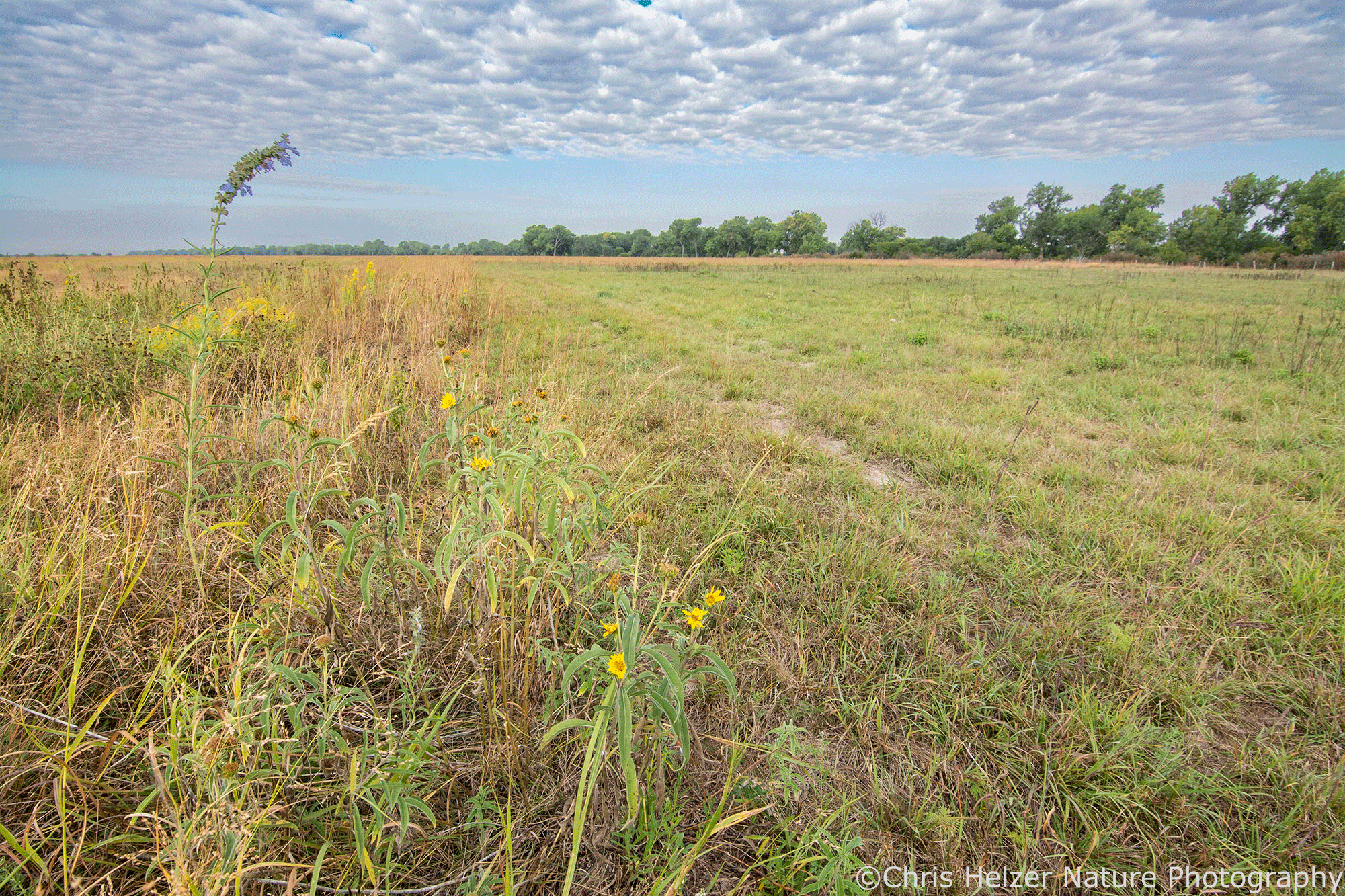
As a whole, this management unit (roughly 500 acres, with more prairie across the creek to the north – out of frame to the right) provided a wide variety of habitat conditions for the plants and animals living in it back in 2023. Last year, in 2024, we burned yet another patch, which shifted grazing pressure to a new portion of the site and allowed the 2023 burned areas to start growing tall again. New management treatments in 2025 will continue to shift things around, while maintaining the same kind of habitat variety – just in different places.
If you missed it, I talked much more about habitat heterogeneity and why it’s important in this recent post. Our primary objective for the Platte River Prairies is to sustain high ecological resilience, which relies heavily upon species diversity (animals, plants, and more). We’re working under the assumption that providing a constantly-shifting mosaic of habitat types is the best way to support that species diversity.
There’s a lot of science that backs up that shifting mosaic assumption, but we try to test it whenever we can. Plant diversity has been very stable over the last 20 years or so on the sites I’m able to monitor closely. Habitat use by wildlife, including insects, is harder to quantify, but what we’ve seen has been positive. Birds species appear in different places each year, but all the species we’d expect to see always show up. Similarly, regal fritillary butterflies and other insect species seem to be doing well, but follow their favorite habitat conditions around the site. The plains pocket mouse – a species of concern in this part of the world – maintains surprisingly consistent populations, regardless of our management actions.
We’re always looking for researchers who’d like to help us look more closely at any aspect of the system – let me know if you’re interested! In the meantime, we’ll keep experimenting and learning the best we can.








 The Prairie Ecologist