This post was written by Alex Brechbill, one of our Hubbard Fellows this year. Alex has a great aptitude and personality for environmental law and policy work, but not to the detriment of his outdoor work ethic – as you’ll see here. Also – Stay tuned for an announcement very soon about the application period for the next round of our Fellowship.
After graduating college with a degree in political science, I was convinced I was going to dive headfirst into a cubicle. There was something very exciting about it. I would have my own desk, the ability to throw on a sweater because the A/C is just a bit too chilly, and maybe, if I’m lucky, two monitors on my computer. This image was so idyllic because most of my work experience includes me being knee-high in mud (and probably not mud, if we are being honest), saturated in sweat, and consistently covered in perma-dirt, no matter how fancy I get with my laundry.
I was convinced I would have that dream cubicle. I wanted to, and still want to, pursue environmental law in some capacity: paralegal, administrative assistant, research, etc. Despite having plenty of outdoors jobs, I’ve had my fair share of indoor positions, slowly building a collection of slacks, khakis, corduroys, and dress pants for the day that I finally get my name on a desk. However, that collection will have to keep gathering dust, because my favorite pants are my workpants.
They are khaki canvas Dickies, with the classic red patch on the right butt cheek. They are size 32×32, but depending on the day, they would ideally be about two inches snugger and two inches longer. I’ve had them for four years. They were originally intended for my dad, but I intercepted them as they were my size.

Are these pants freshly laundered or have I worked in them for three weeks? You can never really tell by just looking at them.
Workpants are the physical manifestation of how much it takes to keep ecosystems in their desired condition. Without a little elbow grease, most of our prairies would be thickets of Siberian elm, a sea of musk thistles, or thatch dense enough you’d have to Bear Grylls your way out. Growing up, I marveled at how beautiful landscapes could regulate themselves without any intervention. However, there is a lot of behind-the-scenes work. It takes folks out in the field every day of the week, not just when it is convenient, but when it’s raining, windy, hot, cold, summer, or winter. It is by no means glamorous work, but it’s rewarding, beautifully messy work. My pants have borne the brunt of that labor, from mud to paint. Every spot, snag, hole, wrinkle, or stain has a story.
In the last seven months, I have conducted a very scientific study regarding the reasons I have washed my workpants. Although the research is ongoing, I have some results that I think are notable for this audience. One might ask, “are most scientific studies done in colored pencil and marker?” The answer is that although it may seem archaic, I assure you it is still very scientific.
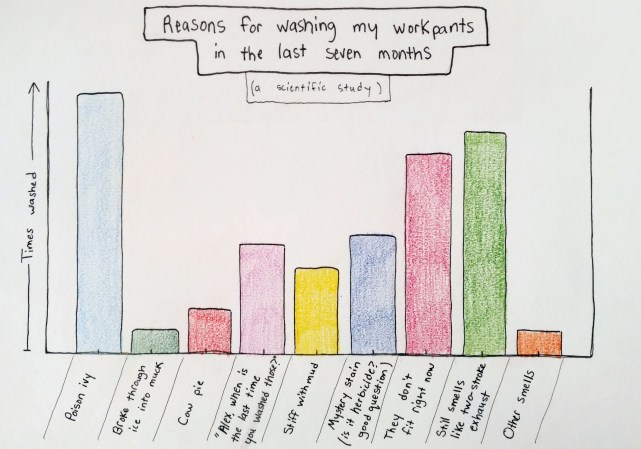
Life-long scientific research. Still trying to get it published in Workpants Quarterly.
Some of the preliminary findings are that there has been a lot of poison ivy this year and that I’ve done a lot of chainsaw work, as shown by the lingering smell of two-stroke exhaust. After looking at the raw data and punching some numbers, I found that there is a clear correlation between my pants not fitting and how long I have been chainsawing. On occasion, after I take off my chaps, one may think that I’m wearing a second pair of chaps underneath my chaps, however, that is merely the outline of my sweat from where the chaps were once occupying.

This is the Achilles’ heel of any good pair of pants, the classic backpocket wallet hole. I prefer the hole in my backpocket to be somewhere in between “that’ll be fine” and “I think I lost my wallet in the prairie.

Once upon a time, these pants used to be more of an orange-khaki color, as shown by the color under the cuff. Over the years they’ve been sunbleached and built up a good patina. They get better with time, like a fine wine.

Permadirt and blue stains. Really it’s a match made in heaven.
Although it made a small appearance in the above data, breaking through the ice was one of my favorite experiences. In February, I and the other field staff were preparing for crane season, and one of the objectives was to remove cattails to make a clear view of the roosting cranes on the river. The river was still frozen at this time, but I was still wary of the thickness of ice. From the bank of the river, I removed all the cattails that I could reach. However, there were still cattails out further that were blocking the view of the river from the blind. Thinking of the cranes, I braved the ice. As I reached the outer edge of the cattails, I knew my goose was cooked. I plunged two feet down into the brisk water and got stuck in the muck, the murky water flowing into my boots. Within an instant, the stale winter air became rank with pungent, marinating muck that had not been disturbed for months. The damage was done, my Muck Boots were filled with literal muck, and I wasn’t going anywhere. To my demise, I finished the job, removing the cattails. To exit the icy water, I laid the weedwhacker on ice near the bank and beached-whaled myself out of the mucky water. Like I said, it’s not glamorous work, but it’s rewarding. The science is still ongoing, but if you’d like to contribute to my (very scientific) research, I’d be curious if you have any good stories about your trusty workpants!