Apply Now for the Hubbard Fellowship!

We are now accepting applications for the 6th class of Hubbard Fellows with The Nature Conservancy in Nebraska.  Application deadline is September 21, and the position will run from February 2019 through January of 2020.

This has been one of the most satisfying programs I’ve ever been involved with.  The opportunity to supervise and mentor young, bright future conservation leaders is incredibly energizing, and fills me with hope.  If you or someone you know is interested in learning more about the Fellowship, you can click here or just go to the Hubbard Fellowship tab at the top of this blog’s home page.

Current Fellows Alex and Olivia (left), along with TNC staffer Amanda Hefner and former Fellow Katharine Hogan prepare themselves to collect data at The Niobrara Valley Preserve.

The Hubbard Fellowship program is designed to help recent college graduates get comprehensive experience with a conservation organization and give them a big leg up toward their career.  The hope is to bypass the need to spend several years working short-term seasonal jobs to gain a variety of experiences by giving them all those experiences within one position.

Fellows become an integral part of our land management and restoration team – harvesting and planting seeds, killing weeds, clearing trees and brush, fixing fences, helping with bison roundups, and much more.  They also collect data and interact with a number of scientists and research projects.  Beyond that, however, they are also very active in communication and outreach, leading volunteer work days and sandhill crane viewing tours, speaking to various audiences, writing blog posts and newsletter articles, and helping with our social media presence.  They get a chance to learn about and help with fundraising, see how budgeting and financial management works, and become active participants in conservation strategy meetings and discussions.  Fellows attend our statewide board meetings, are active participants in our statewide strategy meetings and workshops, and attend multiple conferences in and out of the state.

On a tour during a statewide conservation conference, Dillon and Jasmine pause to contemplate their futures.

Beyond those experiences, Fellows also develop and implement an independent project that both fits their particular interests and fills a need for our program.  Those projects have included field research, social science research, enhancing our volunteer program, developing educational materials, and more.  Those projects give Fellows in-depth experience within a topic of interest, but also a substantial accomplishment to point to as they move toward graduate school or apply for permanent jobs.

Evan collects insects for a research project being conducted by a visiting scientist from Kansas State University.

We are looking for motivated, future conservation leaders who want to live and work in rural Nebraska and become an integral part of our conservation efforts for a year.  The application process includes a short essay and letter of reference, in addition to a cover letter and resume.  All materials must be submitted by midnight on September 21, 2018.  Housing is provided for the Fellows, right in the middle of our Platte River Prairies, west of Grand Island, Nebraska.

Please pass this on to anyone you think might be interested.  Thanks!

Katharine and Eric explore a waterfall at the Niobrara Valley Preserve during a staff canoe trip down the Niobrara River.

A Tough Plant, Not A Weed

I blame whomever named the plant.  Giving a plant the name “ironweed”, apparently – according to Google – because of its tough stem, creates an unnecessarily negative connotation right from the start.  It’s an unfair connotation for a plant that is both beautiful and important.  It’s also a big favorite of butterflies; something I can attest to after spending a couple hours last weekend chasing monarchs and others around ironweed patches at our family prairie.

Ironweed at our family prairie, growing abundantly in a smooth brome-filled draw.  The abundance of the plant goes up and down each year, but it never spreads beyond the draw or shades out the grass around and beneath it.

There are three species of ironweed (genus Vernonia) in Nebraska, and two that are common in the prairies I am most familiar with.  Both of those – V. fasciculata and V. baldwinii – seem to act in similar ways, but the first likes a little wetter sites than the second.  Both species can occur as scattered plants across a prairie, but are also often found in fairly dense patches where conditions favor them.  That patchy local abundance is the first mark against them by people who don’t appreciate their value.  The second mark is that cattle absolutely refuse to eat them.  This both helps them stand out (especially when blooming) in heavily grazed pastures and helps them spread across those same sites since they gain a strong competitive edge when surrounding plants are all being grazed hard.

Like many other plant species I tend to admire and write about, however, ironweed is not an invasive plant – it’s an opportunist.  It takes advantage of soil and management conditions that favor it, but doesn’t just spread aggressively across pastures.  If you look online, it’s not hard to find websites that encourage its control in pastures.  I dispute that.  At least in my experience, ironweed has its favorite locations (often in draws or other low spots where moisture and nitrogen are high) and pulses in abundance within those locations as grazing treatments and weather vary from year to year.  At our family prairie, ironweed is fairly abundant in some of the low draws where high nitrogen also strongly favors smooth brome, but while there are years when those patches are thicker than others, the overall patch sizes and stem densities of ironweed aren’t any higher today than they were 15 years ago.  That matches what I see elsewhere in central and eastern Nebraska.

(I found a university website online that blamed ironweed for making cattle have to look harder to find grass, thus reducing grazing efficiency.  Give me a break.  That’s the same attitude that leads to people spraying pastures to remove everything that isn’t grass, and then wondering why they need to fertilize their grass and supplement their cattle’s diet.  The same people blame others for the lack of wildlife and pollinators on their land.  …Ok, I’m done ranting – let’s talk about butterflies.)

When I arrived at our family prairie last weekend, I immediately noticed monarch butterflies flying all over the place.  I’d seen a surprising number of larvae back in July, so figured we might have a good August, but I was still impressed with how many adults I saw.  I’m guessing there were 40-50 or more across our 100 acres of prairie.  They kept moving, so it was hard to count them…

Almost every monarch I spotted was either flying or feeding on ironweed.  A few other flowers got attention too, including wild bergamot (Monarda fistulosa), Flodman’s thistle (Cirsium flodmanii), and some early tall thistle blossoms (Cirsium altissimum), but ironweed clearly monopolized most of their attention.  I started stalking monarchs with my camera and eventually found a couple that let me get close enough for to capture reasonable photographs.  While I was doing that, I also spotted myriad bees, along with quite a few other butterfly and moth species.

Here are some photos of the butterflies and moths that were kind enough to let me get close.  I didn’t ever get a good shot of a bee, though there were at least a dozen species feeding on the ironweed flowers, and I also never caught up to one of the many silver-spotted skipper butterflies that were all over the place.

This is one of many monarchs that were floating from plant to plant across ironweed patches last weekend.

I haven’t looked up this moth yet. Maybe one of you can save me the trouble? Thanks in advance.

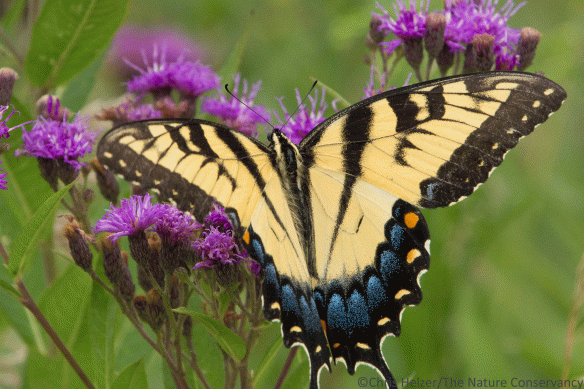
I’ve been seeing a lot of adult swallowtails around lately, including this tiger swallowtail , which was pretty easy to spot, even from across a large draw.

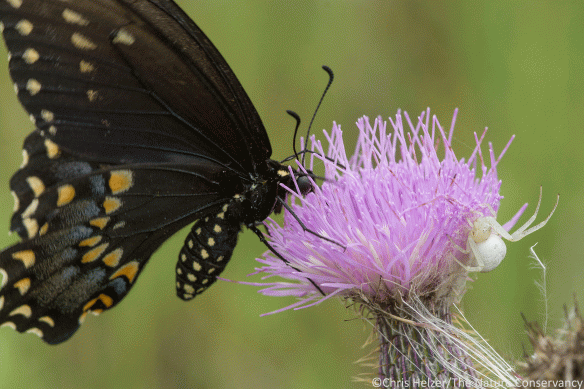
Ok, this black swallowtail wasn’t on ironweed when I photographed it, but it went to ironweed after feeding on this native thistle.  I was taking bets (in my head) about whether or not the crab spider on that thistle would be able to take down the big butterfly. The butterfly eventually moved within striking distance, but the spider didn’t attack, so I’m guessing it decided to wait for something a little smaller.

Thanks to Neil Dankert, I can tell you that this gorgeous little brown skipper butterfly is a tawny-edged skipper.

Ironweed is too beautiful and important for its name.  Maybe we need a campaign to rename it, and maybe that campaign would help convince people, including those at a certain unnamed university, to leave this plant alone to do its job.  Either way, it might be fun to think about potential names.  Any ideas?