At a recent Nebraska conference, Shelly Kelly of the Sandhills Task Force made a point worth some serious consideration. She told a roomful of wildlife biologists that if they want reluctant ranchers to seriously consider using prescribed fire, using photos of big scary flames in presentations and social media posts is probably counterproductive. Instead, Shelly suggested sharing more photos of fires that are clearly under control, with people calmly working around them. Even better, she suggested, we should share photos of green grass beneath the skeletons of dead invasive trees, showing the positive results that follow fire.

We got our first prescribed fires of 2018 done last week. This photo captures some of the 5 minutes or so of intense fire following about an hour of boring backing fire lines on one of those burns.
I appreciate her point. Most of my favorite prescribed fire photos are the ones I took during the big head (wind-driven) fire at the end of a burn – when the flames are high and there’s lots of color and action. Visually, those images are certainly more powerful than photos of a small fire backing slowly into the wind during the early stages of a burn. However, it’s important to remember that “powerful” might not be the attribute to lead with when talking to a skeptical audience that fears the potential negative consequences of fire.
On the other hand, I don’t necessarily think we need to stop showing people powerful images of fire – we should just try to provide appropriate context for those images. After all, the power of fire is why it’s so valuable as a management tool. It can take some pretty tall flames and a lot of heat to kill eastern red cedar trees, for example.
Context is important. Posting an image of huge flames and a towering smoke column on Instagram or Facebook with a short caption like, “Woo Hoo!! We had a great burn today!!” will probably get lots of likes from experienced fire folks. However, someone unfamiliar with prescribed fire might look at that same image and assume it was taken by a reckless pyromaniac who was endangering the public and him/herself. As a result, that person might be much harder to turn into a prescribed fire supporter.
Expounding a little in an image caption can help quite a bit. Something like, “Here’s an image from the finale of today’s controlled burn. After two hours of slowly burning out a boundary around our fire unit, we were able to send this hot fire through the prairie to kill lots of invasive trees before it ran into what we’d burned earlier and put itself out.” Or whatever – you get the idea.

We start each burn with a small test fire in the downwind corner . That gives us a chance to see how the fire and smoke are going to behave before we commit to the whole enchilada. If we don’t like what we see, we can easily shut down and wait for a better day. Last week, we had dry conditions, but wind speeds were low enough that we could burn safely.
Even better, we should probably share broader series of images showing the entire process of the fire, including the boring backing fire that sets the stage for that big finish. Photos of a nice straight firebreak, with black on one side and unburned grass on the other, can help drive home how careful, competent, and effective we are. After posting a few shots of people in yellow suits laying down lines of small flame inside neat boundaries, it’s probably ok to slide in a couple photos of flaming infernos and torching cedar trees. It might be smart to include at least one more photo after those flashy shots, though, showing that everything turned out well in the end…

In this photo, we’re laying down a band of water along the edge of a mowed strip surrounding our burn unit, and Olivia is lighting the grass just upwind of that wet and mowed line.
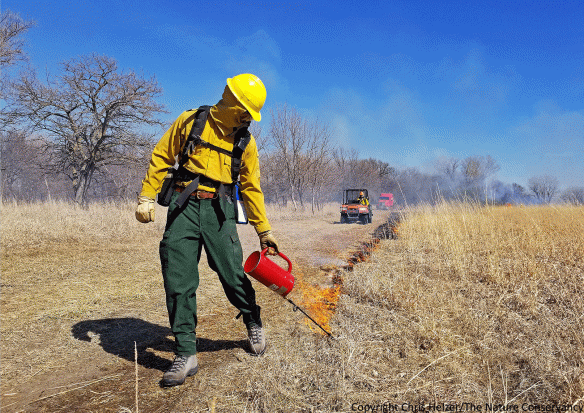
With both a wet line and a mowed firebreak to catch it, Alex lit a line of fire that we allowed to back into the wind. Several vehicles with water followed behind to make sure the flames stayed inside the unit.

Eventually the backing fire created a wind band of black that acted as a catcher’s mitt when the big fire ran into it later.

Once the black lines were prepared, we ignited the upwind portion of the unit and allowed fire to roar through the unit until it hit the black and was extinguished.

These lines of fire are safely inside wide bands of black that have already burned.

Olivia watches the last of the smoke dissipate as the fire burns itself out.
I’ll try to follow my own advice about fire communications in the future, and you can remind me when I forget. It’s absolutely appropriate to celebrate the power (and let’s face it, the beauty too) of fire by taking and sharing photos. However, we should also celebrate and share the care and strategy that go into making those powerful fires safe and effective.
Be safe out there.

 The Prairie Ecologist