With this post, I’m finally getting around to something I’ve been contemplating for several years. Back in October, 2015, Alan Short sent me an email from South Africa. He’d been reading this blog and was interested in exploring similarities between South African grasslands and the prairies of North America.
After some emails back and forth, Alan brought his colleague Greg Martindale into the conversation, and Greg then suggested I talk to Devan McGranahan – a professor at North Dakota State University who I first met at some patch-burn grazing meetings more than 10 years ago. Devan spent a year in South Africa doing post-doctoral work, which lets him compare North American grasslands to those in South Africa.
I’ve found the similarities and differences between the grasslands on our two continents to be fascinating and I’m hoping you will as well. In this post, I’ve asked Alan, Greg and Devan to provide a quick introduction the South African grassland, or veld, as it is locally known. In a future post, we’ll explore some management issues. You can read a little more about the South African grassland biome here.

Grassland and forest patch – in Fort Nottingham Nature Reserve. Such forests form fire refuges and are important component in the species and structural heterogeneity of the mesic grasslands in KwaZulu-Natal. The forest is an endangered vegetation type, Eastern Mistblet Forest, which is a form of montane forest. Photo and caption information by Greg Martindale
PE:
Alan, can you give a basic description of what the grasslands of South Africa look like and how they might compare to ours here in North America?
Alan:
Our grasslands have quite a wide range of climatic and geological variation. The eastern parts are high rainfall (700-2000mm, or 28-79 inches, per annum) down to about 500mm, or 20 inches, in the west where they start grading into the shrubby vegetation of the karoo. From that point of view, the range in precipitation is probably fairly similar to the US.
A couple of big differences might be that southern African grasslands are entirely summer rainfall, apart from some of the subtropical coastal grasslands which are mostly fire-maintained and have more evenly distributed rainfall. We do get snow on the mountains, and occasionally in the foothills (every 3-4 years), but it probably doesn’t contribute to precipitation in the same way that snowfall in North American prairies do.
The major structural feature of much of the African continent is the interior plateau, with a steep escarpment on the eastern flank which blocks a significant fraction of the rainfall coming in from the warm Indian Ocean in the east. So, in the grasslands of the escarpment itself, you have high-rainfall, mostly fire-maintained grasslands with patches of natural forest in the sheltered valleys and southern flanks of the mountains. These areas are particularly prone to invasion by alien invasive woody species. On the plateau, the grasslands are more climate-maintained, although fire still plays an important role.
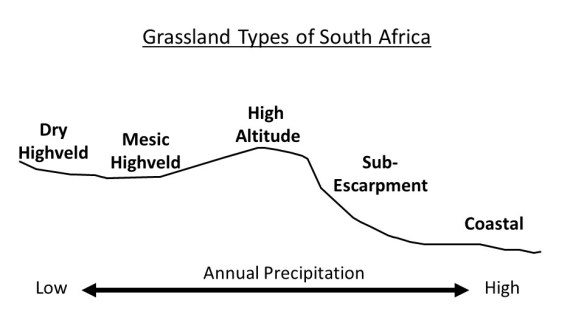
Illustration by Chris Helzer. Apologies for over-generalizations
The biodiversity is spectacular. There’s a very long evolutionary history in these grasslands and a high rate of endemism. In the moist grasslands, much of the plant diversity consists of perennial, fire-adapted species with large underground organs. Annuals become more dominant in the semi-arid grasslands. The grasses are mostly tropical and subtropical species, with many of the same subfamilies as found in some of the North American prairies. At high altitude, once you get into basalts of the Lesotho Highlands and the summit of the Drakensberg (above about 2500m, or 8200 ft), temperate genera like Festuca and Poa become more common. There are a lot of endemic frogs, birds, reptiles and invertebrates, most of which are on the endangered species lists. In the central (plateau) grasslands as well as the coastal grasslands, huge herds of game were once a feature, but they’ve mostly disappeared and been replaced by livestock, apart from game farms and nature reserves.
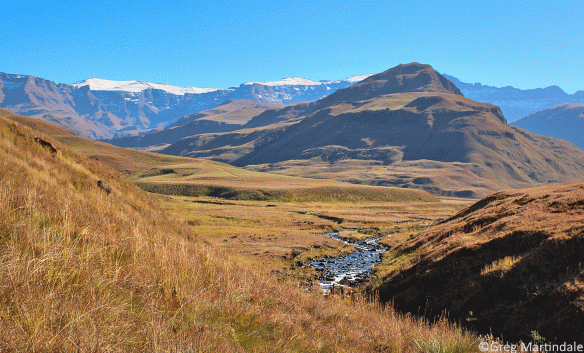
Grassland and mountains in the Lotheni Nature Reserve, which is part of the uKhahlamba Drakensberg World Heritage Site. The vegetation types here are montane grasslands, Southern Drakensberg Highland Grassland and uKhahlamba Basalt Grassland. These grasslands are grazed by free roaming wildlife species, the largest of which are eland and they are burnt on three or four year cycles. Photo and caption information by Greg Martindale
PE:
Devan, you spent a year in South Africa but are also very familiar with grasslands in the U.S. What can you add to what Alan described?
Devan:
The South African diversity is indeed striking, both in the types of grasslands and the species richness of even the grasses themselves, not to mention forbs. The spatial variability in distinct grassland types is itself higher than I associate with North American grasslands, and they are all packed into a less extensive area. The lack of snow-derived moisture is indeed a difference but I suspect the lack of frost (at lower elevations) is a bigger difference between the northern prairies I’m familiar with and probably all of South Africa’s grassland. Soils under African grassland are old and oxidized and much of the grassland biome reminds me more of eastern Oklahoma than anywhere else in North America: reddish soil and high productivity.
Alan mentioned the Drakensberg grasslands. It does snow in the Drakensberg. It gets cold, and one can see it in the soils: decomposition is slowed and deep, black organic matter builds up. These grasslands crank out as much grass biomass as any tallgrass prairie. But despite being set aside as a World Heritage Site and managed by the provincial wildlife authority, grazer density on these grasslands is much lower than one would expect. Grazer density is low because the sward drastically loses nutritive value in the winter and simply can’t support large herds. These high-altitude grasslands are known as “sourveld” and are complemented by “sweetveld” – rangeland that can be grazed all winter long. Again, I think a lot of these differences to North America are climate-driven, the difference between dormancy driven by cold vs lack of precipitation.
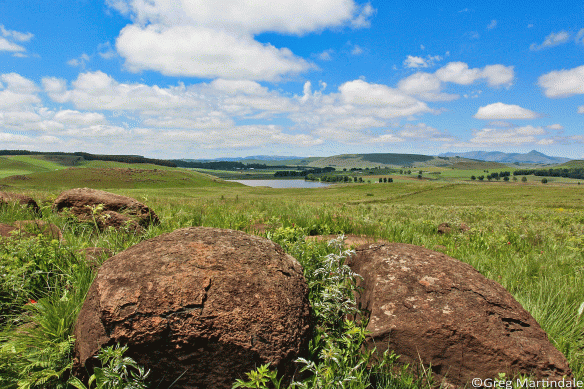
Mooi River Highland Grassland in the KwaZulu-Natal Midlands – this area it utilised for cattle grazing and is burnt on a three to four year cycle. Photo and caption information by Greg Martindale
PE:
Greg, how are the grasslands in South Africa doing today?
Greg:
The grassland biome, which is the second largest biome in South Africa, at approximately 350 000 km2 (about the size of Iowa and Nebraska combined – PE), includes the country’s main economic centre, the Witwatersrand (Johannesburg and surrounding cities), which is its most populous, rapidly urbanising and industrialising region. Due to this, and other pressures such as crop production and the operations of several key industries including mining and forestry, approximately 60% of the biome has been irreversibly transformed.
Levels of transformation and these intense and growing pressures are of particular concern because the biome comprises a centre of diversity with an estimated 3 788 plant species and only 2% of it is formally conserved. Almost the entire area of the biome that has not been irreversibly transformed is used for livestock agriculture. The overall extent of grassland in South Africa, appears to be primarily determined by climatic variables, although fire and grazing exert considerable influence over the biome’s boundaries.

Umgeni Vlei Nature Reserve – a Ramsar site and the source of the Umgeni River, KwaZulu-Natal’s most important river, as it is the main source for the economic centres of Durban and Pietermaritzburg. This nature reserve is subject to controlled grazing to allow areas to be kept open for the breeding of wattled cranes, a critically endangered species. Photo and information by Greg Martindale.
Biographical information:
Alan Short
Alan Short is a rangeland ecologist and independent consultant, advising farmers, conservation agencies and other land managers in southern Africa on sustainable range management principles. Previously, he worked as a research scientist at a provincial department of Agriculture, ran a national rangeland monitoring program for South Africa, and spent two years working for a conservation program in Mozambique.
Greg Martindale
Greg is the director of a small non-profit organisation in South Africa, which focuses on creating new protected areas with landowners. This builds on work he did when he was employed by the KwaZulu-Natal provincial conservation authority. Through this work he interacts closely with landowners to devise approaches to the management of grassland for livestock grazing, which are compatible with biodiversity conservation and the maintenance of critical ecological processes.
Devan McGranahan
Devan Allen McGranahan learned about tallgrass prairie growing up on his family’s farm in Clay County, Iowa, and learned about managing it while at Grinnell College. Afterward he spent a year living on game farms across southern Africa before taking up graduate studies at Iowa State University on a patch-burn grazing project. After returning to South Africa as a Fulbright Scholar in the Department of Grassland Science at the University of KwaZulu-Natal in Pietermaritzburg, South Africa, Devan joined the Range Science faculty at North Dakota State University. He specializes in grassland fire ecology.
Suggested Reading:
Low, A.B. and Rebelo, A.G. (1996) Vegetation of South Africa, Lesotho and Swaziland. Department of Environmental Affairs and Tourism, Pretoria.
O’Connor, T.G. and Bredenkamp, G.J. (1997) Grassland. In Cowling, R.M., Richardson, D.M. and Pierce, S.M. (eds) Vegetation of Southern Africa. Cambridge University Press, United Kingdom.
Reyers, B. and Tosh, C.A. (2003) National Grassland Initiative: concept document. Gauteng Department of Agriculture, Conservation and Land Affairs, Johannesburg.