In case you hadn’t noticed, the climate is changing. Things are getting weird, and they’re going to get weirder. Here in central North America, we’re expecting more and more intense storm events and drought periods in the coming decades. Scientists are scrambling to figure out how to predict and facilitate the inevitable changes those crazy weather events will bring to natural systems, including prairies.
Fortunately, prairies have been training for this for a very long time. A few months ago, I wrote a post about the resilience of prairies, and how that resilience is built largely upon the diversity within their ecological communities and the size and connectivity of prairie habitats. Prairies that are relatively big and still have the majority of their potential plant and animal species are going into this encounter with rapid climate change with what you might call solid bench strength.

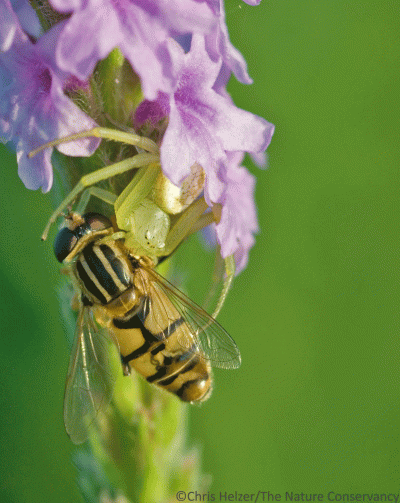
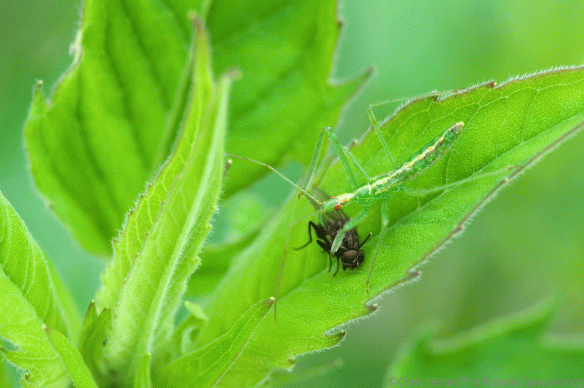
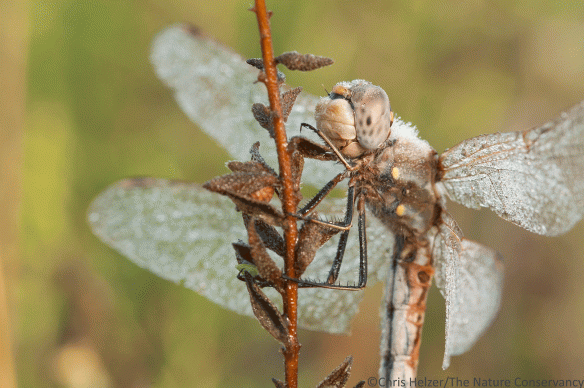
Diversity of plants and animals is the keystone to ecological resilience. The Nature Conservancy’s Nachusa Grasslands, Illinois.
In sports, teams want to have lots of available players that represent a broad diversity of skills. Each opponent they face will have its own individual mix of power, endurance, speed, and other attributes. A successful team can build a roster for each game that counters their opponent’s strengths, no matter what they are. The number and quality of their players is a team’s bench strength.
Healthy prairies have great bench strength too. No matter what gets thrown at them, they can adapt by changing their roster of species. The speed at which they can drastically change the makeup of their “team” is impressive. Anyone who has spent many years watching the same prairie has seen this in action, but none of us have seen prairies go through what Professor John Weaver saw back in the 1930’s and 40’s.
Weaver, one of the best known prairie ecologists of all time, had been studying 30 “large typical prairies” across parts of Nebraska, Iowa, Kansas, and Colorado prior to the start of the Dust Bowl era. His baseline data gave him an invaluable opportunity to document the dramatic changes to the plant communities of those prairies during and after the droughts of the 1930’s. What he recorded, along with his former student F.W. Albertson, was an incredible testimony to the dynamism and resilience of those prairies. Their 88 page 1944 publication, entitled “Nature and Degree of Recovery of Grassland from the Great Drought of 1933 to 1940” encapsulates the bulk of their findings in one place, and is worth a read if you have the time.
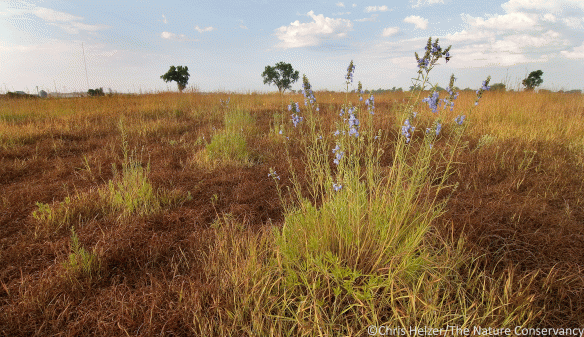
In 2012, we got a small glimpse of what Weaver and Albertson saw in the 1930’s, but our drought – while severe – only lasted one year here in Nebraska.
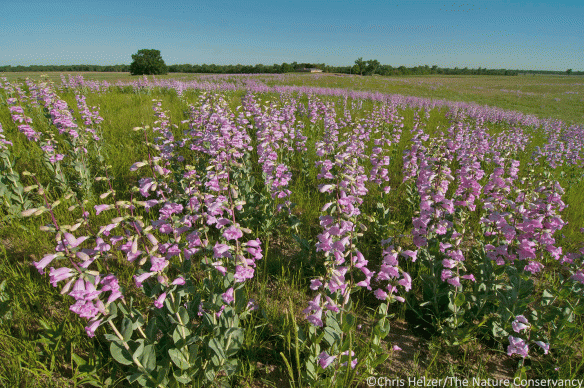
In 2013, the response of the prairie to the 2012 drought included some explosions of wildflowers, including shell leaf penstemon (Penstemon grandiflorus).
One of the biggest plant community shifts Weaver and Albertson documented was the widespread and dramatic death of grasses such as big bluestem (Andropogon gerardii), little bluestem (Schizachyrium scoparium), and Kentucky bluegrass (Poa pratensis), and the subsequent rise of other grasses such as prairie dropseed (Sporobolous heterolepis), sand dropseed (Sporobolous cryptandrous), porcupine grass (Stipa spartea), and most of all, western wheatgrass (Pascopyrum smithii). Western wheatgrass populations exploded throughout the mid to late 1930’s, to the point where many prairies were completely dominated by it, to the near exclusion of other plant species. In fact, in a 1942 publication, Weaver said the following, “The large area of drought-damaged true prairie and native pasture now dominated by western wheat grass and the harmful effects of the successful competition for water of western wheat grass with species of greater forage value present a problem of much scientific interest and great economic importance.”
In other words, as they made massive substitutions within their lineups, prairies were changing so much they became almost unrecognizable, even to those who knew them best. Weaver and Albertson watched waves of forb species they’d always considered to be of little value become stars on the field, and they and others didn’t quite know how to react. Daisy fleabane (Erigeron strigosus), Missouri goldenrod (Solidago missouriensis), and heath aster (Aster ericoides) were all examples of wildflowers that suddenly rose to prominence in new and major ways. The two dismayed scientists described how heath aster, a “nearly worthless native forb,” formed near monocultures across wide swaths of prairie, to the extent that it “ruined many of the prairies…for the production of hay, because of its brush-like growth.” Others were out of their depths on this too, and Weaver and Albertson reported that “considerable native sod was broken because of the seriousness of this pest.” In the following sentence, however, they begrudgingly added a short sentence, “Of course, it did protect the soil.”
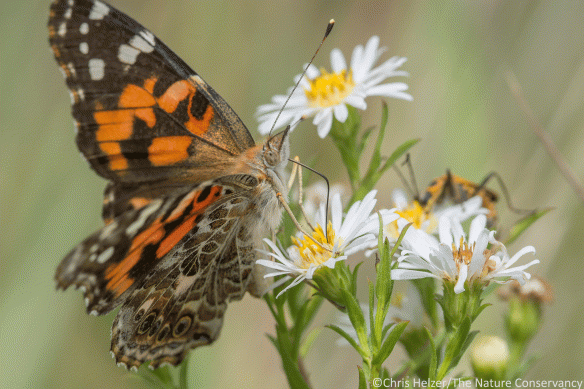
While Weaver and Albertson considered heath aster to be “nearly worthless” it plays an important role in the prairie, and is an important food source for pollinators in the fall.
Exactly. While the strategy was foreign and frightening to those who hadn’t seen prairies dealing with these kinds of conditions before, those prairies were just doing what they’ve done many times before – making whatever roster adjustments were necessary to keep functioning at a high level. In addition to forb species they denigrated as weeds, Weaver and Albertson noted that many wildflowers with “large storage organs”, including bulbs and corms, also greatly expanded their population size during the dust bowl years. This included species like Violet wood-sorrel (Oxalis violaceae), bracted spiderwort (Tradescantia bracteata), windflower (Anemone caroliniana), and wild garlic (Allium canadense). Those species and others increased the size of the patches they’d occurred in previously, but also were found “in many new locations.” Other native forbs that became superabundant in some prairies, especially early in the dust bowl years, included prairie ragwort (Senecio plattensis), white sage (Artemisia ludoviciana), and yarrow (Achillea millefolium).
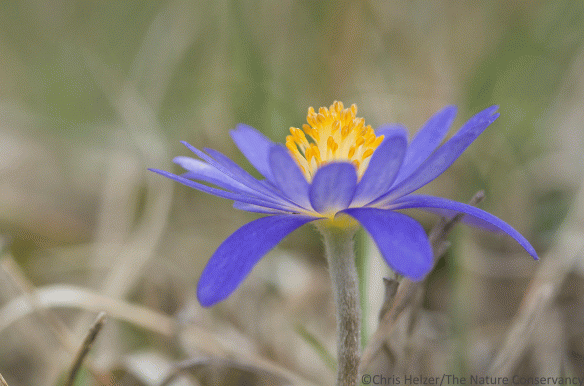
Windflower (Anemone caroliniana) was one of the wildflowers with “large storage organs” that proliferated during the droughts of the 1930’s.
As rains started to return in the early 1940’s, Weaver and Albertson watched with amazement and renewed optimism as plant communities started “recovering”, which of course meant they were returning to a composition more familiar to the people observing them. Grasses were often the first to rebound in prairies, including big bluestem, which initially formed large and lush monocultures in many places. Wildflowers that hadn’t been seen for seven years or more, suddenly appeared everywhere, including blue-eyed grass (Sisyrinchium campestre), which grew “more thickly than if the stands of 7 normal years had been combined.” Downy gentian (Gentiana puberula), which had been considered rare prior to the big droughts, became much more common in the early 1940’s than Weaver and Albertson had ever seen before, with abundances of “15 or more plants in a space of a few rods”.
Stiff sunflower (Helianthus pauciflorus) returned fairly quickly to “normal abundance” by 1943, as did many others, including silverleaf scurfpea (Pediomelum argophyllum), cream wild indigo (Baptisia bracteata), and buffalo pea (Astragalus crassicarpus). Prairie violets (Viola pedatifida), pussy toes (Antennaria neglecta), and others came back more slowly, but returned nevertheless. Importantly, those returning species didn’t appear to be traveling from long distances. Instead, they simply re-emerged, either from seeds or underground buds, from where they’d been sitting on the metaphorical bench, awaiting the call to step up to the plate again.
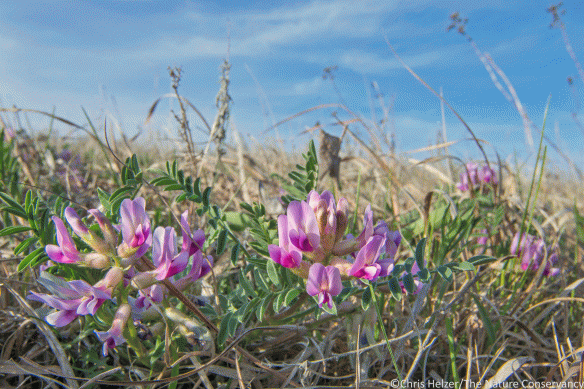
Buffalo pea (Astragalus crassicarpus) and many other wildflowers recovered from the long droughts at a speed that amazed Weaver and Albertson.
The prairies we know today have been through a lot. In Nebraska and surrounding states, we have specific documentation of the kinds of extreme roster changes prairies can and have made to adjust to the world around them, thanks to the work of John Weaver and F.W. Albertson. If you have a favorite local prairie, and I hope you do, it’s important to remember that the way it has looked for as long as you’ve known it is only a small sample of what it’s capable of. Smart teams don’t reveal their secrets before they need to.
As we work to keep prairies healthy through this period of rapid climate change, it’s both useful and reassuring to remember what they’ve been through before. Today’s prairies certainly have additional challenges to deal with today, compared to the dust bowl days (more invasive species, more landscape fragmentation, etc.), but many should still have sufficient bench strength to make the adjustments they’ll need to make in the coming years. Our responsibility is to provide management that helps prairies sustain their plant and animal diversity, as well as to protect prairies from additional conversion to cropland or other land uses. Where possible, restoring prairie habitat around and between prairie fragments can also help build resilience. In short, we have to allow prairies to do what they do best – adapt and adjust. Prairies are wily veterans and they’ve been in this game for a long time. It’s a good bet they’ve still got a few tricks up their sleeve.