
Back in July, my daughter tagged along with me on a trip to the Niobrara Valley Preserve. Because she’s in college now, and I don’t see her all that often, it was particularly gratifying to have a few days of concentrated time together. On the last morning of our trip, we decided to hike the Preserve’s public trail through some hills overlooking the Niobrara River and its valley.
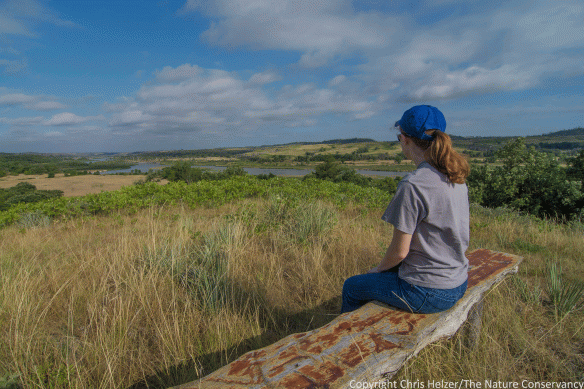
The peacefulness of this scene belies the violence that had taken place only a few moments before…
Not long after we started walking, I heard a cicada burst out of the grass in front of us and loudly rattle off into the prairie. It was a sound we’d heard many times over the previous days, but this time, instead of fading gradually away, the sound stopped suddenly, only a second or so after it started. A couple steps later, my brain finally identified the anomaly and I turned around and walked in the direction the cicada had flown. I found it where it had landed, and quickly saw why its flight had been cut short. The cicada was lying on the ground, making short buzzing noises, and there was a big robber fly sitting right on top of it. The scene was particularly impressive given the size of the cicada (about the size of my thumb) compared to the much smaller fly.

Despite being significantly smaller than the massive cicada, the robber fly brought it down pretty quickly , and seemed to know just where to insert its proboscis between the chinks in the cicada’s armor.
Robber flies are common in prairies, and we’d been seeing quite a few hanging around during the previous weeks. I knew they were voracious predators, but had never seen one take down another animal so much bigger than itself. Only a year ago, I got to watch one intercept and kill a tiger beetle that was trying to fly away from me. Watching that robber fly come out of nowhere to knock a beetle out of the air was impressive, but at least in that case the predator was a lot bigger than its prey.
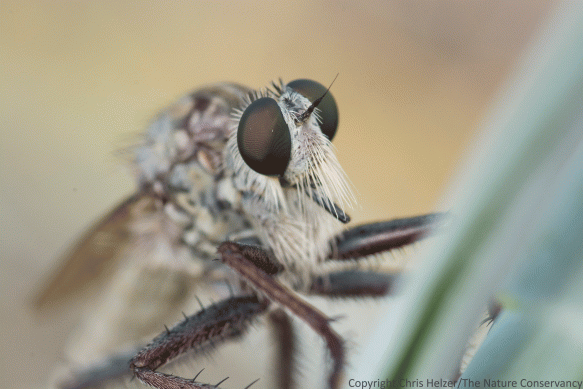
I photographed this robber fly just a week or so before the cicada attack.
Since I didn’t actually see this particular attack, I can only assume the robber fly followed the typical robber fly script. It was probably perched nearby, scanning the skies for prey, and as the cicada lifted off, the robber fly launched itself like a guided missile and rammed into the cicada, knocking it to the ground. Then, it must have very quickly employed its hypotharynx (modified mouthparts) to inject a toxin into the cicada. That toxin rapidly immobilized, and eventually liquefied the cicada’s insides. By the time I arrived on the scene, the cicada was already close to death, and certainly wasn’t going anywhere. Anna and I didn’t want to disturb the robber fly’s meal, so we walked on, leaving the fly to suck the cicada shell dry – a well-earned meal.


 The Prairie Ecologist