A couple quick comments before I share this week’s photos…
First, a brief celebration. This little prairie blog surpassed 1,000,000 hits a few months ago, which is both shocking and humbling. In addition, more than 3,500 people now subscribe to the blog via email and/or Twitter. Most gratifying to me, however, is that as of today, there have been 10,000 comments in response to posts and photos on this blog. I can’t tell you how much I appreciate the discourse that occurs here. Out of those 10,000 comments, there have been only a handful that weren’t respectful, constructive, and/or informative. While I don’t reply to all comments, please be assured that I read every single one, and aside from that aforementioned handful, I appreciate them all very much. Whether you’re expressing your appreciation for a photo or thought, asking questions about topics we’re exploring, or sharing additional information, the comments are my favorite thing about writing this blog. Please keep sending them!
Second, thanks to Brandon Timm, biology teacher at Aurora High School (Nebraska), I can now say I’ve appeared on a podcast! Mr. Timm has a podcast, called My Science Story, in which he interviews a variety of scientists, discussing both their work and the path they followed to get where they are. His main objective is to inspire students to see themselves as potential scientists, but the podcast is also a great way to catch up on what some fascinating scientists are up to these days. If you’re interested, you can listen to the episode I appear on HERE, but please also check out his other episodes. I think you’ll be impressed.
Ok, now the photos:

A hybrid of sandsage and sandhills prairie in Garden County, Nebraska.
While I tend to turn my camera toward small insects and flowers, I often find myself in some pretty extraordinary landscapes, especially the Nebraska Sandhills, where I am surrounded by nothing but open grassland as far as I can see in every direction. Using photography to capture the sense of immensity and pleasant isolation I feel in those landscapes has turned out to be a big challenge for me. Even with a wide angle lens, it’s really hard to portray the expanse of grassland and sky around me. In the above photo, for example, there is nothing but grassland between me and the horizon at the top of the photo (several miles away), but while it’s a nice image, it doesn’t do justice to what I was seeing.

Wetland, dunes, and sky. Cherry County, Nebraska.
In this second photo, I wanted to show both the foreground vegetation as context for the wetland and vegetated sand dunes behind it, and the clouds gave me a great sky to work with as well. However, the photo seems about three times too narrow to portray what I saw as I stood near the edge of the clear water. Sure, I could have stitched multiple images together in a panorama, but when I try that, I’m usually disappointed by the result. I can show more of the landscape, but the scene seems to become somehow smaller rather than larger. I’m not sure I can verbalize why that is.
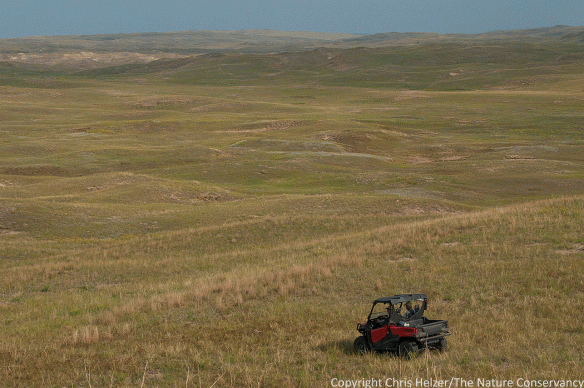
Sandhills prairie. Cherry County, Nebraska.
This last photo comes about as close as I’ve gotten to showing off the expansiveness of the Sandhills. Ironically, it was shot with a zoom lens set at about 54 mm, which is far from a wide angle. However, I was able to get up high, include a vehicle in the foreground for some context, and include an awful lot of landscape between me and the distant horizon. It’s the depth of the image, rather than the width, that makes it work for me. But even this image is a poor representation of reality.
I guess you’ll just have to go look for yourself.


 The Prairie Ecologist