Photos of the Week – August 20, 2024

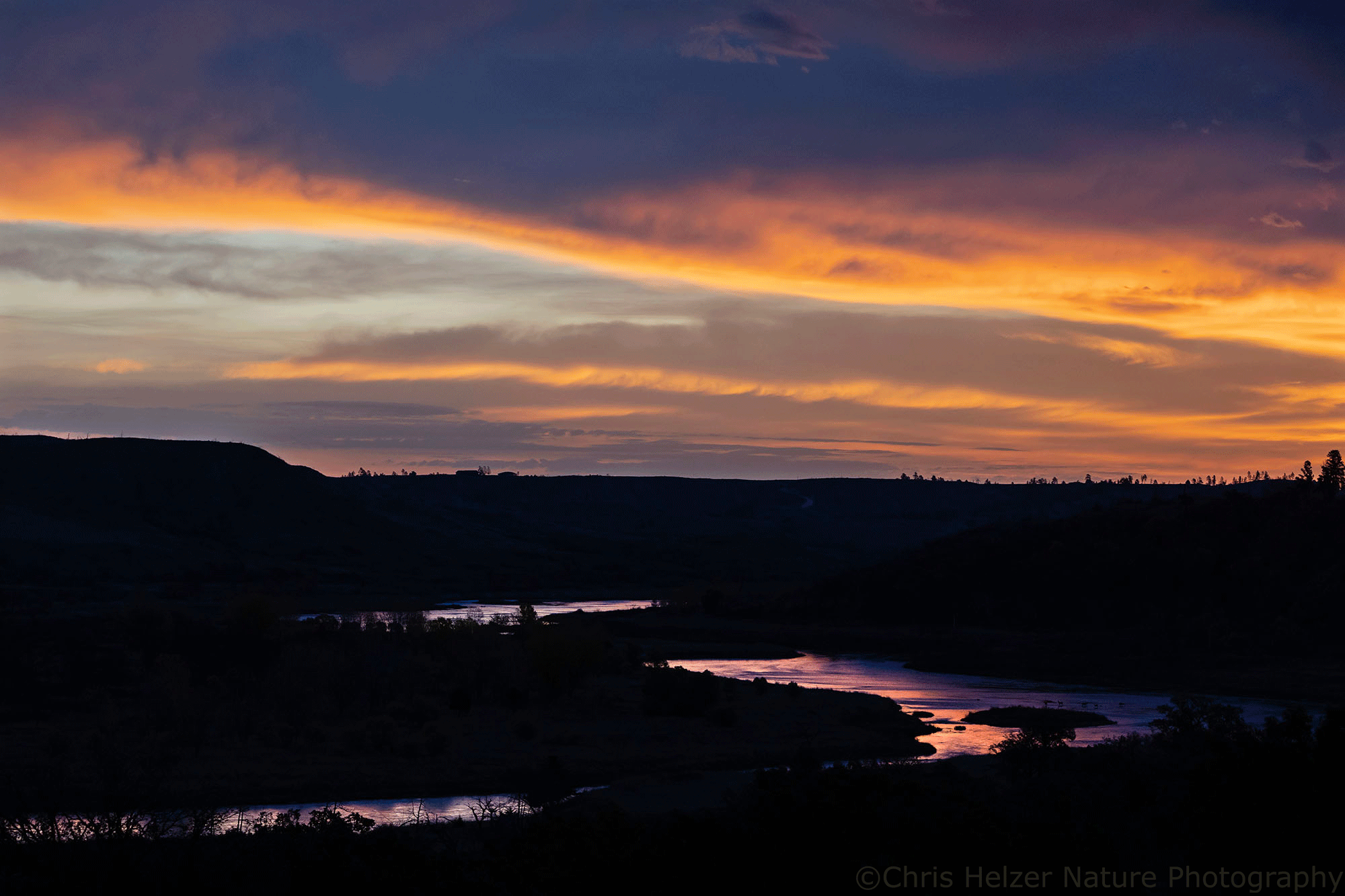
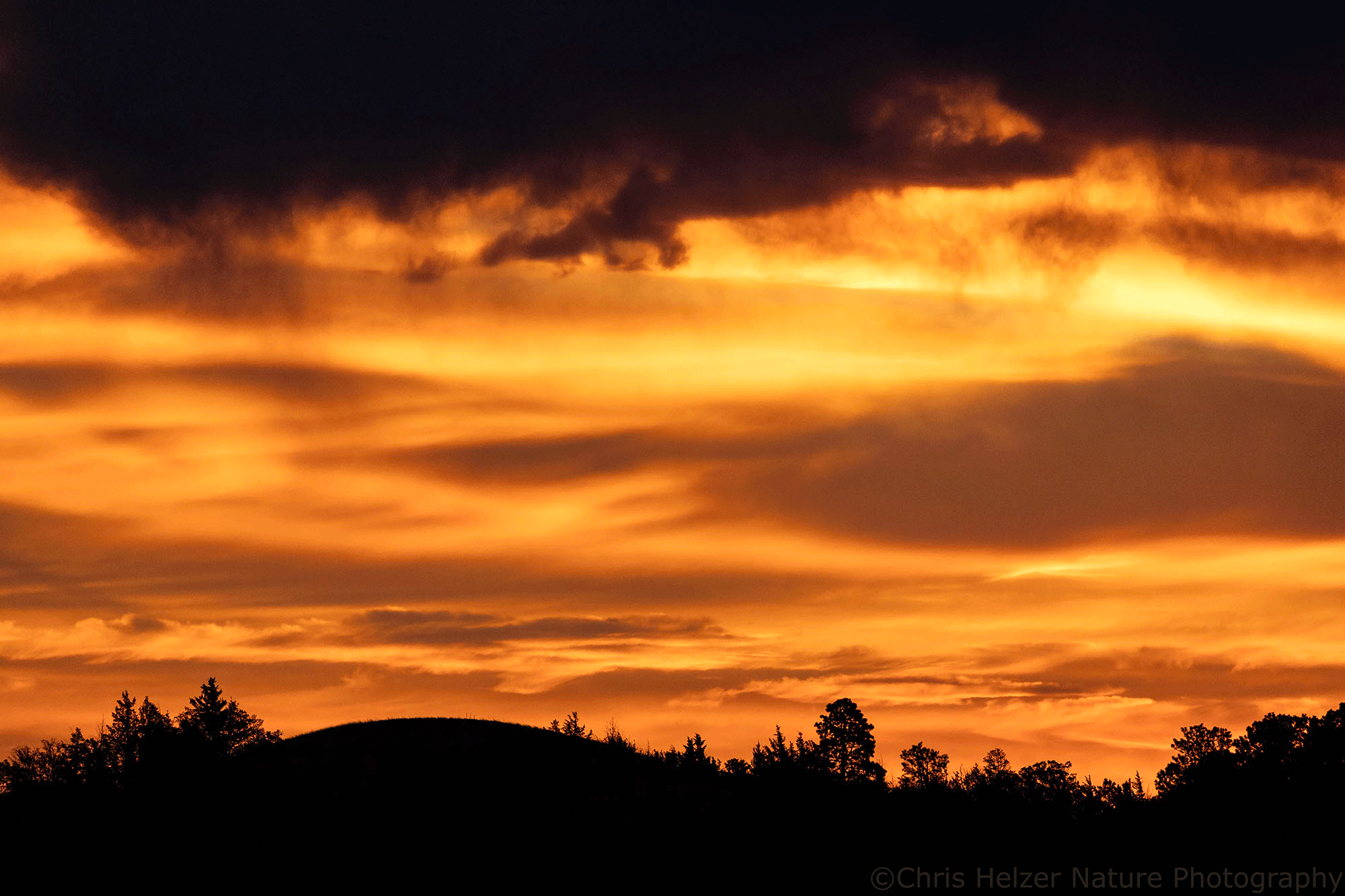
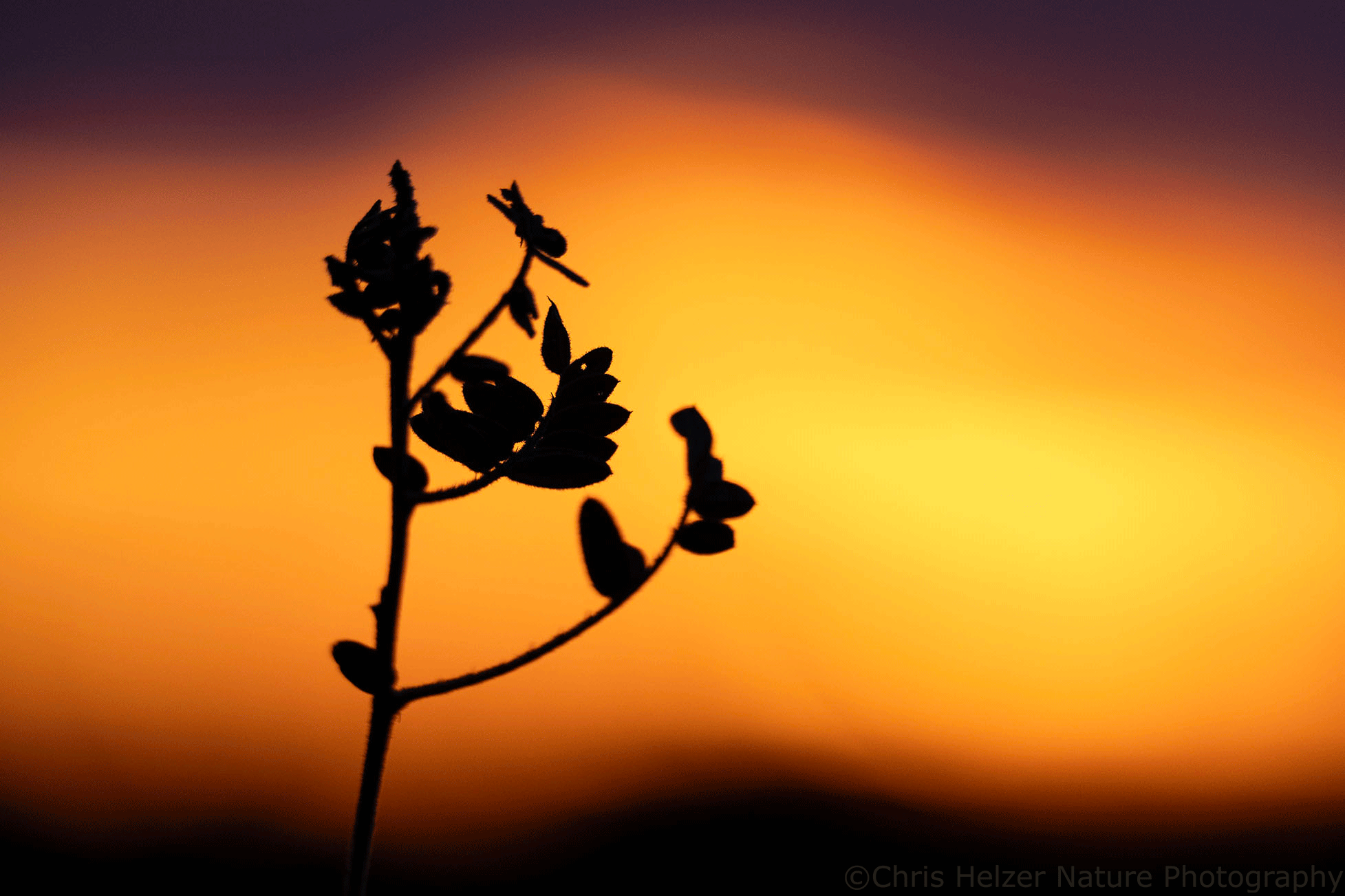
I made two early morning trips to the Platte River Prairies last week to catch the sunrise and explore with my camera. We’re in the early stages of the late summer yellow phase of those prairies. Three of our sunflower species are in full bloom, including one perennial (stiff sunflower) and two annual species (garden sunflower and plains sunflower). Three other perennial sunflowers are just beginning to open their flowers as well (Maximilian and sawtooth sunflowers, as well as Jerusalem artichoke).

Missouri goldenrod has been yellow for several weeks, but is now being joined by its cousins, including Canada, giant, and stiff goldenrod. Black-eyed Susans, upright prairie coneflower, buffalo bur, fabulous oxeye, and other yellow-flowered plants are in the latter stages of their blooming period, but still around. The prairie is dressed to the nines right now and most of its favorite accessories are yellow.

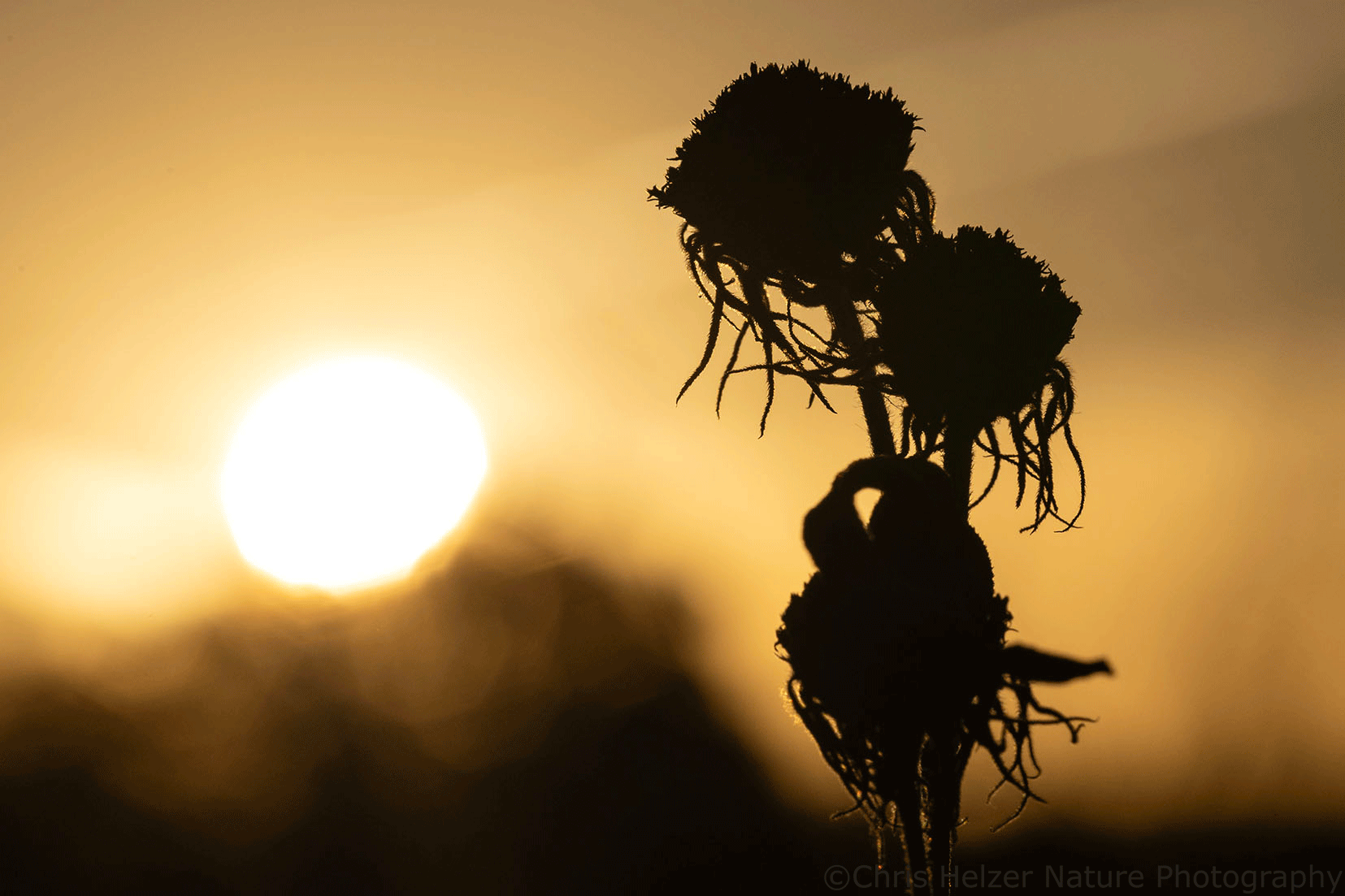
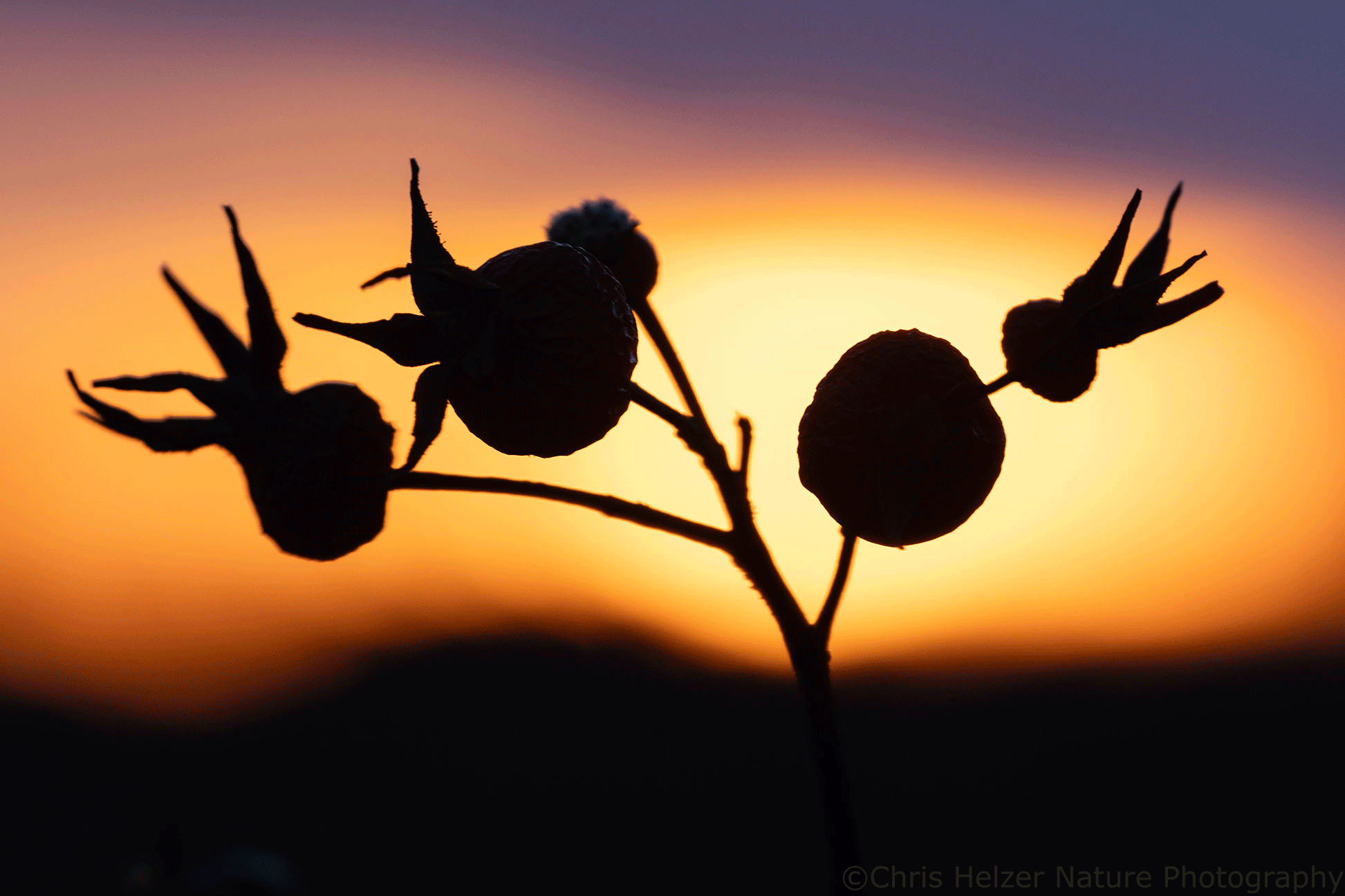
Buffalo bur, a spiny native annual wildflower, greets the sun with me on an early morning last week.

There are many other colors in the late summer prairie, of course, and lots of texture. Flowers of white, blue, purple, and other hues are scattered throughout the scenery. Most of the grasses in the prairie have bloomed by now, as well – some much earlier in the season and others just getting going. Most of those flowers are on tall skinny stems, adding a lot of vertical lines to the prairie canvas.

Roundheaded bushclover and stiff goldenrod in restored prairie.

Ok, that’s enough of me sounding like an amateur poet. The thing is, this is a pretty spectacular time of year to be in the prairie. Ungrazed prairie can be tall and woolly enough that I have to deploy my ‘tallgrass gait’ to avoid being repeatedly slapped in the face by grasses and wildflowers. I’m sure every prairie enthusiast has their own version of the gait, but mine involves each foot making an outward-circling (wax off) motion as I push it forward. That does a pretty good job of moving the vegetation out of the way just long enough for my face to pass through before it closes in again behind me.

Male longhorned bees waking up on their overnight roost as the sun hits the stiff sunflower blossom they slept on.

Personally, I find myself spending most of my time exploring sites that are currently being grazed, or – even better – recovering from last year’s grazing. Those sites are easier to walk through because the vegetation is less tall and dense. Plus, the recovery patches tend to have the most wildflower and insect abundance, which is helpful in my macro photography efforts.

Most of the photos shown here were taken within those recovery patches, except for the photos of cattle. Those were taken in patches that are being actively grazed. You probably would have figured that out on your own.

All the photos above, along with the next several, were taken in a patch of prairie I planted back in 2000. I used an old EZEE-Flow ‘drop spreader’ machine to plant the grass seed, but broadcast all the wildflower seed by hand. I did that as I drove back and forth on an ATV with a bucket hanging off the handle bars. It took a couple days to plant all 60 acres and my shoulders were really sore by the end – both from tossing seed and from driving one-handed.

The memory of that effort surely colors my appreciation of the site today, but it really is a special patch of prairie, even from an unbiased perspective. As I said in my last post, I get a lot of gratification from prairie restoration work, and this planting happened as I was starting to feel confident in what I was doing. It also happened at the beginning of a 5-year drought, so the establishment was slow and agonizing, making the eventual success even more meaningful.

Good grief. I sound old, huh?

Stiff goldenrod and late summer prairie.

Apropos of nothing, here’s a quick trick for photographing flat prairie landscapes, in case you’re interested. The photo above was taken with my camera just above the top of the stiff goldenrod in the foreground. The horizon behind is mostly visible, emphasizing its flatness and the vegetation looks like it’s all the same height. Meh.

The photo below was taken with the same plant in the foreground, but the camera was moved about a foot lower. Now the prairie looks more like it really is – a mixture of heights and textures. The horizon is broken up by the plants poking above the grass canopy, which makes the scene feel much more as it felt to me at the time (beautiful and diverse). It’s also more like the way most inhabitants of the prairie see it, which seems right.

The same plants and prairie as above, but from a slightly lower angle.

The photo below shows another longhorned bee that spent the night perched on a flower. Since most bees are solitary (not social, with queen, workers, etc.), and only the females make themselves nests and bring food to the eggs they’ve laid there, males don’t have a sheltered tunnel to sleep in overnight. As a result, they just find a spot to hang out all night. This time of year, they are often covered with thick dew by morning, making them easy photo subjects.

Longhorned bee (male) on a black-eyed Susan flower in grazed prairie.

The next photo shows a big black bull, which, along with the rest of the herd, was grazing part of the restored prairie. The taller prairie vegetation from the earlier photos is just behind the bull, but you can’t see it because of the angle of the photograph (taken while I was lying on the ground). The cattle were grazing this particular patch of prairie because it was hayed earlier in the summer, creating an area of lush, nutritious regrowth.

Cody, our Platte River Prairies Preserve Manager, is using that hayed patch much like we use fire in our patch-burn grazing and the cattle are following the pattern very nicely. The hayed area is getting lots of grazing because of that nutritious regrowth, maintaining short habitat structure for the plants and animals that want that. Despite the cattle having access to it, the unhayed area is largely ungrazed. It’s fairly tall, but not as tall as it will be next year when the grasses have had another year to fully regain their vigor from being previously burned and grazed.

There’s another patch – burned last summer – within the same pasture. It’s fun and messy, but I didn’t get over there before the sun got too bright for good photography. I’m only one man. I can only do so much.

Black angus bull with black-eyed Susan (with a hover fly on it) in the foreground.

On Saturday morning, I woke up early and decided to go catch the sunrise again. This time, I went to a different site we’d burned last summer. It got grazed pretty hard late last summer and somewhat earlier this year. Cody created a new burn patch this spring that pulled a lot of the grazing off the summer burn, though, which is speeding its recovery along. I was curious to see what it looked like.

By the way, ‘recovery’ isn’t really the right word. The prairies aren’t injured or anything, it’s just that the grass vigor has been weakened and that leads to a pulse of wildflowers that ordinarily struggle to compete with full-strength grasses. I need to come up with a better term to describe that period. Post-grazing flower party, maybe? I’ll keep working on it.

Anyway, I arrived in time to catch the sun breaking the horizon and used some big patches of stiff sunflower as foreground for photos. The prairie hasn’t ever been plowed, as far as we can tell, but we’ve overseeded it with some plant species that were missing because of a ‘difficult history’ of management before we acquired it about 20 years ago. Stiff sunflower is one of the species that has established well from that overseeding, though it’s still patchy in occurrence.

Stiff sunflower and sunrise.

I was having a lot of fun with the sunflowers and sunrise, which led to me taking way too many photos. Too many, because it created some difficult decisions about which ones to show here. I promise these three are all different from each other, though the overall feel is very similar. It was an absolutely gorgeous morning.

More stiff sunflowers and the same sunrise.

Maximilian sunflower was starting to bloom along the edge of a big slough, so I used it as a foreground, too. Sometimes, I put the sun on the left side of the sunflower. Other times, I put the sun on the right. Variety is the spice of life.

Sun and Maximilian sunflower.
Maximilian sunflower and sun (the same of each, but in a different order because of where my tripod and I were standing)

Here’s one more photo (below) of the Maximilian sunflower patch. All these were taken with a telephoto lens (100-400mm lens) to get the sun to look big. It looked big in real life, too, but without a longer focal length lens, it wouldn’t have appeared that way in the images.

More Maximilian sunflowers with the same sun. There was only one sun.

After most of the color left the horizon, I switched to a wide angle lens and played around with another stiff sunflower patch. Similar to the guidance I shared above, I made sure my camera was below the height of the flowers, making the images more interesting and letting the viewer feel like they were in the prairie instead of just seeing it from above. I don’t want to give you the impression I invented this technique, by the way. I’m just passing it along in case you’ve not heard of it. No one has a patent on the idea of holding your camera a little lower when you take a photo. At least, I hope not.

Stiff sunflower and sun through a wide angle lens.
More stiff sunflowers and the same old sun once more.

Pretty soon, the sun had risen high enough that the light was getting bright and the contrast tricky to deal with. I realized I hadn’t really photographed the actual prairie much (just sunflowers), so I turned around, put the sun to the my side, and tried to capture photos of the grassland around me. This was the patch we burned in the summer of 2023, so I was pleased to see both good numbers of wildflowers, along with grass that looked like it was regaining its vigor.

Stiff sunflowers with a soldier beetle and fly on the one closest to the camera.
There was more than one flower blooming. Here’s some wild bergamot (with more stiff sunflowers in the background).
Another stiff sunflower. It was too pretty not to photograph.

Before I lost the light altogether, I wanted to do a little insect photography, so when I came across a couple male wasps on big bluestem, I switched to my macro lens. Shortly after that, I spotted a buckeye butterfly. I got a couple photos of it before it flew off. Then, I stalked it for a few minutes and I got a couple more photos of it on its next two perches. I left it alone after that because it was clearly trying to soak up the warmth of the sun and it felt mean to keep shifting it around.

Five-banded thynnid wasps (males) roosting on big bluestem.
A buckeye butterfly still wet from dew.
The same buckeye butterfly trying to catch some warming rays.
Grasshopper sparrow on Maximilian sunflower.

As I was leaving the prairie, I stopped to say hi to the cows and check out this spring’s burn patch. This is the area the cows have been hitting the hardest, but even so, the grazing was pretty patchy. Coming out of a couple years of drought, Cody had reduced stocking rates for this year. Then, of course, the rains came, the vegetation has exploded, and we don’t have enough cattle to keep it all cropped down in the burned patches. Nothing wrong with that, but we don’t have the big expanse of short habitat we’d normally have.

Cows staring at me with a solar well in the background (where they drink).

The photo below shows the patchy nature of the grazing in this spring’s burn patch. Some of it is being grazed short, but there aren’t enough cows to graze the whole burn patch short. This area is part of a low-diversity grass planting from before we owned the property, so plant diversity isn’t great, but there are at least some big yellow-flowered plants like Maximilian sunflower and some goldenrods.

Patchy grazing in this spring’s burn patch.

Just as I was ready to hop in the truck to head home, the cows came up close to say hi. I took a photo of a calf with its colleagues behind it. I took several rapid-fire shots. Just as I started, it stuck its tongue out and made me laugh. I don’t think it was being goofy on purpose, of course, but it sure seemed similar to a kid trying to ruin family picture day!

A nice portrait, just a half second before the next one…
“Come on, Percival! Stop messing around and let us get a good photo!”

It’s always worth getting up for sunrise, but this time of year might be the best of all for an early morning prairie walk. There’s usually dew to help slow and highlight invertebrates, and the morning wind speed is often low. That, mixed with the abundant color and varied habitat structure of late summer prairies makes it a pretty spectacular experience. I hope you can get out and see a prairie sunrise soon!

The Joy and Gratification of Strategic Prairie Restoration

When I think back on my career so far, it’s hard to come up with anything that’s been more gratifying than my work in prairie restoration.  After all, what could feel more conservation-super-hero-like than taking a low-productivity row crop field and converting it to high-diversity prairie?  Today, I can walk through hundreds of acres of restored prairies for which I harvested the seeds, planted the seeds, and have managed/overseen management over the last 20 years or more. 

This diverse and beautiful prairie was a cornfield until 2002.

Yowza.  That’s a great feeling!

That’s why it’s awfully frustrating to hear people say something like, “well, but it’s not REALLY restored, is it?”

What are you even talking about? 

“Well, the amount of soil organic matter in your previously farmed site is a lot lower than in that unplowed prairie over there…  It’ll take another 100 years or more before your site matches that real prairie.”

“Look, it’s pretty and everything, and I guess you’ve got most of the right plant species, but the relative abundance of the species is completely different in that real prairie over there.”

“Where are the bison, prairie, dogs, elk, and wolves?  If it was really restored, you’d have all those functional components of prairie.  You’ll just never be able to really restore the prairie – it’s gone forever.”

This patch of prairie was planted in 2000 with about 200 plant species. This is what it looked like in 2017 after we hit it with pretty intense grazing for most of 2016.

Ok, look.  Let’s talk about expectations, objectives, and the apparent lack of joy and wonder in some people’s lives.

Why do we do prairie restoration?  There’s no single answer to that question, but having an answer is key to deciding whether you’ve been successful or not.  (You might have noticed that I’ve been using a lot of italics in this post.  Italics help with emphasis and ensure you’re reading the text in the same way I’m thinking as I write it.  I’ll try to refrain, though, because eventually it’ll become irritating.)

Anyway, it’s important to know why you’re restoring a site.  Are you trying to create bird habitat?  Something pretty look at through your dining room window?  A place where you can see lots of bees and butterflies?  All those are very achievable objectives, and no one can say you’ve failed if you see birds, beauty, butterflies, and/or bees.  Actually, knowing some people, they might still say it, but you can ignore them because you know you were successful.

From a conservation standpoint, I think the most powerful objective for prairie restoration is to help stitch a fragmented landscape back together.  For example, the stated objective for the prairie restoration work at our Platte River Prairies in Nebraska has been to enlarge and reconnect prairie fragments in a landscape dominated by row crops.  We started with small, isolated patches of prairie that were separated by crop land.  We wanted to make those little fragments function as larger, more connected units increase the viability of the populations of prairie plants and animals and strengthen the ecological resilience of the whole community.  That felt important, but also testable.

A diverse seed mix was important to our restoration objectives, so we worked hard to harvest as many species as we could.

To build restored prairies and meet that objective, we harvested seeds from as many prairie plants as we could – harvesting from the prairie fragments we were hoping to improve, but also from similar sites within a few counties from the project area.  Those seeds were planted in crop fields adjacent and/or in-between prairie fragments.  We used seed mixes of 160-215 species of plants for most of the projects I supervised (including seeds for some wetland habitat we embedded within many of those sites).  As those restoration projects became established, it sure looked like we’d created some nice connective tissue between those fragmented prairies. 

Over the years, we’ve tried to evaluate our success in multiple ways.  I’ve done a lot of data collection to ensure that the plant species we harvested seed from became established and have stuck around in the restored sites.  They did, and they have.  The sites have experienced lots of fire, grazing, and drought and have maintained their plant diversity.  That feels like a good indication of ecological resilience. 

The planted prairies, though, are really just the means to an end, and that end is the viability and resilience of the formerly isolated prairie fragments.  Because of that, the most important measures are those that evaluate whether those prairie fragments are better off now than before.  Testing is ongoing, and will be for a while, but the news so far as been very good.

Through some basic species inventory work, we’ve shown that most of the ant, bee, mouse, bird, and grasshopper species in the prairie remnants (unplowed prairies) can also be found in the restored habitats.  That’s a crucial first step.  We hope to keep digging to see how those species are using the restored habitat.  Is it meeting their requirements for nesting, foraging, sheltering, etc.?  Those are more difficult evaluations, but important.

This southern plains bumblebee is just one of many bees that has moved into and used restored habitat between remnant prairie fragments.

The restored habitat often looks different than that of the remnants.  That doesn’t bother me.  In fact, there are advantages to it.  For example, Emma Greenlee, a 2022 Hubbard Fellow, showed that our restored prairies often complement the pollinator resources (flowering plants) available in adjacent remnant prairies.  Emma showed that when flower numbers dipped for a while in remnant prairie, the adjacent restored prairie habitat usually compensated by having a big pulse of available flowers at the same time.  The reverse was also true.  In other words, because we’ve added restored prairie to the neighborhood, bees and other pollinators have a much more stable supply of food throughout the season.

We’ve also enjoyed the benefits of larger prairie expanses when it comes to prairie stewardship.  It’s a lot easier to manage for the habitat needs of all our target prairie species when we’ve got more space to work with.  Because every animal has its own requirements for vegetation structure (height, density, patchiness, etc.), we try to provide all the possible habitat types we can in every prairie.  Creating a shifting mosaic of habitats is really tough in small prairies because there’s not room to make them all – especially because many animals (notably birds, but also others) need habitat patches to meet certain size requirements.  In larger prairies, we can provide the full range of habitat patch types, and at what we think are appropriate scales.

Larger prairies also reduce the exposure to habitat edges where lots of bad things can happen.  The boundaries of prairie habitat, for example, are often places where invasive plants try to enter.  As a result, the border zones of prairies require a lot of extra work to scout for and suppress trees, shrubs, or herbaceous plants trying to infiltrate the site.  In a small prairie, the entire site can basically count as a ‘border zone’.  If you make that prairie bigger by restoring adjacent habitats, you can create some interior ‘core areas’ where invasion pressure is reduced.

I could continue, but the point is that we’re seeing strong evidence that we’ve achieved our restoration objective.  The small, isolated prairies we started with seem to be functioning as larger, more connected units and are reaping the conservation benefits of our restoration work.  That sure smells like success to me!

I harvested and planted the seeds that led to this pretty little patch of prairie. It’s the function, though, more than the beauty that gives me the most happiness.

Sure, the soils beneath a site that was in row crops for 60-100 years still look different than those beneath adjacent unplowed prairies.  Plant communities planted 20 years ago aren’t going to look exactly like those in prairies that have been around for thousands of years and were shaped by various iterations of human stewardship during that whole period.  And, no, we don’t have bison, elk, prairie dogs, or wolves (though we are seeing more prairie chickens).  Guess what?  None of those variables are particularly relevant to our objectives.

We wanted to use prairie restoration to improve the resilience and long-term survival chances of our small prairies and their inhabitants.  I think we’ve done that, though we’ll keep trying to evaluate our success.  The fact that restored habitats have soil organic matter levels that are different from remnants, or that some plant species are more or less abundant, doesn’t mean that we’ve failed. After all, we’re not trying to replicate our prairie fragments; we’re trying to save them! 

Habitat loss and fragmentation are the biggest threats to prairies in many places.  It’s extraordinarily difficult to sustain populations of species in tiny, isolated prairie patches.  Countless events, including fire, grazing, haying, or herbicide treatments by prairie managers could wipe out a species of leafhopper, snake, or toadflax in a small site.  It’s hard to see how those species might recolonize when the nearest prairie is miles away, across expanses of crop fields and/or urban development.  As a result, successful stewardship of small grasslands is extraordinarily challenging.

I don’t know how we can possibly save those prairies without making them bigger and more interconnected.  The only way to do that is via prairie restoration in surrounding areas.  Many restoration projects, including ours, have shown that restored habitats can enlarge, connect, complement, and otherwise improve the viability of small prairie fragments.  That’s great news! 

So, why should we let people tell us why our restored prairies don’t look right, don’t have the right soils, or are otherwise not measuring up to what they think a restored prairie should be?  Prairie restoration is incredibly important and gratifying.  Let’s celebrate our successes and keep looking for more ways to make bigger and better prairie landscapes!

.

Additional information you might find interesting:

A short philosophical post that puts prairie restoration into a helpful context (according to me).

A post and interview about wrestling with the complexities around seed sourcing for climate-change adapted restoration projects.

The Bureau of Land Management’s Seeds of Success Program aimed at “increasing the quality and quantity of native plant materials available for restoring and supporting resilient ecosystems.”  The program includes a strong set of protocols, many of which are relevant to site-based restoration programs.