Photos of the Week – July 18, 2024

I apologize for not sharing more photos from my square meter plot today (trust me, I’ve got plenty to show you!) but I made a quick trip to the Niobrara Valley Preserve this week. There were only a couple of short windows of time for photography, but I tried my best to take advantage of them. On Monday evening, I wandered around a sand blowout (bowl-shaped depression caused by wind erosion). I saw a lot of activity, only some of which I managed to photograph. I missed the sand wasps and robber flies, but did manage to get some photos of a big beetle, a tiger beetle, and a very accommodating lizard.

A dung beetle just before it lifted into the air and flew away.
A big sand tiger beetle (Cicindela formosa)
A common lesser earless lizard (Holbrookii maculata)

I had to follow the tiger beetle around for a while before finally getting a good photo, and the beetle didn’t stick around long. The lizard, though, was surprisingly willing to hang out. That happens sometimes, but I don’t know why. I’d like to think it’s my charming personality but it’s possible other factors are involved.

The lizard and I had a good chat while I photographed him.
Look at that handsome profile.

After a while, I decide that if the lizard was going to be that comfortable with my camera, I’d go for broke. I switched from my macro lens to a wide-angle lens with the ability to focus almost up to the glass (Canon RF 15-30mm). Approaching veeerrrry slowly, I managed to get the lens within an inch or so of the lizard and get a few photos. It backed off, but I managed a couple other shots before leaving him alone to enjoy the rest of the evening.

Earless lizard with a wide-angle lens.

The big show going on in the Nebraska Sandhills right now features fourpoint evening primrose (Oenothera rhombipetala). It’s an incredibly showy biennial plant that is blooming throughout the landscape. As a biennial, a flush of fourpoint evening primrose is a good indicator of events that happened two years ago. In this case, that included drought conditions that made vegetation relatively sparse, let a lot of light hit the ground, and stimulated the germination of a lot of evening primroses.

The drought enabled primrose germination in many locations across the Sandhills, but they are particularly dense where grazing or other disturbances helped create even more bare ground and/or less vigorous grass competition. Those plants then spent last year (a wet year) as low-growing rosettes of leaves before bolting up this year and popping out profusions of large yellow blossoms. They’ll die at the end of this growing season, but they’ll each leave behind thousands of seeds to fuel the next primrose explosion whenever favorable conditions return.

Fourpoint evening primrose along the edge of the blowout that contained the beetles and lizard.

As the evening sun disappeared behind clouds Monday night, I photographed a few primroses along the edge of the blowout. The light was subtle (drab?) but the flowers were showy enough to make some nice images. I decided that if Tuesday morning’s sunrise allowed it, I’d go out and try to photograph some of the bigger patches nearby.

Primroses in front of a muted sunset.

There were lots of clouds Tuesday morning, and the sun popped in and out of them as it rose, creating some fun light for landscape photography. It wasn’t hard to decide what to feature in the foreground.

Fourpoint evening primroses inside the fence of our east bison pasture.

I headed for the bison pasture, guessing that the year-round grazing there had created some nice patches of primroses. I was right, though later in the day, I found much larger and more dense areas of primroses – long after the both the good light and my time had run out. Oh well. It’s hard to complain.

As the sun moved in and out of the clouds, I took advantage of the variable light to try lots of angles and compositions. I circled around within a few acres, often returning to the same plants to shoot them from a different perspective and/or under different lighting conditions. The two photos below show how much difference light makes.

I photographed this patch of plants as the sun was behind some diffuse clouds.
This is the same patch as above, but photographed just a few minutes later after the sun had popped back out of the clouds.

I find that yellow flowers can be particularly challenging to photograph in bright light. They can easily get washed out and lose detail in images. That made things tricky as the sun rose higher because I liked the rich color and contrast with full light but also appreciated the diffusion caused by thin layers of clouds. I had plenty of time and subject matter, so I kept playing around for an hour or so before I finally had to go get ready for some actual work.

Primroses with the sun behind me.
Primroses with the sun in front of me.

The Sandhills is a landscape of about 12 million acres of prairie. That expanse, along with the hills and (in many places) numerous wetlands and lakes, makes it a pretty spectacular place. When you add in profusions of big showy flowers, though, it’s out of this world. If you’ve never driven through north-central Nebraska, I’d politely suggest you add it to whatever list you have to keep track of the important experiences you want to have in your life.

If you do make the trip, be sure to stop and hike the trail at the Niobrara Valley Preserve. There are some other great options for exploration as well, though, including the Valentine, Crescent Lake, and Fort Niobrara National Wildlife Refuges and the Halsey and McKelvie units of the U.S. Forest Service, among others. There’s no bad time to visit the Sandhills, but if you can time your trip to coincide with big blooms of primroses or sunflowers, you’re living right.

Even More Photos From The Same 1×1 Meter Plot Of Prairie – Early July Edition

The square meter photography project (2024 version) continues. Today’s post contains some of my favorite photos from the first half of July – all taken within the same 1×1 meter plot I’ve been staring at since late April.

You might be thinking, “Surely, he’s not been sitting there for the whole summer?” Nope. I go other places. I have a full-time job, in fact. I even take photos in other prairies.

But when I’m not exploring my square meter plot, I’m usually thinking about it. Wondering what I’m missing. Wondering if that butterfly that keeps eluding me is perched alluringly on a milkweed flower right now. Wondering if the lynx spiders or tiger flies have caught anything new today, or if any new mushrooms have popped up.

A wasp peers out of its overnight roost inside a cluster of dew-covered butterfly milkweed flowers.

As I keep saying, this project is not just about seeing how many species I can photograph. I’m trying to showcase how beautiful and complex prairies are, even within a tiny area, and to find and share as many stories as I can. It’s more about enjoying and appreciating prairies than doing a full inventory of their denizens. (Denizens is a word we fancy writers use to show off our vocabulary or when we feel like we’ve been underutilizing the letter z.)

That said, I have photographed about 209 species of plants, animals, and fungi so far! I’ve almost doubled my entire 2018 total of 113, using the exact same square meter plot. I think I’m getting good at this.

Given the difficulty of distinguishing between species of invertebrates, I’m being very conservative about calling one critter a different species than another. Hopefully, that means the count will grow even higher as I get more experts to help me with identifications. For now, though, I’m elated to have already photographed about 200 species by mid-July.

The most diverse groups of species so far have been the following: Bees (16), Spiders (17), Plants (18), True Bugs (23), Beetles (33), and Flies (40). I’ll be adding a couple more grasses soon – switchgrass and indiangrass are both in the plot, but I haven’t yet found the perfect composition for a photo. There’s no rush – they’re not going anywhere!

This leaf-footed bug (Catorhintha sp.) was the only insect I photographed feeding on butterfly milkweed in 2018.

Butterfly milkweed has continued to be the big draw for insects this month, though its flowering season is nearly over. In 2018, I was surprised by the lack of pollinating insects I found visiting butterfly milkweed. Only one leaf-footed bug species (above) showed up. I didn’t see much happening on butterfly milkweed outside my plot either. It was confusing and disappointing.

This year, the same leaf-footed bug (Catorhintha sp) has been a common visitor – sometimes three or four at the same time – but it has been joined by many other pollinators. Honey bees have been the most abundant, but I’ve also seen and photographed little leaf-cutter bees, sweat bees, wasps, flies, beetles, and ants. I still haven’t managed to get a butterfly to pose for a photo, but I’ve seen some in the area.

One of two similar-looking leafcutter bees I’ve photographed on butterfly milkweed this year.
A wasp that has been a frequent visitor.
I only saw this wasp once, but it worked through the milkweed plant very diligently.

Lead plant continues to bloom as well, though most of the flowers are being eaten by Japanese beetles, which reduces its availability for other insects! I have, though, seen what I’m pretty sure is the same miner bee species (Andrena quintilis) that visited lead plant frequently back in 2018. I’ve seen other pollinators on lead plant as well, but certainly not as many as I would have if the dang Japanese beetles weren’t so persistent.

A miner bee feeding on lead plant.
One of many Japanese beetles working over the flowers of lead plant.

It’s been fun to use the bright orange milkweed flowers as background for other photo subjects. That opportunity is quickly coming to an end now, but it was fun while it lasted!

Planthopper nymph with butterfly milkweed color behind it.
A tree cricket on lead plant, but with a nice orange background.
A closer shot of the tree cricket.
Morning dew drops with orange accents and background.
These are some of the last milkweed blossoms in the plot. Most of the flowers are done.
I’ve tried to photograph fallen milkweed flowers. There have been plenty to choose from.
Another fallen flower.

I’m seeing a lot more spiders than I did back in 2018. That includes some of the same species (like lynx spiders) that I saw back then, but quite a few new ones. Many of the spiders have been small enough that they’re really difficult to photograph and I wonder how many I missed in 2018 because I just wasn’t looking hard enough. Some spiders are consistently building webs within the plot, which almost never happened six years ago.

A female lynx spider.
A male lynx spider (note the big, dark pedipalps below its head).
This female lynx spider made a lightning fast leap at the little fly on the left, but just missed it.

I’ve seen several long-jawed orb weavers on webs. Last week, though, I got to watch one of them spin a web right in front of me. The process was impressively brief. It seemed to take only a few minutes between the spider laying out some support strands and putting the last touches on a fully-formed web. I really enjoyed watching the final stages when the spider was quickly spinning around with its head toward the center of the web and its spinnerets (toward the tail end of its body) facing outward.

The long-jawed orb weaver spinning around and completing its web between butterfly milkweed flowers.
As soon as the web was completed, the spider was ready to eat and sat quietly in the center of the web. Unfortunately, the first insect to blunder into the web was a honey bee, which basically pulled the whole thing apart and then flew off.

One morning, I noticed a spider with a big white bulbous abdomen in a tent-like shelter made out of a bent butterfly milkweed leaf and some silk. It was only a few inches from the ground, so it took a while to get myself positioned to photograph her. Once I was there, I ended up staying for about 15 minutes. As I watched, a much smaller male approached and ended up successfully (as far as I could tell) mating with the female and then escaping with his life.

Mating cobweb spiders in a milkweed leaf tent.

Initially, I thought the spiders were orb weavers, but later discovered they were cobweb spiders (Theridiidae). One big clue was the tangled-web I saw the female sitting on a few days after she mated… Anyway, it was fascinating to watch the male approach the female and deposit sperm with his palps into openings in her abdomen. Afterward, he hung out nearby. I wondered if he was sticking around to keep other males from trying to mate, but I didn’t see any further action take place, so I don’t know.

It’s been a wet year so far, with a lot of thunderstorms moving through. One evening, after a storm had moved through, we looked out our dining room window to see one of the brightest rainbows I’ve seen. I raced (cautiously, and within the speed limit) across town and ran down the trail to my plot, but the color started to fade about 30 seconds before I got there. I plopped down on the ground anyway, breathing harder than I like to admit, and got a few photos before the rainbow completely disappeared.

30 seconds, though. Oof.

The last remnants of a big rainbow with my plot in the foreground.

Despite missing the best of the rainbow, the sky still put on a nice show for the next half hour or so, with what looked like ‘mammatus-ish’ clouds hanging overhead and beautiful evening light. Eventually, I went back home, only to return an hour or so later to see if I could get any photos of glowing lightning bugs. I did, but I’m not super happy with them so I’ll try again.

Post-storm clouds above butterfly milkweed at my plot.
I’ve had at least one or two lightning bugs in the plot most days. Sometimes I see them feeding on nectar (I assume) from butterfly milkweed.
Another lightning bug, but I’ve not gotten good photos of them when they’re putting on their light show.

I almost always find new species when I visit. In fact, just this week, I finally had my first day without finding a new species. In a way, it was a relief because I’d found myself feeling slightly anxious each visit until I’d photographed my first new (for this year) species of the day. Now, I don’t have to worry about keeping the streak alive and can just enjoy whatever I find.

Most of the photos I take aren’t of species I’m seeing in the plot for the first time, but I have a great time looking for new ways to capture portraits of them. There have been some that flew or jumped away when I first spotted them, but many of those have given me a second or third chance on subsequent visits. I always make sure to take a photo from far away first, before sliding slowly closer, hoping they’ll let me get a more up-close-and-personal shot.

Convergent lady bug, preparing to fly.
This broad-nosed weevil species has been a frequent visitor – sometimes more than one at a time. I sat and watched this one feeding on a Maximilian sunflower leaf for a while.
A tiger fly with a captured leaf hopper.

Flies are (as in 2018) the most diverse group of invertebrates I’m seeing. I’m pretty sure I’ve got several more species than I’m currently counting, but I’m being extra careful with all the ones that look similar to each other. I’ve discovered tiger flies this year, which I’ve never knowingly photographed before, and have enjoyed watching them feed on a variety of small prey items, including leafhoppers, small bugs, and other flies.

A fly silhouetted on Maximilian sunflower.

My 200th species of the year (probably) was an old friend, Delphinia picta, a picture-winged fly I first discovered in 2018 while doing this same project. It was one of my favorites from that year, so it felt really good to see it again. It was especially nice to see it the third time this year, because that was the first time it actually let me get close enough to photograph it!

Delphinia picta – a picture-winged fly that looks like it wears a gas mask.

I’ve seen red milkweed beetles (Tetraopes tetrophthalmus) several times, and have photographed at least three of them, but only one of those was actually on milkweed at the time. The other two landed on Maximilian sunflower and hung out while I crept up on them with my camera. They’re awfully charismatic, which is why one of them was featured on the cover of the book I wrote about my 2018 version of this project!

Red milkweed beetle.
This photo features three species. Lead plant, a leaf hopper, and a tiny thrip (the little yellow squirt to the right of the leafhopper). And yes, I saw the thrip as I was taking the photo, and it took a while to get both it and the leafhopper’s eyes in focus at the same time! Especially because the thrip kept moving.

I’ve found several new plant species (compared to 2018) in my plot this year, though I’m sad that stiff sunflower (Helianthus pauciflorus) apparently migrated away during the last six years. Stiff sunflower is still very abundant elsewhere in Lincoln Creek Prairie, but not in my little plot. That’s the way it goes, I guess, but I sure miss it.

One of the new species that’s appeared is black nightshade, a weedy native annual that I’ve never actually photographed before. It has small, but attractive flowers that I’ve enjoyed getting to know. I’m guessing it appeared because this spring’s prescribed fire allowed enough light to hit the ground to stimulate seed germination.

Black nightshade (Probably Solanum ptychanthum)

There is so much I can’t squeeze into these already-too-long posts. I’ve got a whole series of photos of those mating cobweb spiders, for example, and a dozen more lynx spider photos that are really nice, but that don’t fit here. More importantly, I’ve watched all kinds of drama play out and am trying to write down stories so I’ll be able to circle back to them later on.

Some of those stories happen within a few seconds, including moments of predation (or attempted predation). Others are more drawn out, including plants that are thriving and others that aren’t – either because of competition from other plants or because they’re being eaten or otherwise affected by animals. I know who the actors are in some of the stories, but others are a mystery, including whomever has been eating the seed heads of heavy sedge (Carex gravida) when I’m not around!

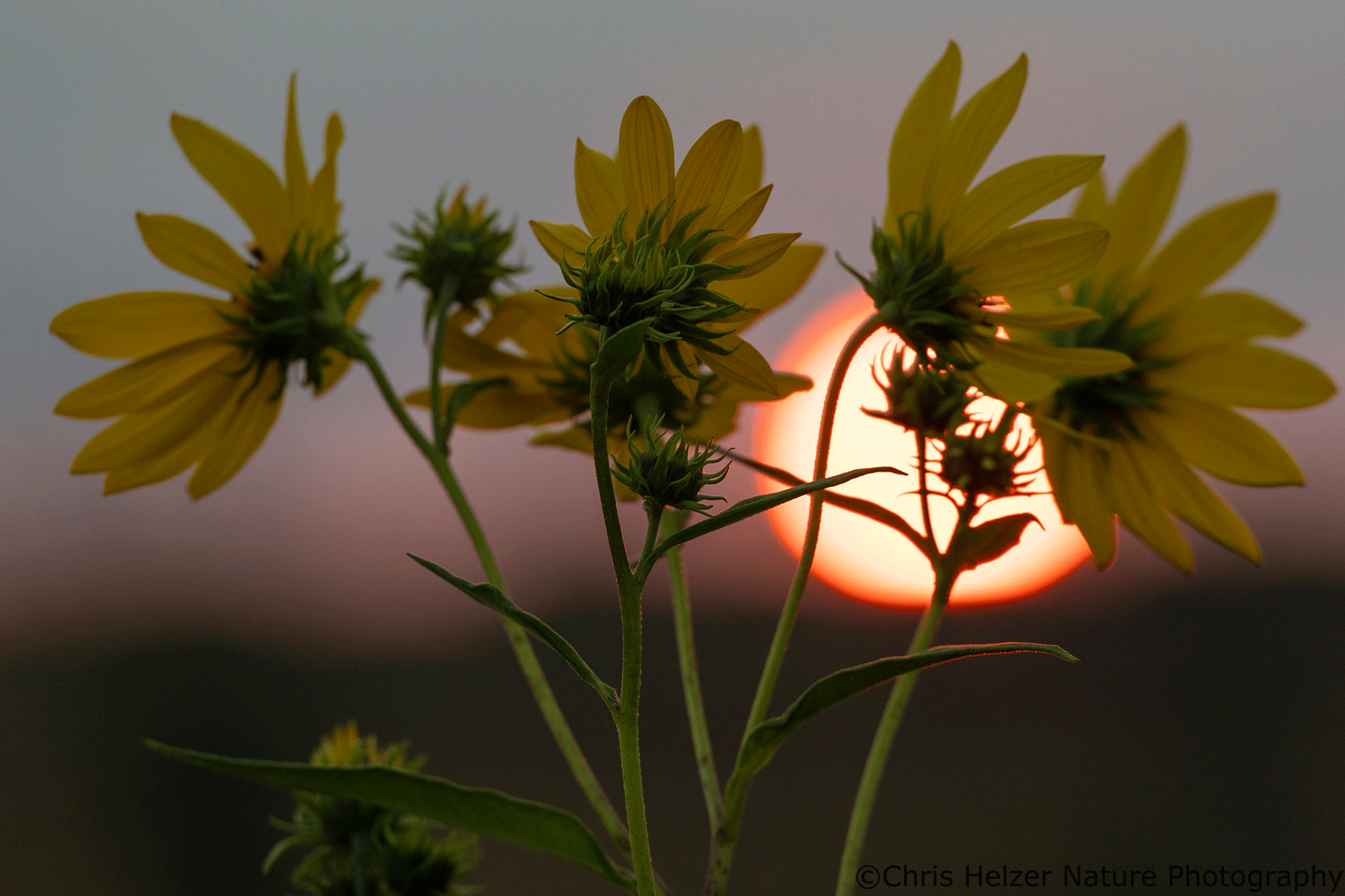
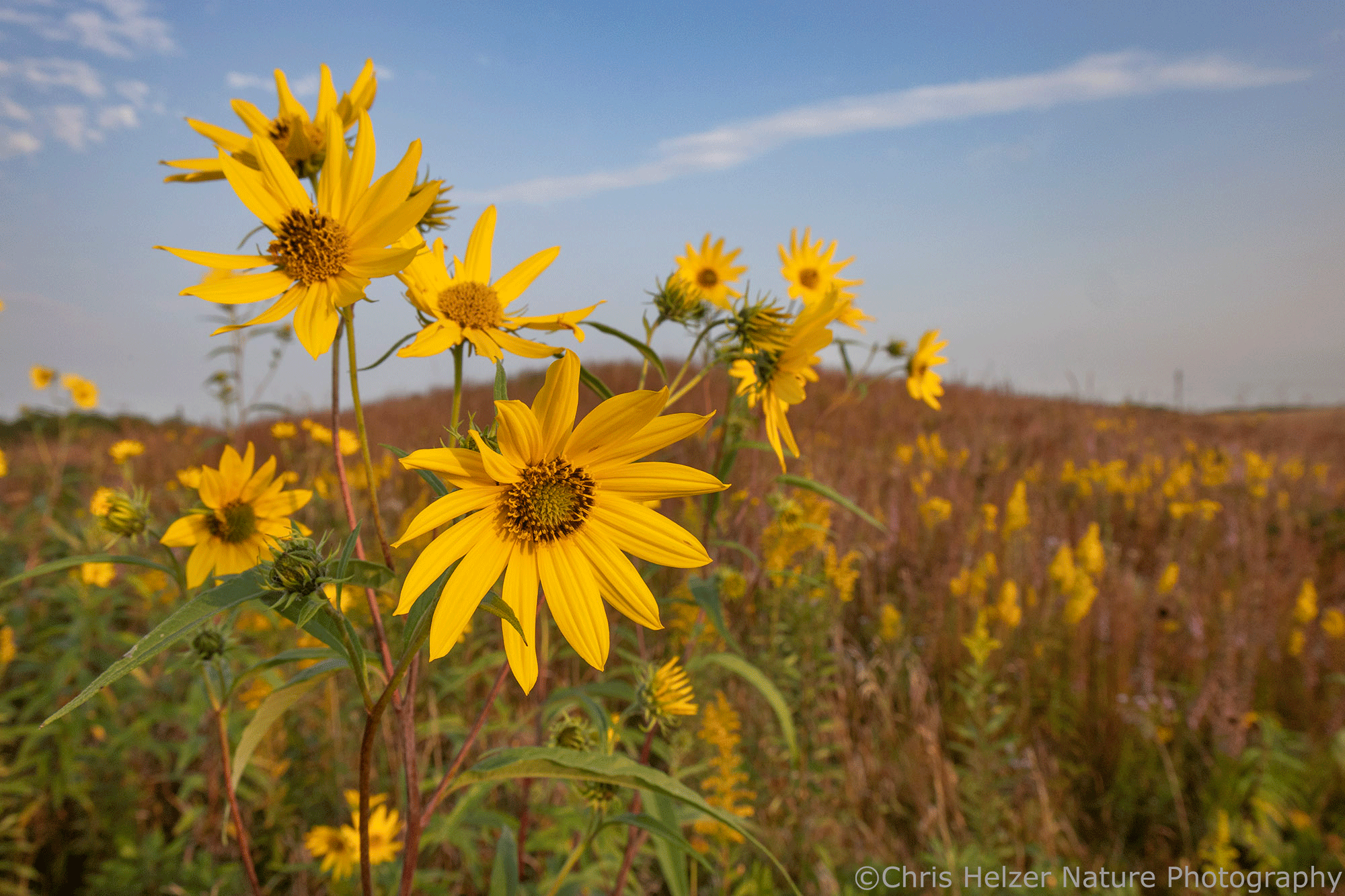
I’m losing the orange color in the plot, and it’ll be a while before Maximilian sunflower provides its late summer yellow, but I’m not worried about finding enough to photograph during the next few weeks. In fact, I’m more worried about all the action I’ll miss during my week-long vacation coming up, during which I’ll be out of town and unable to keep tabs on all my friends!