Hubbard Fellowship Blog: Ant Swarm (and Lunch)

This post was written by Evan Barrientos, one of our Hubbard Fellows.  Evan is a talented writer and photographer and I encourage you to check out his personal blog. If you would like to see more of his photographs, you can follow him on Facebook.

Don’t worry, I didn’t eat a swarm of ants. But late last September while I was harvesting seeds I did notice enormous clouds of small flying insects swarming above the prairie. The swarms were constantly shifting shape but they were roughly the size of small cars slowly floating across the land. Intrigued, and slightly mesmerized, I walked directly beneath one.

09282015_nebraska_6622

Closer up I could see that the mystery insects had very narrow waists, which suggested that they might be in the order Hymenoptera (ants, bees, and wasps). Their brown color made me think they might be flying ants.

09282015_nebraska_6637

Then I began to notice several individuals crawling in the grass below the swarm. Some were caught in spider silk; not complete webs, but loose strands of silk. Looking around, I realized that there were dozens of silk strands scattered among the grasstops of the prairie. As I knelt to photograph one ensnared ant, I saw a small jumping spider stalking another. The spider crept up, grabbed the ant, and carried him away for lunch. Were these silk strands deliberate traps set by the jumping spiders or were they just remnants of ballooning juvenile spiders that happened to catch the ants? I still don’t know.

09282015_nebraska_spiderwasp-1

Later, I sent the photo below to James Trager, an ant expert, and learned that these were in fact flying ants, Myrmica americana to be specific. It still AMAZES me that there are people who can identify insect species  from just one photo!  He explained that there are actually three different species that currently are all called M. americana because two have not been officially named yet. The unnamed species I encountered is very common, which shows how much we still have to learn about even the insects in our backyards.

09282015_nebraska_6748

Not only did Trager know the species’ name, but also the explanation for their hypnotic swarming behavior. When it’s time for M. americana to reproduce,  winged males swarm together, forming what’s called a lek.  Reproductive females are drawn to the spectacle and watch from the leaves below. Males will periodically descend from the swarm to crawl around in search of females to mate with (or get snagged by spiders). If a male is lucky enough to avoid the predators below, he may find a female to copulate with. But the challenge doesn’t end there. Once a male begins copulating, dozens of other males will often swoop in and try to do the same, forming what’s called a “mating ball.” After the whole fiesta has ended, the female pulls out her wings (so that she can convert her wing muscle into food to feed her offspring via glandular secretions) and walks away in search of a place to start her own colony.

Finally, here’s a video of the lek, first at full speed, then in half-speed slow motion.

My Long Irrational Nightmare is Over. Sort of. Nevermind.

Many of you are familiar with one of the great disappointments in my life.  I know you’re familiar with it because you take great delight from bringing it up in conversation when I see you in person.  I can’t count the number of times I’ve been introduced to someone at a conference or other event, and as I shake their hand, they smirk and ask, “Have you seen an otter yet?”

And I always answer “no.”

This is despite the fact that I have spent more than 20 years working along the Platte River, where there are very high populations of river otters – especially in the stretch of river where The Nature Conservancy owns most of our land.  I see tracks, scat, and other sign of otters often.  Other staff, researchers, volunteers, neighbors, and (I assume) people just driving past on the interstate have all seen otters.  But I have not.

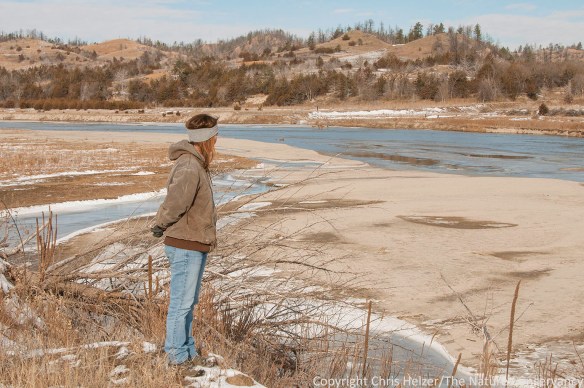
Well, I have an update on that situation.  During the week of Christmas, my wife Kim and I spent several days up at the Conservancy’s Niobrara Valley Preserve.  It was a combination work trip/vacation.  One morning, Evan Suhr, the Preserve’s land steward took us out to look at the results of last year’s grazing and fire treatments.  During the trip, we took a brief break and walked down to the river to see where Hazel Creek dumps into it.

Evan Suhr. Niobrara river in winter. The Nature Conservancy's Niobrara Valley Preserve, Nebraska.

Evan Suhr along the bank of the Niobrara River.  The Nature Conservancy’s Niobrara Valley Preserve, Nebraska.

As we stood on the river bank admiring the view, I heard the sound of soft ice cracking, looked up, and stared right into the face of a river otter.  Yes, really.

I had my camera in hand, but had my wide angle lens on, which was worthless for photographing wildlife.  I called out to Evan and Kim to look at the otter and fumbled around in my camera bag for my longer lens.  Before I could get the lenses switched, the otter dipped back below the surface.  A few minutes later, however, we saw it reappear just upstream, and a second otter head popped up next to it.  Unfortunately, there was a dead cedar tree partially blocking my view of the otters.  I stepped slowly and carefully around the tree, but just as I did, both otters disappeared again.  Kim managed to see the two of them once more before we headed back to the truck, but I didn’t, and never managed to get a photo.

So, how am I to feel about this?  First, defensive.  YES, I saw an otter.  I have two witnesses to back me up, as well as a photo of the hole through which the first one popped its head.  I don’t care what you say – I saw an otter.  Two, in fact!

Ice hole where an otter was a few seconds earlier...

This is the hole in the ice through which an otter head popped up.  I have witnesses.

Second, it was really cool to see those two otters.  After waiting so long, and enduring so much grief, the experience was even more sweet than it would otherwise have been.  We didn’t get to see them for long, but they were fairly close, and it was exciting.  It was especially nice that Kim and I both got to see them.

Third.  Now that I’ve moved beyond the initial thrill of seeing those otters, I can’t help slipping a little back into the kind of bitterness I’ve expressed about otters before.  Yes, I saw otters, but I still haven’t seen them along the Platte, where I’ve spent many years waiting and looking for them.  I also didn’t manage to get even a bad photo of them, despite the fact that I saw them twice and HAD MY CAMERA IN MY HANDS at the time.  I can’t help thinking this may be part of the broad otter conspiracy against me.  It’s almost as if the otters were afraid I was giving up on ever seeing them and decided it’d be a lot more fun to throw me a crumb and make me want the rest of the cake even more.

I know, I know.  I’m being completely irrational and ungrateful.  I know I should just enjoy the experience of seeing them and not worry about the fact that it happened on a different river or that I didn’t get a photo taken.  I also acknowledge that it’s unlikely (but not impossible!) that the otters of Nebraska are in any way conspiring against me.  I know all of that.  But I can’t help it.

Kim Helzer. Niobrara river in winter. The Nature Conservancy's Niobrara Valley Preserve, Nebraska.

Kim, being a normal and well-adjusted human, was ecstatic to see the otters and harbors no hard feelings toward them.  That, or she’s in on the plot.  I’m not sure.

Until I see an otter along the Platte River, I’m just not going to be satisfied.  Sure, I’ll do my best to enjoy my life otherwise.  My wife and kids are wonderful, I have a great job, and life seems very good.  It’s just not quite complete.  But sooner or later, those otters are going to slip up.  One of them is going to fail to notice that I’m there and it’ll pop out of the water with a fish in its mouth and start tap dancing on the bank – as they do when I’m not around.  But THIS time I’m going to be there.  With my camera.  And we’ll see who’s laughing then, won’t we??

Yes we will.