
I’m in Austin, Texas this week, attending a conference of science and stewardship staff of The Nature Conservancy from around the country. Ahead of the conference, I attended a field trip through portions of the Texas Hill Country near Austin. It was an excellent and thought-provoking tour. It’s always great to see other sites and talk to their managers about what they’re doing and why.
We spent Tuesday morning at the Conservancy’s Barton Creek Preserve, about 4,000 acres of rocky hills near the west side of Austin. The site manager, Brandon Crawford, talked us through the ecology and management of the preserve. The most striking feature of the site to me was the lack of soil. Most (all?) of the Hill Country has a legacy of serious overgrazing – first by cattle, and then by goats after the land would no longer support cattle. Many years of that mistreatment resulted in a loss topsoil from the hills, leaving a shallow-soiled landscape with even less soil and vegetation than before.

Many years of chronic overgrazing and subsequent erosion of topsoil led to the kind of sparsely vegetated terrain on the hills of the Barton Creek Preserve.
The tops of the hills at the Barton Creek Preserve are dominated by shrubby species such as mountain laurel, along with scattered live oak trees and Ashe junipers (similar to eastern red cedars). Growing around and between those woody plants was little bluestem, along with gramas, dropseeds, and a variety of wildflower species. It was striking to realize that the Barton Creek Preserve receives about the same annual rainfall as our Platte River Prairies back in Nebraska – our sites look incredibly lush compared to the almost desert-like appearance of the Hill Country grasslands.
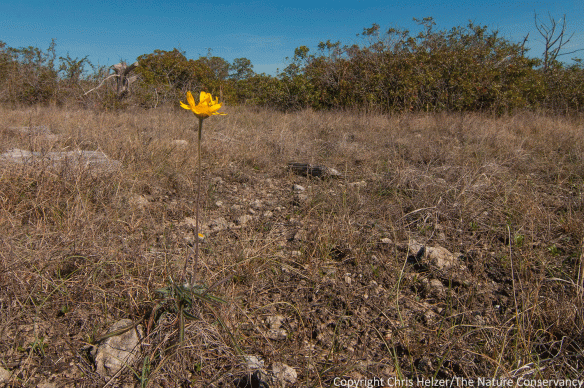
It was a pleasant shock for a Nebraska ecologist to walk around Texas prairies in 80 degree February weather and see blooming flowers. The temperatures are above normal in Nebraska this week, but it’s going to be a while before we start seeing flowers in our prairies.
The shallow soil and sparse brushy habitat at the Barton Creek Preserve supports the black-capped vireo, a federally-listed endangered species that nests in low shrubs. Brandon works to maintain that shrubby habitat structure by using prescribed fire and mechanical cutting to keep the Ashe juniper from becoming too dominant in uplands. It’s not an easy job – especially given that prescribed fire is tricky when you’re surrounded on all sides by housing developments – but it is very different from the kind of ecological management I’m more familiar with. Brandon focuses mainly on creating habitat structure for vireos, but he’s also helping out a number of other animal and plant species that continue to scrape out a living in the hills.
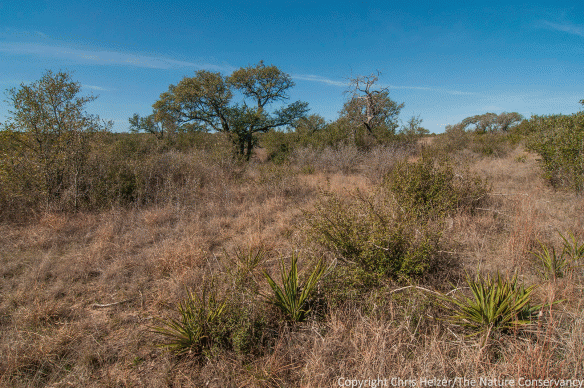
This area was recently cleared of juniper to create the kind of habitat structure needed by black-capped vireos.

I was really surprised to see numerous (relatively fresh but empty) snail shells on the dry rocky hills of the Barton Creek Preserve. Apparently, Brandon’s habitat work supports more than just birds.
Down the slope from the hill tops, much of the Barton Creek Preserve is covered by a kind of “old growth” woodland dominated by live oaks and Ashe junipers. That woodland is home to another endangered bird species – the golden-cheeked warbler. Brandon told us the warbler needs about a fifty-fifty mix of oak and juniper in its woodland habitat, with about 95% canopy cover. So while junipers can cause problems for the vireos on the hilltops, they are a critical piece of the habitat for the warblers on lower portions of the preserve. At this point, Brandon isn’t using much prescribed fire in those woodland areas, though he’s considering it, and is watching the results of other similar sites where managers are experimenting with low intensity fires that clean out the surface layer beneath oaks and junipers without killing the bigger trees.
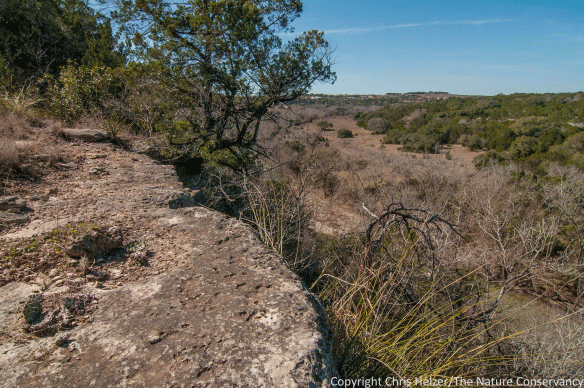
A rocky overlook above Barton Creek. The woodland in the top right corner of the photo is where the golden-cheeked warblers make their homes.
At our Platte River Prairies and Niobrara Valley Preserve in Nebraska, our management is aimed at creating a shifting mosaic of habitat types and maintaining plant diversity. By moving fire and grazing intensity around our sites each year, we always provide a variety of habitat types, and we measure success by the diversity of plant and animal species we support. By contrast, Brandon’s role at Barton Creek is to manage the structure of two distinct and static habitats – hill tops and lower slopes – and his success is primarily measured by whether or not he’s supporting two endangered bird species. He’s providing habitat for many other organisms too, of course, but in that fragmented ecosystem surrounded by housing developments, just keeping those birds alive is a pretty good accomplishment.
Good land management starts with clear objectives. Without them, it’s not possible to measure success. I’ve met a surprising number of land owners and managers who can’t clearly describe what they’re aiming for on their property. I’m not sure how they know what to work on each day. Although Barton Creek Preserve has very different objectives from the ones we’ve set for our prairies in Nebraska, the objectives fit the site and it was interesting to learn about how Brandon is working to meet them. The people in and around Austin (not to mention the warblers and vireos!) are lucky to have Barton Creek Preserve in such good hands.

Ecologists and land managers from around The Nature Conservancy traded ideas as Brandon (black cowboy hat) showed us his work at Barton Creek Preserve.


