We had a winter storm pass through our area at the tail end of the Thanksgiving weekend. After a light coating of ice, we got a couple inches of fluffy snow. Monday was a gloomy overcast day – too dark to inspire me to venture out with my camera. However, Tuesday morning began with a beautiful sunrise and calm winds. A fantastic opportunity for winter prairie photography. Unfortunately, I had to enjoy the light from the interstate as I drove to a meeting. Wednesday was another great sunrise and morning of light, but I was on the road again – heading to a different meeting. Yesterday, most of the snow melted and, just like that, the first snow of the year was gone. Not a single photograph taken…
So, instead of posting a beautiful photo of fluffy snow on the prairie today, I’m reaching back to a photo from August.
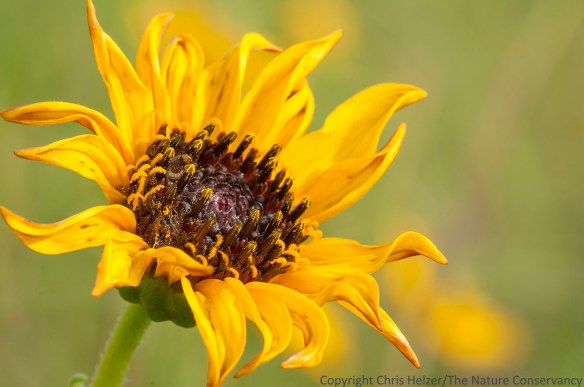
Stiff sunflower (Helianthus pauciflorus) Lincoln Creek Prairie, Aurora, Nebraska. Click on the image to see a larger version – and maybe the hidden visitor on it.
I like this photo of a stiff sunflower for several reasons, including the interesting shapes of the ray flowers (“petals”) that are not yet fully extended. However, I also like the photo because there is a hidden visitor on the flower that I didn’t see until well after I took the photo. Can you see it?
Here is a cropped version of the image to give you a better look.
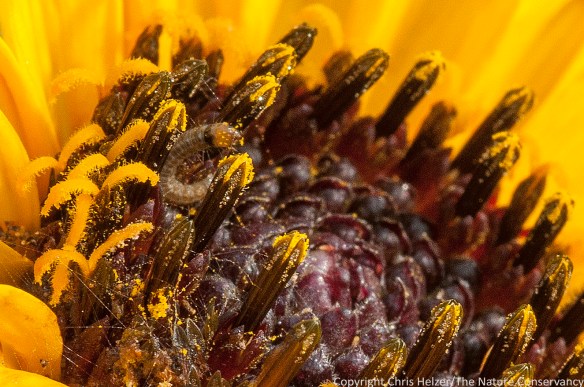
Can you see the tiny larva feeding on pollen?
I don’t know what this little larva will grow into, but it appears to be feeding on pollen and stringing lines of silk between anthers as it moves. I featured a similar larva in an earlier post that showed a sunflower which had been “sewed shut” by silk – probably as a protective measure to allow the larva to feed on the flower under cover. I wonder if this larva will follow the same procedure as it gets bigger and can’t hide as easily out in the open.
Interestingly, the photos from that earlier post featuring the “seamstress larva” were taken on the same day as the photo in this post. In fact, I took the photo of the tiny larva just a few minutes after photographing the sewed-up flower. You’d think I’d have been on the lookout for larvae on sunflowers, but I still missed it, even through my macro lens. Then, I missed it again as I worked up the photo later, even as I was looking closely at it on the computer to adjust sharpness, etc. I guess that’s a testament to the effectiveness of the hiding strategy of this little larva!
I hope its camouflage allowed the little larva to grow up, pupate, and have lots of offspring to carry on its strategy. I bet it did.