I’m getting excited about this upcoming field season. For the first time in several years, we’re going to be attempting to harvest seed from as many prairie plant species as we can. Between about 1997 and 2005, we spent much of each field season hand-picking seeds from a broad diversity of species – often ending up with over 200 species by the end of the season. It was exciting and fulfilling, and we were often able to create up to a couple hundred acres of new prairie habitat each year. Since that time, we’ve focused less on converting cropland to high-diversity prairie (we ran out of cropland!) and more on harvesting large amounts of fewer species to overseed degraded prairies. I’m not sure we’ll be able to harvest as many as 200 species this summer – we’re pulled in many more directions now than we were in our “glory years” of seed harvesting – but making the attempt will be fun.

A clonal patch of bracted spiderwort (Tradescantia bracteata) in a 2002 prairie planting. It isn’t hard to find these patches (when they’re blooming) despite the fact that we had only about 1 cup of seed spread over about 70 acres.
During those glory years, we worked hard to build the most diverse seed mixture possible. We used to joke about how many seeds we had to get from a plant species before we could add it to that year’s harvest list. It kind of felt like cheating when we’d only find a handful or two of seeds from a species but would add it to the list anyway. However, we justified listing those species because of conversations with people who had much more experience than we did (especially Bill Whitney with Prairie Plains Resource Institute) who claimed that even a few seeds would usually be enough to establish a species in a new prairie. Besides, we figured if the species was appropriate to the site, tiny populations would spread out over time.
Now that I’ve had up to 17 years to watch the establishment of plantings I personally harvested seed for, I can testify that Bill and others were right. Sometimes, just a few seeds really are enough. That knowledge is awfully good for morale when we’re on our hands and knees searching for violet or pale poppy mallow (Callirhoe alcoides) plants to harvest from. Those are just two or many examples of plants that are short, have widely scattered populations in our prairies, and are difficult to find at seed harvest time because the surrounding vegetation has grown tall enough to obscure them from sight. To make things worse, neither of those species produces many seeds per plant, so even when you find a plant, you might only get 20-50 seeds out of it. Knowing that those 20-50 seeds are worth finding makes crawling on hands and knees seem much less tedious. Ok, a LITTLE less tedious.

Violets are difficult to find after they are done blooming. Even when you find them, each plant produces few seeds (and you have to get them before the pods pop open and toss the seeds away…)
Last week, I finally found time to finish data entry from my 2014 plant community monitoring of some of our restored prairies. Looking through the long-term data trends, it was gratifying to see hard evidence that small amounts of seed really do turn into robust plant populations. Here are a few examples. (Warning: this next portion of the post includes actual graphs of actual data. If you are turned off by graphs or data, please skip to the last paragraph now.)

Data from a mesic restored prairie with sandy/loam soil and scattered sand ridges.
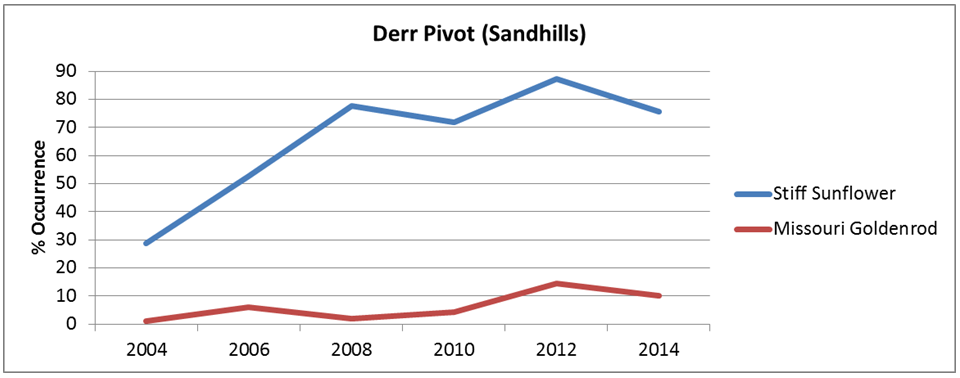
Data from an upland sandhills restored prairie.
In the above two graphs, similar trends can be seen for populations of stiff sunflower (Helianthus pauciflorus) and Missouri goldenrod (Solidago missouriensis). These data were collected from approximately 100 1×1 m plots across each site, and the graphs show the % of plots within which each species was present. The top site (mesic) was sampled annually and the bottom (sandhills) was sampled every other year.
It might look as if Missouri goldenrod is a rare plant in these prairies, but remember that in order to show up in more than a couple 1×1 m plots, it has to be fairly abundant. Stiff sunflower, on the other hand really is ubiquitous. Interestingly, only about 3 gallons of fluffy/stemmy Missouri goldenrod seed was in the mix for the 70 acre mesic site and 10 gallons for the 110 acre sandhill site. About 5 gallons of sunflower seed (still in hulls, with some stems included) was planted in the sandhills and 3 gallons in the mesic site. Both are fairly respectable amounts of seed given that they were hand harvested, but they were spread pretty thinly across 180 acres.

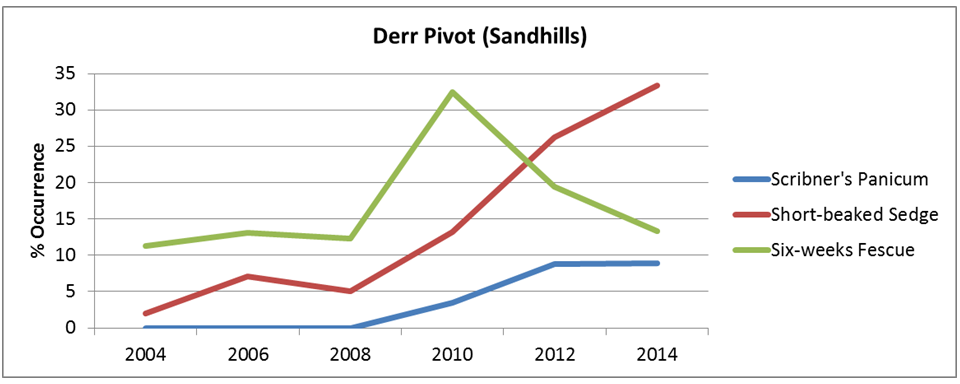
The second two graphs (above) show two perennial species, a grass named Scribner’s panicum (Panicum oligosanthes) and the short-beaked sedge (Carex brevior), as well as the annual grass six-weeks fescue (Vulpia octoflora). The two perennials seem to be on a slow steady climb in abundance across both sites, which is excellent. Meanwhile, the annual appears to be doing what annual plants should do, which is to flourish during periods when competition from surrounding plants is temporarily suppressed. We had harvested very little seed for all three of these species that year, so it’s gratifying to see that they are becoming part of the established plant community. Specifically, we had:
– only 7 cups (!) of seed for the short-beaked sedge across 180 acres (both sites combined).
– about 2 gallons of stemmy seed for Scribner’s panicum.
– 3 1/2 cups of six-weeks fescue (tiny seeds) for the sandhills and 1 cup for the mesic site.
I knew we hadn’t collected much seed for these species, but I was still surprised by how little we’d had when I went back to check the records. There are many other examples I could share of species that established very nicely (and/or are increasing over time) despite small amounts of seed in the planting mixture. Some of those species established fairly quickly, but most are slowly increasing in abundance, either through clonal (rhizomatous) growth or because each new generation of plants puts out more seed to spawn the next generation.

Fourpoint evening primrose (Oenothera rhombipetala) established well in our sandhills restoration despite less than 2 cups of seed planted on 110 acres. The biennial species is episodic in its abundance – just as it should be.
The seed we harvest this coming season will be planted on about 50 acres – far fewer than the 150-200 acres we planted each year before we ran out of cropland to restore. However, regardless of planting size, the major challenge is still to find and harvest seed from a diverse mixture of plant species. We’ll be digging out our old lists of species, harvest times, and notes about where the best plant populations can be found. Then we’ll strap buckets to our waists and start picking seeds. It should be a fun year!
…and on those days when we’re laboriously searching for tiny plants hidden beneath tall grass, we’ll remember that with seed harvesting, every little bit helps!
Click here for more information on prairie restoration in Nebraska.