As the year winds down, I’ve been looking back at some of my favorite photos from 2023. I’ve had a bunch of fantastic opportunities to travel around the central U.S. this year – sometimes for work and sometimes for fun. It’s also been a great year for photography close to home.
In today’s post, I’m sharing some of my favorite photos that came from right here in Aurora, Nebraska during the last year. Some are from my yard and others are from Lincoln Creek Prairie, which is about a mile across town from my home (and the site for my 2018 square meter photography project).
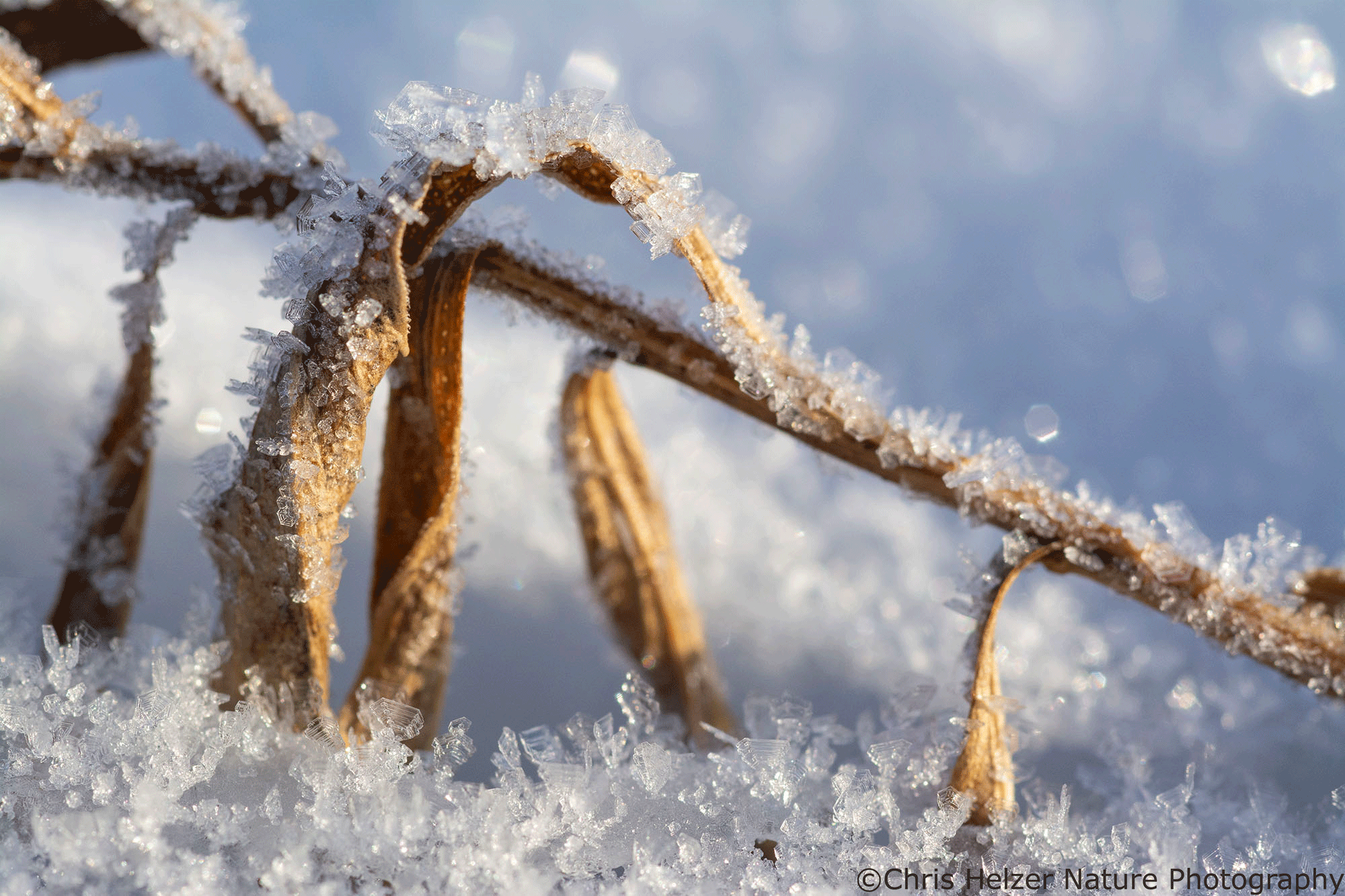
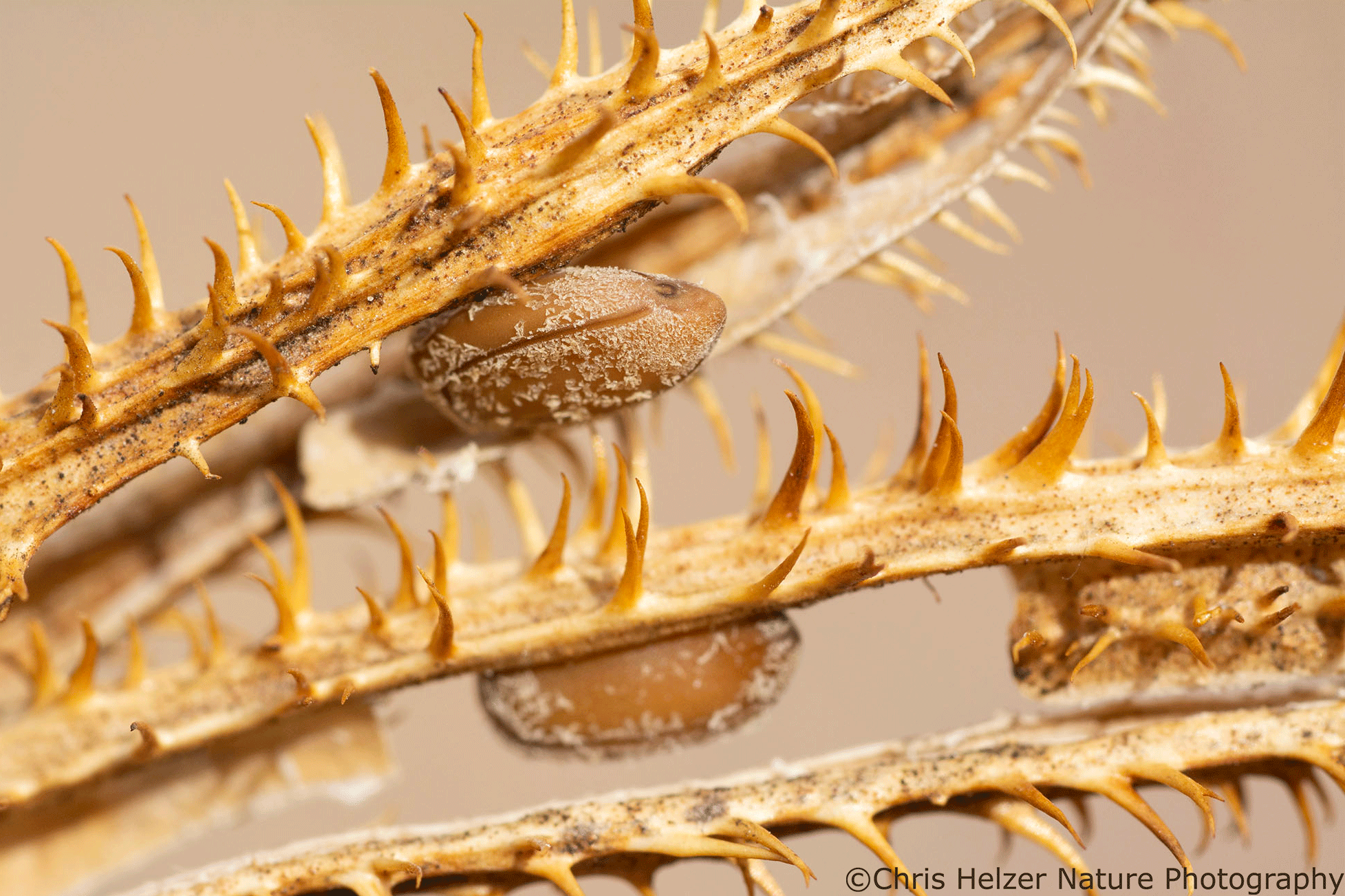
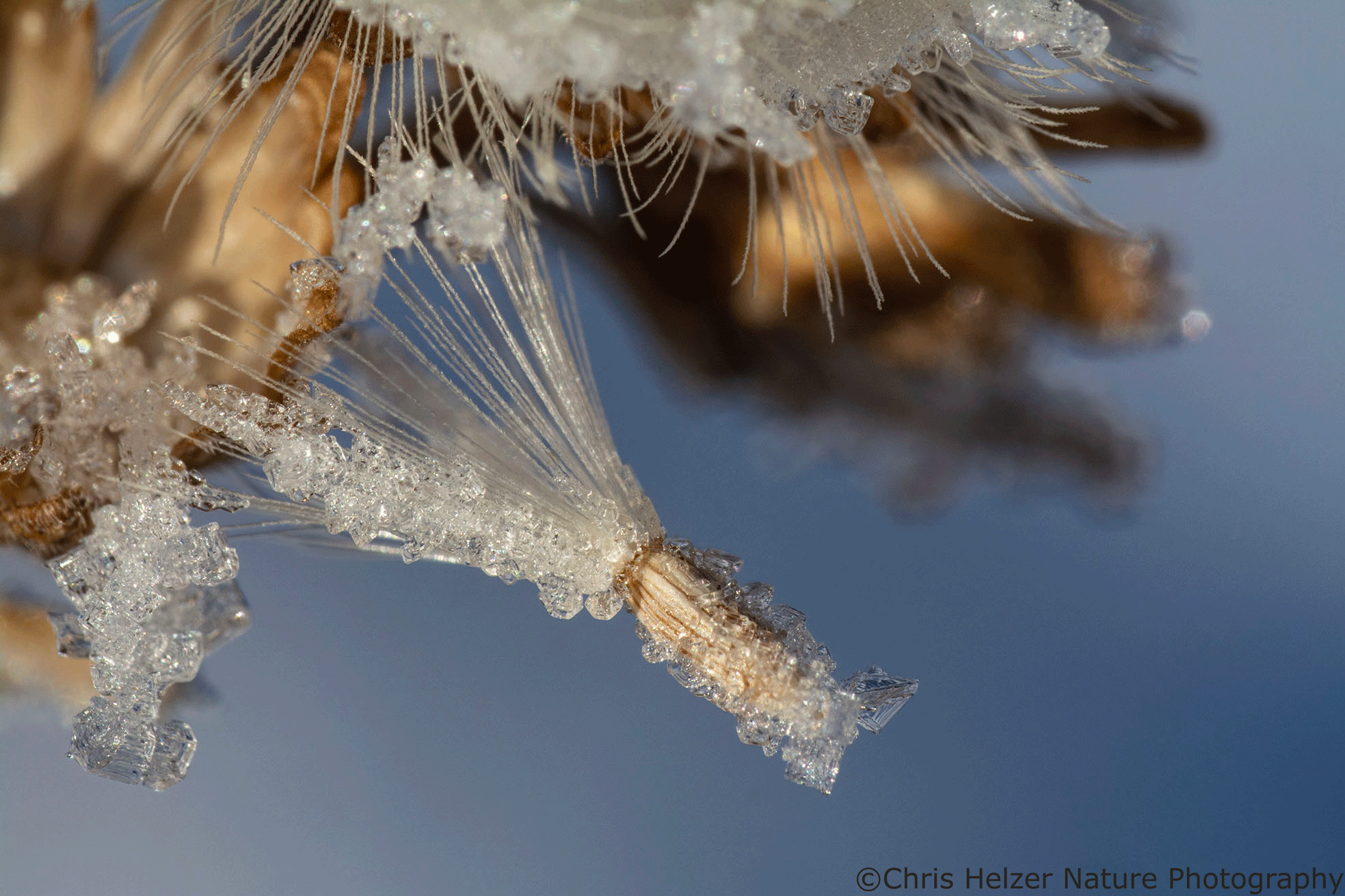
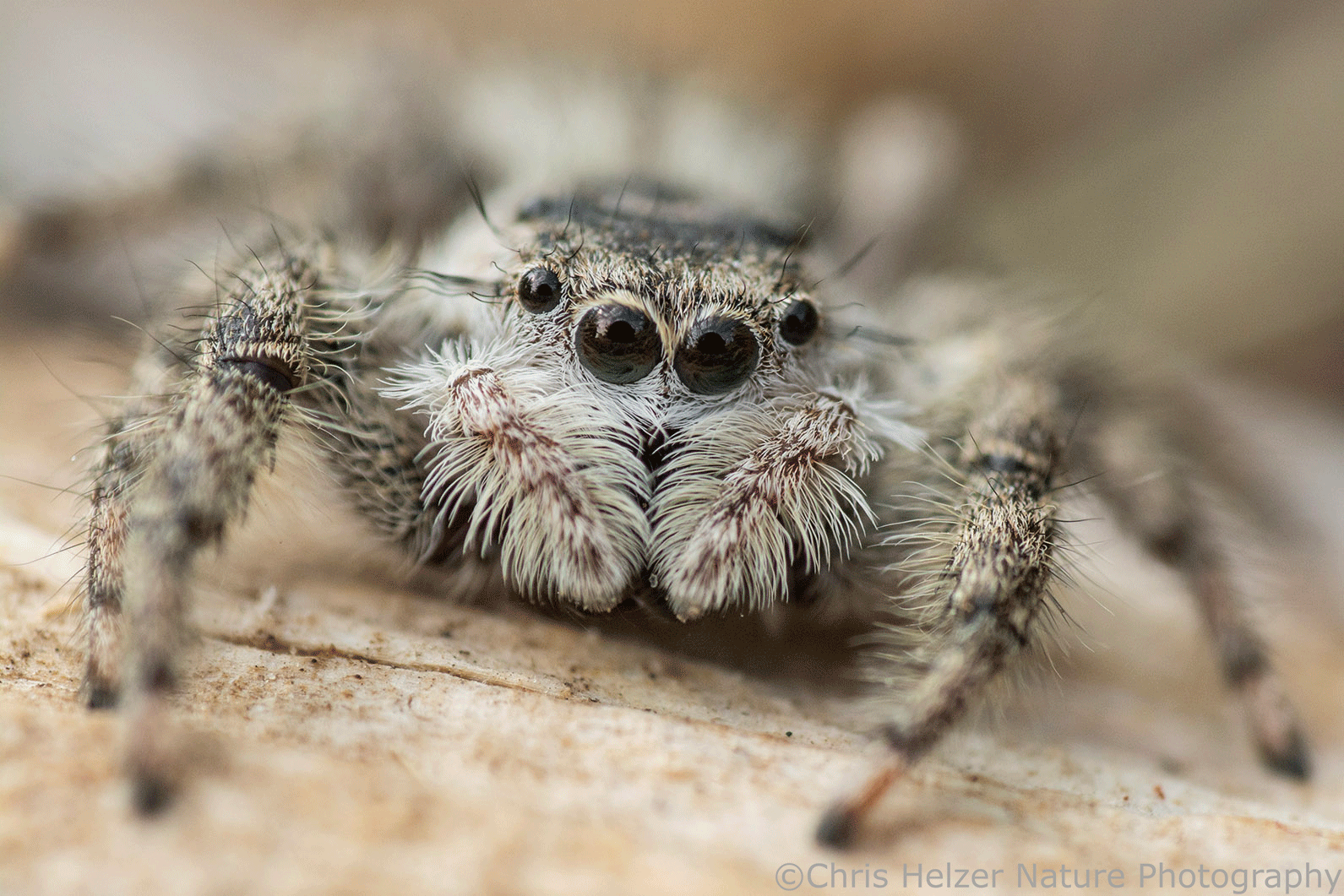
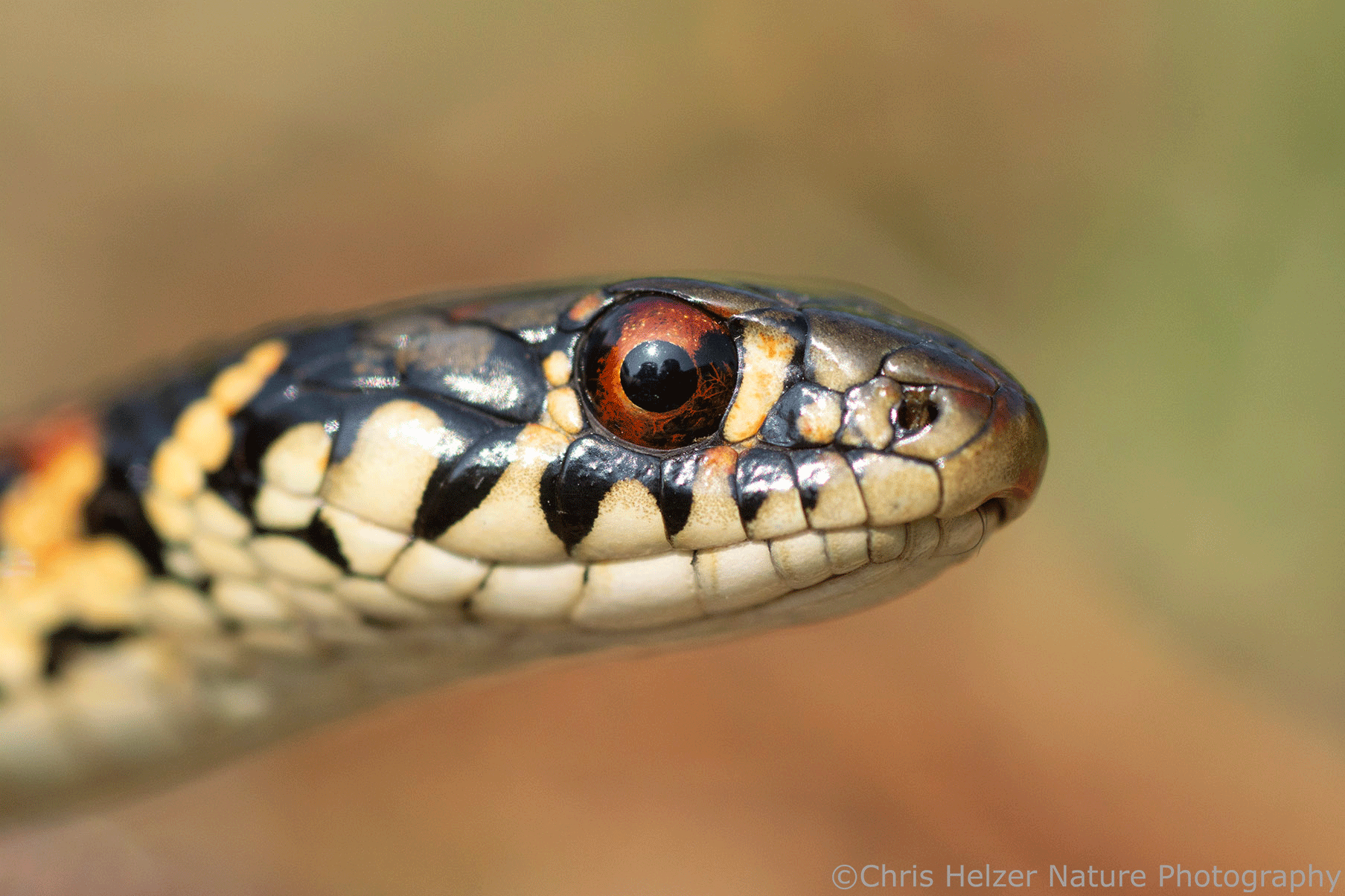
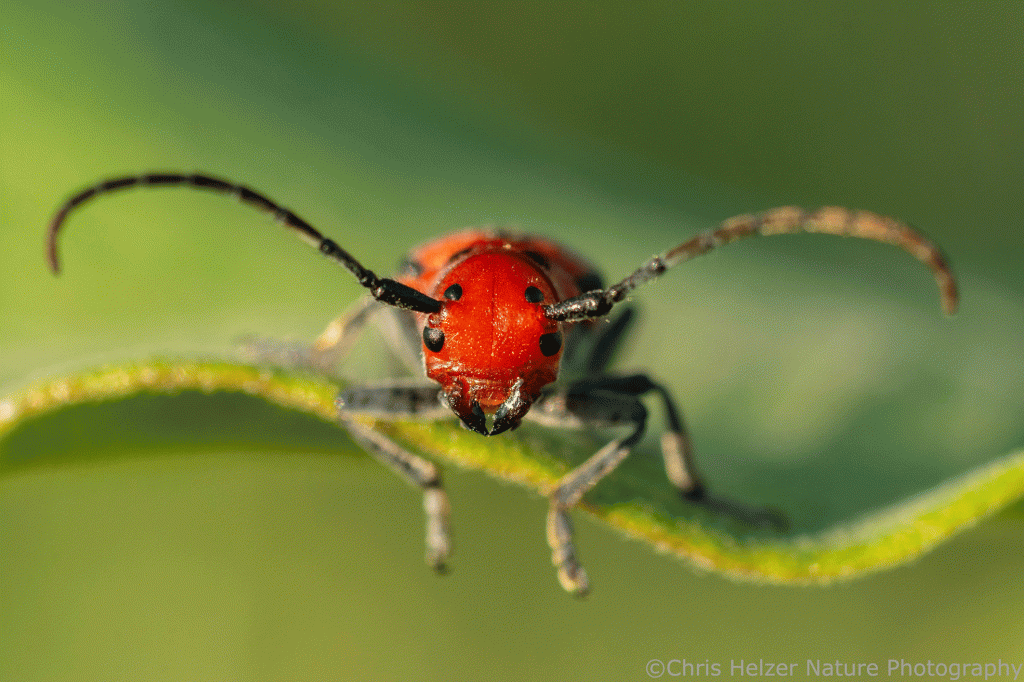
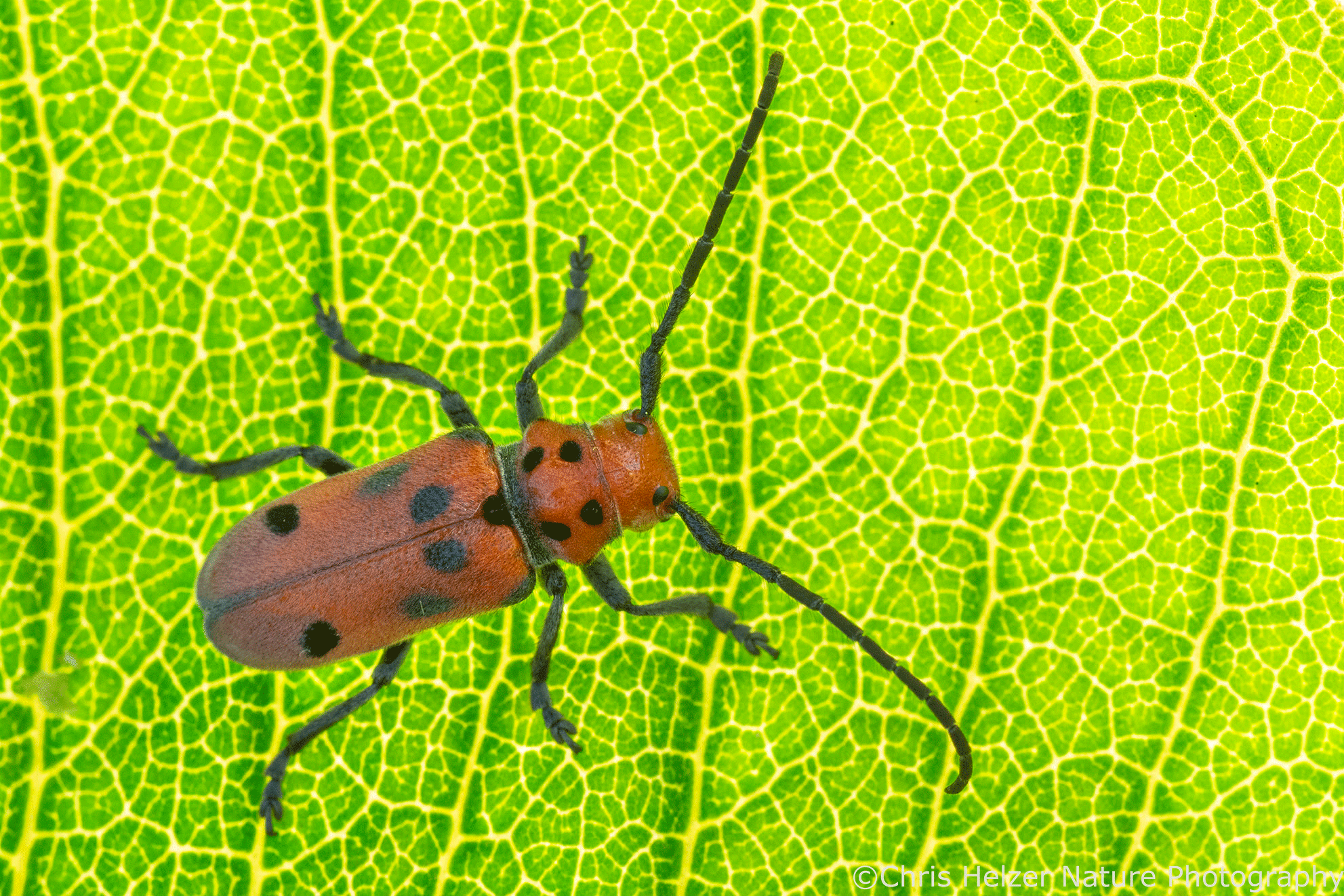
Goldenrod plant with frost and snow. Lincoln Creek Prairie. January 2023.Seeds and pods of sensitive briar (Mimosa quadrivalvus) at Lincoln Creek Prairie. January 2023.Stiff goldenrod (Solidago rigida) seed and frost. Lincoln Creek Prairie. January 2023.Jumping spider in my front yard. May 2023.Common garter snake (Thamnopsis radix) – red phase – in my yard. June 2023.Red milkweed beetle (Tetraopes tetrophthalmus) at Lincoln Creek Prairie. July 2023.
Red milkweed beetles are hard for me to pass up. For one thing, they often sit nicely for photos, which is handy. More importantly, they’re just interesting-looking creatures, with their long antennae and bright red bodies. It looks like they have four big eyes on their face, but that’s actually because their two primary eyes are bisected by the bases of their antennae! The three milkweed beetles shown here were all photographed on the same day.
Another red milkweed beetle at Lincoln Creek Prairie. July 2023.I liked the way the milkweed leaves formed a staggered series of panels in the background of this red milkweed beetle photo. July 2023.
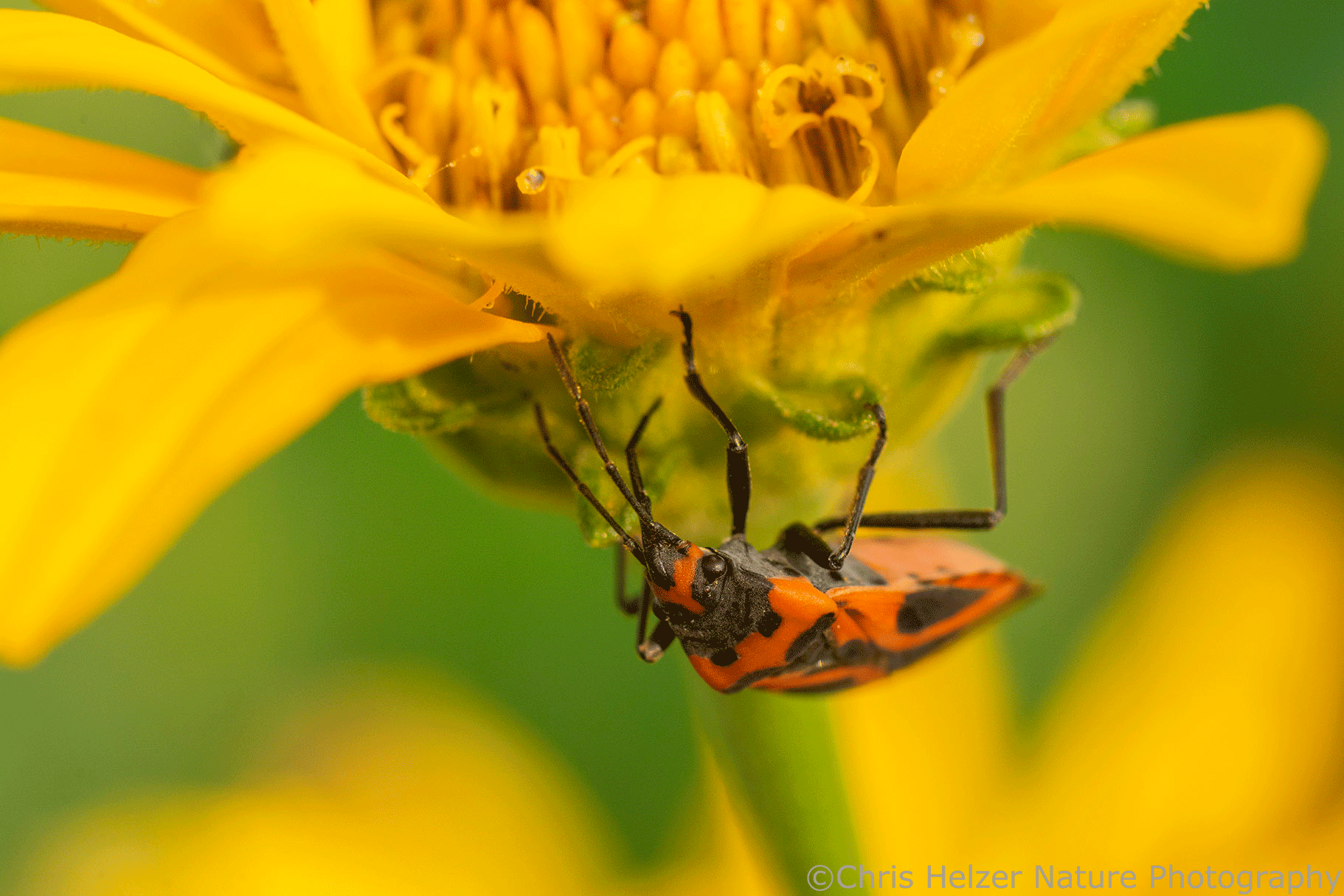
Back in July, I wrote a half-serious post about the unfairness of naming plants and animals “false” something-or-other just because they happened to look kind of like another species. I used the false milkweed bug and its favorite food source, false sunflower, as examples. At the end of the post, I suggested better names for the two species: spark bug and fab-u-lous ox-eye. The photo below features both species.
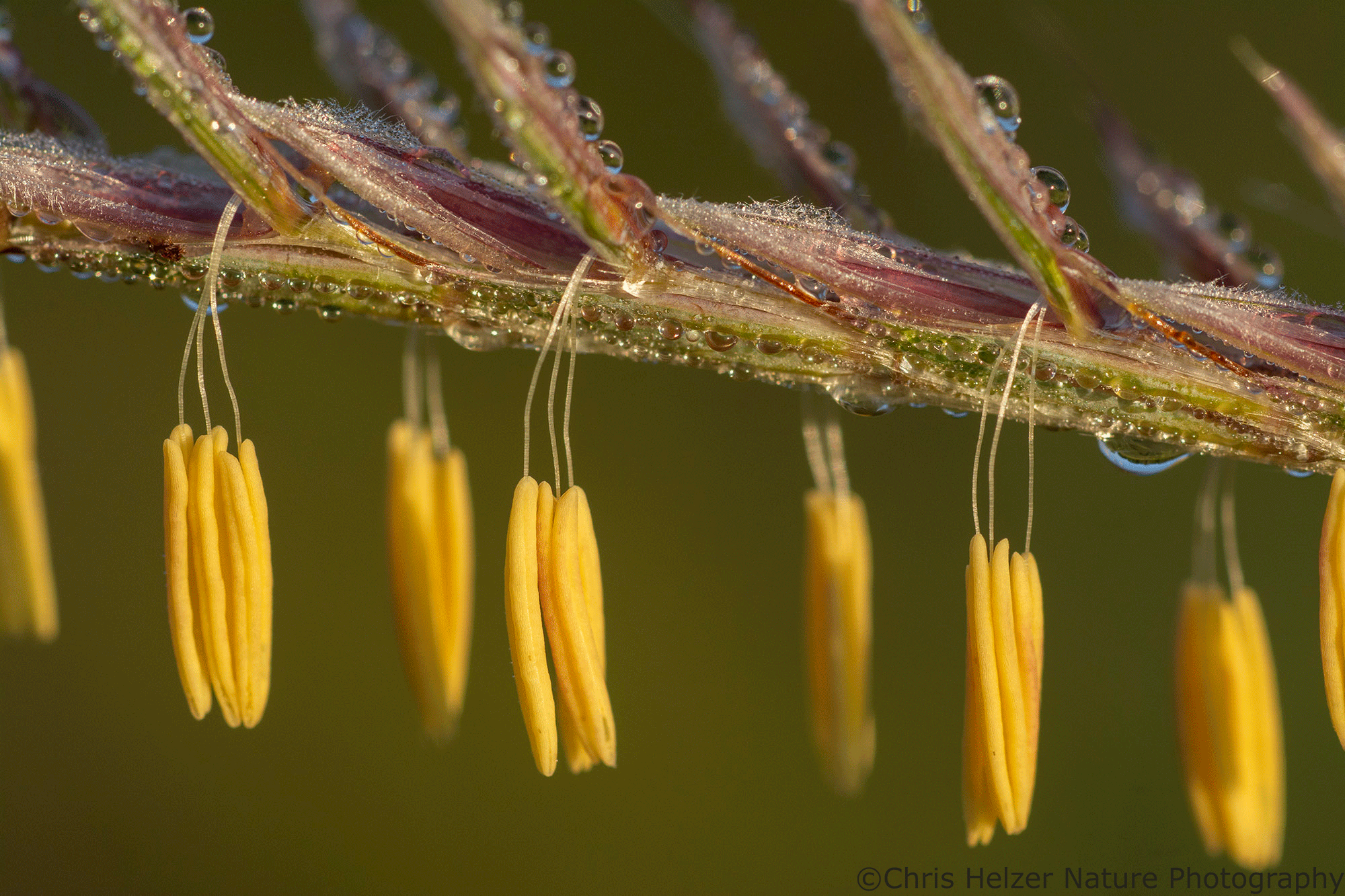
A ‘spark bug’, aka false milkweed bug (Lygaeus turcicus), on ‘fab-u-lous ox-eye’ (Heliopsis helianthoides), it’s favorite plant to feed on. Helzer yard. July 2023.Big bluestem flowers (Andropogon gerardii) at Lincoln Creek Prairie. August 2023.
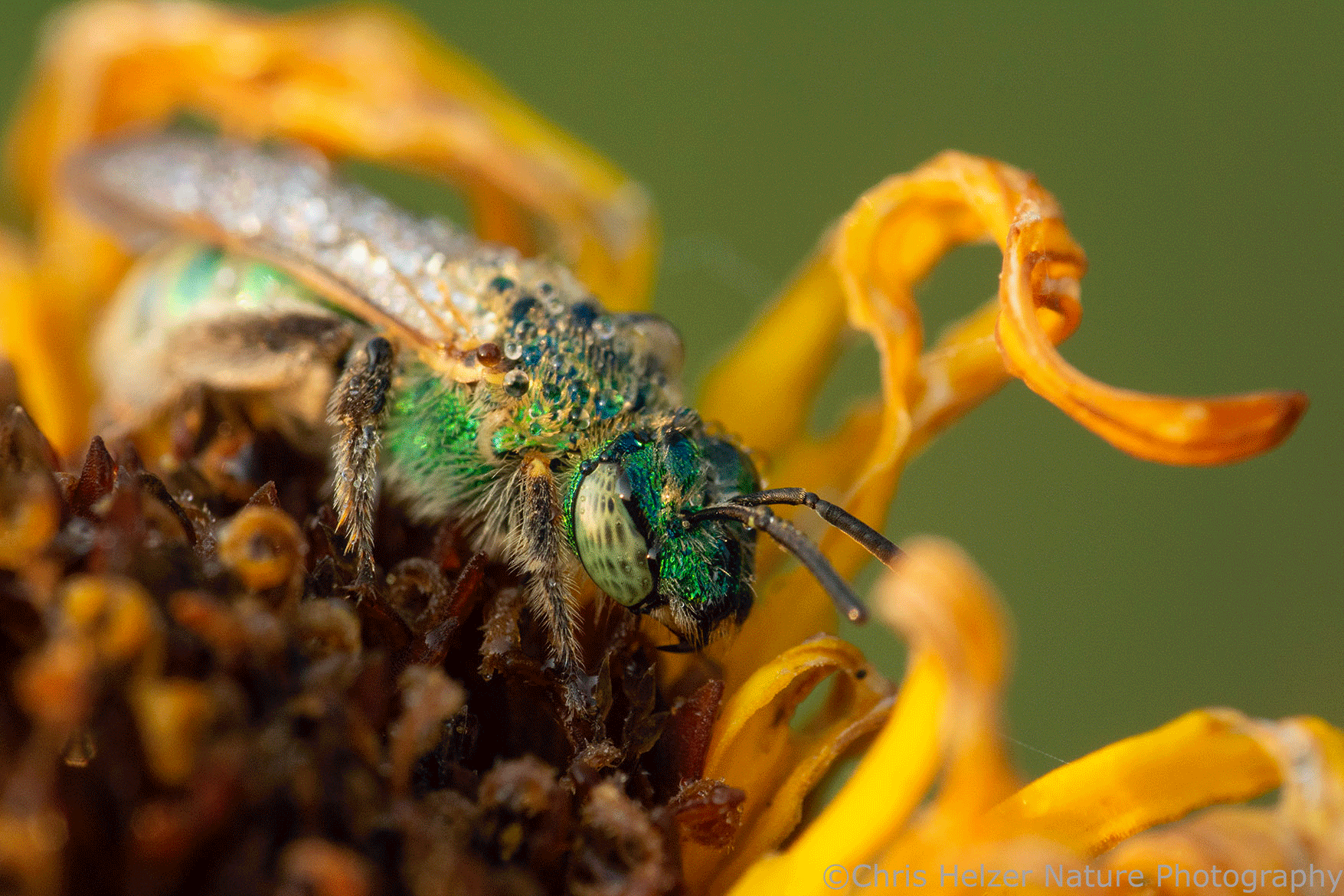
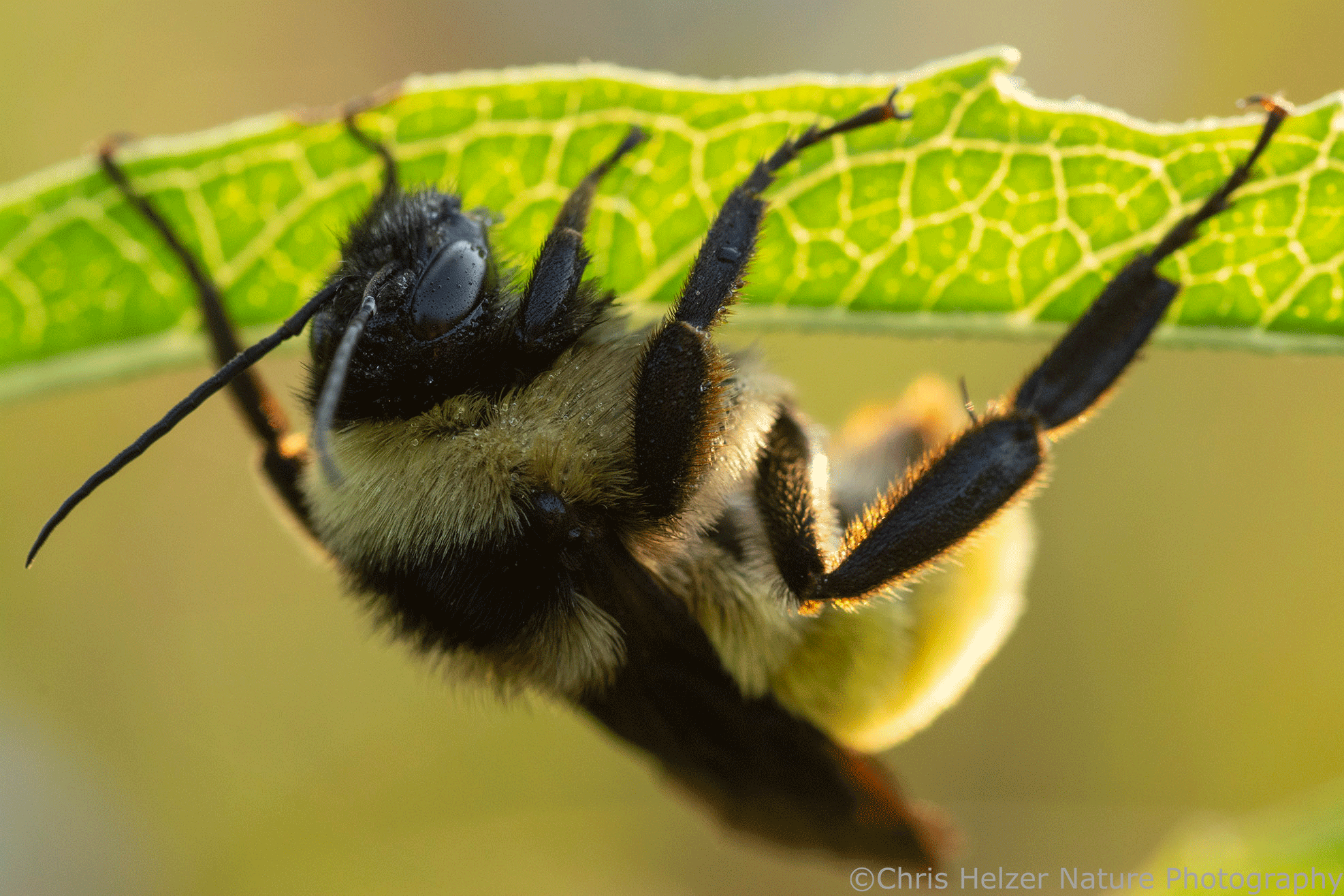
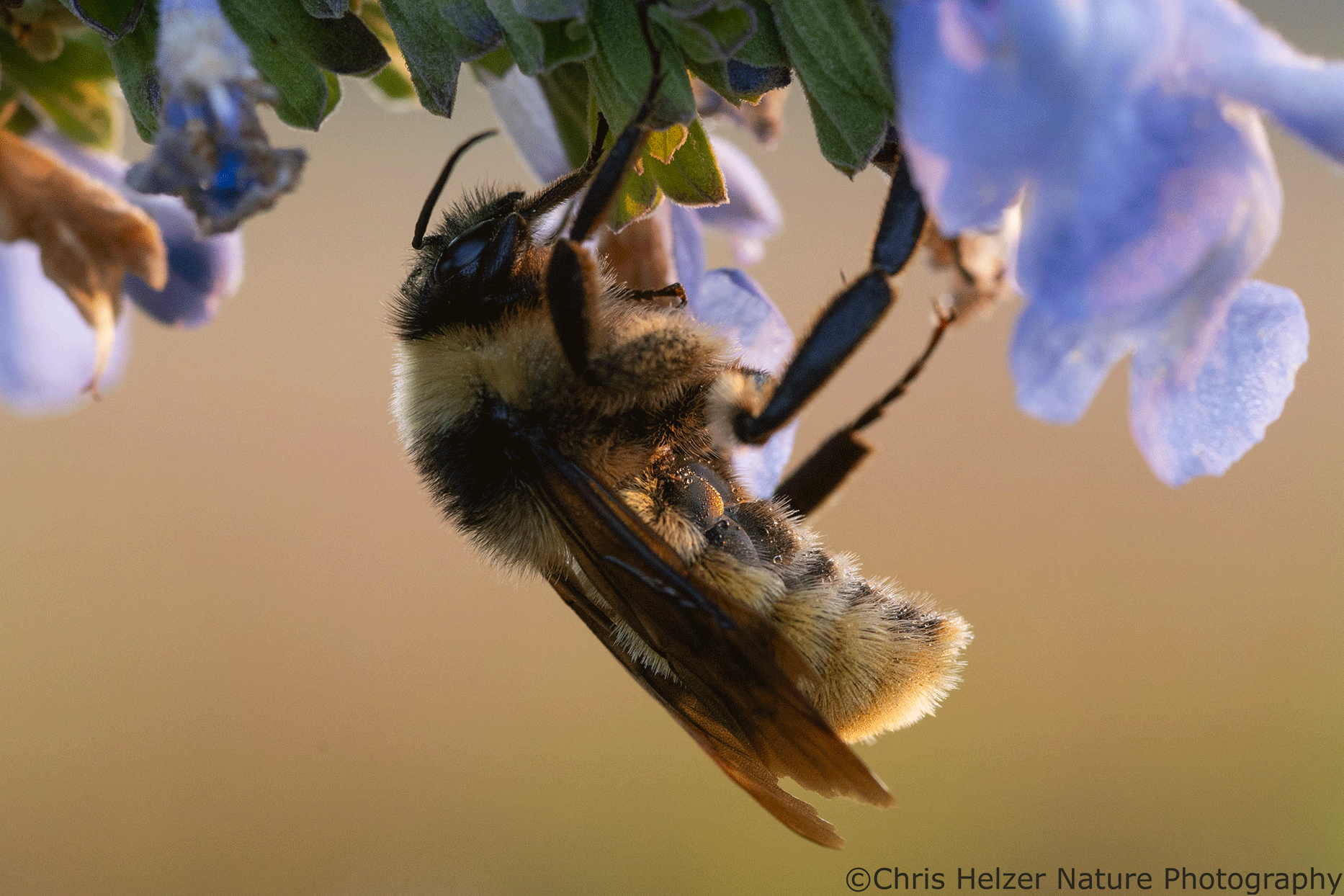
Waking up in the morning to photograph bees on their overnight roosts, often covered in dew, is one of my favorite activities. I had a lot of those photo opportunities this year, but here are three I really liked from Lincoln Creek Prairie.
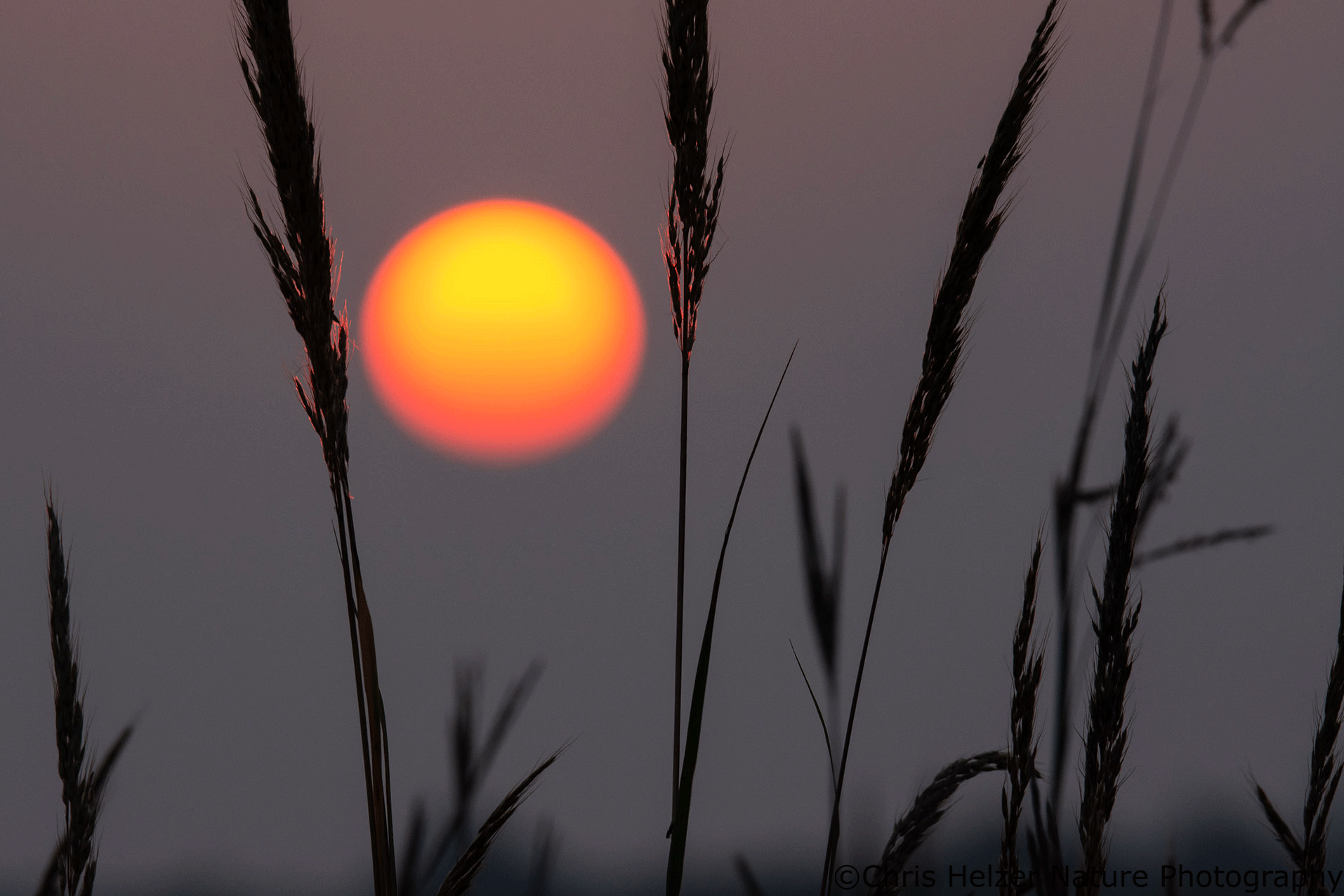
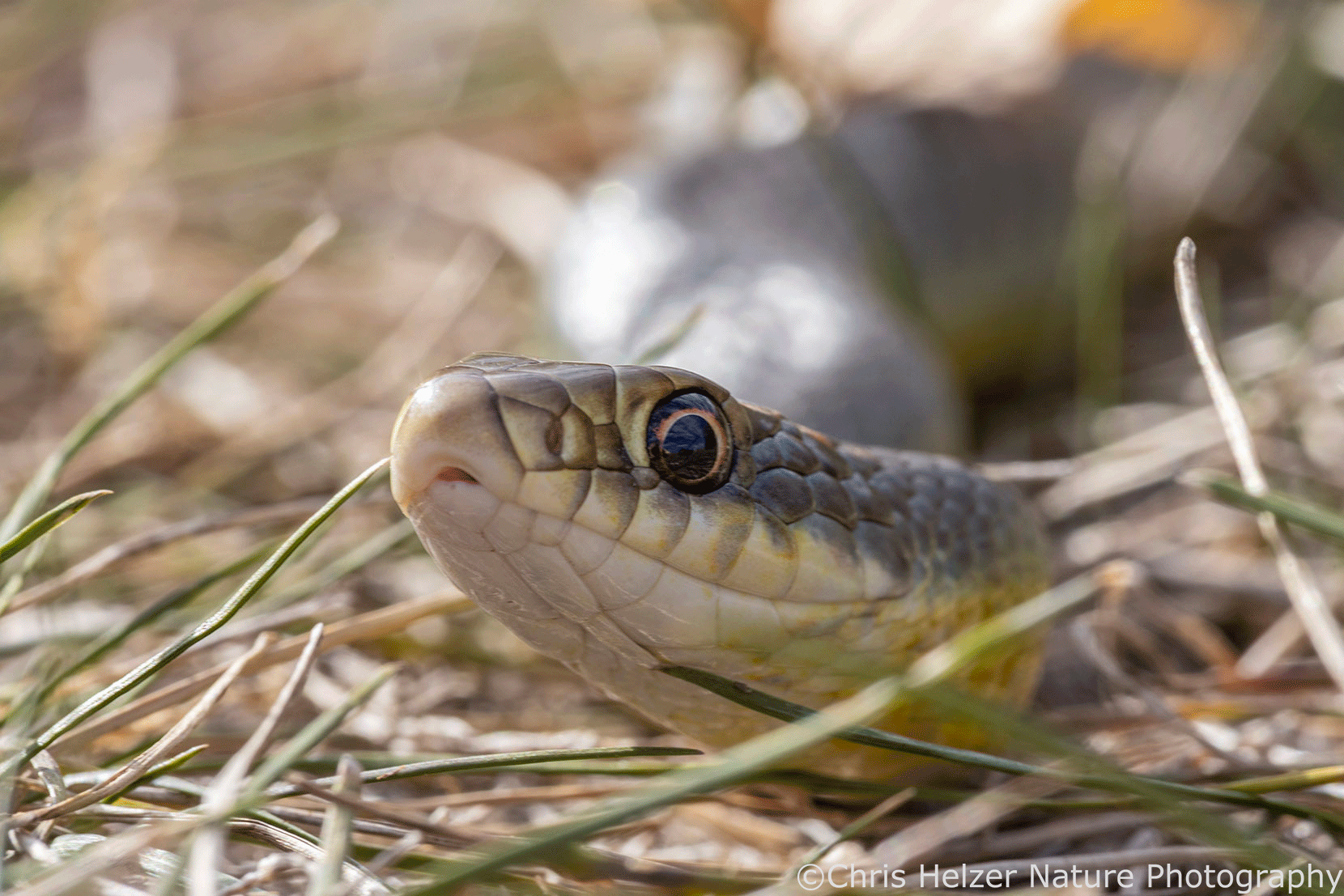
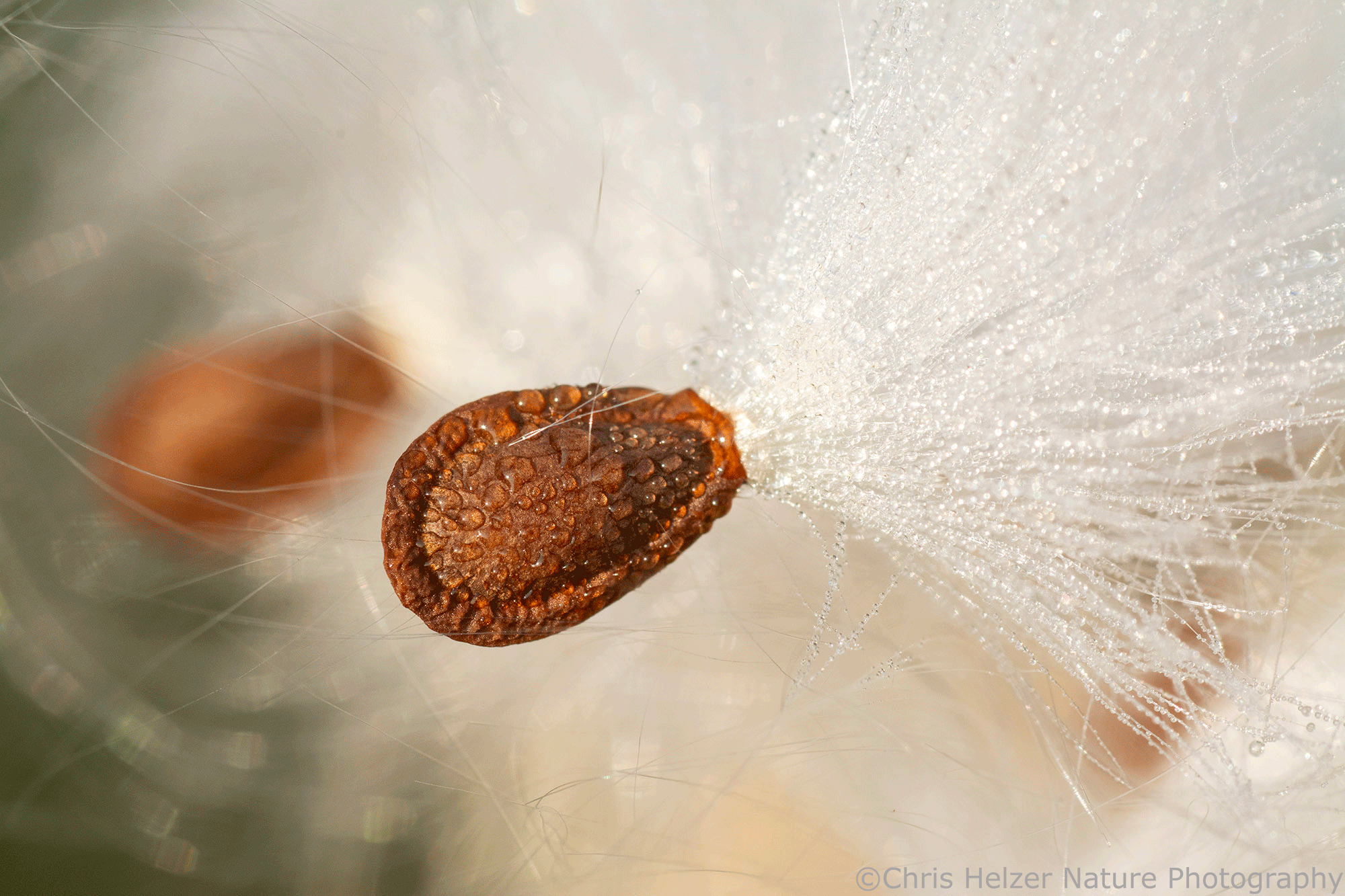
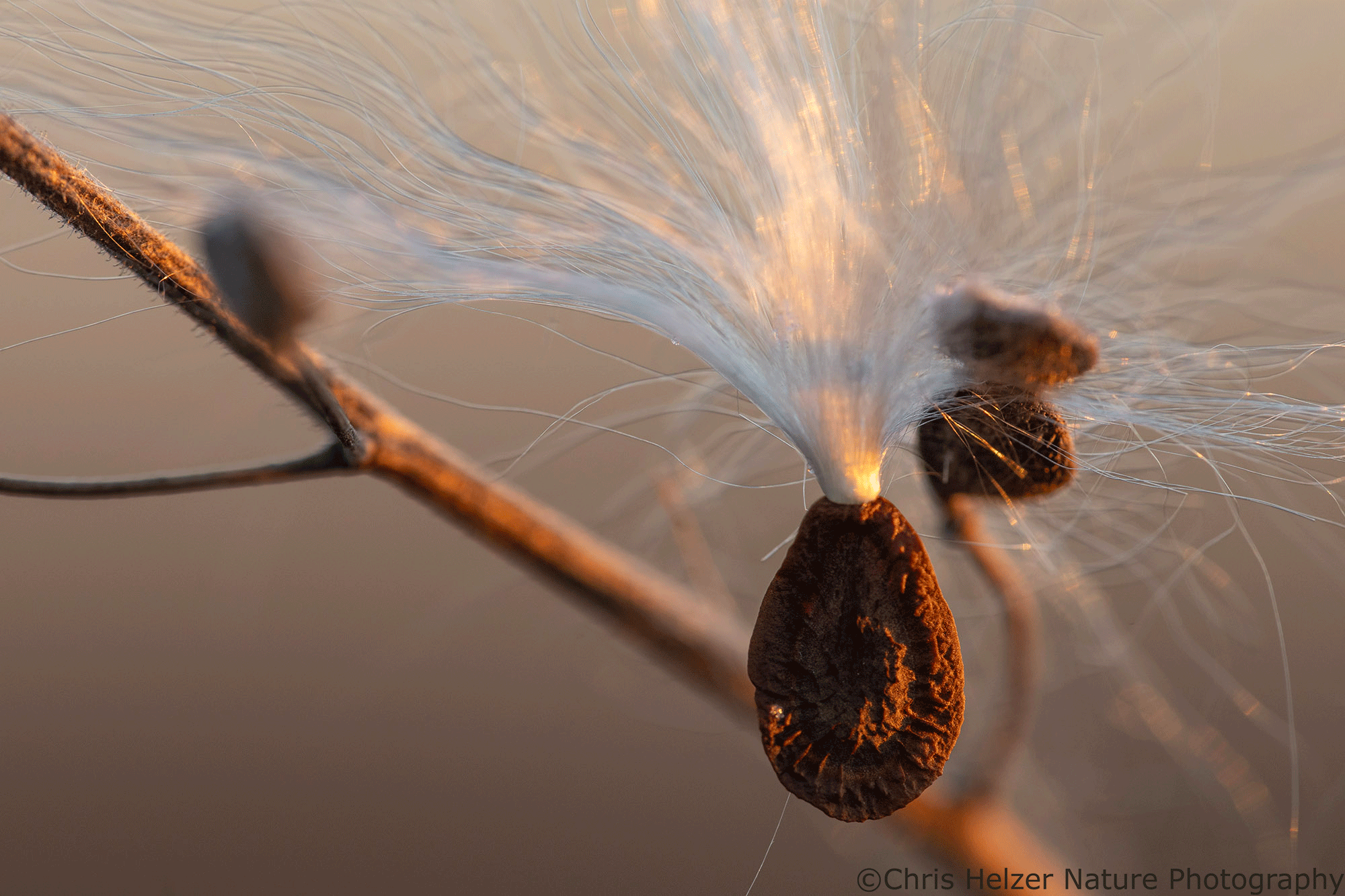
A metallic green sweat bee (Augochlora?). Lincoln Creek Prairie. August 2023.A male American bumblebee (Bombus pennsylvanicus). Lincoln Creek Prairie. September 2023Another male American bumblebee (Bombus pennsylvanicus) on pitcher sage (Salvia azurea). Lincoln Creek Prairie. September 2023Indiangrass on a smoky sunrise morning. Lincoln Creek Prairie. September 2023.Eastern yellow-bellied racer (Coluber constrictor flaviventris) at Lincoln Creek. November 2023.Common milkweed seeds (Asclepias syriaca) and dew at Lincoln Creek Prairie. September 2023Common milkweed seeds (Asclepias syriaca) and dew at Lincoln Creek Prairie. September 2023
There you go. I’m lucky to have quick access to small restored prairie close to home, as well as lots of prairie plants in my yard, but most of you who are reading this probably have areas of native plantings within a few miles of your home. If so, take the opportunity to find and enjoy the natural beauty and diversity living right around you! Maybe you can compete with this trio in Australia and the amazing project they undertook in their backyard.
Stay tuned for more ‘best of 2023’ photo series soon!
Quick announcement: if you’re a graduate student doing research related to conservation in the Great Plains of North America, you should check out the J.E. Weaver Competitive Grant Program. We are offering up to five grants of $1,500 each to graduate students. Read more here.
About a week ago, I posted a bunch of nerdy graphs with data from some of our restored sites at the Platte River Prairies. I’ve been glad to hear from at least some of you that found those interesting. However, graphs showing how species richness or individual species occurrence changes over time are interesting, but they only show parts of the overall story. I’ve been playing with another way to better illustrate the full picture of a plant community’s species composition through time.
Photographs can help illustrate what prairies look like and how they change through time, but they only show the plants that are most visually apparent at the time of the photo. This is a 2009 photo of a restored prairie planted in the year 2000. It is one of the two sites I’m highlighting in today’s post.
What I really wantto do is to step back and look at an entire plant community to examine how its composition changes through time. The concept I’m sharing today has been useful to me, but I’d love to hear feedback from others. I’d also like help naming the graphics I’ve constructed. When I started, I called them plant community signatures, but that’s doesn’t feel quite right. Help?
(For those of you who are more interested in pretty pictures than data, I did throw in a few recent photos of ice bubbles at the very end of today’s post, just for fun. If you want to see them, however, you’ll have to scroll past all my cool visual data representations first.)
The data used to create these illustrations are the same data I showed graphs of in my last data post. As a reminder, to collect the data, I plop down a 1x1m plot frame, list the plant species within it, and then repeat that over and over across a site (about 70 or more times per site). I can then calculate frequency of occurrence for each species, which is simply the percentage of those 70 or so samples each species was found in.
Once I have the data, I lay it out in a spreadsheet format to display the frequency of occurrence changes for each species through time. However, to make it easier to see patterns, I’ve colored each cell so that less frequent occurrence is light green and more frequent occurrence is dark green. I’ve also tried to group species together in a logical way. The result – at least to me – is a fascinating way to step back and study how plant composition varies over time.
I’m displaying results for two sites here. The first is a 1995 planting that I’ve collected data from annually since 2002. The second is a 2000 planting that I’ve collected data from every other year since 2003. I’m not displaying results for every species – just 60 or so of the species in each site that are abundant enough to be captured fairly regularly in 70 1x1m plots. If you want more details on these sites, you can get it from my last data-heavy post.
SITE 1 – Dahms 1995 Prairie Restoration. A 45 acre mesic site on sandy loam soils planted in spring of 1995 with approximately 150 plant species.
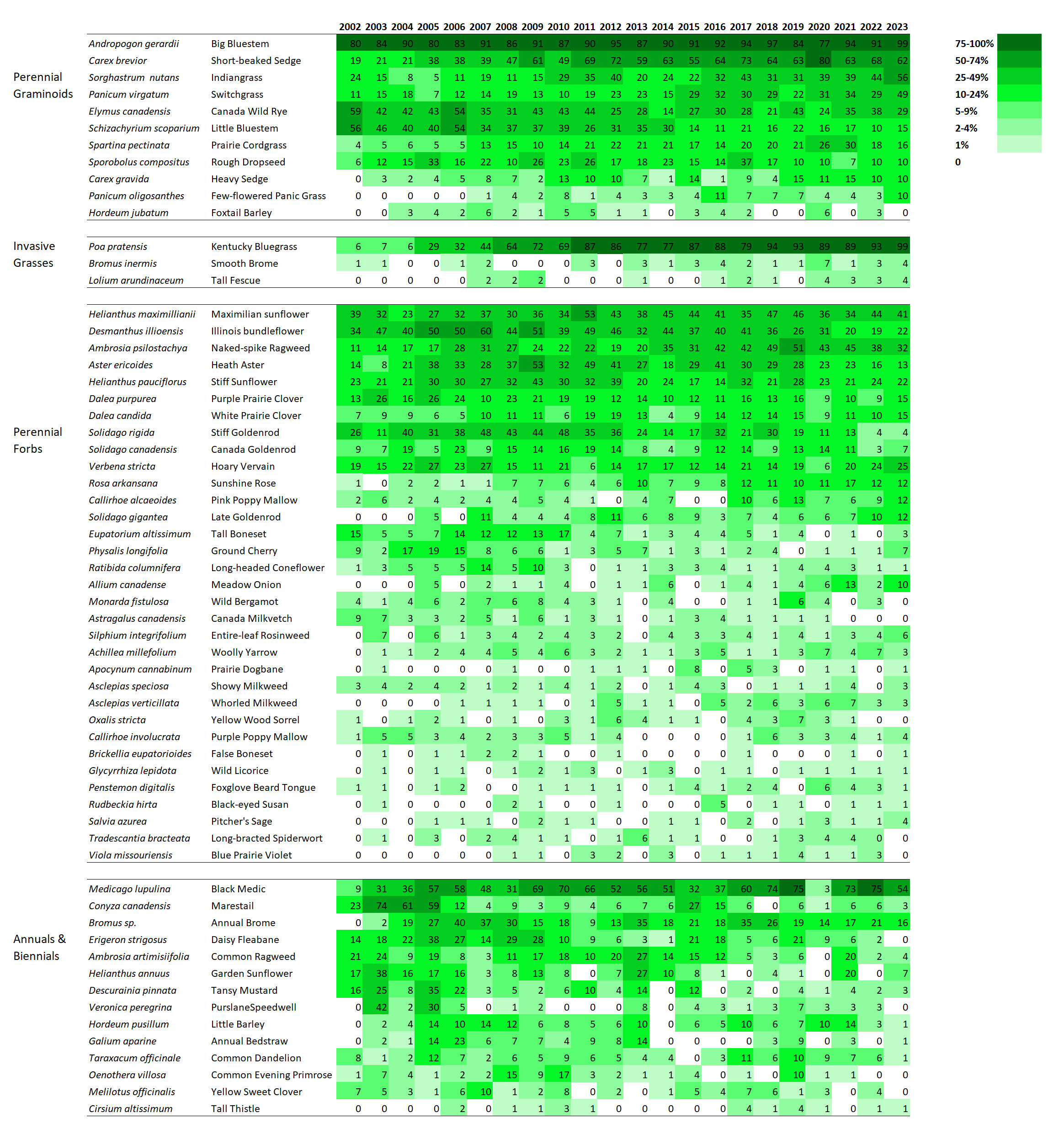
Here is the full graphic for the 1995 prairie restoration. It shows the frequency of occurrence between 2002 and 2023 for each featured species.
Remember to click on the title to open this post online if you’re reading it in an email. Doing that will then allow you to click on each image to see a larger, more clear version of it.
When I stare at this graphic, the first thing I notice is that there are very few examples of species that are on a distinct trajectory of increasing or decreasing frequency of occurrence. Most species simply fluctuate up and down through the years – some more dramatically than others. As expected, most of the most variable species are in the ‘annuals and biennials’ category. I think that’s great, and is evidence of ecological resilience.
Now, let’s look more closely at each of the four categories.
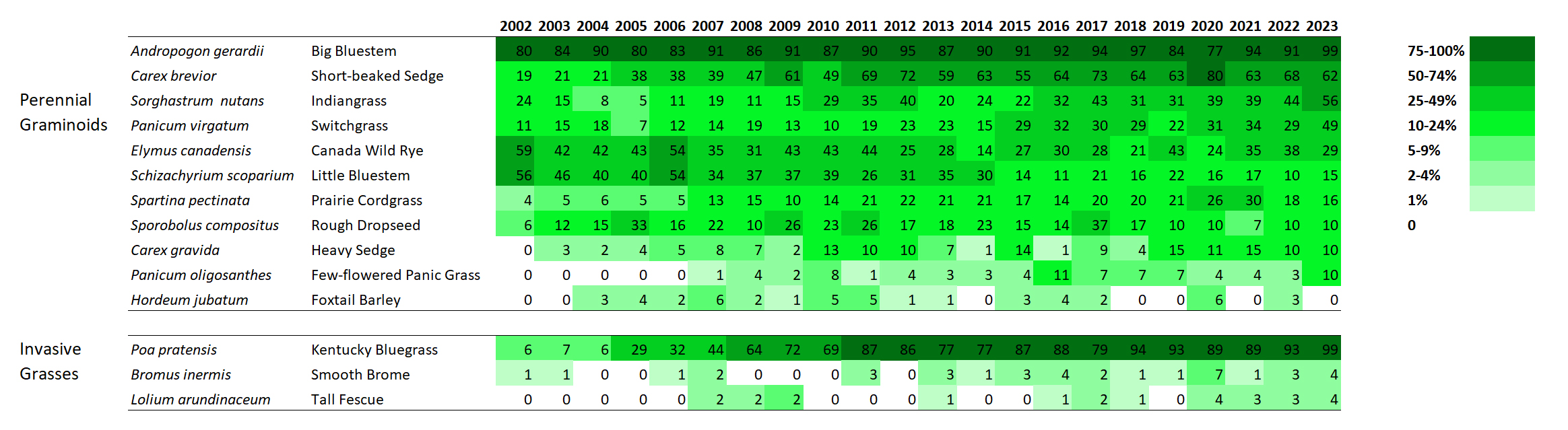
This graphic shows perennial grasses and sedges, including three invasive perennial grasses. Two species show a strong trend of increasing abundance. One is a native sedge (Carex brevior) and the other is Kentucky bluegrass.
Looking at the perennial grasses, it’s clear that big bluestem has been a dominant feature of this site for the duration. That’s fine, but not particularly surprising to me. What’s more interesting is the increasing abundance over time of both short-beaked sedge and Kentucky bluegrass. I’m happy about the sedge becoming more common. It’s a cool little plant. Kentucky bluegrass, of course, is less exciting because it has the potential to form monocultures and decrease plant diversity.
However, and this is really important, I’m not seeing any evidence – either here, in my other analyses, or on the ground, that Kentucky bluegrass is having a significant impact on plant diversity. Now, that could certainly change, but at least so far, it seems to be just hanging out (though it’s hanging out in a lot more places than it used to). It’s a great reminder that we should always measure the impact of invasive species, rather than just measuring the extent or abundance of the invaders themselves.
I’ll quickly highlight two other species that intrigue me. Little bluestem has become less common across the site over time, though it seems to have stabilized at about 10-20% occurrence in recent years. Simultaneously, prairie cordgrass has done the opposite, becoming more common.
Little bluestem likes drier habitats and cordgrass likes wetter. Does that mean the site has gotten wetter? I don’t think so. Instead, I think what we’re seeing is a long-term self-sorting process of a planted prairie. When the site was planted, the seed mix included way more little bluestem seed than cordgrass seed. As a result, I think the early establishment of those two species wasn’t representative of their actual adaptation to the site. Over time, I think they’ve both shifted around until they’ve settled into the microsites (and abundances) they’re best suited to.
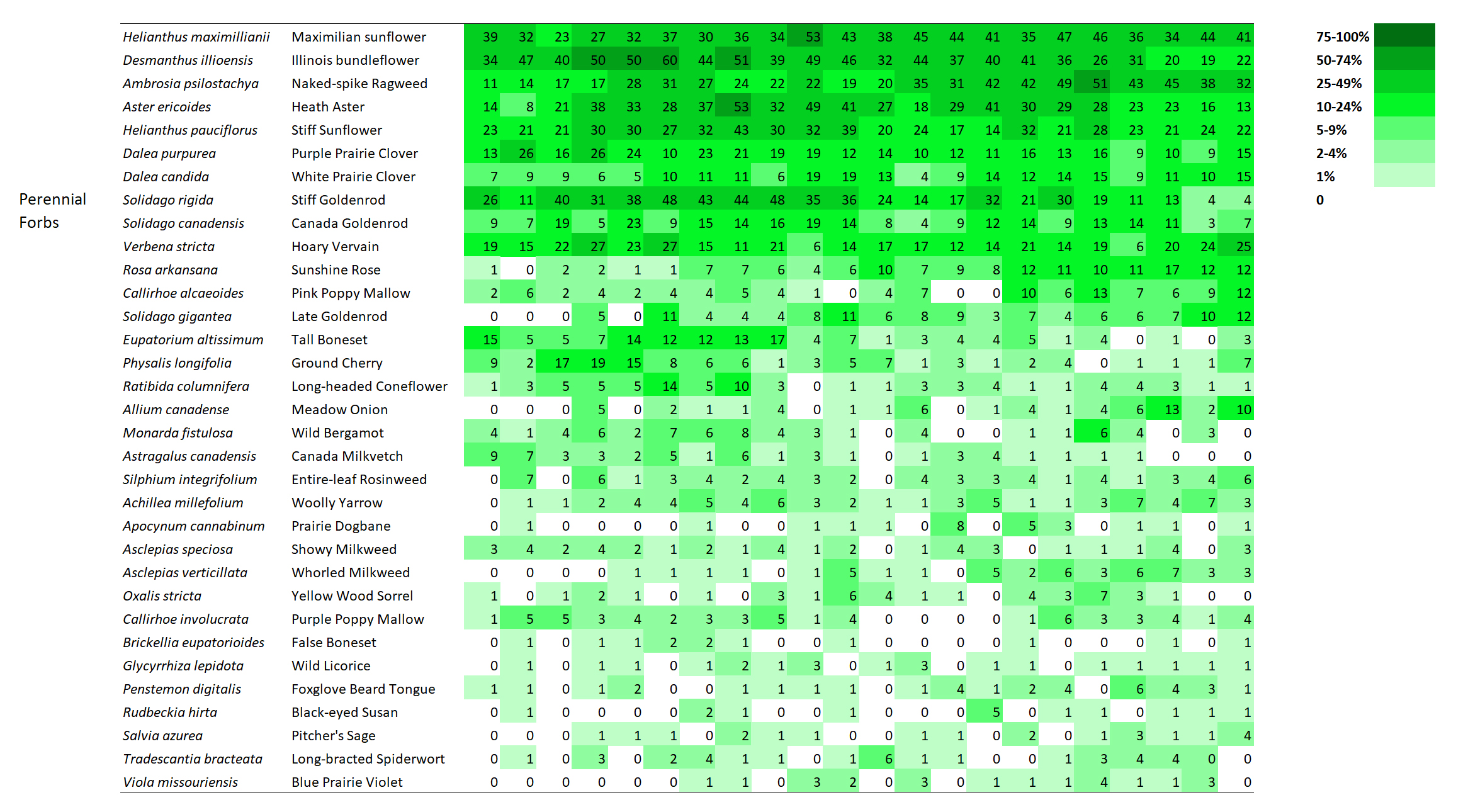
Frequency of occurrence for perennial forbs in the 1995 planting.
I don’t see much drama happening within the perennial forbs at this site. That’s pretty reassuring, actually, given the kinds of stresses that the prairie has experienced. It’s been managed with patch-burn grazing or open gate grazing since 2002, when this data collection started. As a result, the plant community has been exposed to fire, season-long intensive grazing, and multi-year rest/recovery periods. On top of that, of course, are the wet and dry years that can also significantly affect the growth and survival of plants. It’s good to see that none of these species seems to be disappearing (which also matches up with my other analyses of our restored prairies).
The only species I see that seems to show a significant trend toward lower abundance is tall boneset. That’s not a species known to be particularly sensitive to grazing pressure, as far as I know. In fact, I think of it more as a plant that does well with the kind of lower grass dominance that comes after a bout of grazing.
My best guess is that tall boneset is a species that started out very abundant because of both lots of seed in the mix and a slow, weedy early establishment period for this planting. Over time, it might just be dropping in abundance because it’s not as competitive in this soil type when competition from its neighbors is stronger. I’m just guessing here, though. The point is that the graphic helps me identify this pattern and ask questions!
Short-lived plants and their frequency of occurrence through time.
Within the annual and biennial plants I included, it’s fascinating to see how volatile their frequency of occurrence can be from year to year. I don’t see any species with a decided trend – the species seem to just bounce up and down. What’s most intriguing to me is that all the bouncing doesn’t seem to be synchronized across species. In other words, all these short-lived plants are responding to different stimuli as they increase and decrease in their abundance.
SITE 2 – Dahms 2000 Prairie Restoration. A 69 acre mesic prairie on sandy loam soils planted over the winter between 1999 and 2000.
Now, let’s look at the second site (the one shown in the photo at the beginning of this post).
The Dahms 2000 restoration was planted with 202 species, most of which have been found at the site. Here is the full graphic for this planting, showing frequency of occurrence data for about 60 of those plant species.
I’ve only collected data from the Dahms 2000 site every other year, so there are fewer columns. Also, the site was only in its fourth growing season when I started collecting data, so we’re seeing more of the ‘early establishment’ phase of this site than we did of the 1995 planting, which was in its 8th year of growth when I first collected data there.
Frequency of occurrence for perennial grasses and sedges, including two invasive grasses.
Interestingly, there is a little more directional change within the grasses at this site than in the 1995 planting. Is that because the data includes earlier periods? Maybe, but even so, the change seems to continue past the first 8-10 years for at least some species. Big bluestem, Indiangrass, short-beaked sedge, and switchgrass all seem to be on trends of increasing frequency. Canada wildrye seems to be going in the opposite direction so it’ll be interesting to see if/where it levels off.
Both Kentucky bluegrass and smooth brome have increased in percent frequency over time. However, as in the 1995 planting, I’m not seeing any negative impacts on species diversity (yet?).
Frequency of occurrence of perennial forbs in this 2002 planting.
Within the perennial forbs, a few species at the top (stiff sunflower, yarrow, and bergamot) seem to be on an upward trend, at least before the last sampling period. You might notice that there are a lot of species – across all the categories – that dipped in frequency in 2023. I’m pretty sure that’s a consequence of thatchiness caused by a recent lack of fire and grazing, which was intentional on the part of the Platte River Prairies preserve manager (a combination of a scheduled rest period and a response to a couple dry years). I’m confident the numbers will bounce back up again over the next few years as the site gets more fire and grazing again.
Apart from those species, I think the most interesting thing about the perennial forbs is the lack of many obvious trajectories. For the most part, species seem fairly stable in their abundance through time, though some ebb and flow in interesting ways. Some species that have been labeled ‘aggressive’ in some circumstances don’t seem to be acting that way here, including Canada goldenrod and Maximilian sunflower.
Frequency of occurrence of annual and biennial plants in a 2000 prairie planting.
Just as in the first site, short-lived plants bounce around a lot in their frequency of occurrence. The variation over time is evident even though the data was only collected every two years. Once again, I don’t see much synchrony within those bounces, which tells me each species responds individually to the myriad stresses applied to the site over time. Fascinating!
So, there’s my attempt at a visual display of plant community change in our restored prairies. Does the approach seem helpful? Suggestions for improvement? Ideas for what to name the graphics?
.
And now, for those of you hoping to see pretty pictures, here are three photos of ice bubbles from a restored wetland at the Platte River Prairies last week. Enjoy!





 The Prairie Ecologist