
Photo of the Week – May 27, 2011

Ring-necked snakes are small and slender snakes that are fairly common throughout many habitats – but not often seen.  This one squirted out from beneath a cedar tree I was cutting down last weekend.

Ring-necked snakes can grow to about 15 inches in length. This one was about 10 or 11, and about the diameter of a pencil. Very cute.

Ring-necked snakes are nocturnal snakes that come out at night to feed on earthworms and other invertebrates.  The rest of the time they are most often found beneath logs or other dark places where they can stay cool and moist during the day.  They often live in colonies, so if you find one there may be quite a few more nearby.  This one seemed to be alone, as far as I could tell. 

The most intriguing thing to me about ring-necked snakes is their habit of coiling their tail when they’re threatened.  The salmon color of this snake’s underside, combined with the tight coiling of the tail created an image that looked much like an earthworm.  I wondered if this was a technique used to attract predators away from the snake’s head so they would attack the (less valuable?) tail portion instead.  I’ve not seen any corroboration of this – so I’d appreciate knowing if anyone else has ideas or information…
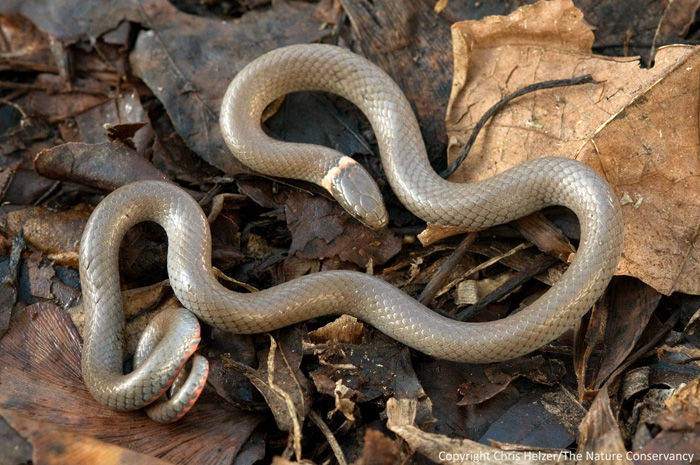
The ring behind the head makes ring-necked snakes easy to identify, but they also have the (unique?) characteristic of coiling their tail when threatened. If that fails, they sometimes play dead as well.

Another defense mechanism of this snake is to play dead if it’s being harassed.  We saw this in action after I handed the snake to my 10 year old son so he could look at it.  He was very gentle, but after a few minutes of “examination” the snake apparently had enough handling and went completely limp.  Even it’s eyes looked dead (or at least not right).  When my son handed it back to me I thought for sure we had a dead snake on our hands, but after a few moments of being left alone, the tongue flicked out a few times and the snake miraculously came back to life…  Pretty neat.

Reader Feedback Opportunity – What Do You Think?

I’ve been writing this blog for about eight months now, and it’s been an extremely enjoyable and fulfilling experience.  As I’ve told many people, I learn something from every post.  I learn by forcing myself to research, justify and corroborate my viewpoints and facts as I write about each subject.  I also learn from the many insightful comments and questions you’ve sent back to me through replies to posts, emails, and phone calls.

Stormy sky over a recently-burned Griffith Prairie, north of Aurora, Nebraska. Owned and managed by Prairie Plains Resource Institute, this diverse mixed-grass prairie has undergone extensive eastern red cedar removal and is managed with prescribed fire and grazing.

While writing the blog is fun for me, I’m doing it on work time – – so I have some responsibility to justify the time I spend on it.  It’s difficult to measure the effectiveness of something like a blog because although I get some statistics on how many times each post is read, I don’t really have any idea who’s reading it or what they think about it (except when people reply with comments/questions). 

I’ve decided that the most effective way to see whether or not the blog is achieving its objectives is to simply ask.  So – I’m asking. 

Here are my rough objectives for this blog:

1. Provide an interactive and updated source of prairie-related information as a companion to my book on prairie management.

2. Raise awareness and enthusiasm about prairies.

3. Provide a searchable on-line forum for discussion about challenges related to prairie management and restoration.

4. Improve the management and restoration of prairies by providing useful (and sometimes provocative) information and ideas.

.

If you have a few minutes this week, I’d love to hear back from you about how I’m doing on those objectives.  You can simply reply to this post or you can send me an email (chelzer@tnc.org).  Please tell me what you think so far. 

–  Has the blog changed the way you think about or manage/restore prairies?

– Is the information technical enough?  Too technical?

– What do you like most/least about the blog?

– Do you have ideas for future blog post topics?  Any other suggestions for improving the blog?

I can’t thank you enough for reading (and responding to) the posts I’ve written so far.  I look forward to many more future discussions!