
Hubbard Fellowship Blog – Hummingbird Moths

A guest post by Anne Stine, one our Hubbard Fellows.  All photos by Anne.

I adore hummingbirds, and I sometimes bemoan their rarity in my new home here on the Platte.  I grew up thinking they were better than fairies- they are cute, ferocious, and they migrate long distances despite their small size.  While hummingbirds themselves are scarce in this part of the country, “hummingbird moths” are abundant.  Hummingbird moths are so-named because they hover and fly like hummingbirds, sip nectar, and are approximately the same size as hummingbirds. I never noticed hummingbird moths growing up, so since moving here it is as if hummingbirds dropped out of the system and were replaced by enormous insect imposters.

Hummingbird moths, or sphinx moths, are large, furry, and active in the day.  Their caterpillars are called “hornworms” because they have what looks to be a long horn extending off their rumps.  Most of these larvae have multiple potential food sources.  Around here, likely food plants include four o’clocks, wild grapes, elms, and evening primroses1. While some species of hornworms eat crops like tobacco and tomatoes, they are infrequently a pest requiring treatment.  In fact, with their propensity to eat undesirables like Siberian elms and weedy species like four o’clocks and evening primrose, one could even characterize them as beneficial.

Hornworm

Hornworm larvae, possibly of white-lined sphinx moth?

There are two broods of sphinx moth annually, one emerging in spring and another in fall2.  Hornworms pupate in shallow excavations in loose soil1.  In the past few weeks I’ve encountered hornworms attempting to dig their burrows in our driveway at the crew house. Of the adults, I see the white-lined sphinx moth (Hyles lineata) most frequently.  Twice they have been attracted to my brightly colored clothing (pink shirt, orange shirt).  The moths hovered around investigating me for nectar reserves.  I’ve seen them feed on a variety of flowers, so they must not be too picky.

Hummingbird moths are an intriguing substitute for hummingbirds. Hummingbird moths are widely distributed across North America, so it would be interesting to learn if their role as pollinators takes on a greater importance in areas where hummingbirds are absent.
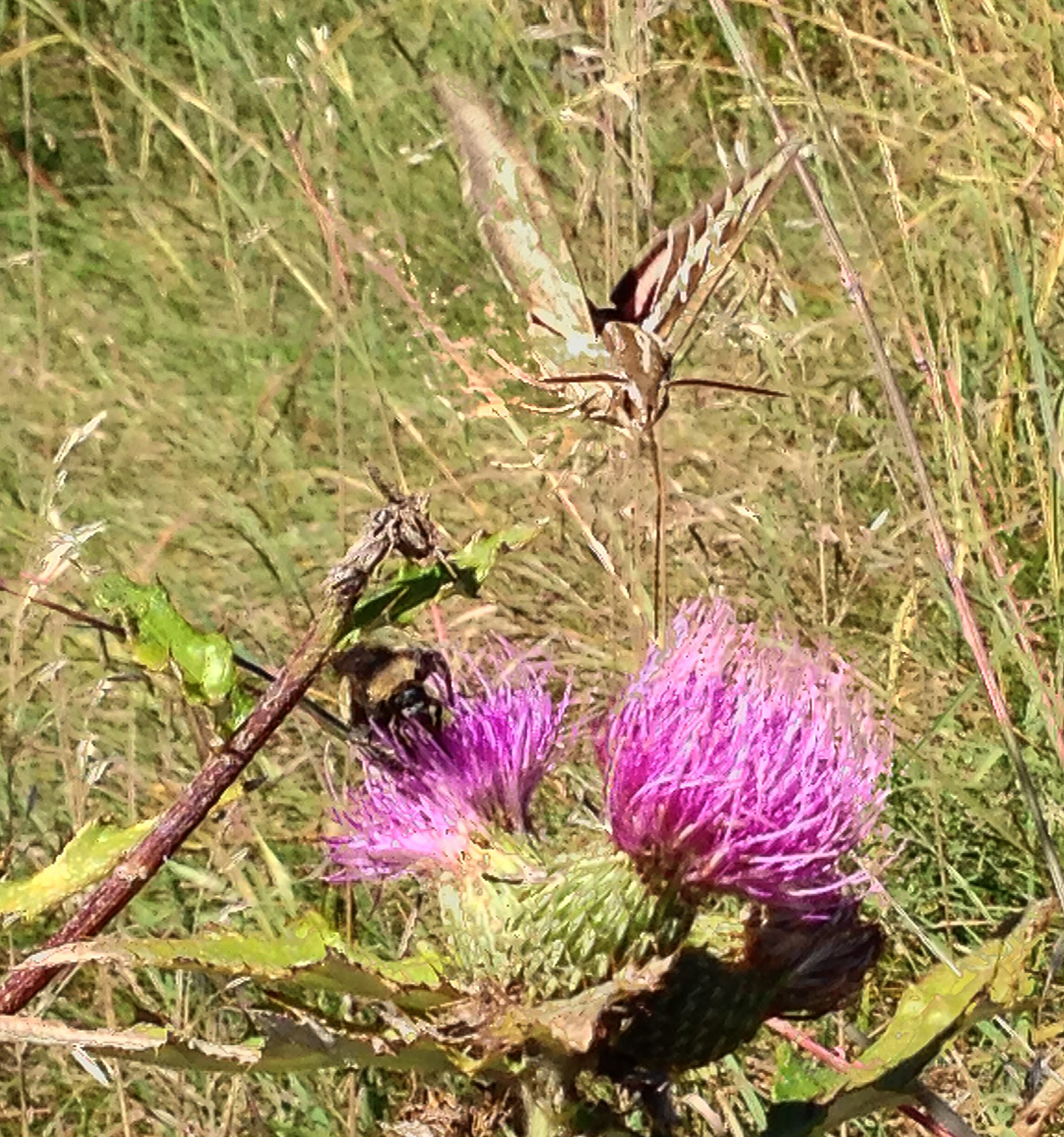
Front

White-lined sphinx moth, front view.

.
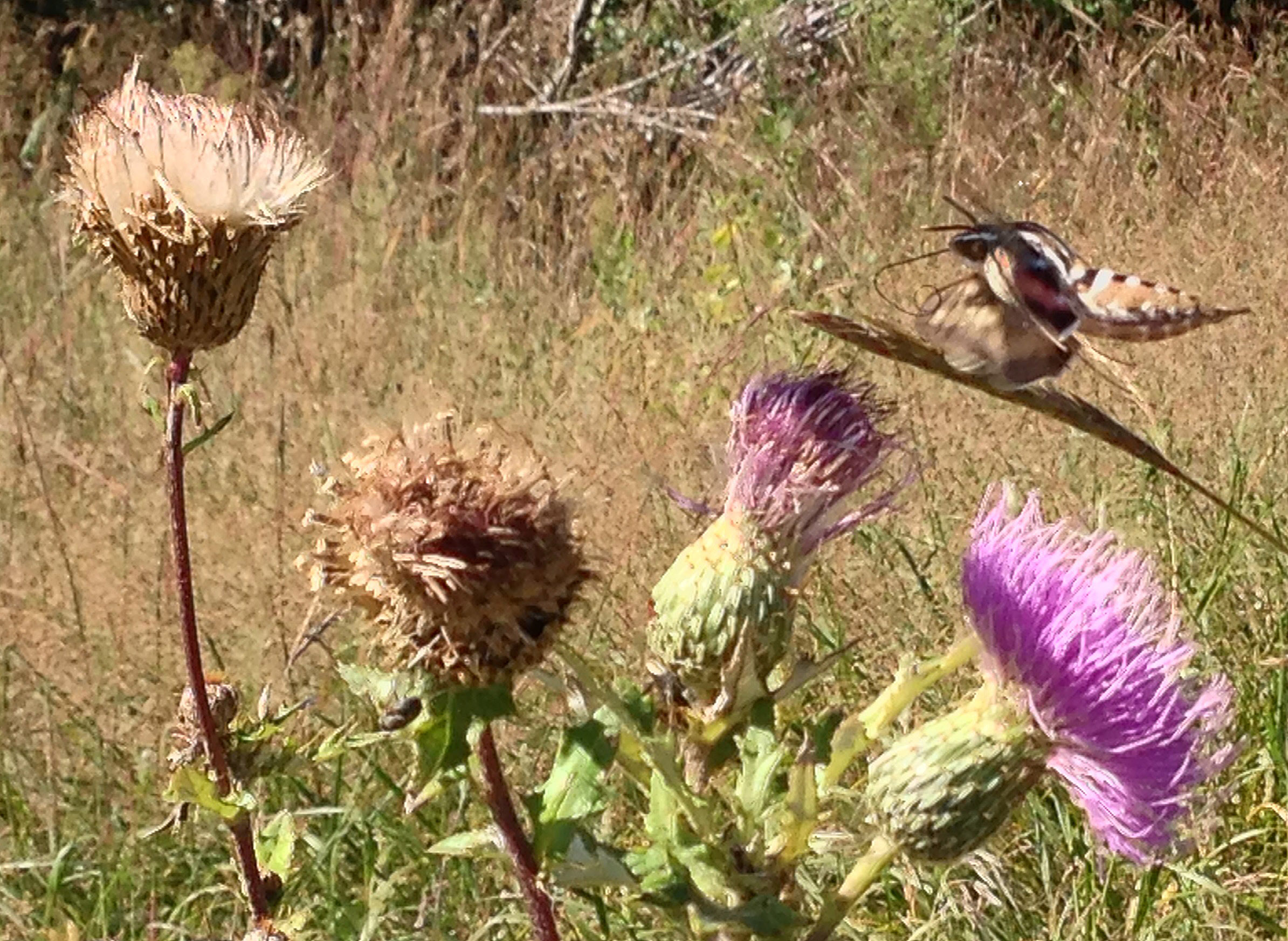
side

White-lined sphinx moth, side view, proboscis unrolling.

.
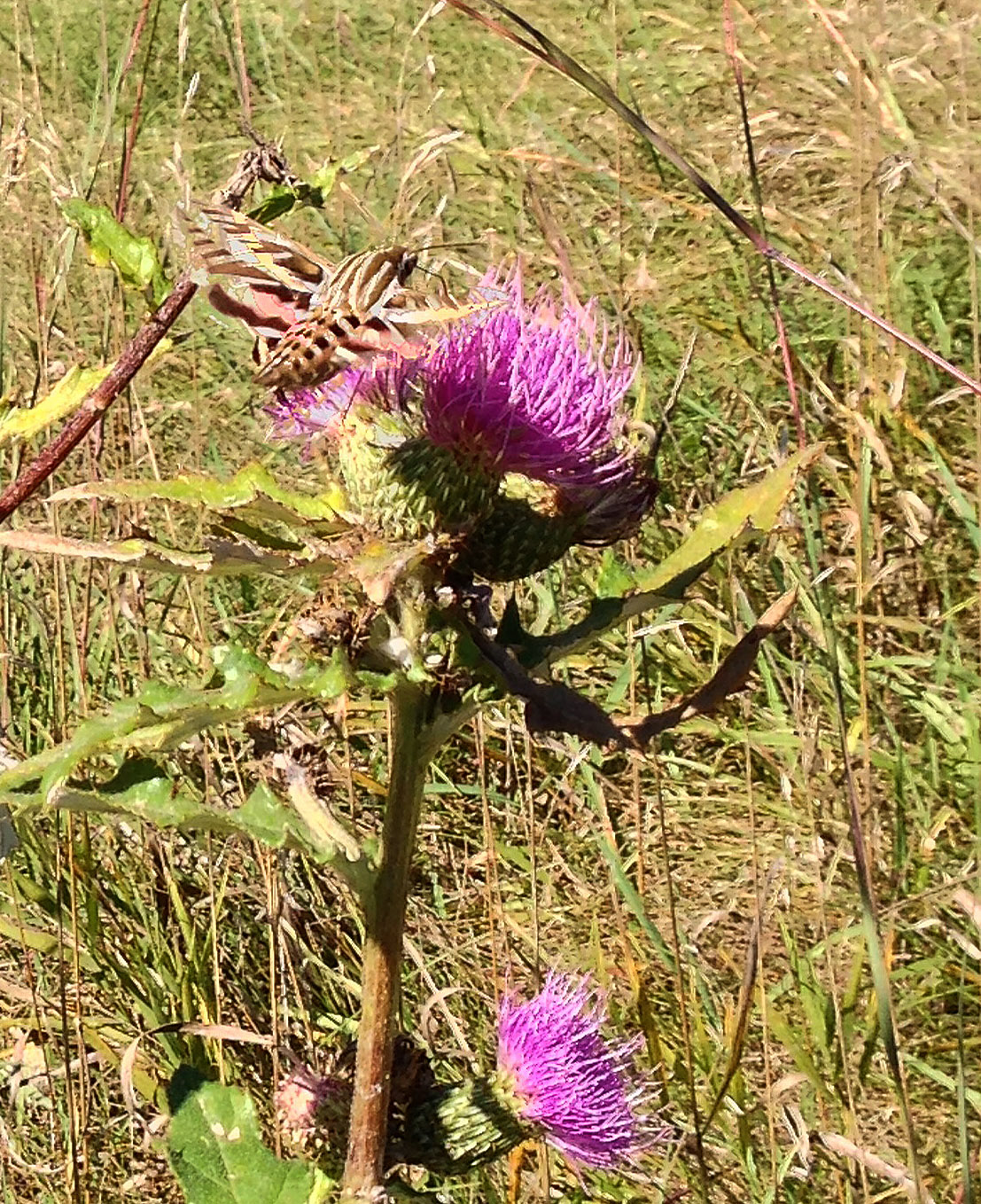
from back

White-lined sphinx moth, back.

1  http://www.butterfliesandmoths.org/species/Hyles-lineata

2 http://puyallup.wsu.edu/plantclinic/resources/pdf/pls48sphinxmoths.pdf

Hubbard Fellowship Blog – Seed Harvest Musings

A guest post by Anne Stine, one of our Hubbard Fellows:

I had a pretty good foundation in forest ecology leaving graduate school, but I’ve really developed my forb and grass ID skills since starting work here in Wood River.  Prairie ecology has grown on me.  I was trying to explain it to a forest-loving friend: once you know the local plants, (that is, you see their uniqueness and their ecological and historical roles), you get a better feel for a place.

One of my favorite stewardship tasks is harvesting native seeds.  The best assignments are for hard to find plants that require some knowledge of their life history to locate.  I really enjoy the scavenger hunt and foraging aspects of searching for less widely distributed species.  I also had one of my major botanical victories seed harvesting on the prairie.

Prairie seeds drying in our seed barn.  Platte River Prairies, Nebraska.  Photo by Eliza Perry, Hubbard Fellow.

Prairie seeds drying in our seed barn. Platte River Prairies, Nebraska. Photo by Eliza Perry, Hubbard Fellow.

I was driving around, looking for Canada milkvetch (Astragalus canadensis), when I spotted a familiar stalk sticking up in the pasture.  I remembered it as a plant that had ridden shotgun in the truck with my field supervisor for a few weeks- clearly someone had harvested it.  I just didn’t know what it was.  Its flowers were now gone, only the long brown stalks and seed heads remained.  The leaves looked like a cross between a strawberry and a prairie rose (Rosa arkansana).  I collected the seeds and took the stalks home to identify. I was excited to discover that the plant in question, tall cinquefoil (Potentilla arguta), is indeed in the rose family!  Ecologists find their thrills where they may…

As a natural history geek, I can’t help but delight in picking up random facts about prairie plants.  For example, rocky mountain bee plant (Cleome serrulata) is a glorious nectar source for pollinators in mid-summer.  Doves eat the seeds in the fall.  Its leaves and seeds were also eaten by some Native Americans, “in spite of its strong smell” (“Grassland plants of South Dakota and the Northern Great Plains”, Johnson & Larson 1999). It takes all kinds, the authors seem to say.  I didn’t find the odor especially displeasing, but evidently even botanists have personal opinions.

Rocky mountain bee plant.  Platte River Prairies, Nebraska.

Rocky mountain bee plant. Platte River Prairies, Nebraska.

Foxglove penstemon (Penstemon digitalis) is one plant whose smell I do find distasteful, and its fragrance garnered no mention. This wildflower is not widespread, but neither is it difficult to find.  You smell it before you see it.  Interestingly, it’s the seed heads and red stalks that stink, not the flower.  I left a bucket in the cab of the truck while I harvested other things, and when I came back the cab was filled with flies.  They followed the bucket to the truck bed when I moved it.

Most of the seeds we collect this year will be used in over-seeding projects, intended to increase the diversity of prairies we manage.  Over-seeding is one strategy we can use to boost a site’s forb population without tearing up the prairie and starting over.  Building a native seed bank of local ecotypes is a useful technique to increase your chances of success in prairie restoration.  It’s not bad work either, if you can get it.