
If You Play With Fire…

There’s nothing playful about safe and effective prescribed burning.  Too many things can go wrong to take it lightly.  Sometimes, I think people see prescribed fire as something that needs to be done to maintain prairies, but they can’t necessarily point to specific objectives for a particular fire.  Nor can they describe what kind of burning (season, intensity, size, ignition pattern) is needed to achieve those objectives.  Falling into the trap of burning because it seems like the right thing to do leads to two big risks.  First, there’s a good chance that the fires will not be conducted in a way (or at the right time of year) that do much good – and could even be counterproductive.  Second, because prescribed fire can be a hazardous activity, conducting one without clearly defined reasons means taking big risks for no good reason.
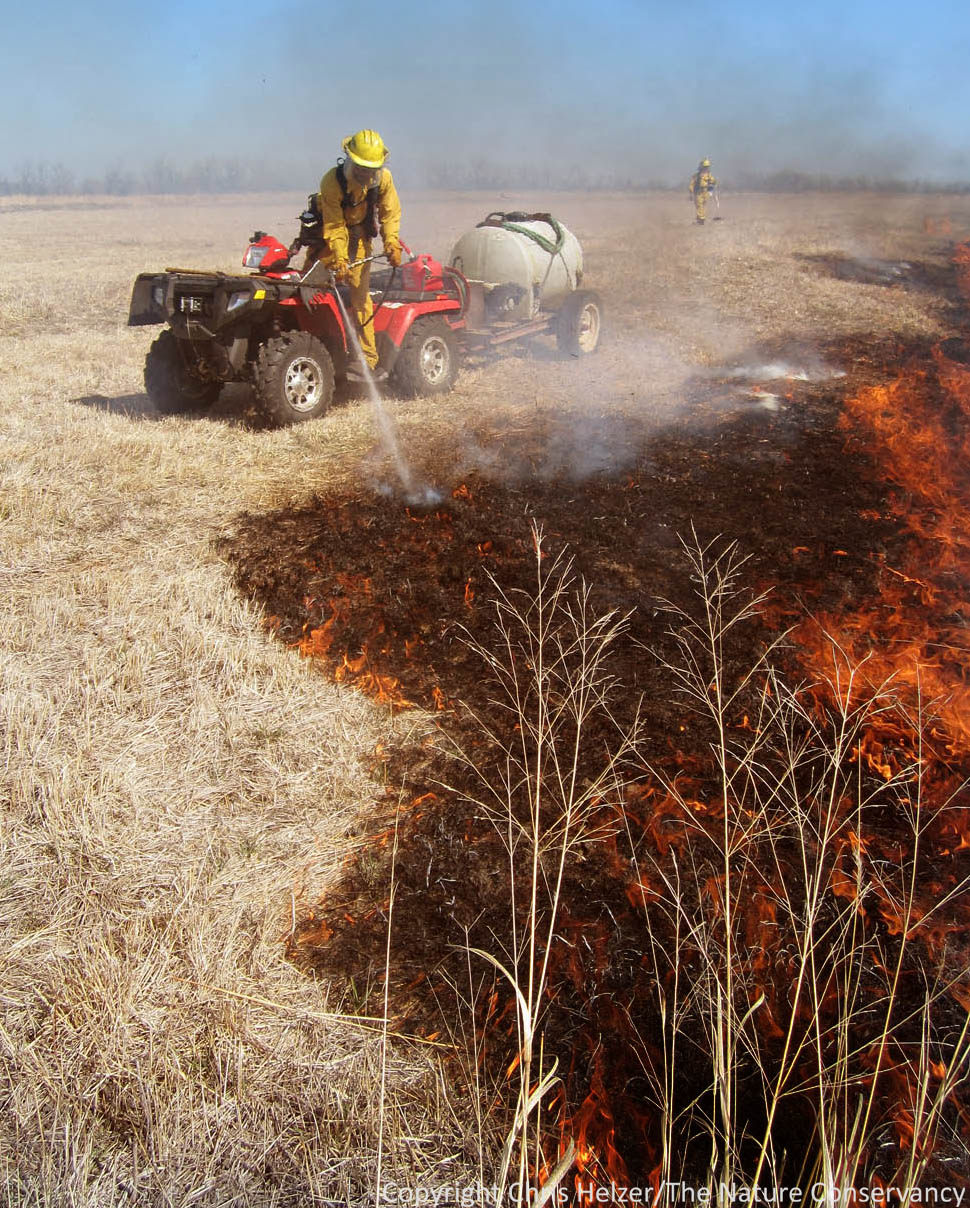
A prescribed fire we conducted last week. This one went off without a hitch. Most of them do.

We’ve completed two prescribed fires so far this spring.  As always, we spend way more time planning our fires than implementing them.  That planning starts with setting clear ecological objectives (defining why we’re burning in the first place) which dictate the location, size, season, and even the tactics used during the fire.  Once we know what we’re aiming for, we write a burn plan that can help us achieve that in the safest way possible.  Our plans detail the kinds of weather conditions and tactics needed to be successful, but also spend a lot of time on contingencies.  What will we do if the fire gets away?  What does the surrounding landscape offer in terms of safe areas and threats in the case of an escaped fire.  How will we respond if someone gets hurt?  For me, writing a good burn plan means thinking through all the worst case scenarios.  There’s nothing fun about it.

Unfortunately, even after all that planning, things still go wrong.  Last spring, I wrote about a burn we did in which we ran into repeated equipment issues, and had to shut down for a while until we could get re-equipped and complete the burn.  In another fire last year, I overestimated the strength of our blackline containing the fire, and the wind-driven head fire jumped it in one place, forcing us to quickly chase it down.  This spring, our first prescribed burn started out well, but the wind came up sooner than had been forecast, and we shut the fire down because a Red Flag Warning was issued.  In all of those cases, there were no serious repercussions, and our training and planning helped us deal effectively with unexpected circumstances.  Because we’d planned for each contingency, everyone knew how to react when the time came.  No property was damaged and no one got hurt.

The threat of injury is what makes prescribed fire especially stressful for me.  Between potential equipment mishaps and quickly-changing weather and fire conditions, there are numerous opportunities for someone to get hurt.  So far, I’ve never had anyone get injured on a fire I’ve been a part of, but that fortunate record certainly isn’t making me complacent.  As if I needed a reminder of the danger, one of our crew was helping a partner organization with a fire last week and suffered some slight burns on his neck and face while trying to extinguish a drip torch.  After trying and failing to smother the flame at the tip of the torch with a gloved hand (per protocol) the crew member then tried to blow the flame out, and some of the burning torch fuel splattered onto the cotton bandana around his neck.  Before he could get the bandana off of his head, he suffered small burns in several places.  After a quick trip to a nearby medical clinic, he was fine – though he had to shave off the remainder of his singed beard.

It appears there were several things that contributed to the torch incident, possibly including some issues with the torch itself that caused excessive fuel to build up in the torch’s tip, making it particularly difficult to extinguish.  After the fire was wrapped up there was considerable discussion about what happened, and hopefully we all learned some things that will make us all safer in the future.  Regardless of the cause, however, the aspect of the event that struck me the most was that our crew member was injured doing something he had done hundreds of times before.  It’s sobering to know that something as mundane as extinguishing a torch led to injury, and that it could have been much worse than it was.

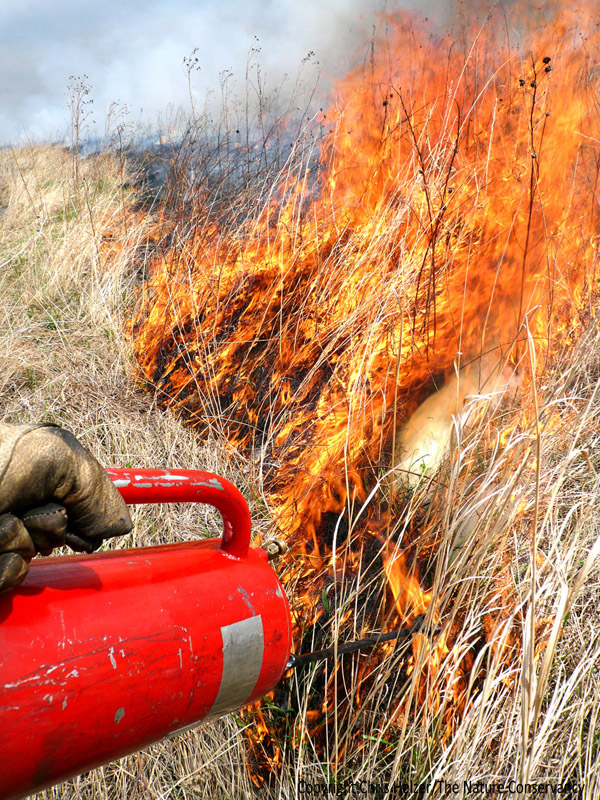
Lighting the head fire of our prescribed burn last week. This was the easy part. The planning, training, weather monitoring, equipment preparation, and black-lining were all done. (Not pictured - the knot in my stomach)

I am a strong and vocal advocate for the use of prescribed fire to manage both private and public lands.  On the other hand, prescribed burning is not a sport, it’s a tool, and it’s a tool that we should employ strategically – not for fun, or without specific objectives in mind.  If someone can’t clearly explain what they’re trying to achieve by conducting a particular burn, I don’t know how they can justify taking the risk of dropping a match.  In addition, if some doesn’t have a clear and detailed plan for how to ignite and contain a fire, and how to respond when things go wrong, I don’t think they have any business lighting that fire in the first place. 

I know people that really enjoy conducting prescribed fires.  Frankly, those people make me nervous, especially if they’re in charge.  I don’t dislike prescribed burning, and I get a feeling of satisfaction whenever we wrap one up successfully – especially because I can appreciate the ecological benefits of doing so.  But while there is active fire on the ground, there’s a knot in my stomach, and that knot subsides slowly, even after the last of the smoke has faded into the sky. 

It’s fantastic that the use of prescribed fire is growing among prairie landowners and land managers.  More importantly, the greatly increased availability of training and equipment means that we’re not only burning more acres, but we’re also more sophisticated – and hopefully safer – as we do so.  However, things will still go wrong.  Property will be damaged and people will get hurt.  It can happen during even the simplest fires.  That doesn’t mean we shouldn’t burn.  It does, however, mean that we should burn only when it can be done safely and only when we can burn in ways that achieve important objectives.  Otherwise, the risk can quickly outweigh the rewards.

Be safe out there…

.

You may be interested to read these previous posts about prescribed fire:
The importance of equipment redundancy in prescribed fire.

Why prescribed fire doesn’t contribute to global warming.

The Myth of Self-Sustaining Prairies

Here’s a question I get asked occasionally:  “At what point will my prairie become self-sustaining?”

There are lots of ways “self-sustaining” can be defined, of course, but usually the person is hoping that at some point they can just step back and let the prairie do its thing with very little or no human input.  In other words, they hope the prairie will function like a machine.  Once you have it tuned up correctly, it’ll hum along just fine with only occasional inputs of fuel or maintenance.

Ah, that it would be so easy.  Unfortunately, there is a short answer to the question, and it’s a disappointing one.  The answer is, “It just doesn’t work that way.”

Here’s the short explanation of that short answer:

A prairie with no management at all accumulates thatch from each successive year of plant growth, and if not removed, that thatch eventually builds up to the point at which only a small number of plant species can survive.  Unfortunately, the most dominant of those surviving species tend to be either trees/shrubs or invasive plants.  In the eastern half of Nebraska, smooth brome tends to be a primary winner, along with tree species such as Siberian elm and eastern red cedar.

Besides the issue of thatch build-up, there are just too many threats, particularly from invasive species and trees, for prairies to maintain their species compositions and ecological functions without human management.  This is particularly true with tallgrass prairies in an agricultural matrix.  The degree of vulnerability to invasion depends upon soil type and the surrounding landscape.  Some soil types seem favor invasives more than others – oftentimes, high soil nitrogen levels can favor exotic grasses, for example.  The degree of invasive species pressure on a prairie is also influenced by the abundance and proximity of those invaders in the neighborhood around the prairie . However, all prairies (that I’m aware of) have some degree of vulnerability to invasive species.

Active management, such as the application of prescribed fire, is needed to prevent excessive thatch buildup and to help suppress invasive species.

That’s the short answer.  A longer and better answer is that tallgrass and mixed-grass prairies are not “climax communities” in the classic sense.  In my early ecology classes, I learned that terrestrial plant communities move through a process called succession from bare ground to some final stable state – usually a forest.   Bare ground is colonized by opportunistic species, which are eventually pushed out by longer-lived grasses and wildflowers.  Those grassland species are then replaced by various generations of tree species, each topping out the other until a final set of tall long-lived trees becomes dominant and creates a stable community.  Disturbances such as fire or severe weather events might set back succession temporarily, but the process keeps moving toward that climax community.

Prairies don’t fit that successional model very well.  Prairies are maintained (and defined?) by disturbances such as fire, grazing, and drought.  Without some combination of those ecological processes, prairies turn into woodlands.  Because of that, some might argue that prairies are simply an ephemeral stage of the longer successional process, and not really a stable ecosystem.  Others might argue that the whole idea of ecological succession is overly simplistic and not representative of the way all ecosystems function.

Without getting into that larger argument, the real point is that if we agree prairies are important, and we want to maintain them, active management is necessary.  Some people point to expansive prairies in Great Plains landscapes and wonder if those prairies could maintain themselves without humans if given the chance.  After all, lightning-caused fires and roaming herds of bison should be able to take care of things without interference from people, right?  In reality, we don’t have any historical precedent to back that up.  Today’s prairies have only been around since the last ice age –  about 10,000 years (less in the east, more in the west.)  During that entire time, people have been active managers of those prairies.  Fires set by Native Americans were much more abundant and extensive than lightning-caused fires.  Bison herds, and many other herbivores, responded to those fires by focusing grazing in those recently burned areas.  That intensive fire/grazing disturbance interacted with and compounded the impacts of long droughts, floods, and other weather-related events.  Cumulatively, those major disturbances maintained the integrity of prairies.

Along with climate and fire, bison (and other grazers/herbivores) were a major force that shaped prairies. However, people and their activities were also an important component of the process.

There’s really no way (and no reason) to separate people from prairie.  Regardless of the intent or motivation of the people who manage prairies – historically or now – their actions have tremendous impacts.  Similarly, inaction by people who control prairies has tremendous impacts as well.  In the natural resource management world, the phrase “No management is still management” is well-worn but nevertheless true.

Of course, defining the need for continual human management – even in the absence of today’s new challenges such as invasive species – doesn’t solve the problem.  What kind of management is needed?  How do we know when to do what?  The answers to those questions are complex, still being debated, and the primary subject of this blog, my book on prairie management, and myriad discussions among prairie managers around the world.

Some people who agree that prairies require some level of active management still search for a relatively simple management recipe to follow.  Annual haying or burning or two to three-year rotations of fire or grazing are examples of management regimes that are commonly used and advocated for.  This is really just a small step up from the idea that prairies should maintain themselves.  In this case, the argument is that prairies should be able to maintain themselves if we just provide them the right basic disturbance framework.

I’ve given my opinion on simple, repetitive management regimes often within this blog (see my Calendar Prairies post as an example).  I think repetitive management threatens plant diversity because there are always some plant species that are favored in a particular management regime and others who are not.  Over time, those species not favored will inevitably fade out of the community if the same regime is applied over and over.  Perhaps more importantly, animal species – including insects – with fairly specific habitat structure requirements are similarly affected.  Some species thrive under repetitive management if that management consistently favors them.  However, those animals that don’t find what they need in that management system can’t normally survive for many years in suboptimal habitat like many perennial plants can.   Animals without appropriate habitat either move or die – and in fragmented landscapes, or in landscapes where the same management is in place across the entire landscape, moving may not be a viable option.

Annual haying provides good growing conditions for many plants - especially those the bloom and produce seed prior to the haying date. On the other hand, some of the plant species favored by annual haying (including smooth brome) can become invasive. In addition, some desireable native plant species do poorly under annual hay management and eventually disappear from those prairies.

All of this adds up to one conclusion.  Diverse, functioning prairies require active, constant, and thoughtful management by humans.  There’s no getting out of that responsibility.  If we choose not to be active thoughtful managers, we are choosing to let prairies degrade, and we’ll have to live with the consequences (“No management is still management”).  Hopefully, though, most people with influence over the management of prairies will embrace their role, and be active managers – as well as active participants in ongoing discussions about the impacts of various management techniques and systems.

Though active prairie management is time-consuming, and often expensive, it’s also extremely rewarding.  Whether it’s a small backyard prairie garden, a 20,000 acre grassland, or something in-between, every year is a chance to try new things, see what happens, and learn from the experience.  More importantly, the diversity of plant, insect, and invertebrate species in well-managed prairies – large and small – is its own reward.  Who could ask for more than that?