Trying to Figure Out What We Did Right

When converting crop land to restored prairie, it’s always hard to predict what you’re going to get.  Numerous examples prove that even when you control as many variables as possible – including soil conditions and the rate, timing, and technique of planting – no two seedings turn out alike.  Sometimes, you can use hindsight to explain what happened (weather conditions, herbicide carryover, etc.) but most of the time it’s clear that we just don’t understand much of what’s happening out there.

I’ve been analyzing some data from one particular restored prairie lately, and trying to puzzle out what’s going on.  In this case, the results are good – which is nice.  It’d be nicer, of course, if I could explain WHY things worked so well and then replicate whatever happened…

The Dahms 2000 prairie restoration has turned into one of the most aesthetically pleasing prairies we manage along the Platte. It has tremendous diversity and abundance of wildflowers. Most importantly, its plant diversity is still increasing fairly rapidly after twelve field seasons.

The prairie in question was seeded with a mixture of about 200 plant species onto 69 acres of disked cropland that had been in corn the previous season.  The seed was planted sporadically between December 1999 and April 2000.  Wetlands were added to the site by excavating down close to groundwater and recreating the kind of swale/ridge topography that is typical of nearby Platte River meadows.  Those wetlands and sandy spoil piles (ridges) were seeded with appropriate seed as well. 

All of the seed was broadcast onto the site – some by fertilizer spreader and some by hand (I was experimenting) and no harrowing or packing of the soil was done.  Unfortunately, this was the last year BEFORE I started keeping good records of the amount of seed from each plant species I included in the mixture, so I only have a list of the species we harvested seed from that year.  What I know is that my seeding rate per acre was about 15 gallons of grass seed (mostly big warm-season natives) that was harvested by combine from nearby prairies, and about 1/2 gallon of hand-harvested forbs, grasses, and sedges.  That’s roughly 12 bulk pounds of grass seed and 1/2 pound of forb (wildflower) seed per acre.  I have no idea what germination rates were that year, but it was a pretty light seeding rate compared to what many others around the country use.  Today, our typical mix is a little lighter on grass and includes about twice the forbs.

To cut to the results, this prairie has turned into our most diverse and showy restoration we’ve ever done.  You’d never know we’d used such a light seeding rate of forbs by looking at the site now – its appearance is dominated by big showy wildflowers.  By every measure I use to look at the plant communities of our restored prairies, it comes out high.  I’ve found 178 plant species in the site so far, which is excellent.  The mean Floristic Quality (combination of species number and “conservatism values”) is high, and still climbing rapidly.  It averages twelve plant species per square meter, which is higher than most other restored or remnant prairies in the area.  (Yes, I know that seems like a very low number to you eastern tallgrass prairie folks, but it’s good for out here.  Don’t rain on my parade, ok?)  Twelve years after it was planted, tall warm-season grass species are still not very dominant.  The species found at the highest frequency is big bluestem, and it was only in about 80% of 1m2  plots stratified across the site last June.  In short, it’s a beautiful prairie.  And I don’t know why.

I know most of you are ITCHING to see the actual data tables and graphs, but because there are a few who aren’t, I’m including them as a PDF file, which you see by clicking here.  The PDF also includes a cumulative list of plant species found in the restored prairie.

Flower species such as black-eyed Susan (foreground) and bee balm (pink flowers in the background) are still dominating the plant community in this photo from 2009 (the 10th growing season of this seeding). The lasting abundance of those species is, I think, tied to the lack of dominance by major grass species.

It’s particularly impressive that this seeding turned out so well, because the odds seemed stacked against it early on.  It was seeded right at the beginning of a 7 year drought.  The first several years were dominated (as usual) by weedy species and a few colonizing native species such as Canada wild rye and common evening primrose, but in this prairie those species remained dominant for several more years than is typical.  Once other plant species started breaking through, there were few legumes present – and we don’t typically have problems establishing legumes in our prairies.  Those legumes are still more scarce than in other nearby sites, but they’re increasing over time.  Finally, in about its eighth season, the site stopped looking like a weed patch and matured into something that most people would recognize as a prairie.

As I’ve discussed in other blog posts, I’m still struggling to define success in our overall prairie restoration efforts, but at the scale of individual seedings, there are a couple things I look for.  First, I want to see a good diversity of plant species, and I want to see that diversity sustain itself over time.  Second, I don’t want to see invasive species increasing at the expense of that overall plant diversity, even as the prairie is exposed to disturbances such as drought, fire, and grazing.  So far, this restored prairie passes those tests with flying colors.  We’re moving toward implementing some measures of invertebrate use as well, but aren’t there yet.  Initial data and observations, however, show higher butterfly abundance and diversity in this site than in other nearby restored prairies – for whatever that’s worth.

The prairie has been managed with some periodic fire and grazing, which should be helping to suppress dominant grasses. However, this site has gotten much less of that kind of management than nearby restored prairies, and those other prairies have stronger populations of major grasses, so management can't explain the whole phenomenon. In this photo, cattle are grazing in the burned portion of this site - within a patch-burn grazing system. The grasses are primarily grazed short, helping to showcase the abundance of the forbs.

So why did this restoration turn out so well?  I really have no idea.  It caught a couple nice rains during its first spring, but the rest of the summer was awfully dry.  The overall seeding rate for forbs was considerably lower than we use now, but I don’t know how much seed we had of individual species.  I wish I understood why it has taken the big grasses so long to fill in, but I don’t.  I think the delayed grass dominance probably plays a role in encouraging the abundance and diversity of wildflowers at the site, but I don’t know how to replicate it.  The soils at the site are a little sandier than some of our other sites, but we’ve worked on sandier soils and had very quick grass establishment, so it seems unlikely that the sand is the key.

Besides its aesthetic appeal, the prairie is also a great seed harvest site because of its wildflower abundance. Nanette Whitten (left) and Mardell Jasnowski (right) are harvesting seeds in this photo.

The vast majority of our prairie restorations turn out pretty well, but this one is extraordinary, and I can’t explain it.  Was it something about our technique?  Something about the weather or soil conditions?  I know I should probably just be happy with the results, but I want to know WHY! 

Success is sure frustrating.

The Importance of Weedy Flowers for Butterflies

In our Platte River Prairies, regal fritillaries and other butterflies appear to depend heavily on a few weedy wildflower species as nectar plants.

I was in graduate school when I first started learning to identify butterflies.  I participated in several July 4th butterfly counts around Nebraska, and got to know some people who could help me with the tougher-to-identify species.  I was a good birder at the time, and quickly found many parallels between bird and butterfly identification.  One of those was that skippers were just like sparrows – lots of small drab-colored species that were really difficult to tell apart.  The difference, of course, was that I could catch skippers with my net to see them up close.

One species that wasn’t difficult to identify was the regal fritillary.  Once I figured out how to tell the difference between regals and monarchs I started seeing regals everywhere.  In fact, when I helped with July 4th counts, regal fritillaries were usually one of the most abundant species we saw.  I didn’t realize until later how rare regals are in eastern prairie states, and how fortunate I am to live in Nebraska where their populations are still strong.

Regal fritillary butterflies are still common in many western tallgrass prairies and mixed grass prairies, but have largely disappeared from most eastern prairies.

As I learned more about the species and its conservation status, I saw some inconsistencies between what regals were thought to need for survival in eastern prairies and what our Platte River Prairies were providing.  For example, many people I talked to from the east told me that regal fritillary larvae needed prairie violets for a food source.  However, our Platte River Prairies – which are full of regal fritillaries – only have the heart-shaped-leaf blue violet (Viola pratincola), and no prairie violets.  In addition, plant species like purple coneflowers (Echinacea spp) that are heavily used as nectar plants by regal fritillaries aren’t present in the floodplain of the Central Platte River.  In 2010, with the help of Dr. Ray Moranz of Iowa State University, we started a research project to learn more about how regal fritillaries survive and thrive in our prairies.

Through the project, we’re investigating multiple aspects of regal fritillary habitat use – including nectar plant use, the use of remnant vs. reconstructed prairies, and the way in which regals interact with a landscape managed with a combination of fire and grazing.  We’ve only completed one field season so far, and will need more time to answer those questions, but we have already seen some very striking results in terms of nectar plant use.

To collect our data, we regularly walked transects through our prairies and counted butterflies – noting nectaring behavior when we saw it, and recording the species of flowers the butterflies were nectaring on.  I’m only referring to the nectaring data in this post because we’ve got more work to do to analyze the other data we collected.  It’s also important to remember that these are just pilot-year data, although they match what I and others have observed for many years.

Though we saw many hundreds of regal fritillaries on our transects, relatively few were actually nectaring.  Early in the season when numbers were highest, we saw mainly males – patrolling for newly emerging females.  When those females finally arrived on the scene we started to see nectaring behavior from both males and females, but observations of nectaring were still relatively rare.  Multiple years of data collection will be important to confirm the patterns we saw this first year.

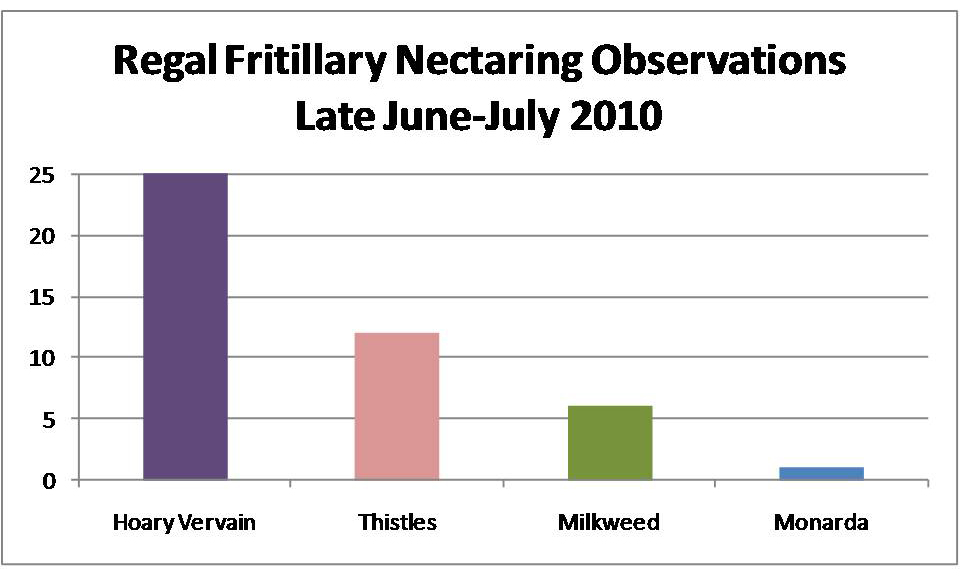
There were really only two kinds of wildflowers that attracted the vast majority of nectaring regal fritillaries through the 2010 season, and both are usually called weeds.  The first was hoary vervain (Verbena stricta) and the second was a small group of thistle species – primarily Flodman’s thistle (Cirsium flodmanii) and tall thistle (Cirsium altissimum).  Hoary vervain is a native wildflower that is largely considered to be a pasture weed by many people because it thrives in overgrazed situations.  Cattle don’t like to eat it and it can spread quickly when the surrounding grasses are weakened.  (However, it also decreases in abundance very quickly when the grasses regain their vigor.)  Flodman’s and tall thistle are two native thistles that are also considered to be weedy plants, and that do well in overgrazed pastures.  The third favorite plant was actually several species of milkweeds lumped together (primarily weedy species like Asclepias syriaca and A. speciosa).

During the early part of the summer, the majority of regal fritillaries nectaring on flowers chose hoary vervain.

In late summer and early fall, vervain largely stopped blooming and other species became more important for nectaring, particularly native thistle species.

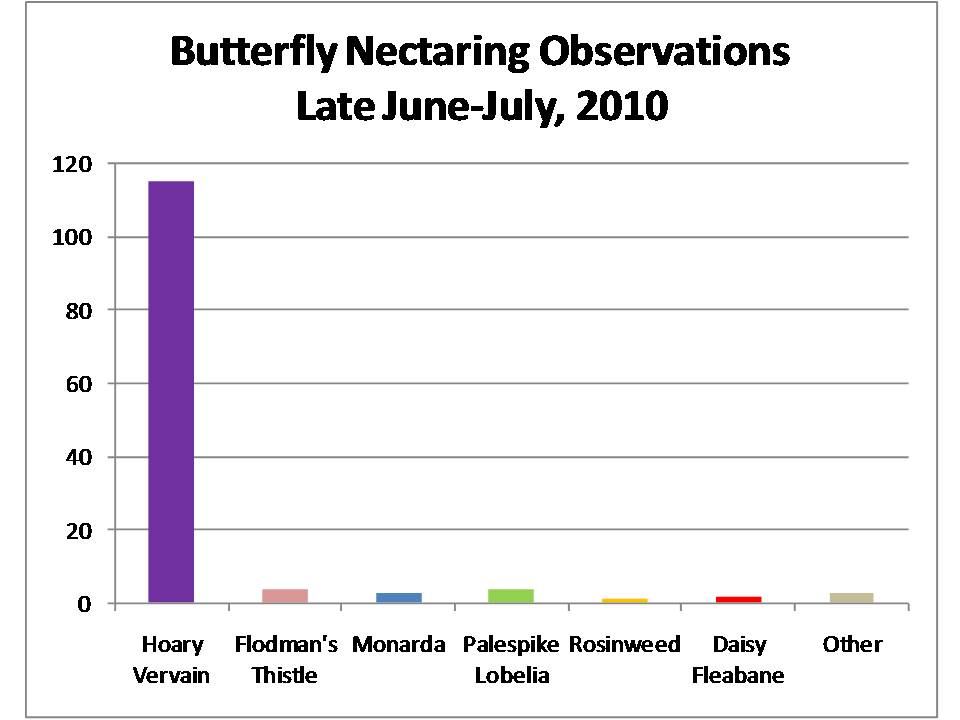
Most of our data collection centered on regal fritillaries, but we also collected data on other butterfly species.  So far, there doesn’t appear to be much difference in the nectaring preferences of regals and the larger butterfly community.  During the early part of the season, hoary vervain was the primary choice for most butterflies and a variety of other species got only infrequent visits.  Later in the season when hoary vervain was largely done blooming, thistles and a few other species, including wild bergamot – aka monarda or Monarda fistulosa and rosinweed (Silphium integrifolium), shared the load.

Observations of early summer nectaring across all butterfly species showed that hoary vervain was the dominant selection for nectaring.

Later in the season, other flower species split the nectaring observations fairly evenly.

One of the most interesting aspects of doing this research on butterflies has been that I’ve been able to look at our prairies through the eyes of butterflies – and that’s given me some surprising insights.  Our remnant prairies are largely degraded by years of overgrazing and broadcast herbicide use, and we’ve been working to slowly bring them back to higher floristic quality.  I’ve assumed that increasing floristic quality would also be good for many other species, including butterflies.  In addition, we’ve worked very hard at getting the highest plant diversity we can into our restored (reconstructed) prairies.  While we’re not restoring those prairies for butterflies, specifically, I’ve always assumed that butterflies would benefit from high plant diversity.  From our very preliminary data on butterflies, it appears that while our restored prairies have many more flower species, including many showy species, they may not be providing any better nectaring opportunities than our remnants!  The flower species most used by regal fritillaries and other butterflies are hoary vervain and thistles, which are at least as common in our remnants as in our restorations.

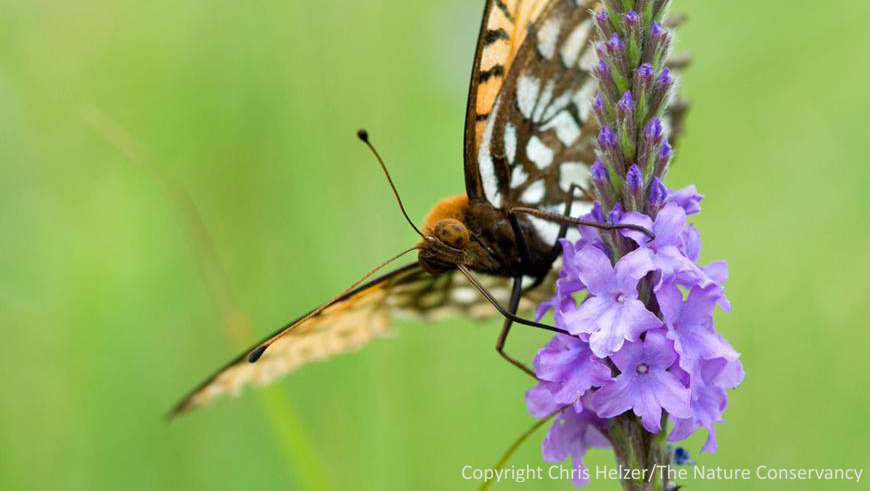
Regal fritillaries, and other butterflies, seem to rely heavily on hoary vervain for nectar in our Platte River Prairies.

I’m confident that there many other benefits of the plant diversity in our restorations, of course, including the availability of a variety of larval host plants for butterflies.  But it’s a little humbling – and intriguing – to see butterflies relying on plant species that do well in beat-up pastures rather than flocking to our showy restored prairies!  It’s important, of course, not to extrapolate these results to other parts of the country.  I’m not saying that regal fritillaries can survive in beat-up pastures in eastern states.  If that was so, we’d have many places in the east with lots of regal fritillaries.  Nebraska and other western states with high numbers of regal fritillaries also have landscapes with relatively high amounts of native prairie – and that may be the most important factor for regal fritillary survival.

The other lesson from our early data seems to be that the value of “weedy” species shouldn’t be discounted just because they thrive in conditions many flower species can’t take.  Vervain and thistles could be the primary plant species supporting our butterfly populations along the Platte River right now.  That’s a pretty good argument for being valuable.  In addition, the violet species that the regals must be using as a larval food plant along the Platte is considered to be relatively weedy because it does well in degraded pastures.  I’m sure glad we have a lot of it – and so are regal fritillaries!  Other weedy plant species have value as well – apart from their obvious role in filling space when “good” plants are weakened by fire, grazing, or drought.  The seeds of native ragweed and annual sunflower species, for example, seem to be excellent food sources for many small mammals and birds (judging from the density of tracks around the plants when it snows).

I’m really looking forward to next season’s butterfly transects.  I enjoyed reacquainting myself with butterflies last summer, and it was good for me to look at our prairie work through a different lens.  I’m sure we’ll learn more as we collect and analyze more data.  In the meantime, we (and our butterflies) will continue to enjoy and appreciate our weeds.

A big thank you to Dr. Ray Moranz for his assistance setting up this project.  Also, Mardell Jasnowski directed most of the data collection in 2010, with help from Nanette Whitten, Nelson Winkel, and Natalie Goergen.