Contrasting Approaches to Prairie Management: Leopold, Land Health and Cabbages.

“A Land Ethic” is the concluding essay in Aldo Leopold’s 1949 book, A Sand County Almanac, and is the most powerful and relevant piece of conservation writing I’ve ever read.   Leopold’s essay spells out the changes we need to make in the way we view our relationship with the land, and it is both impressive and frustrating that nearly everything in that essay still reads true today.  If anyone reading this blog post has never read A Sand County Almanac, please stop reading this, go pick up a copy of the book, and read it.

I’ll wait…
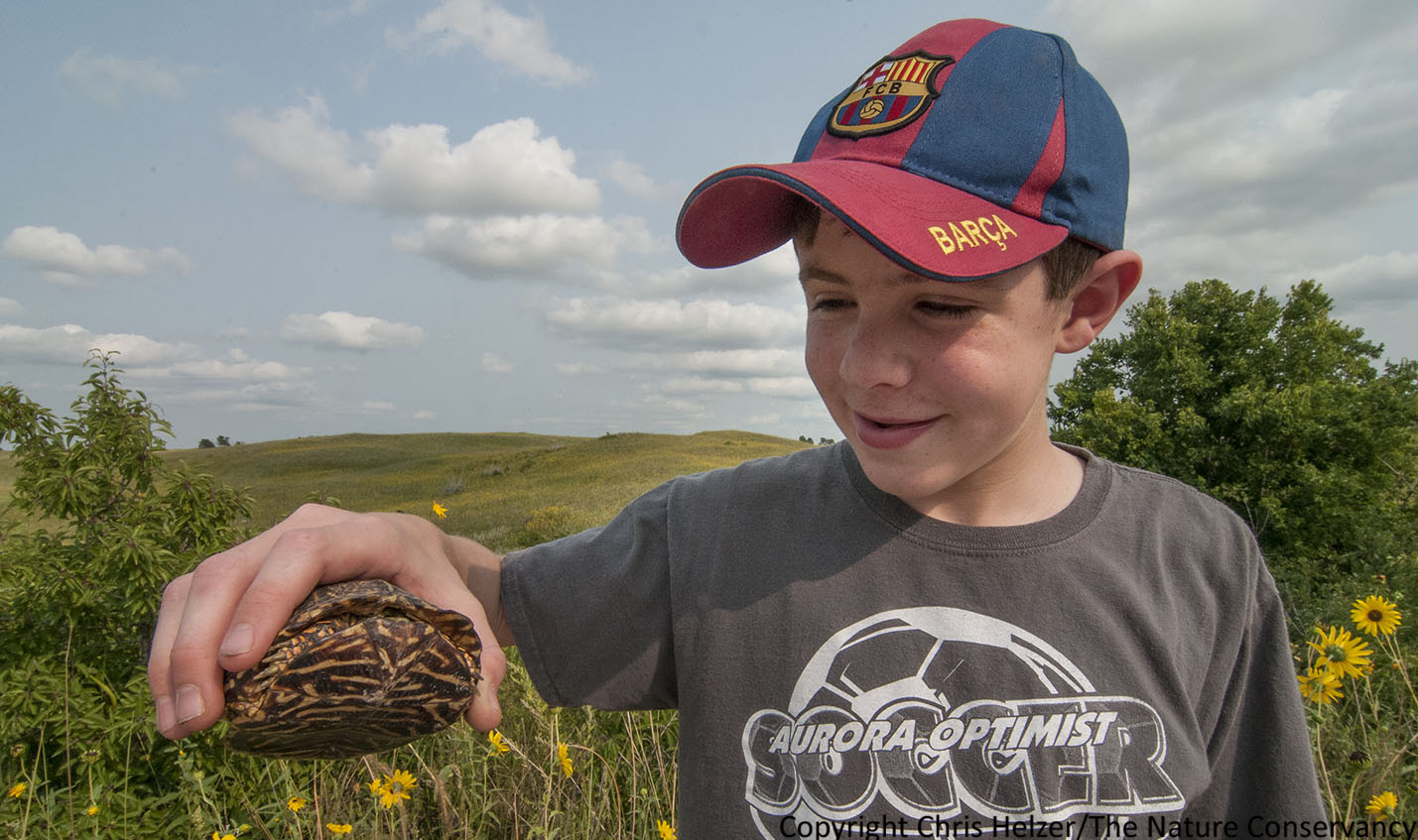
Instilling a land ethic in my kids is one of my highest priorities as a parent.

Instilling a land ethic in my kids is one of my highest priorities as a parent.

One of my favorite parts of “A Land Ethic” is the section titled “Land Health and the A-B Cleavage”.  I’m always blown away by how neatly Leopold synthesizes the field of conservation into the first three sentences of that section:

A land ethic, then, reflects the existence of an ecological conscience, and this in turn reflects a conviction of individual responsibility for the health of the land. Health is the capacity of the land for self-renewal. Conservation is our effort to understand and preserve this capacity.

The very next paragraph introduces an issue I’ve been wrestling with for a long time.

Conservationists are notorious for their dissensions. Superficially these seem to add up to mere confusion, but a more careful scrutiny reveals a single plane of cleavage common to many specialized fields. In each field one group (A) regards the land as soil, and its function as commodity-production; another group (B) regards the land as a biota, and its function as something broader.

Leopold goes on to describe how some in his field of forestry are “quite content to grow trees like cabbages” while others have a less agronomic and more ecological approach.  He also points out that the fields of wildlife management and agriculture each have their own parallel examples of this dichotomy.  These contrasting views of the world still exist in various forms, from the way farmers think about their fields to the way people in cities value natural resources.

I see Leopold’s A-B cleavage very clearly in prairie management.  One example can be found in the way prairies are used for livestock production.  Many livestock producers see prairies primarily as grass farms, and the worth of a plant is determined by its palatability and nutritional value to livestock.  Broadcast herbicide application is commonly used in an attempt to remove “weeds” and leave only the grasses cattle or other livestock most like to eat.  Optimization of grass production also manifests itself in grazing strategies; particularly systems that move cattle through multiple paddocks with the primary goal of increasing the production and dominance of grass.  Grass farmers are exasperated by the perennial reoccurrence of “weeds”, despite their best efforts to prevent them. They don’t see that those weeds fill ecological roles grasses can’t, including roles that improve the overall health and productivity of the land.

A grass farmer's nightmare, these ragweed plants and other "weeds" play important ecological roles and fill in open spaces created by intensive grazing or drought.

A grass farmer’s nightmare, these ragweed plants and other “weeds” play important ecological roles, including filling open spaces created by intensive grazing or drought.  Removing them with herbicide application only results in more “weeds”, which fill the same spaces again.  Perennial grasses easily outcompete these opportunistic plants under light or no grazing pressure.  In fact, a year after this photo was taken, this site was dominated by big bluestem.

Other ranchers, however, see prairies as much more than grass farms.  Instead, they recognize that their livelihood relies on an extraordinarily diverse community of organisms above and below ground.  To these ranchers, the only weeds are those that reduce the diversity of the prairie community and make the land less healthy by Leopold’s definition of health: the capacity of the land for self-renewal.  Livestock producers on this side of the cleavage understand that they and their livestock depend upon soil, plants, pollinators, predators, pathogens, and the interactions between them.  A plant’s importance is not judged only by whether or not a cow will eat it, but also by the roles it fills in the larger community.  Those contributions include the communities of microbes living in the plant’s root system, pollen and nectar for pollinators, and food for herbivores, which in turn support predators that regulate populations of their prey.  Ranchers with an ecological perspective gain as much appreciation from watching bees buzzing from plant to plant as they do from watching the weight gains of their cattle, even though the latter is what allows them to pay their taxes and keep their land.

Just as there is a broad range of perspectives among livestock producers, there are wide contrasts among those who manage prairies for recreation and conservation purposes as well.  Some prairie managers have a single species or narrow set of species as their primary management target.  Those targets are include game species such as ring-necked pheasants, white-tailed deer or ducks, but may also be butterflies or a particular class of plants or grassland birds.  Narrowly-focused managers tend to manage their prairies in much the same way each year so as to provide a consistent set of conditions that best suit their preferred species.  Over time, prairie species not favored by that kind of repetitive management regime diminish in number or disappear, decreasing the overall diversity of the prairie community.  Since ecological resilience (today’s term for Leopold’s “land health”) relies heavily on species diversity, the loss of species from the community weakens its ability to support others, including the managers’ favorites.  Ironically, as the community weakens, managers tend to become even more agronomic in their approach by adding food plots, controlling predators, or increasing herbicide use to suppress plants taking advantage of a less diverse community.

Prairie managers with a broader ecological perspective start with the premise that a diverse prairie community is of utmost importance.  They manage in ways that prevent any particular species or group from becoming too dominant at the expense of others.  These managers don’t judge success by the abundance of one species or another, they focus on processes such as pollination, predator/prey interactions, and other indicators of community diversity and ecological resilience.  Variation in the species composition of a prairie between years is a cause for celebration rather than trepidation.  Year-to-year variation means that many different species (especially insects and animals) experience success over time, rather than just the few who thrive under more stagnant conditions.  Managing for diversity is not a simple process, and requires a careful eye and flexible approach, but the result usually produces strong and stable populations of all species – including those desired by more narrowly-focused managers.

Prairies managed for overall diversity have strong ecological processes that support all species - including game animals, songbirds, insects, plants and livestock. Prairies managed for overall diversity have strong ecological processes that support all species - including game animals, songbirds, insects, plants and livestock.

Prairies managed for overall diversity have strong ecological processes that support all species – including game animals, songbirds, insects, plants and livestock.

Whether we are managing for livestock, game species, butterflies, or flowers, the approach we take is critically important.  There is a strong temptation to continually maximize what we think are the enabling conditions for the species we’re most interested in, but that approach ignores the broader complex system those species depend upon.  The grass that cattle eat relies on productive soil, and that soil’s productivity is supported by a diversity of plants, microbes, pollinators and other prairie community members.  Similarly, the fate of butterflies, pheasants, and deer all depend upon the roles played by their fellow citizens of the prairie.

Trying to deal with all of that complexity may seem daunting, but take another look at Leopold’s definition of land health and conservation: Health is the capacity of the land for self-renewal. Conservation is our effort to understand and preserve this capacity.  Note that Leopold doesn’t say conservation entails fully grasping and perfectly managing the complexities of the land.  Instead, he defines conservation as the effort to do so.   I like that.  We don’t have to know everything to be successful.  Instead, conservation is an adaptive process of learning, incorporating new knowledge into our actions, and then trying again.  That means that conservation is accessible to anyone who appreciates the broad complexity of natural systems and attempts to work within them, rather than against them.

…And isn’t that more fun than just growing cabbages?

Disclaimer:  The author of this post intends no disrespect to those who grow cabbages.  Instead he was simply referring to a quote from earlier in the post to reinforce a point and attempt to end a long and heavy essay with something a little lighter.  Cabbage growing is a perfectly legitimate and important activity, especially when done with appropriate consideration for the broader ecological context of soil and other ecosystem processes required to sustain long-term production…  …Ok, I’ll just stop now.

Previous related posts you might be interested in:

Calendar Prairies

Are Botanists Ruining Prairies?

Why I Care About Prairies and You Should Too

Lately, I’ve been trying to figure out why I think prairie conservation is so important.  I’m not questioning my conviction – I feel very strongly that prairies are worth my time and effort to conserve – but if I can figure out exactly what it is that makes me care so much, maybe I can be more effective at convincing others to feel the same way.

I can list off all kinds of logical and aesthetic reasons that prairies are important.  Prairies build soil, capture carbon, trap sediment, grow livestock, and support pollinators.  Depending upon our individual preferences, prairies also provide us with flowers to enjoy, birds and butterflies to watch, and/or wildlife to hunt.

The buckeye is one of the more striking-looking butterflies that can be found in prairies.

Those are all very practical reasons to think prairies are important, but I don’t care deeply about prairies because they make soil and grow pretty flowers.  More importantly, those reasons are not enough to make someone stop and reconsider a decision to plow up a prairie to plant corn or broadcast spray 2,4-D just to reduce ragweed abundance.  If prairie conservation is going to succeed, you and I both need to understand and articulate the deeper reasons that we feel prairies are worth saving.

Which brings me to Dr. Seuss.

As I was mulling over why I cared so much about prairies, the story of “Horton Hears a Who” popped into my head.  In case you’re not familiar with the story, Horton the elephant accidentally discovers an entire community (Whoville) living on a speck of dust.  After he finds and starts talking with the Whos, Horton agrees to help protect them from harm.  The other characters in the book don’t believe Horton when he tries to tell them about the Whos, and actually go out of their way to steal and destroy the speck of dust he’s trying to protect.  Only when the Whos are finally successful at making enough noise to be heard do those other characters recognize the existence of the Whos and agree to help protect them.

Dr. Seuss’s intended moral to the story (repeated many times) is “A person’s a person, no matter how small.”  It’s a fine moral, but isn’t what drew me to the story as a metaphor of prairie conservation.  Instead, I was thinking about WHY the other characters in the story finally changed their minds.   The sour kangaroo and the Wickersham brothers didn’t give up their threats to boil the speck of dust in Beezelnut oil because Horton finally came up with the right logical argument to explain why the Whos were worth saving.  They changed their minds because when they finally heard the Whos making noise they recognized and identified with the Whos as fellow living creatures.

Can you see where I’m going with this?  I think the biggest thing that drives me to devote my career (and a fair amount of my free time) to prairie conservation is that I have developed a personal connection to the species that live in grasslands.  Not only do I know those species exist, I can also identify with them and what they’re doing to survive.  By becoming familiar with them, I became fond of them.

When I was in graduate school, I studied grassland nesting birds.  I got to know those bird species well, including where they lived, how they survived there, and what motivated and threatened them.  I saw prairies through their eyes, and that made me want to help make those prairies as hospitable to birds as I could.  Eventually, I began learning about prairie plants and insects as well.  I was fascinated to find that their stories were equally or more interesting than those of birds.  Each species had their own unique set of life strategies that allowed them to survive and interact with the world around them.  As a photographer, I usually learn about new species by taking a photograph of some interesting plant or insect, and then identifying it and researching its life later.  I’ve yet to come upon a prairie species that doesn’t have an amazing life story, which means the process of discovery continues to be fulfilling for me.

Pitcher sage (Salvia azurea) is one of my favorite flowers to photograph because of it's unique color and shape. It also seems to be a favorite haunt of many insect species, judging by the number that always seem to be crawling around on or near the flowers.

As the number of species I’ve gotten to know has increased, so has my commitment to prairie conservation.  Maintaining the resilience and vigor of prairie communities has grown from something that seemed like a good idea into a personal mission.  Now I’m working to protect things I love, not just species I’d read about or knew about only in the abstract.

Be honest, would you be more likely to send money to help people recovering from a natural disaster in a neighboring town or in a town on another continent?  With rare exceptions, we’d all choose the nearby town.  Why is that?  I think it’s because we can more easily identify with the people who live there.  We can imagine ourselves in their places.  We can see the disaster and their plight through their eyes.  It’s not that we don’t care about people on other continents, but they’re naturally a little less real to us.

By the way, forming sympathetic bonds with species can be dangerous when managing prairies.  The more I know about the species living in my prairies, the more I understand the ways in which those species are affected (positively and negatively) by management activities.  Any management treatment has negative impacts on some species, and impacts from activities such as prescribed fire can be quite dramatic.  Caring about individual species to the point where I’m unwilling to do anything to hurt them would paralyze me.  Management is all about tradeoffs, and while my management objectives are to sustain all the species I can, I have to be willing to knock populations of some species down periodically so that others can flourish.  I think the key is to become attached to the species, but not the individuals.  Tricky…     

Why does all this matter?  It matters because we need to recruit as many people to the cause of prairie conservation as we can.  Excluding a tiny minority of prairie enthusiasts, when the general public thinks about nature and conservation they look right past prairies to the mountains, lakes, and forests beyond – even when prairies are in their own backyard.  After all, what’s to care about in prairies?  It’s just grass.

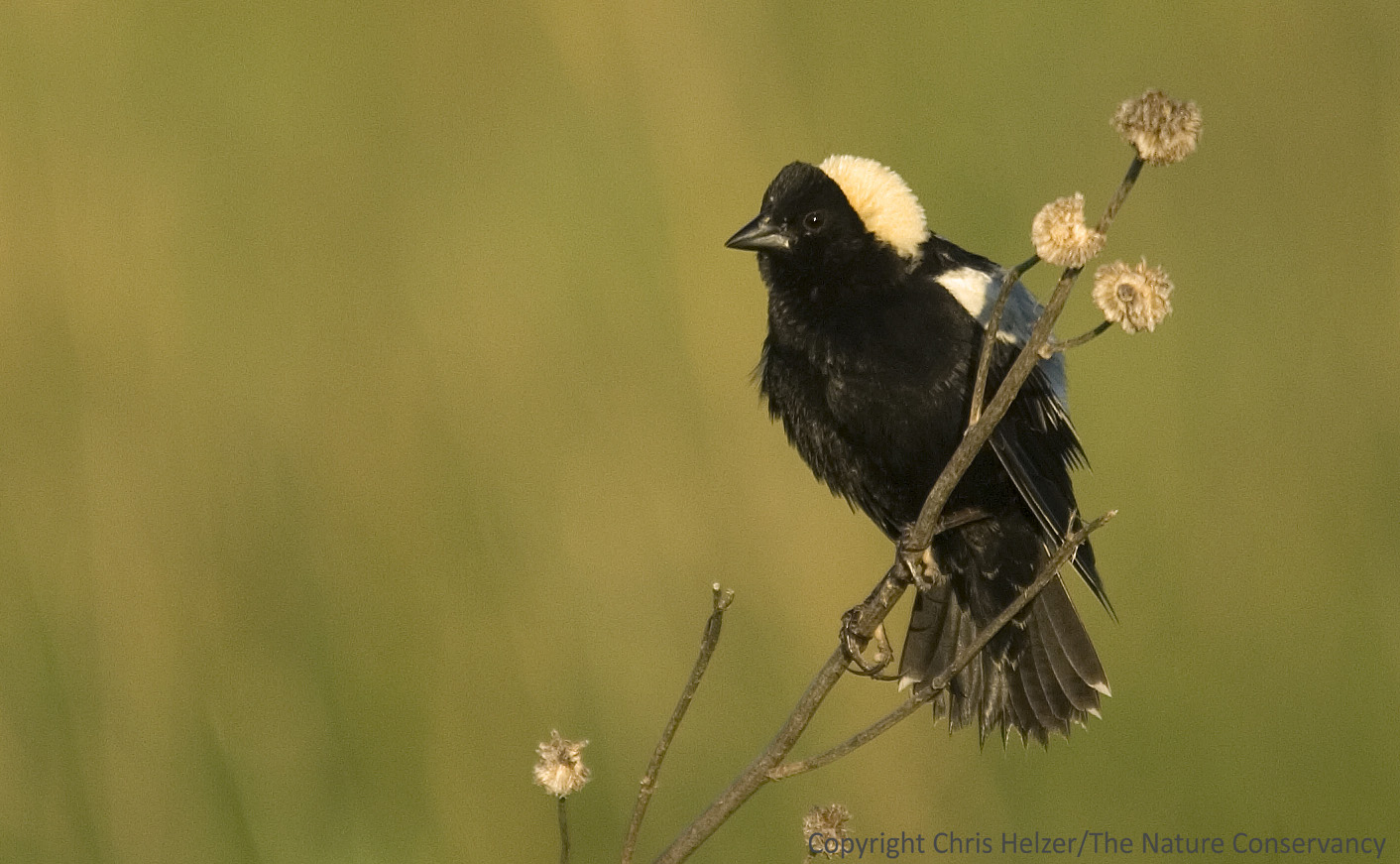
If we’re going to fix that, we’ll need to do more than describe how prairies can help sequester carbon, filter water run-off, or support pollinator populations.   We’ll need to introduce people to the camouflaged looper inchworm that disguises itself with pieces of the flowers it eats – and to the regal fritillary caterpillar which, after hatching from its egg in the fall, sets out on a hike that will end by either finding a violet to feed on or starving to death.  They’ll need to become acquainted with sensitive briar, the sprawling thorny plant with pink koosh ball flowers whose leaves fold up when you touch them.  And who wouldn’t love to meet the bobolink – a little bird that looks like a blackbird after a lobotomy and flies in circles sounding like R2D2 from Star Wars?

The charming and vociferous bobolink.

Through this blog, as well as through numerous presentations, articles, and tours, I spend much of my time sharing what I’ve learned about prairie species with anyone who will listen – hoping that those stories will spur people to explore prairies on their own and start to form their own individual relationships with the species and communities they find.  My photographs and narratives aren’t themselves sufficient to convert people to the cause, but maybe they can at least get some of them to put on their hiking boots and go for a walk.

What about you?  Have you met the citizens of the prairie?  If not, let me help introduce you.  If you have met them, what stories can you tell?  How will you spread your passion about prairies to others?

.

Here are some accounts I’ve written about prairie species I find fascinating.  If you find them interesting too, please share these links with others!

Camouflaged Looper – An inchworm that disguises itself with bits of the flowers it eats.

Yucca Moth – A terrific relationship between a plant and the single species of moth that has the capability to pollinate it.

Submarine Sora – Ever wonder why soras and other rails are so hard to find?

Sensitive Briar – A plant with a koosh ball flower, thorny stems, and leaves that fold up.

Pussytoes – One of the first spring-blooming flowers, and a surprisingly important resource for early season pollinators.

Of Mice and Clover – A great example of the complexity of interactions in prairies.

Crab Spiders – One of the great ambush predators of the world.

Flies – An unbelievably diverse group of insects with a wide range of ecological roles.

Grasshoppers – From their cute little faces to their complex communication strategies, it’s hard to beat grasshoppers.