Should We Manage for Rare Species or Species Diversity?

Land managers constantly make difficult decisions without really knowing the long-term consequences of their choices.

Balancing the sometimes conflicting needs of rare plants like Canada milkvetch (Astragalus canadensis), pollinators, and many other components of prairie communities can be a major challenge. 

For those of you who aren’t ecologists, here are some important vocabulary terms you’ll need to know for this post. 

 1. Conservative species – plants or animals primarily restricted to “intact” or “high-quality” natural areas, as opposed to species that commonly occur in degraded habitats.

2. Species richness – the number of species found in a certain area. High species richness means there are lots of different kinds of plants and/or animals present

3. Species diversity – a kind of modified species richness that also takes into account the evenness, or relative abundance, of each species. When one site has a few dominant species and lots of uncommon ones, it is less diverse than another site with the same total number of species but with more evenly distributed numbers of individuals.


Imagine this situation:  You’re put in charge of managing a tallgrass prairie with thriving populations of several rare plant species.  The prairie is located in a highly fragmented landscape dominated by rowcrop agriculture.  The prairie has been managed with frequent spring burning for many years, and the populations of those rare plants has been pretty stable for at least the last couple of decades.  As you take over, the previous manager tells you she’d recently been considering management changes that might increase overall plant and animal diversity but would likely reduce the population sizes of some rare plant species.  You have to decide whether to stick with the existing management regime or try something different.  What would you do?

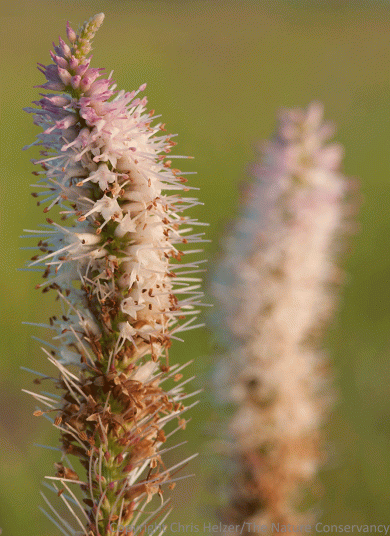
Culver’s root (Veronicastrum virginicum) is a conservative plant species found in a small subset of today’s tallgrass prairies.

It would be perfectly rational and defensible to stick with the strategy that has sustained healthy populations of rare plants for a long time.  Because those plants aren’t found at many other sites, prioritizing them in this prairie makes good sense.  However, before you lock in that choice, let’s consider some other information.

First, there is often an assumption that an abundance of rare plants is an indication that the rest of the prairie community is also intact and healthy. While that assumption seems logical, it’s not always the case.  A good example of this comes from an Illinois study by Ron Panzer and Mark Schwartz.  Their research in the Chicago region showed that neither the number of conservative plant species or rare plant species predicted the number of conservative or rare insect species at a site.  Instead, Panzer and Schwartz concluded that overall plant species richness was more important for insect conservation.

Plant diversity also helps support healthy populations of pollinators and herbivores (invertebrate and vertebrate) by ensuring a consistent supply of food throughout the year.  A wide variety of plant species allows pollinators and herbivores to find high quality food at all times, even though each plant provides those resources at different times of the season.  For this and other reasons, increasing plant species richness can increase both the abundance and diversity of animals, especially invertebrates.  In addition, managing for a variety of vegetation structure types (including a wide range of both plant stature and density) can also help support more animal diversity, including birds, mammals, reptiles, and insects.

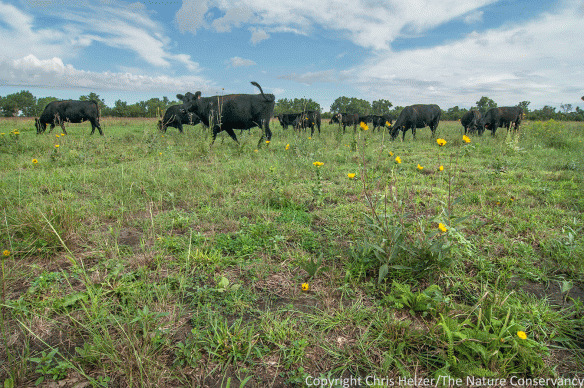
Grazing can decrease the size of rare plant populations, especially in comparison to sites under repetitive haying or burning management. However, carefully planned grazing can also increase plant diversity and provide more varied habitat structure for wildlife and invertebrates.

Every species of plant and animal plays a certain role within the prairie community.  High species richness provides redundancy of function and helps ensure that if one species disappears or can’t fill its role, others can cover for it.  That contributes to ecological resilience – the ability of an ecological community to respond to stress without losing its integrity.  Ecological resilience may be the most important attribute for any natural system, especially in the face of rapid climate change, continuing loss and degradation of habitat, encroaching invasive species and other threats.

Aside from the benefits of managing for species richness, a strict management focus on the needs of a few species can put others at risk.  The use of prescribed fire, for example, provides a competitive edge to some plant species, but has negative impacts on other plants, as well as on some animals.  There have been vigorous arguments between advocates for frequent burning and people concerned about rare butterflies and other insects, as well as reptiles and other animals that can be extremely vulnerable to prairie fires.  Repeated intensive grazing by cattle or bison is another management strategy that favors some plant and animal species, but can negatively impact many others, especially without adequate rest periods between grazing bouts. Management that consistently provides favorable conditions for a few species at the expense of others may eventually eliminate some species from a prairie altogether, or at least reduce their ability to effectively contribute to ecosystem functioning.  If those losses lead to decreased ecological resilience, the resulting impacts may end up negatively affecting the same species a site manager is trying to promote.

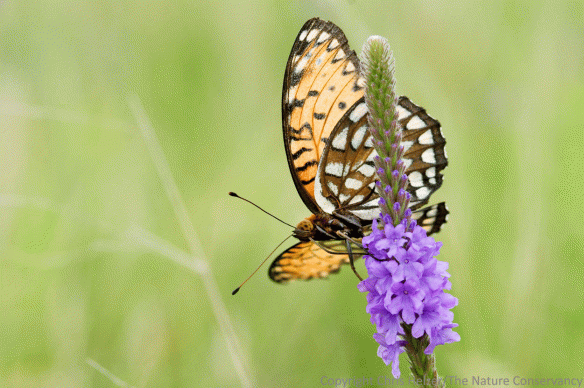
Regal fritillary butterflies are very sensitive to fire, and can be eliminated from isolated prairies if the entire site is burned at an inopportune time. However, populations can also thrive in large prairies managed with a combination of fire and grazing, as long as sufficient unburned areas are available, and many of their favorite nectar plants (like this Verbena stricta) are common, or even weedy.

So, what’s the right path?  Should we prioritize management for rare or conservative species, assuming that other species don’t need as much help?  Or should we focus on species diversity and ecological resilience because we need the strongest possible natural communities in today’s challenging environment?  How should scale (size of prairie) influence decisions?

There are plenty of potential benefits and risks associated with each path, and I’m not here to tell anyone which they should choose.  In most cases, my own tendency is to focus on diversity and resilience, but I completely understand why managers would go the other way, and I think every situation needs to be evaluated independently.  For example, if a species is teetering on the brink of extinction and we need to keep it alive while we create more habitat elsewhere, I’m perfectly fine with prioritizing management to favor that species.

In other cases, I worry that we’re too sometimes unwilling to manage prairies in ways that promote changes in plant composition.  Years of repetitive management (especially frequent haying or burning) create conditions under which plant communities seem very stable.  However, that stability may be a response to consistent management rather than an intrinsic quality.  Allowing plant populations, even of rare species, to fluctuate in size, or even persist at a lower abundance than we’re used to is not the same as driving those species to extinction.  If rare species survive in smaller populations but the surrounding community is more resilient, that may be a win.  Having said that, reducing the size of rare species’ populations can make them more vulnerable to local extinction, and I don’t take that kind of risk lightly.  These are challenging issues.

This bottle gentian plant (Gentiana andrewsii) is an extremely conservative plant, and was growing in a hayed meadow in the Nebraska Sandhills where management conditions are very stable from year to year.

The hard truth is that we don’t yet understand enough about ecological systems to make these kinds of decisions confidently.  I understand the impulse to manage conservatively, sticking with what seems to have been working for a long time – especially in small and isolated prairies.  At the same time, I also think we need to build as much diversity and resilience in our prairies as we can – focusing on both plants and animals – especially in landscapes where we don’t have many left.  I’m glad managers are experimenting lots of different strategies, but we should all take responsibility for collecting data that help us evaluate our management, and keep open minds as we share what we learn with each other.  None of this is easy, but it is certainly important.

The Risks of Managing Prairies Exclusively for Plants

Prairies are often defined as plant communities dominated by grasses, sedges, and wildflowers.  However, prairies are also home to thousands of animal species, not to mention countless varieties of fungi, bacteria, and other microbes.  Animals are just as much part of the prairie as plants, and they can have immense impacts on the plant community and overall prairie function.

Mixed-grass prairie managed with periodic fire and intensive grazing. Gjerloff Prairie - Prairie Plains Resource Institute.

For most of us, prairies are characterized by the plants we see when we walk through them. Gjerloff Prairie – Prairie Plains Resource Institute. Nebraska mixed-grass prairie managed with periodic fire and intensive grazing.

Despite the importance of animals, many prairie managers and biologists focus largely on plants when evaluating the quality of a prairie or when making management decisions.  Interestingly, many ranchers do the same thing, though they tend to focus mostly on dominant grasses while biologists often look more at plant species diversity and/or rare plant species. Regardless, it is rare that the needs of harvest mice, leafhoppers, or smooth green snakes are incorporated into management plans or evaluations of prairie quality.  (A major caveat is that some prairies are managed primarily for bird habitat – either song birds or game birds – a practice that has its own set of ramifications.)

Deer mice and other small mammals are rarely considered during management planning. Small mammals and other animals have specific needs for habitat structure, however, and are also vulnerable

Deer mice and other small mammals are rarely considered during management planning. Small mammals and other animals have specific needs for habitat structure, however, and their populations can decline or disappear after several years of unfavorable habitat conditions.

To be fair, there are good reasons to give plants primary consideration in management planning.  Cattle ranchers correctly recognize that cattle feed mostly on grass, so maintaining robust stands of grasses is critical for a successful ranching operation.  For biologists and conservation land managers, plants are often good indicators of prairie health.  Plant communities are easier to assess than insect or small mammal communities, and they provide the foundation for many ecological processes.  Pollinators, for example, rely on plant diversity and abundance of flowering plants.  Many other insect species need particular plant species or groups of plant species for food and/or living quarters.  A diverse plant community also provides a consistent supply of vegetative growth and seed production for plant-eating animals.

Bees and other pollinators rely upon plant diversity to provide a consistent supply of flowers throughout the growing season. This bee (Svastra sp) is on a native tall thistle (Cirsium altissimum) in September.

Bees and other pollinators rely upon plant diversity to provide a consistent supply of flowers throughout the growing season. This bee (Svastra sp) is on a native tall thistle (Cirsium altissimum) in September.

Not only are plants helpful in assessing prairies, every plant species is also significant and worthy of conservation for its own sake. However, the same is also true for animal species.  A prairie without birds, ants, butterflies, or grasshoppers just wouldn’t be the same, and not just from an aesthetic standpoint.  The complex interactions between all the various organisms in prairies are difficult to study, but absolutely critical to ecological function.  Studies that have excluded or suppressed populations of small mammals or insects have documented tremendous changes to the plant community – usually resulting in lower plant diversity and dominance by a few species at the expense of others.

Animal communities are vital to prairie communities and ecological function, and conserving healthy animal communities relies on at least two broad factors: plant diversity and a variety of habitat structure. As mentioned earlier, most pollinators and herbivores rely upon a wide range of plant species in order to be able to find food at all times of the season, and many insects depend upon particular plant species for survival.  However, habitat structure is also critically important for animal communities, and because every animal has its own unique habitat requirements, prairies need to provide a wide variety of habitat conditions.

Habitat structure for animals is driven by factors such as the amount of plant litter covering the ground and the height and density of the vegetation.  Some animals depend upon short vegetation with lots of exposed bare ground, some need tall dense vegetation, and still others prefer something in-between – or combinations of several habitat types.  The size and distribution of habitat patches is also important.  For example, some animal species need fairly large areas of a particular habitat structure, while others thrive best in situations where small patches of short and tall vegetation are intermixed.

A variety of habitat structure types across a prairie helps ensure a diversity of animal species, including invertebrates, will thrive.

A variety of habitat structure types across a prairie helps ensure that a diversity of animal species, including invertebrates, will thrive.  This area of intensive grazing is adjacent to other patches of taller and thicker vegetation.  Restored prairie in The Nature Conservancy’s Platte River Prairies, Nebraska.

This is the same restored prairie as shown above, but in a diffrent yet

This is the same restored prairie as shown in the previous photo, but in a year when management provided different habitat structure.  Cattle have grazed much of the grass, but have left behind a diversity of blooming plants, including Canada milkvetch (Astragalus canadensis), compass plant (Silphium laciniatum), black-eyed Susans (Rudbeckia hirta), bergamot (Monarda fistulosa), and many others.  Platte River Prairies, Nebraska.

Prairie management regimes that don’t consider animals’ needs can lead to problems.  For example, prairies with relatively uniform vegetation structure provide limited options for animals, regardless of whether that structure is uniformly short, tall, or somewhere in the middle.  A subset of animal species will thrive in those prairies, but other species can experience significant population declines.  If those same conditions persist for too long, some animal species can disappear completely.  Whether or not those species return depends upon the mobility of the animals and the degree of habitat fragmentation around the prairie.

Some management tactics can also cause animal populations to disappear or decline dramatically.  While it is an important part of prairie management, prescribed burning can be particularly dangerous to animals, especially if an entire prairie is burned at once. Fire can directly kill animals, including insects overwintering or living inside plants, but animals can also suffer from the sudden loss of habitat.  These impacts are especially severe in fragmented landscapes where there is nowhere for animals with limited mobility to go for better habitat, and no way for recolonization by species wiped out by fire.  Uniform haying and intensive grazing can have some similar impacts to fire, although both tend to leave a little more habitat for at least some species.

Snakes like this red-sided garter can be vulnerable to fires that occur during the growing season. However, dormant season fires can also be very damaging for insects and other species that overwinter in grass litter or in aboveground stems of plants.

Snakes like this red-sided garter can be vulnerable to fires that occur during the growing season. However, dormant season fires can also be very damaging for insects and other species that overwinter in grass litter or in aboveground stems of plants.

Plant diversity and the survival of rare plant species are important objectives for prairie management.  However, the same can be said for animal diversity and rare animal species.  In some cases, well-planned management can largely account for the needs of both.  Providing a shifting mosaic of habitat patches across big prairies can usually facilitate plant and animal diversity, and accommodations can be made for rare species or species sensitive to particular management tactics such as fire or grazing.  Understanding the needs and evaluating responses of various groups of plants and animals, however, is crucial to successfully adapting management strategies over time.

Conserving all species is much more difficult in small and/or isolated prairies.  A single prescribed fire can potentially wipe out animal species, and repetitive use of any management tactic, including fire, grazing, haying or rest risks eliminating species as well.  Read more about the challenges of managing small prairies here.

In both large and small prairies, setting clear objectives for management is very important.  Ideally, those objectives will accommodate the needs of most or all animal and plant species and sustain ecological resilience.  In reality, it’s more likely that the needs of some species will have to be sacrificed or given less priority than others.  As an example, frequent burns might sustain high populations of many plants (including some rare species) and help suppress invasive trees or grasses, but are likely to eliminate some species of butterflies and other invertebrates, and potentially some snakes and other vertebrates as well.  Alternatively, applying periodic patchy grazing and rest treatments in the same prairie could increase habitat heterogeneity to the benefit of many animals, but could reduce the relative abundance of some sensitive plant species while stimulating higher populations of more grazing tolerant plants.

These kinds of management decisions can be extremely difficult, and there are no easy answers.  The disappearance of any species from a prairie is a big loss, particularly at isolated sites, and we don’t yet know how to predict the ripple effects of losing most species.  Even when management decisions don’t directly eliminate species, reducing population sizes can make species more vulnerable to diseases or other factors that could eventually wipe them out.

Regal fritillaries are

The regal fritillary butterfly is one of many prairie animals that has been shown to be vulnerable to disappearing from prairies because of incompatible management.  Even for fairly mobile species like butterflies, recolonization after local extinction is far from assured, especially in fragmented landscapes.

No matter what management decisions are made, it’s crucial that land managers consider the needs of as many species as possible – including both plants and animals.  It’s not necessarily wrong to manage a prairie primarily for plant diversity or to sustain populations of rare plants.  It’s also understandable that a cattle rancher would want to sustain consistent vigorous stands of grass.  However, in both cases, managers need to acknowledge and accept that optimizing conditions for a particular suite of plant species will lead to negative consequences for other species, including both animals and plants.

Hopefully, continuing research and experience will help us better understand the inescapable tradeoffs that come with these kinds of difficult decisions.  For now, the impacts of losing plant or animal species and the potential for those losses to affect ecological resilience are still very unpredictable.  The best we can do is to be clear and honest with ourselves and others about why we’re making decisions, and do our best to evaluate the results and learn as we go.


If you’re interested in learning more about how excluding or suppressing animal populations can lead to unexpected and complex reactions in grassland communities, here are a couple example research papers.

Herbivory and Plant Species Coexistence: Community Regulation by an Outbreaking Phyotophagous Insect.  Walter P. Carson and Richard B. Root.  2000.  Ecological Monographs 70(1):73-99.

 Secondary plant succession: how is it modified by insect herbivory?  V.K. Brown and A.C. Gange. 1992. Vegetatio 101:3-13

Massive and Distinctive Effects of Meadow Voles on Grassland Vegetation.  2006.  Henry F. Howe, Barbara Zorn-Arnold, Amy Sullivan and Joel S. Brown, Ecology 87(12):3007-3013

Effects of Coyote Removal on the Faunal Community in Western Texas.  1999.  Scott E. Henke and Fred C. Bryant.  Journal of Wildlife Management 63(4):1066-1081