
At our Niobrara Valley Preserve (NVP), we’re experimenting with prairie management techniques to see if we can create a wider range of habitat conditions than is found throughout much of the Nebraska Sandhills. On many Sandhills ranches, pastures look fairly similar to each other in terms of vegetation structure. That’s because Sandhills ranchers tend to be careful in their grazing management to avoid wind erosion that can cause “blowouts” of bare sand. As a result, pastures are rarely grazed intensively enough to create wide expanses of bare ground. If intensive grazing does happen, it’s usually on a small scale and/or for short periods of time, which allows for quick recovery of grasses.

The Nebraska Sandhills have tremendous innate heterogeneity. Just in this photo, you can see areas of bare sand created by pocket gophers and/or other animals, habitat structure created by various kinds of plants, including grasses, wildflowers, yucca, and shrubs. Vegetation height varies greatly across small areas.
Overall, the ecology of the Nebraska Sandhills seems very healthy. It’s a huge and mostly intact grassland landscape, and because of the dry sandy soils, topography and diversity of vegetation, there is quite a bit of habitat heterogeneity that is independent of management. As you walk across most Sandhills pastures, you will move through both short/sparse vegetation and taller/dense vegetation, and occasionally come across other structural components like yucca plants or plum thickets. Wildlife and insect species can often find the habitat structure they need somewhere in that pasture, though it might be in a small patch surrounded by other habitat types. That seems to be true even for many bird species, which have relatively large breeding territories. As an example, in pastures with fairly tall vegetation, we often see and hear horned larks that are (apparently) nesting in a few small and scattered patches of the short vegetation structure they prefer. Those patches of short habitat often occur in gravelly flat areas or in favorite feeding areas for cattle, where grass growth is weak because of frequent grazing.

This late July photo shows a portion of our west bison pasture that was burned this spring and has been grazed intensively by bison all year. Because bison are in the pasture year round, they had immediate access to the burned area and started grazing regrowth as soon as it was available.
We’re trying to figure out more about how management with patch-burn grazing or other similar grazing systems affects Sandhills ecology. Patch-burn grazing has part of the management of our bison pastures at NVP since the early 1990’s. Because of that, we know Sandhills vegetation can recover from fires that are followed immediately by season-long intensive grazing. However, we still don’t know much about how many animal species might respond – positively or negatively – to the kind of large patch heterogeneity created by this kind of management. Instead of pastures with interspersed small areas of tall and short vegetation, we’re trying to create large patches (500-1000 acre patches within 10,000-12,000 acre pastures) of each habitat type and then shift the location of those patches between years.

Plains sunflower (an annual) often becomes very abundant after fires because it germinates well in exposed soil and then thrives in the absence of strong competition from perennial grasses. This is the current year’s burn patch in our east bison pasture, where plains sunflower tall and blooming, surrounded by short-cropped grasses.
Creating large patches of various habitat types could bring both advantages and disadvantages to different species. As an example, large patches could create an abundance of resources that support larger and more viable populations of some animal species. On the other hand, a vole who likes thatchy habitat could wake up in the middle of a 1000 acre burn, and it would have to make a long dangerous trip to find a more suitable place to live. Trying to evaluate those potential costs and benefits is a big challenge for us.

This landscape shot shows the abundance of plains sunflower across the entire burned patch.
One possible advantage of the kind of shifting mosaic of habitat approach we’re trying is that it helps avoid risks that come from having the same habitat conditions in the same place year after year. Just as crop rotation can help avoid buildups of pests and pathogens, shifting habitat types from place to place could have important benefits. For example varying the location of habitat types from year to year could limit disease outbreaks and help prevent predators or herbivores from building up large and potentially destabilizing populations.

Showy evening primrose, aka fourpoint evening primrose (Oenothera rhombipetala) where the prairie was burned in 2015 and grazed intensively in both 2015 and 2016. This opportunistic biennial is taking advantage of a long period where grasses are weakened by prior intensive grazing and haven’t yet recovered.
The most intriguing part of our experimentation for me, though, is the idea that we could create large ‘recovery patches’ where grasses have been weakened by a full season of intensive grazing and the plant community is temporarily dominated by opportunistic, mostly short-lived plant species. That combination of short grasses and tall ‘weedy’ wildflowers can provide excellent brood-rearing habitat for some birds and important structure for reptiles and invertebrates that need to regulate their body temperature by moving quickly from sun to shade as needed. Studies in other landscapes have shown that this kind of recovery patch habitat creates pulses of high insect biomass, which could have numerous impacts – including the provision of an awful lot of food for wildlife. In addition, if an abundance of opportunistic plants include species beneficial to pollinators, that could provide quite a bonanza of resources for bees, butterflies, and other insects.

Zoomed out
In most of the Sandhills, patches of ‘weedy’ habitat tend to be in small, static and widely scattered locations such as around windmills or other places where cattle or bison frequently congregate. We’re wondering what might happen if we created big patches of the same habitat type and shifted their location from year to year. In our Platte River Prairies, patch-burn grazing (and similar strategies) has sustained prairie plant diversity over many years, but we haven’t looked closely for similar responses in the Sandhills. In addition, we know a little about how birds respond to patch-burn grazing in the Sandhills, but not much about impacts on other species like lizards, pollinators, small mammals, or invertebrates. Now we’re trying to collect data on the responses from all those different organisms.
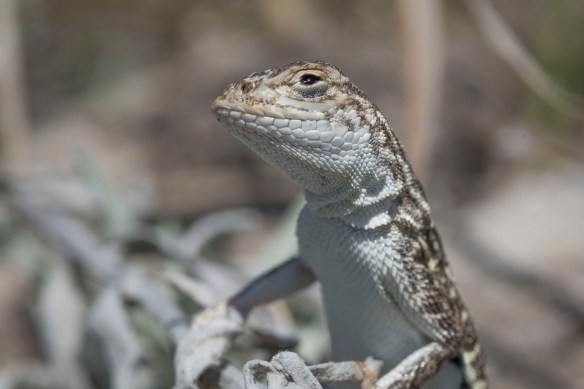
The lesser earless lizard is often found in and around sand blowouts or other habitat patches with abundant bare sand. Will they respond positively to much larger patches of sparse vegetation? Can they successfully shift their population locations as we burn/graze new sites?

Will pollinators such as this plasterer bee (Colletes sp) benefit from higher abundances of flowering plants in big patches of Sandhills prairie that are recovering from season-long intensive grazing?

This is part of our east bison pasture that hasn’t burned since 2012, and has been only lightly grazed during that time period. It should support a different array of wildlife and allow different plant species to thrive than more recently-grazed areas. Providing a wide range of habitat types across the prairie seems beneficial for biological diversity, but we still need to test that idea in the Sandhills.
I’ve really enjoyed digging into all the questions we have about our attempts to create more habitat heterogeneity in the Sandhills. We haven’t had time to answer many questions yet, but we feel like we’re at least creating something different than what exists throughout most of the Sandhills landscape. A few years from now, we might conclude that the heterogeneity we created didn’t really result in any significant positive or negative impacts compared to what exists elsewhere. If that’s the conclusion, we’ll move forward with that in mind. On the other hand, we might find that there are some important positive (and/or negative) impacts of the shifting mosaic approach we’re testing. In the meantime, it’s exciting to have the opportunity to try something different and watch what happens. Stay tuned…

If nothing else, huge populations of Plains sunflower like this one in our west bison pasture provide a different (and I think beautiful) look to parts of the Sandhills landscape at the Niobrara Valley Preserve.

 The Prairie Ecologist