Hubbard Fellowship Blog – A Watershed Reflection by Dillon

This post is by Dillon Blankenship, one of our Hubbard Fellows.  

Though I came into the Hubbard Fellowship to learn about restoration and conservation of prairies, I have had the good fortune to spend a fair amount of time in, associated with, or, at least, thinking about stream and river systems too. Most of these experiences have been of the Platte River – from surveying for mussels in a southern braid to visiting the various dams, diversions and other irrigation structures that utilize its mighty flow. Oh, and of course, how about the bazillion hours shared with roosting sandhill cranes and awestruck visitors in riverside blinds this spring!

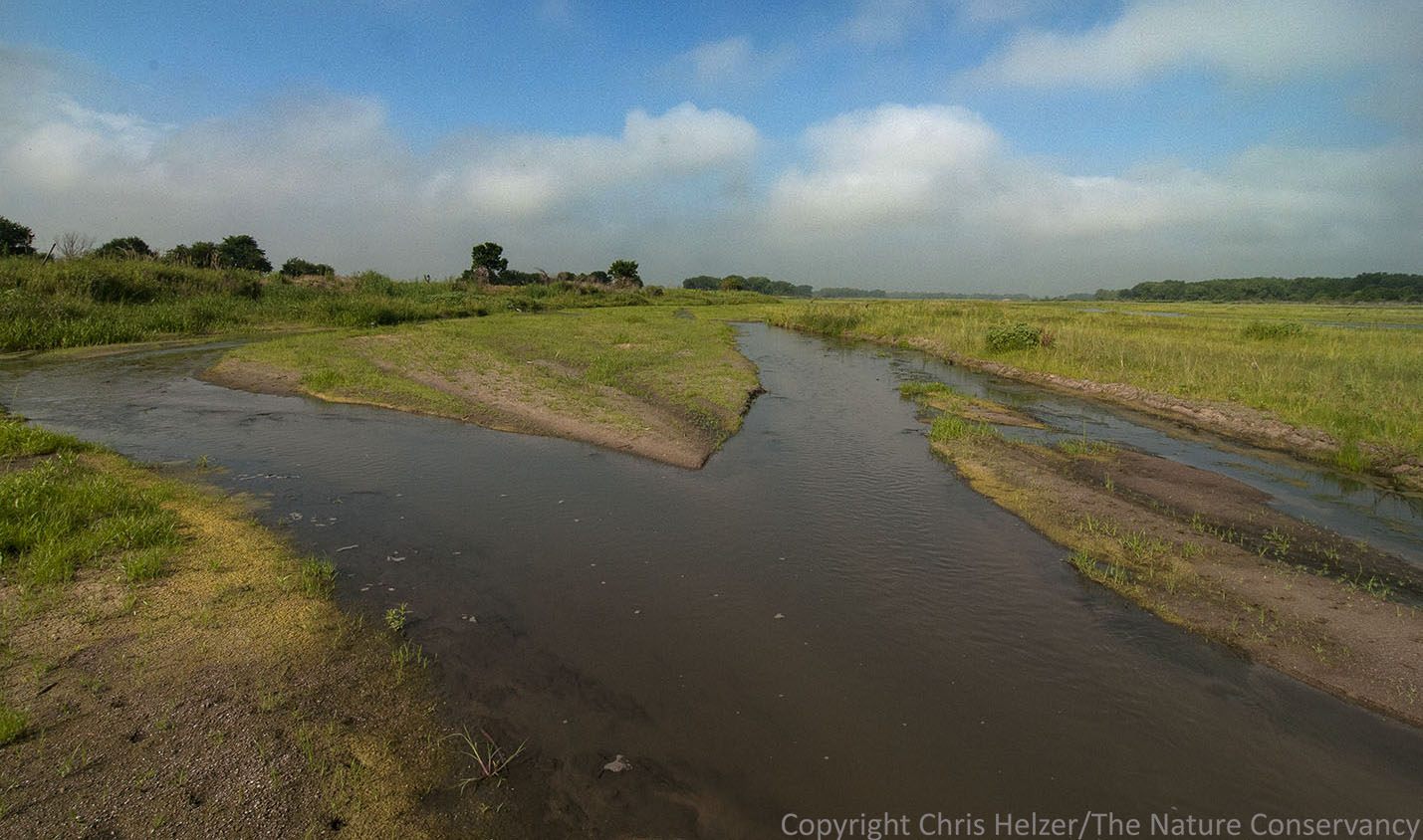
The Central Platte River near Wood River, Nebraska.

The Central Platte River near Wood River, Nebraska.

Even when my work does not lead me there, the Platte is inescapable – I drive across it to go just about anywhere and often parallel it for miles on end (who is following who?) as I journey across the state. It is also a persisting reference point and a comforting explanation for some of the tree lines I see from Interstate 80. Its associated groundwater makes possible our impressively realized agricultural potential and supports a great diversity of plants and wildlife. Here is a good map of the extent of the Platte Watershed –  http://en.wikipedia.org/wiki/Platte_River#/media/File:Platterivermap.jpg – which I see in the embodiment of the Platte River itself, but is much more expansive than a single waterway.
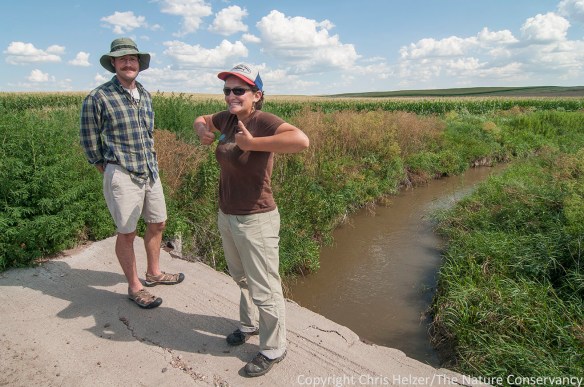
Hubbard Fellows Dillon Blankenship (left) and Jasmine Cutter stand near an irrigation ditch during a tour of Platte River irrigation activities.

Hubbard Fellows Dillon Blankenship (left) and Jasmine Cutter stand near an irrigation ditch while on a tour to learn about irrigated agriculture and the Platte River.

I mention this on The Prairie Ecologist blog now because I am feeling particularly inspired to appreciate my watershed today. I’ve been doing an online course concerning water issues in the western United States that has had me thinking a lot about where my water comes from – which, thankfully, is plentiful enough from its origins in the Rockies to me and on to the Missouri that I don’t have to borrow from watersheds beyond my own. It has also illuminated the complexity of how we allocate water resources to satisfy interests across state boundaries (Colorado, Wyoming, and Nebraska for the Platte) and has altogether inspired a deeper appreciation for this vital fluid’s movement across the landscape.

Of course, The Prairie Ecologist blog community is a diverse crowd when it comes to geography, so I expect many of you to be intrinsically tied to rivers and watersheds beyond the Platte and that is great!

Some of your attachments must be physical – you live on them and in them and they, quite literally, are a part of you. However, I also suspect you have been affected by water systems in nonmaterial ways– the memory of a family canoeing trip (or “tanking” excursion if you are Nebraskan), the viewing of an inspiring water-related natural spectacle, or the comfort of a secret fishing spot for contemplation and big catfish.

Many people's strongest experience on the Platte River comes while watching sandhill cranes in the spring.

Many people’s strongest personal connection with the Platte River comes from watching migratory sandhill cranes in the spring.

Despite being a Platte River patron – and to some extent a lover of the Loup and a Niobrara nut – I also feel the pull of waters from previous, far-off stations (Oregon’s Willamette River, the Buffalo River of Arkansas…) and am excited to be shaped by whichever watersheds I call home in the future.

For the sake of this watershed reflection, I want YOU to get involved in these musings…

In a book*I have been reading I found this gem of a question, which is particularly relevant here:

After the author reminds us that the human body is nearly 2/3 composed of water, he asks, “What body of water makes up 2/3 of you?”

Well? [This would be a good time for you to utilize that comments section at the bottom of the page…]

And if, by chance, the Platte IS your river, I hope you will check out what our friends at the Platte Basin Timelapse project have been up to as they document and share “a watershed in motion.” http://www.plattebasintimelapse.com/


*Urrea, Luis Alberto. Wandering Time. Tucson: University of Arizona Press, 1999. Print.



Hubbard Fellowship Blog – Jasmine and Tractors

This post is written by Jasmine Cutter, one of our Hubbard Fellows.  

I Like Big Tractors and I Cannot Lie

I think I’ve had unacknowledged tractor-envy for a while. Growing up in the suburbs, the biggest piece of “machinery” I dealt with was probably our push lawnmower. When I moved to Minnesota and the prevalence and presence of large farm machinery increased greatly, I’d often find myself feeling a little jealous of the people who got to drive combines (once I learned that’s what those giant things are called) and the other mysterious, long-limbed machines; they commanded so much power at their fingertips, and I wondered what the world looked like from so high. When I got to use a riding mower in Montana (my first time on non-automotive machinery), I thought that was fantastic. Thankfully, living in Nebraska has provided an antidote to my tractor-envy, and has given me a chance to refine my mowing abilities.

Ear protection: check! Cold protection: check! Awesome sunglasses: check! Don’t worry, I was parked.  Photo by Jasmine Cutter.

Ear protection: check! Cold protection: check! Awesome sunglasses: check! Don’t worry, I was parked. Photo by Jasmine Cutter.

Dillon and I were lucky that soon after our arrival, Platte River Prairies acquired our new, shiny green John Deere 5075E tractor. There is also a well-used, slightly less intimidating, yellow John Deere 401B tractor. I knew that we would get to learn how to operate tractors as part of the Fellowship, but I was unaware of how vital the tractors are to our management here. Most of that was due to ignorance about how many ways a tractor can be put to use (sooo many ways!), but I was also generally naive about how precious labor and time is to land stewards. My previous stewardship experience at Carleton College was in a relatively labor-rich context – working in the Arboretum was a work-study option – and many management objectives were tackled by teams of students wielding hand tools. The dynamic here is very different: there is Nelson, there are the two Fellows (we spend a lot of time on stewardship, but also have other projects diverting our attention), Sam for the last few summers, and Chris and Mardell come and help when they can. Even with the help of our wonderful volunteers who help collect seed and tackle other projects for us, we’re dealing with a lot less available labor. Needless to say, I’m learning a lot about how to prioritize management and how to efficiently tackle our management objectives.

Ownership of a reliable tractor that is the right size and has the right attachments to fit our needs is essential to efficiently completing our stewardship goals. For example, we’ve been spending the last two weeks pulling out old fence line, and while we might be strong, we’re not fence-has-been-buried-by-six inches-of-dirt-and-sod-and-is-now-one-with-the-earth strong. I have tried tugging on those fences, and while we can make some progress, it’s amazing to operate the tractor and feel how easily our hydraulics enable us to tear out these wires that would take us days to uncover and pull out by hand.

.

The mighty green beast in all its glory!  Photo by Chris Helzer.

Our tractors certainly help with efficiency, but simply stated, we depend on them as our primary implement for a lot of our stewardship and maintenance. Our tractors are essential to mowing firebreaks and fence lines, and for shredding invasive vegetation to a height that delays its growth and makes it short enough for our sprayers. When we need to spray a large area (which isn’t too often), the tractor – and Nelson’s innovative spray setups – save us a lot of time, and give us a powerful tool against our more entrenched patches of invasive plants. The tractors are also used for pulling out stuck vehicles (not that we ever do that) and for navigating terrain that’s too swampy for our other vehicles.

I love our tractors because they enable us to accomplish our objectives, but I also appreciate that they give me a chance to hone a different set of skills. Tractor operation requires attention to detail, especially spatial awareness. I need to be able to judge terrain so I don’t tip over, I need to make sure I’m far enough from co-workers and vehicles that I’m not going to damage anything or anyone, and I also need to know which part of the tractor is going to move when I pull a certain lever. Because they are so powerful, it’s hard to undo something once you’ve done it with a tractor. There’s also a lot of multi-tasking. It’s surprisingly challenging to simultaneously steer, manage my speed, avoid obstacles, engage the correct lever, and ensure that I’m spraying (or mowing) what I intend to. But I’m feeling more confident in my abilities every day.

During the corn harvest, our neighbors invited us out to ride along with them in their combine and corn wagon. Years of curiosity finally fulfilled!

During the corn harvest, our neighbors invited us out to ride along with them in their combine and corn wagon. Years of curiosity finally fulfilled!  Photo by Jasmine Cutter.

Tractor time is also appreciated because mowing or spraying is relatively slow-paced compared to most of our stewardship tasks. For all their might, when you’re mowing with a tractor, the swath you’re able to cover is only as wide as the shredder attachment, which is a relatively unimpressive nine feet or so. When you’re covering several dozen acres nine feet at a time at 5mph, that is a lot of laps. But honestly, I really value this time, and the chance to examine every foot of our property (or at least every foot of the perimeter). I’ve honed my ability to identify plants while in motion, discovered gates I never knew existed, observed how voles move through the thatch, and gained a better understanding of how the plant composition of our units shifts with topography.

Our tractors are also indirectly beneficial to my life here. When the farmers are talking about their machinery, I have at least some idea of what they’re talking about, even if our tractor is maybe half the size of theirs. I now know what a PTO (Power Take-Off) is, I have stories about nearly tipping over (there was a buried beaver lodge), and I am able to get some respect when people learn that I drive the tractor, just like Nelson or Dillon.

Dillon driving the John Deere.  Self portrait by Dillon Blankenship.

Dillon driving the John Deere. Self portrait by Dillon Blankenship.

While I’ve satiated the majority of my machinery-related curiosity, my only remaining wish is that I have a chance to operate the mythical skidsteer. I saw one in action at Carleton and marveled at its ability to wrench stumps from the ground (something we desperately need help with along our old fence line). Nelson has told us tales of their dexterity and usefulness at our Rulo site. Hopefully I will get a chance to drive the beast when we rent one in the spring; just think of all the farm cred I’ll garner!