
Hubbard Fellowship Blog – Last Day for the Cattle

A guest post by Anne Stine, one of our Hubbard Fellows.  (All photos are by Anne)

Today (Oct. 1, 2013) the lessee came and got his cattle, as per our agreement.  I’ll miss them. It is with some sadness that Eliza and I have been awaiting their removal from the pastures.  We’ve really enjoyed having cattle around.  I like the way they keep an eye on you in the pastures, and the way they prick their ears and step forward before turning tail and scattering.  I like hearing them bellow (pronounced “bell-er”) at each other to keep tabs on calves and herd-mates. Eliza and I agree that our acreage will seem a lot emptier without them.
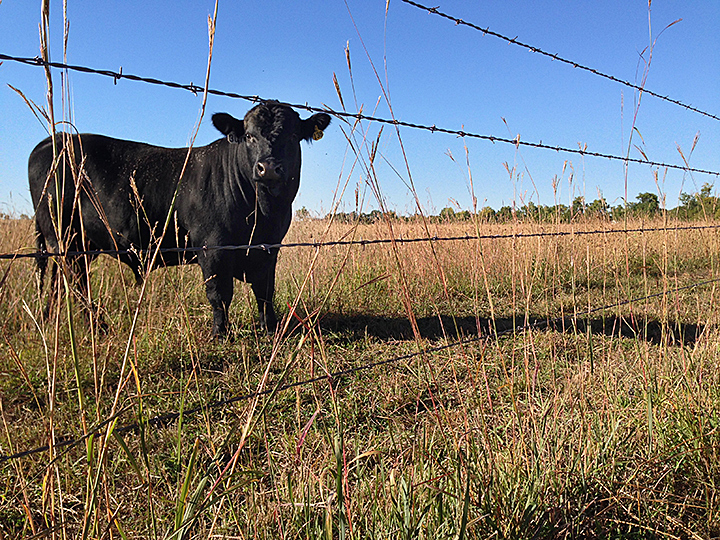
This bull came over to check out my truck.

This bull came over to check out my truck.

It’s funny, because the herds we interact with are a skittish lot, but they are still companionable if you go about your own business without paying them too much mind.  The closest I’ve ever gotten to our lessee’s cattle was when I was harvesting seed from white prairie clover.  At first the cattle were suspicious, but when they saw me hunched over pulling on plants it seemed to put them at ease.  I imagined I looked like I was grazing too.  A cow wandered so close I could hear her huffing and chewing as she snipped grass. I liked being surrounded by the cattle and having them placidly munch around me.

Chris entertaining the cows.  (Editor's note: For the record, I was photographing a management practice, not entertaining cattle.  Not more than a couple of the cows were laughing.)

Chris entertaining the cows. (Editor’s note: For the record, I was photographing a management practice, not entertaining cattle. Not more than a couple of the cows were actually laughing.)

If you step away from your truck cattle will often surround it and start rubbing on it and licking it.  The calves are more curious than their mothers.  They’ll follow trucks and come over to see what you are up to.  I’ve seen cows nose their inquisitive calves away from trucks they were stepping forward to examine.

If I ever have a prairie of my own, I’ll definitely look into leasing out the grass on it.

Goodbye cattle.

Goodbye!

Hubbard Fellowship Blog – Seed Harvest Musings

A guest post by Anne Stine, one of our Hubbard Fellows:

I had a pretty good foundation in forest ecology leaving graduate school, but I’ve really developed my forb and grass ID skills since starting work here in Wood River.  Prairie ecology has grown on me.  I was trying to explain it to a forest-loving friend: once you know the local plants, (that is, you see their uniqueness and their ecological and historical roles), you get a better feel for a place.

One of my favorite stewardship tasks is harvesting native seeds.  The best assignments are for hard to find plants that require some knowledge of their life history to locate.  I really enjoy the scavenger hunt and foraging aspects of searching for less widely distributed species.  I also had one of my major botanical victories seed harvesting on the prairie.

Prairie seeds drying in our seed barn.  Platte River Prairies, Nebraska.  Photo by Eliza Perry, Hubbard Fellow.

Prairie seeds drying in our seed barn. Platte River Prairies, Nebraska. Photo by Eliza Perry, Hubbard Fellow.

I was driving around, looking for Canada milkvetch (Astragalus canadensis), when I spotted a familiar stalk sticking up in the pasture.  I remembered it as a plant that had ridden shotgun in the truck with my field supervisor for a few weeks- clearly someone had harvested it.  I just didn’t know what it was.  Its flowers were now gone, only the long brown stalks and seed heads remained.  The leaves looked like a cross between a strawberry and a prairie rose (Rosa arkansana).  I collected the seeds and took the stalks home to identify. I was excited to discover that the plant in question, tall cinquefoil (Potentilla arguta), is indeed in the rose family!  Ecologists find their thrills where they may…

As a natural history geek, I can’t help but delight in picking up random facts about prairie plants.  For example, rocky mountain bee plant (Cleome serrulata) is a glorious nectar source for pollinators in mid-summer.  Doves eat the seeds in the fall.  Its leaves and seeds were also eaten by some Native Americans, “in spite of its strong smell” (“Grassland plants of South Dakota and the Northern Great Plains”, Johnson & Larson 1999). It takes all kinds, the authors seem to say.  I didn’t find the odor especially displeasing, but evidently even botanists have personal opinions.

Rocky mountain bee plant.  Platte River Prairies, Nebraska.

Rocky mountain bee plant. Platte River Prairies, Nebraska.

Foxglove penstemon (Penstemon digitalis) is one plant whose smell I do find distasteful, and its fragrance garnered no mention. This wildflower is not widespread, but neither is it difficult to find.  You smell it before you see it.  Interestingly, it’s the seed heads and red stalks that stink, not the flower.  I left a bucket in the cab of the truck while I harvested other things, and when I came back the cab was filled with flies.  They followed the bucket to the truck bed when I moved it.

Most of the seeds we collect this year will be used in over-seeding projects, intended to increase the diversity of prairies we manage.  Over-seeding is one strategy we can use to boost a site’s forb population without tearing up the prairie and starting over.  Building a native seed bank of local ecotypes is a useful technique to increase your chances of success in prairie restoration.  It’s not bad work either, if you can get it.