Photo of the Week – August 13, 2015

Nebraska has 108 species of grasshoppers.  They come in a wide variety of sizes, shapes, and colors, and generally speaking, the further west you go in the state, the more species you can find.  While on a short trip to the Nebraska Sandhills last week, I was fortunate to see two of the most beautiful of Nebraska’s grasshopper species.

Lubber grasshopper. Valentine National Wildlife Refuge, Nebraska.

Plains lubber grasshopper (Brachystola magna). Valentine National Wildlife Refuge, Nebraska.

I saw several plains lubber grasshoppers (aka homesteaders) in the prairie.  These huge flightless grasshoppers are about the size of mice (more than two inches long, and very thick).  They feed primarily on wildflowers, including sunflowers and hoary vervain (Verbena stricta).  According to Grasshoppers of Nebraska, they are not crop pests but in years when their population soars, they can present a hazard to drivers because their bodies can make roads slick.  Think of that!
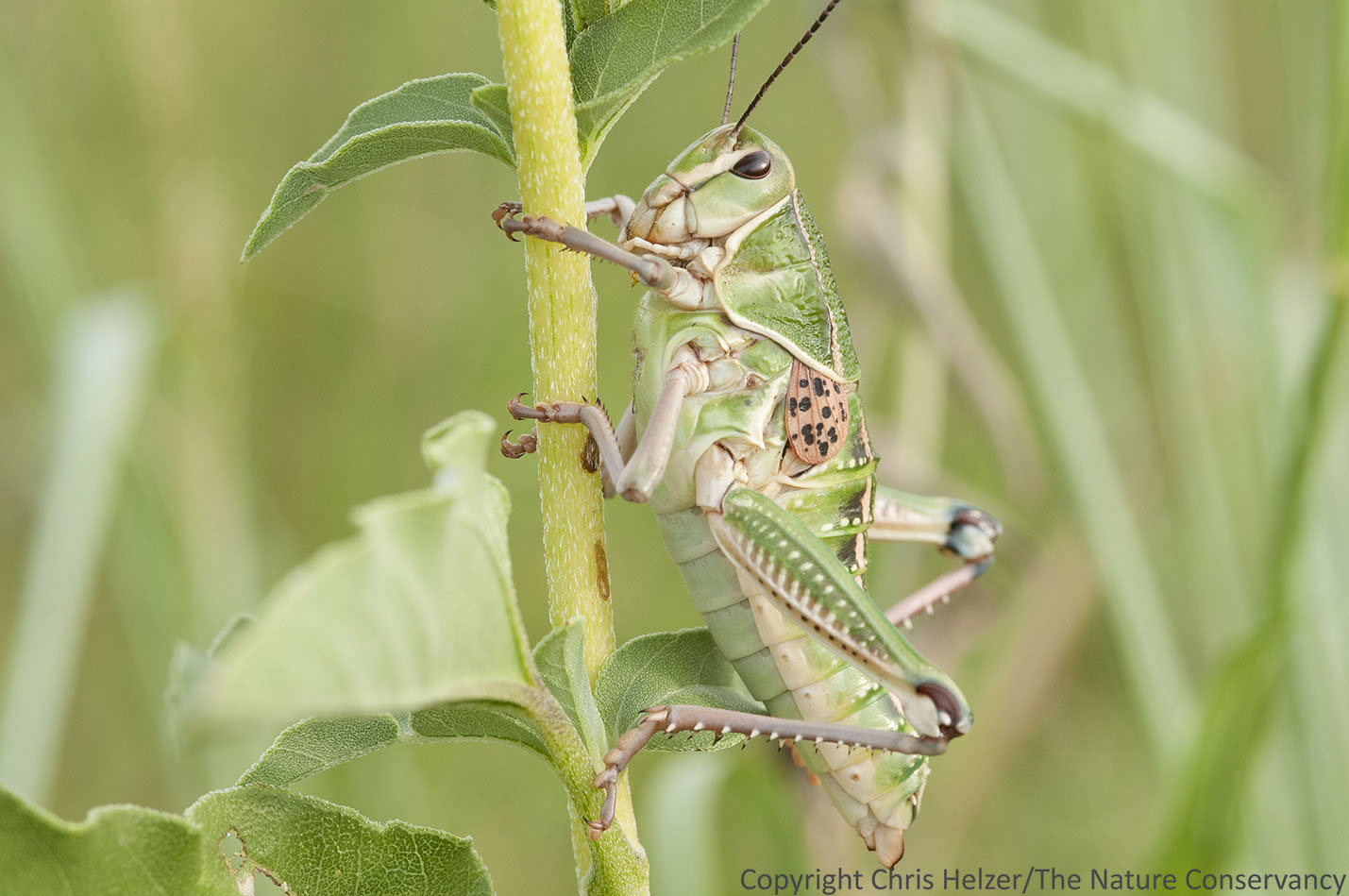
Lubber grasshopper. Cherry county ranch of Jim VanWinkle, Nebraska.

Here is a plains lubber on its favorite (according to some sources) food – an annual sunflower (Helianthus petiolaris).  Cherry County, Nebraska.

I also enjoyed the chance to see a painted grasshopper (Dactylotum bicolor), a species I first noticed last year on a trip to western Kansas.  This gorgeous creature might be the easiest grasshopper in Nebraska to identify – as far as I know, there isn’t anything else in the state that looks remotely like it.  Like the lubber, the painted grasshopper eats primarily wildflowers, particularly false boneset (Brickellia eupatorioides).  It likes habitat with lots of exposed soil, which is convenient for those of us trying to find and photograph them.

Painted grasshopper at the Valentine National Wildlife Refuge. Nebraska.

A painted grasshopper at the Valentine National Wildlife Refuge. Nebraska.  The colors and patterns on this species make it impossible to confuse with others.

Grasshoppers, and katydids, which look like grasshoppers but have much longer antennae, are a fascinating group of insects.  They have interesting and complex communication strategies and each species has its own set of dietary preferences – some are specialists on just a few plant species and others are generalists.  Only a very few are considered to be pest species, and most of those are simply native species that have adapted well to the abundant food humans provide in the form of monoculture row crops.

Perhaps most of all, the sheer abundance and biomass of grasshoppers make them ecologically important in grasslands.  If you collected all the grasshoppers from a prairie, their biomass would equal that of the bison or cattle in the same prairie.  As such, they are a major food source for many other species, including many birds, and major herbivores that influence plant communities in complex ways.

Grasshoppers are also very visually appealing if you take the time to look closely at them.  The plains lubber and painted grasshopper are particularly pretty, but every grasshopper species has its own beautiful combination of colors and patterns.  Go out and find your favorite today!

My Little Buddy

What would you do if a big hairy bug landed on your hand?  Smash it?  Flick it off?  Hop and and down, flail your arms, and make loud high pitched noises?

Well, you COULD do one of those things.  OR, you you could lift your hand slowly toward your eyes, examine the minute details of the bug’s multi-faceted eyes, and admire the design of its predatory body.

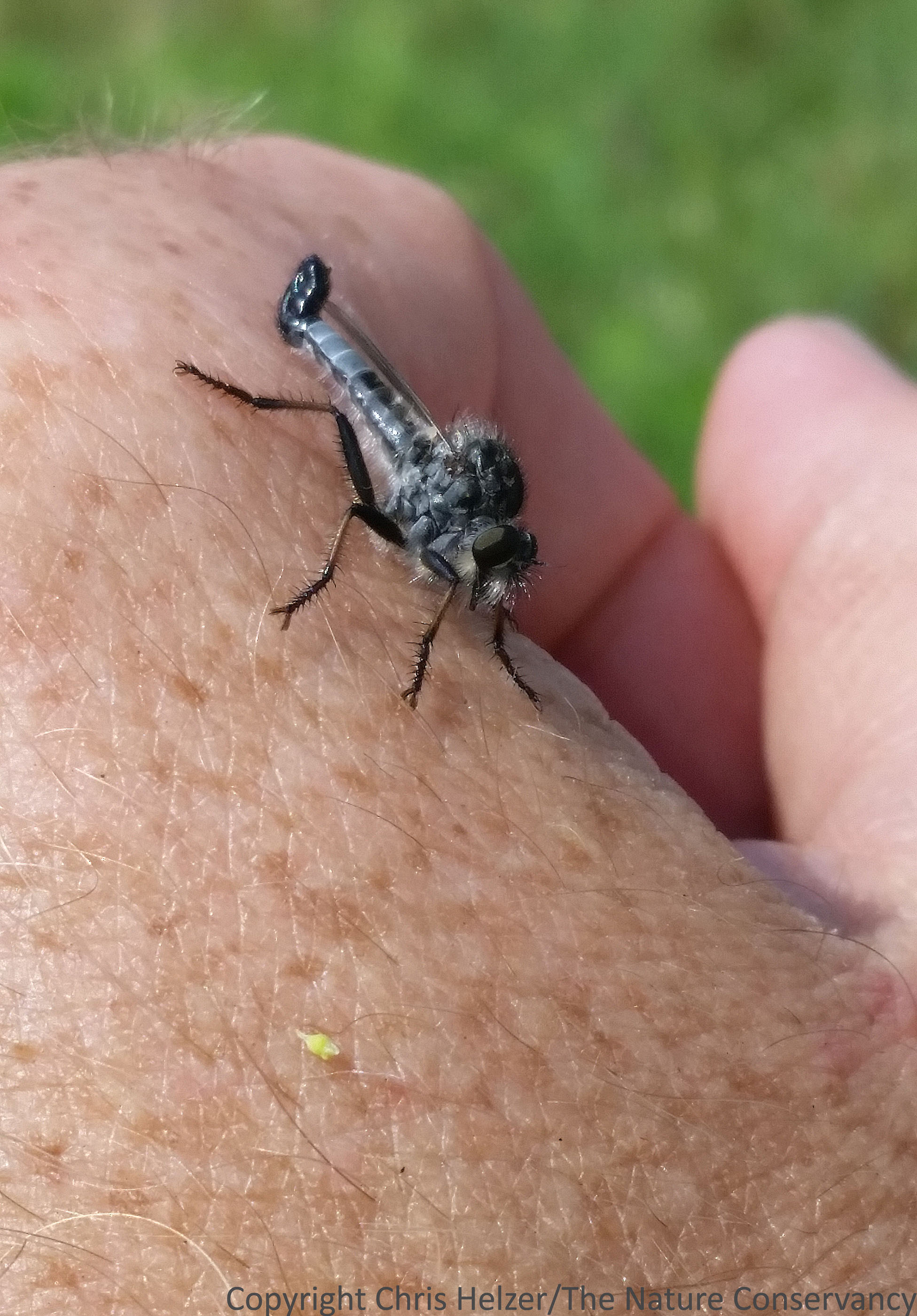
Robber fly  TNC Platte River Prairies, Nebraska.

A robber fly on my hand.  The Nature Conservancy’s Platte River Prairies, Nebraska.

I was finishing some vegetation monitoring last week when a robber fly landed on my hand.  Since I didn’t figure it would stay long, I stopped what I was doing and took a closer look.  After ten seconds or so, I decided I’d try to take a photo of it, so I carefully pulled my phone out of my pocket (the only camera I had with me) and snapped a couple photos.

The fly was still sitting still, so I tried some closer shots and got some decent quality (for a phone) close-up images of the fly.  After a couple minutes, I really needed to finish the last couple sampling plots, so I carefully went about that work while trying not to move my left hand faster than necessary.  The fly stayed on my hand for about 10 minutes!  Just as I finished the last plot and decided to head back to the truck where my actual camera was, the fly apparently decided it had better things to do and took off.

Robber fly  TNC Platte River Prairies, Nebraska.

The robber fly stuck around long enough for photos.

I’m not sure why my little buddy decided to land and hang out on my hand for as long as it did.  My previous experience with robber flies is that they are very difficult to get close to, and even more difficult to photograph.  This one, however, seemed very comfortable sitting on my hand, even as I moved around and continued my work.  For a brief moment, a second robber fly (looked like the same species) landed next to my buddy, but it flew off again almost immediately.

If you’re not familiar with robber flies, they are true flies – just like house flies, horse flies and roughly 37,000 other species of flies in North America.  They have the short simple antennae, sucking mouthparts, and greatly reduced club-like hind wings that distinguish flies from bees, beetles, bugs, and all other kinds of insects. However, robber flies are predatory, which may not fit your mental image of flies, (though there are actually quite a few different predatory flies).  The robber flies I see in our prairies are mostly fuzzy long-bodied predators that often perch on a tall plant, watching for prey to fly past.  When they spot a likely target, they dart out after it, capture it (they hope) and return to a perch to eat it.

I could come up with all kinds of unrealistic and anthropomorphic reasons the robber fly stayed on my hand for so long, but the truth is that I have no idea.  Maybe it just needed a rest, and was too tired to be picky about where it landed (any port in a storm?).  If so, I’m sure glad it picked me to hang out with.

…and not someone who might have responded differently to a big fuzzy bug landing on their hand…