Photo of the Week – July 29, 2011

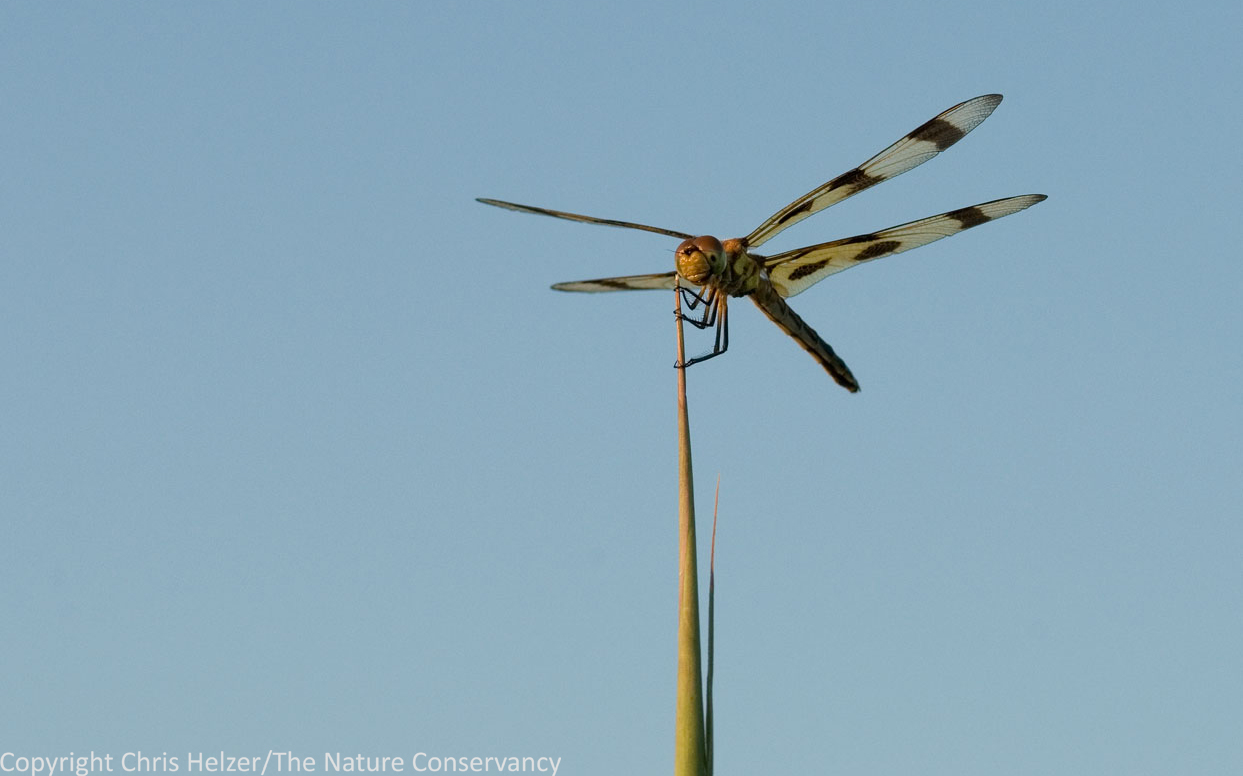
A dragonfly perched high in a restored prairie - The Nature Conservancy's Kankakee Sands Prairie Restoration, Indiana.

While we were at The Nature Conservancy’s Kankakee Sands prairie restoration site in Indiana last week, we got to see a lot of very nice restored prairies.  The last night we were there, I slipped away from the group for a few hours to look for photos.  The heat was stifling and the sun was still bright as it was dropping toward the horizon, but there were some hazy clouds near the horizon, and I hoped for a little good photo light before the sun disappeared altogether.

My objective was to capture the essence of some of Kankakee Sands’ work by photographing landscape images of restored prairies.  I should have known that wasn’t going to end well.  I don’t envy journalists and others who get sent out on photo shoots with specific objectives, because it never seems to work out for me.  The ideal situation for me is to wander around someplace when the light is favorable and photograph whatever combinations of light and opportunity present themselves.  Whenever I try to force the situation, I end up chasing a shot that doesn’t work well, and I either don’t take any photos or I don’t like any of the ones I take.  And meanwhile, I walk right past all kinds of really nice opportunities.

On this particular night, I spent about a 1/2 hour trying to force landscape photos out of a night that really didn’t work for them.  I was in a completely flat prairie with strong light coming from near the horizon, and the result was that the tops of the flowers and grasses were lit brightly and everything else was in deep shadows.  I actually managed to find a few compositions that showed the plant composition of the site by zooming in on small groups of plants that were all favorably lit.  But it wasn’t what I was really looking for.

Eventually, frustrated and drenched in sweat, I gave up and switched to my macro lens so I could follow some of the dragonflies that had been laughing at me the whole night.  The dragonflies were defending territories from high perches, so they were sitting in beautiful light, and would zoom out in circular flight patterns and then return to the same perches.  They were clearly the appropriate photo subject of the night, and I finally gave in and got a few shots before the light gave out completely. 

The new symbol (for me, anyway) of the Kankakee Sands restoration effort - a territorial dragonfly that laughs at photographers.

So – here you go.  This is my photo of the essence of the Kankakee Sands restoration site.  While it doesn’t show what I’d started the evening looking for, it’s actually not a bad representation of a project that is trying to re-build connections between fragmented prairie and wetland habitats for the benefit of the diverse life that relies on those habitats.  This dragonfly was perched and feeding in a site that had been a cornfield just a few years before.  Maybe it’s not a bad symbol of success. 

And either way, it’s what the light gave me…

Coneflower Surprise

Last Friday, I was at my in-laws’ farm in eastern Nebraska (Sarpy County).  Toward evening, the hot, sunny, windy day transformed into a cloudy evening with light winds.  I stepped outside to look over the little patch of restored (reconstructed) prairie in their front yard.  The sun was going down behind the clouds, but there was a small gap of clear sky between the clouds and the horizon.  Foreseeing a small window of time with some good photography light, I went back to the house and grabbed my camera and tripod.

As I came back out of the house, the sun was just coming out from beneath the cloud bank.  There were only a few places in the little prairie that were being hit by the low-angled light, and the best color in the prairie seemed to be the gray-headed coneflowers that were just starting to bloom.

Gray-headed coneflower (Ratibida pinnata). Reconstructed prairie in Sarpy County, Nebraska.

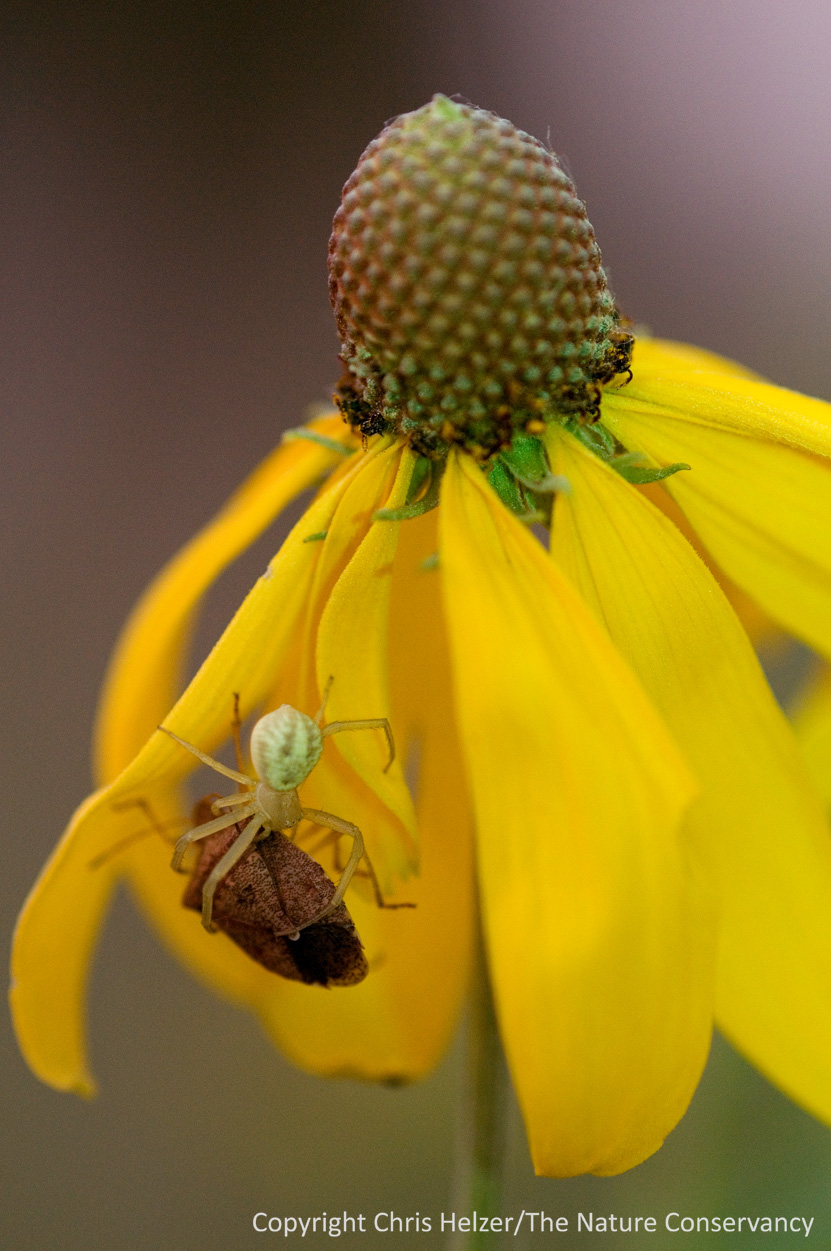
I chose a flower and set up the tripod to photograph it.  After only a couple of shots, a stink bug flew in and landed on the flower.  Just as I began focusing on the stink bug to see if he’d pose for me, a crab spider suddenly squirted out from inside the canopy of coneflower petals and grabbed the startled stinkbug.

A fuzzy first attempt to photograph the stink bug immediately after it landed.

Initially, it looked like the spider was having a hard time finding a place to bite the stink bug through its tough carapace, and for a minute or so, the bug was pulling the spider around the flower and it looked like an even chance that it would escape.  However, the spider eventually latched onto the bug near its rear end and hung on tight.  The stink bug continued to crawl around the flower, hauling its spider cargo with it, but over the next few minutes, the pauses between movements became longer and longer.

The stink bug pulled the tenacious spider around the flower, but the spider hung on tight.

In this photos, you can better see where the spider sunk its fangs into the bug (soft underbelly?) Eventually, the stink bug stopped moving altogether, and it was game over.

As the sun went completely below the horizon, the stink bug finally stopped moving altogether.  After a few more minutes, the crab spider let go and rotated the bug into a new position within its grasp – apparently to feed?  I’ve watched crab spiders attack and feed quite a few times before, but don’t remember seeing one changes positions to feed – they usually seem to just feed through the same initial fang holes they make to kill their prey.

A few minutes after the stink bug gave up the ghost, the spider flipped it around in its grasp. This photo was taken several minutes after the sun had gone down.

Right after the above photo was taken, the wind kicked up, and it felt like a storm was coming, so I left the spider to its meal and went inside – feeling grateful for the opportunity I’d just been given.  Who needs TV??

Photography Notes

For those of you who are photographers, you might be interested in a couple things about this photo series.  As I said earlier, the sun was low in the sky.  It was a nice red color, providing great warm light on the flowers and bugs.  However, the light intensity was low, and there was a slight breeze that was moving all the plants back and forth a little.  I set my camera’s ISO on 500 to allow me to take the photos at between 1/25 and 1/50 of a second, which was sufficient to stop the motion.  The trickiest part was timing the shot between wind gusts so that the eyes of the stink bug were in focus (or, a few times, the eyes of the spider).  I shot about 50 photos over 10 minutes or so, and about 15 turned out sharp.

The last photo above was the trickiest because the sun had been down for a few minutes, and there was no direct light at all.  It was too dark to stop the wind-driven motion of the flower, so my only chance at getting the last shot – which was too good to miss – was to use flash.  Unfortunately, I don’t own a flash other than the pop-up flash on my Nikon 300s camera.  So, I popped up the flash and set the camera on Program.  Having tried to use the flash for macrophotography before, I knew that the flash alone was too bright for close-up shots, so I improvised.  I pulled my arm out of one sleeve of my t-shirt and wrapped the shirt sleeve over the flash and then took the shot.  The shirt acted to diffuse the flash’s light but still allowed enough light for the photo to work.  It took a couple tries to get the focus right (the stupid flower kept moving!) but it eventually worked.  I’d never tried this little trick before, but now I might have to throw an old t-shirt into my camera bag for similar future emergencies!  (or maybe just the sleeve…)