
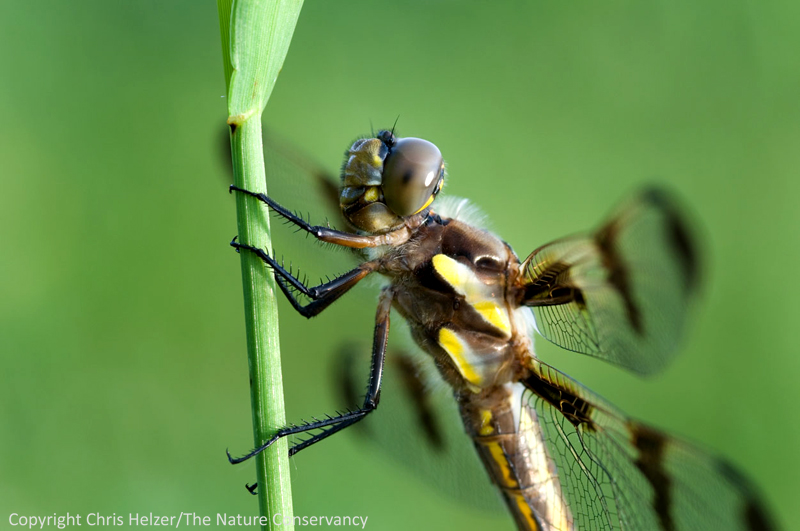
A dragonfly in the early morning - Pawnee County, Nebraska
One of the great things about close-up photography is that you don’t have to travel very far to find subject matter. This photo was taken in the backyard of a house near Steinauer, Nebraska. We had rented the house for some graduate students to use as part of a research project in southeastern Nebraska. I was visiting the students to help set up some vegetation survey work, and found this dragonfly while I was waiting for everyone else to finish breakfast.
The morning was ideal for close-up photographs. The sun was just coming up, and there were diffuse clouds along the horizon that kept some of the intensity out of the light but didn’t remove the warm color. Most importantly, there was almost no wind. I was walking along the yard, following a fenceline between the yard and an adjacent pasture – looking for anything interesting. There was a small depression filled with wetland vegetation just inside the fenceline, and I found several dragonflies perched there, waiting for the day to warm up. Despite the cool morning, a couple of them managed to rouse themselves and fly off as I approached them. This one, fortunately, was not worried about me or my tripod (or was too cold to care) and the sun was just starting to hit it. I was able to swing my tripod around so that the yard was behind the dragonfly – simplifying the background – and took a series of photos as I crept ever closer to it. This was the last one I took before I backed away and left the dragonfly in peace.

 The Prairie Ecologist