Thawing Frozen Bugs; The Grand Experiment

A few weeks ago, I wrote a post about seeing insects frozen in ice, and speculated about how they’d gotten there and whether or not they might still be alive.  Several of you encouraged me to chip them out of the ice and thaw them out, apparently under the impression that I walk around with an ice axe in my camera bag.  Nevertheless, it was a fair point.  Why speculate aimlessly about something that’s relatively easy to test – especially since it wasn’t the first time I had speculated on the same topic?  (See this post from 2014 and this one from 2011.)  For my 2014 post, I actually did pull a beetle out of the ice and watched it thaw.  It was dead.

Yesterday afternoon, I went out to our family prairie with two of our boys.  Daniel needed to do some video work for a school project, and Calvin wanted to continue working on a project he’d started over the weekend, which seems to involve propping sticks against a tree.  Anyway, two boys wanted to go to the prairie – what am I going to do, say no?  We went.

The boys had a great time playing on the ice while I was looking at dead bugs.  I should maybe reevaluate my life choices.

It was about 60 degrees when we got to the prairie, and while the wetland was still frozen enough to walk on, the top of the ice was melting.  Scattered about the wetland and a nearby livestock watering tank were numerous insects that had been frozen yesterday but today were sitting in shallow puddles of water on top of the ice.  Ah ha!  No ice axe required today!  I grabbed a ziplock bag from my pack (an item even more essential to a naturalist than an ice axe) and starting scooping up cold insects and enough water to keep them in.

A cell phone photo of a couple insects on the frozen surface of a livestock watering tank.

When we got home, I dumped the bag of pond water and insects into a shallow bowl.  The following is a series of observations as I conducted this important scientific research project.

A bowl of bugs on my kitchen counter.

February 26, 2018

6:05 pm – Dumped 18 insects into a bowl, having collected them from thawing water on top of the ice at our prairie.  (No ice axe required, thank you.)  Initial observation: the insects appear to be motionless.  Some are floating, others are submerged.  Water is still very cold.

6:31 pm – Added a little warm water to the bowl.  Some of the insects moved as I dumped the water in, but seemed to settle back into stillness as the water calmed.  Brief movement considered inconclusive as to the status of insects as living or dead.  More data needed.

7:48 pm – Water is about room temperature now.  Wondering if the floating are the same that were floating earlier?  Probably.  A couple stray legs seem to be lying around on the bottom of the bowl.  If those insects are soon to be alive and kicking, it appears they’ll have fewer legs to kick than they had last fall.

A stray leg.

8:33 pm – Of the 18 insects I collected and put in the bowl, 18 still appear to be motionless.  Fighting boredom (me, not the insects).  Must remain vigilant in order to complete this project for my readers.

9:07 pm – Nothing to report.

10:15 pm – I’m pretty sure several of these insects are actually flies, and not aquatic insects at all.  Wondering if I should remove those from the dataset so as not to bias the overall survival rate.

Waiter, there’s a fly in my soup.  Oh? What’s it doing?  Nothing.  (Not a funny joke at all.)

10:56 pm – So tired.  Can’t keep my eyes open much longer.  Have decided to call it a night and hope not to lose any insects that reanimate during the night and fly off.  Will cover the bowl to be sure. One of the water boatmen has a certain look in its eye – just waiting for me to go to sleep so it can make its escape?  Better seal the bowl tightly…

February 27, 2018

6:15 am – Woke up and immediately remembered the insects.  Hoped none had eaten each other or escaped.  Scurried out to the kitchen and did a quick count.  All 18 insects accounted for.  None seem to be moving.  Sleeping after a busy night of swimming?  Swished the water around a little, and got some movement, but didn’t seem to be the result of any self-propelling motion by the insects.  Hopes diminishing.

7:10 am – Have decided that maybe the water temperature needs to be higher in order to break diapause.  Added hot water to the bowl.  Awaiting developments.

7:15 am – Trying to fix breakfast and school lunches.  Need counter space.  Re-evaluating this entire project.

7:23 am – Adapted Monty Python sketch running through my head…  “These bugs are no more!  They’ve ceased to be!  They’ve expired and gone to meet their maker!  They’re stiffs!  Bereft of life, they rest in peace!…These are EX-BUGS!”

Figure 1. Number of dead bugs compared to number of live bugs.  Error bars represent 95% confidence intervals.

7:24 am – Ok, I’m calling it.  Experiment over.  These insects are dead, folks.  Of the 18 frozen insects removed from the surface of the ice, 18 died.  This evidence strongly supports the suggestion that insects found embedded near the surface of frozen wetlands are, in fact, dead.  This follows the findings of Helzer (2014) who similarly found a frozen beetle to be dead upon thawing.

Pining for the fjords?  Nope.

Ok?

Ok.  I’m going to clean out that ziplock bag now and get it back in my camera bag.  I don’t want to be left without it when the next scientific opportunity presents itself.

Popular Sunflowers

Plains sunflower (Helianthus petiolaris) is an annual plant that responds quickly to bare ground in the Nebraska Sandhills.  They pop up after fire, intensive grazing, pocket gopher activity or something else allows light to hit the soil.  At times, they can be widespread, as they were the year after the 2012 drought. More often, they are found scattered about the prairie in patches of sparse vegetation.  They have started to bloom in earnest over the last couple of weeks, adding beautiful accents to the summer prairie.

Last week, I spent an hour photographing sunflowers and the wide variety of small creatures I found hanging about on them.  In just one hour, I spotted a pretty incredible abundance and diversity of invertebrates within an area smaller than my backyard.  Sunflowers, especially annual sunflowers, are considered by some to be weeds, but these native wildflowers play really important roles in prairie ecology.  Their seeds are extremely valuable as food sources for many wildlife species and their young leaves and flower buds/blossoms are quality forage for other species, including cattle.  During this time of year, the abundant and accessible pollen and nectar of the flowers is what seemed to be attracting the invertebrates I saw.  Here is a selection of photos displaying some of those sunflower visitors.

A variety of grasshopper, katydid, and tree cricket species are all commonly found feeding on the flower parts and pollen of sunflowers.  Weevils, long-horned beetles, and other beetles are also frequently seen.

Weevils and other beetles (including the one at the top right of this photo) were also present on many of the sunflowers I saw.

Hover fly

As a small female bee (Perdita albipennis) was gathering pollen from this sunflower, a male zipped in and began mating with her. She dragged him around and just kept foraging…

Wasps, like this paper wasp, were crawling around the stems and leaves of the sunflowers, apparently gathering extra-floral nectar that was also attracting abundant ants.

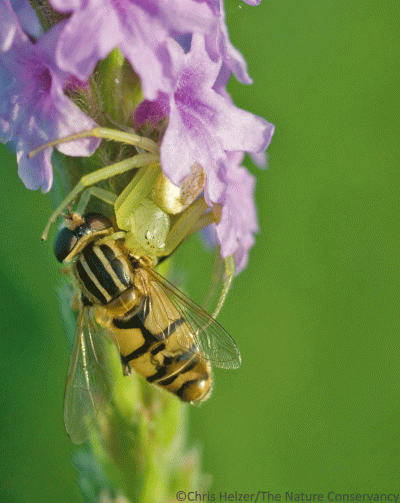
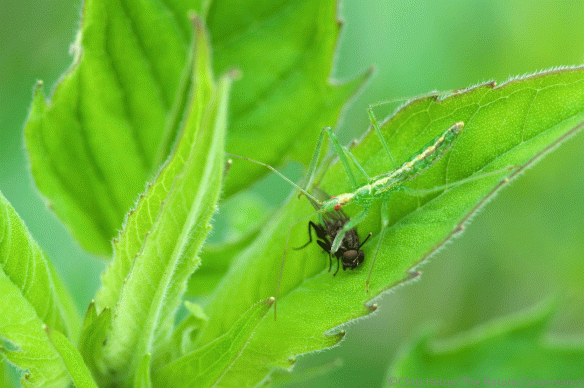
The abundance of herbivores, pollinators, and other insects on the flowers and vegetation of the sunflowers seemed to attract a number of predators as well, including robber flies, spiders, and assassin bugs.

A robber fly perches on a flower bud.

A tiny crab spider.

Assassin bug.

It was hard to see for sure, but I’m pretty sure this assassin bug was feeding on an individual of the same Perdita bee species shown above.

I hope these photos, all taken from a small area and within a short time period, help illustrate the kind of resource annual sunflowers can be in the Sandhills.  I’m sure many other wildflowers host similar numbers of invertebrates, but the height and conspicuous nature of sunflowers make it really easy to see and appreciate their value.

Annual sunflowers aren’t aggressive – they just take advantage of open soil and available root space.  As vegetation recovers from whatever event caused it to become sparse, sunflower abundance diminishes…until they get another opportunity to pop back from seeds and make their contribution to the prairie ecosystem.