
It took me a long time to decide to write a book on prairie management. One of my worries was that I was learning a tremendous amount each year, and a book captures a moment in time. One of the reasons I like writing this blog is that it allows me to share lessons as I learn them, modify my ideas over time, and – best of all – get instant feedback from readers. I learn a lot from watching prairies, but I learn even more from discussions with other people who watch prairies.
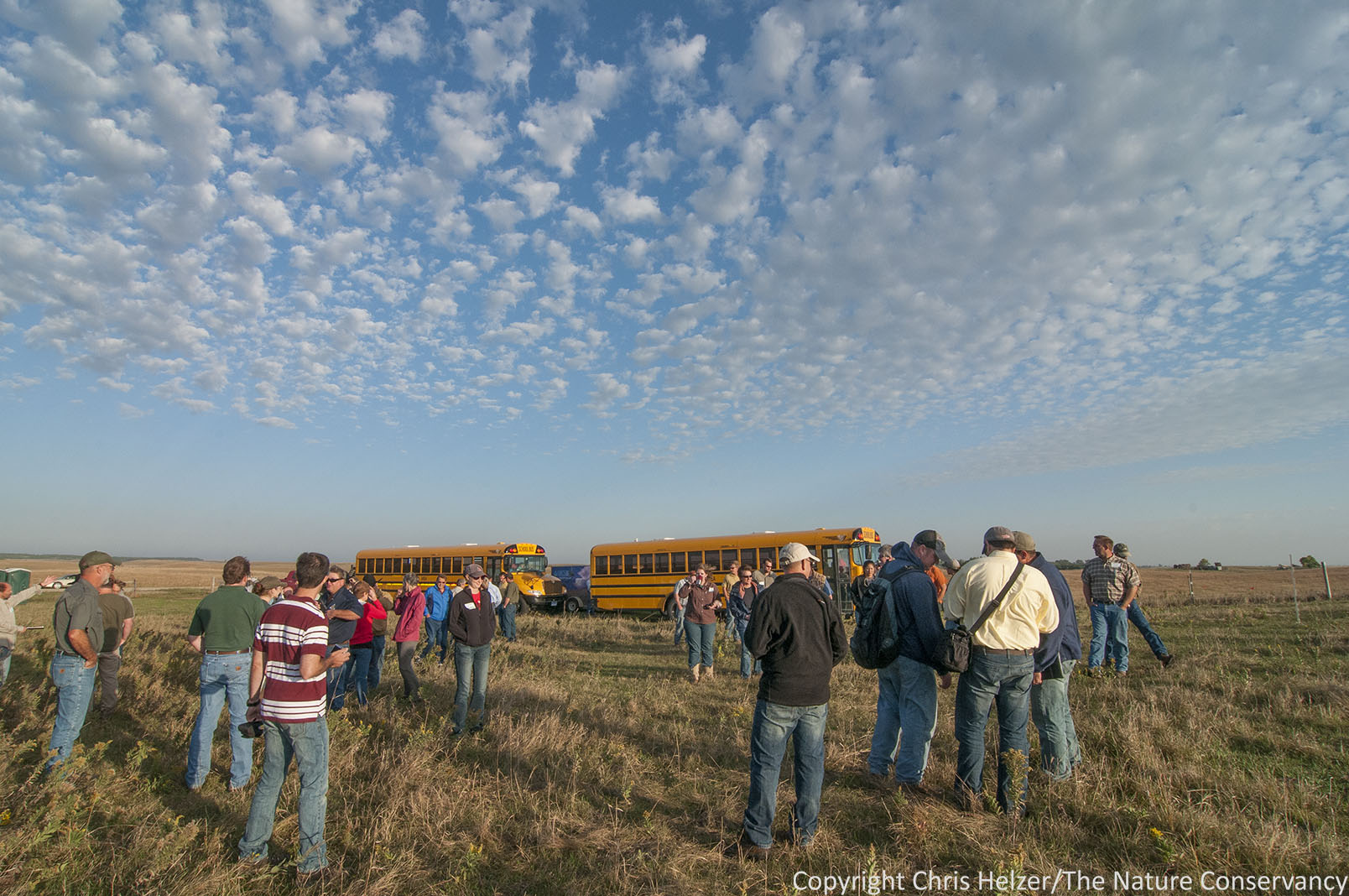
Attending workshops such as the annual get-together of the Patch-Burn Grazing Working Group has helped me continue to learn at a fast rate. (2013 Workshop in South Dakota)
My prairie book came out in 2010, but I actually did most of the writing in 2008 – five years ago. By the time the final manuscript passed through reviews and layout and made it to the publishing stage, there were already a few sections I would have liked to modify. Now that five years have passed, there are even more changes I wish I could make.
Don’t get me wrong, I’m still very proud of the book, and satisfied with its contents. But reading through it recently, I picked out some portions that I would handle differently if I was writing the book today. Here are a few of those:
Page 12 – “Mycorrhizal fungi help plants fix nitrogen”. Ok, I really flubbed this one. As Inger Lamb kindly pointed out to me after the book came out, mycorrizhae help plants pull in food and water more effectively. Bacteria are what help plants fix nitrogen. I should have just skipped the whole topic in the book, given my very rudimentary knowledge of what happens belowground. In my defense, the book went through several technical reviews, and none of the reviewers caught the error either.
…On the plus side, I did manage to spell “mycorrhizal” correctly.
Insects. The insect section in the book was originally three times longer. I was urged (coerced?) by the publisher and reviewers to chop it back drastically because it was so much longer than similar sections on mammals, birds, etc. I wish I’d fought harder to keep it long. As I’ve discussed numerous times on this blog, insects and other invertebrates are WAY more diverse and important to the way prairies functions than any other group of above-ground creatures. The existing insect section in the book is a good primer on some of the insect communities of prairies and their impacts, but doesn’t go nearly far enough. Maybe I’ll write a whole book on prairie invertebrates someday. (But probably not – can you imagine how quickly THAT book would become out of date? We still have a massive amount to learn about invertebrates.)

I didn’t know much of anything about wasps a year ago, but I’m learning more now. This one is in the genus Prionyx and feeds its larvae on grasshoppers. (Thanks to Mike Arduser for that information)
Page 79 – “Managing prairies really means managing the competition between plants.” This is a nice statement, but it’s too narrow. If I was writing that now I would replace “plants” with “species”. In general, my biggest beef with my 2008 self is that I was too focused on plants, and not enough on habitat for other species.
In the prairies I know best, maintaining plant diversity appears to be dependent upon periodically suppressing dominant grasses and giving other plants a chance to thrive. Our management strategies create a dynamic disturbance regime that helps keep any single group of plants from bullying others out of the prairie. However, not all prairies work like the ones I manage. Especially in some eastern tallgrass prairies, which have abundant rainfall and deep organic soils, many prairie plant communities seem to be pretty stable without any management that suppresses grasses. For example, very frequent spring fires seem to do a fine job of maintaining populations of most plant species in some of those sites – maybe because there is less intense competition between plants when soil moisture is abundant?
While frequent fire is able to sustain diverse plant communities in some prairies, I still think the shifting mosaic of disturbances I advocated for in my book is very important. Burning an entire prairie every year creates a single habitat structure across that prairie. That’s great for the species that like that habitat structure. However, a prairie with patches of short, tall, and mixed-height structure is going to provide for more animal species than one with uniform structure. I’m convinced that creating heterogeneous habitat can be done without hurting the plant community, and I think it’s a critical component of good prairie management. So – I think my management advice in the book is still sound, I just wish I’d explained the value of it differently.

Some prairies that are annually burned or hayed (like this one) may be able to maintain plant diversity, but they provide only a limited range of habitat options for wildlife and invertebrates.
Small Prairies. I spent a little time in the book talking about the challenges of managing small prairies, but I’ve spent more time thinking about this subject during the last few years. I wrote a post that summarized much of that thinking back in March, 2012. Many prairies are small enough that providing the kind of habitat patchiness I just discussed might not be feasible or even appropriate. In the eastern tallgrass prairie, many grasslands are only a few acres in size, and much of what I talked about in the management portion of the book would be difficult to apply. I wish I could go back and put in a whole chapter that fleshes out what I discussed in my blog post.
Too bad, so sad. Those are a few of the things I’d change if I could alter my book today. Unfortunately, because of layout challenges and other issues, I can’t just add a few paragraphs or re-write a chapter and then just reprint the book. Even if I could, there’d still be a couple thousand books in people’s houses and offices preserving my out-of-date ideas forever.
I may write another book someday. I might even go back and revise the one I’ve already written, though I dread that process. In the meantime, I’m going to enjoy the opportunity to write in this blog format, which allows me to constantly adapt my ideas as I learn from prairies and from you. Thank you for helping me with that process.


 The Prairie Ecologist