Dealing With a Pervasive Invasive – Kentucky Bluegrass in Prairies

Many of the prairies we manage have pretty degraded plant communities, characterized by low plant diversity and dominance by a few grass species – including the invasive Kentucky bluegrass (Poa pratensis).  Our primary objective for these prairies is to increase plant diversity, which, in turn, bolsters ecological resilience and improves habitat quality for a wide range of prairie species.  Because bluegrass is so pervasive in our prairies, we’ve had to modify our objectives and strategies from those we use to address most other invasive species.

Kentucky bluegrass can stifle plant diversity by crowding out other plants. In many prairies degraded by years of overgrazing and/or broadcast herbicide use, bluegrass is now the dominant plant species and few other plants can compete with it.

When attacking invasive plant species, a common strategy is to contain, and (hopefully) shrink, patches of invasive plants in order to protect plant diversity in non-invaded areas.  In the case of Kentucky bluegrass, however, we have to take a different approach because the species already spans the entire prairie.  Kentucky bluegrass acts like a thick blanket of interwoven stems, roots, and rhizomes – smothering most other plant species beneath it.  Because our goal is to increase plant diversity, we want to make that blanket thin and porous enough that a wide variety of other plant species can grow up through it.   
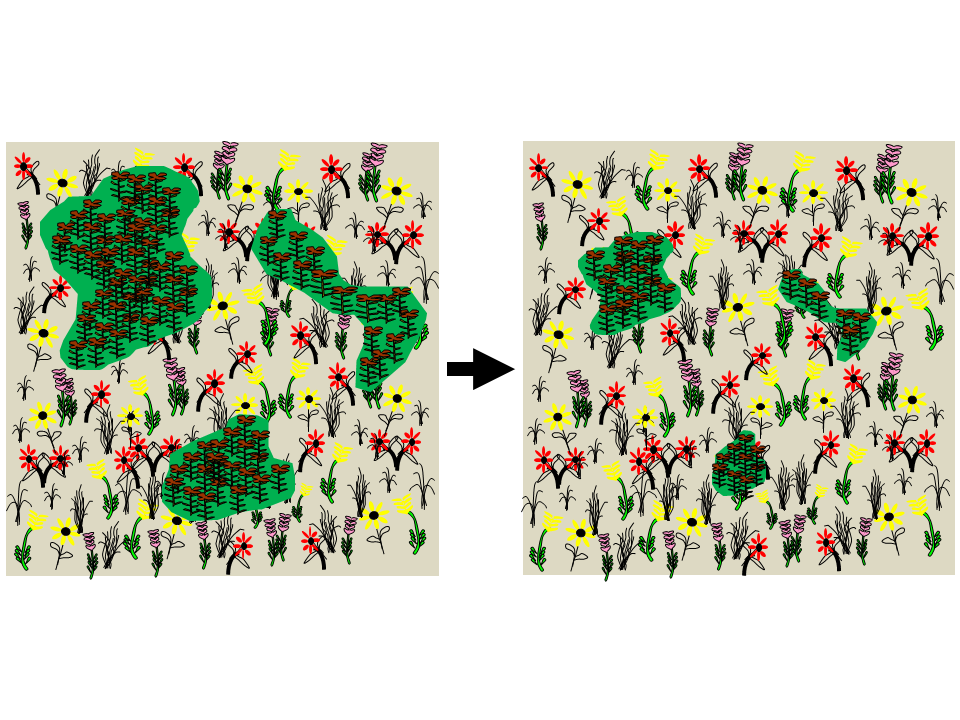
An illustration of a floristically diverse prairie (left) with several large patches of an invasive plant.  When dealing with many invasive species, we can focus on reducing the size of infestations in order to restore a more diverse plant community.
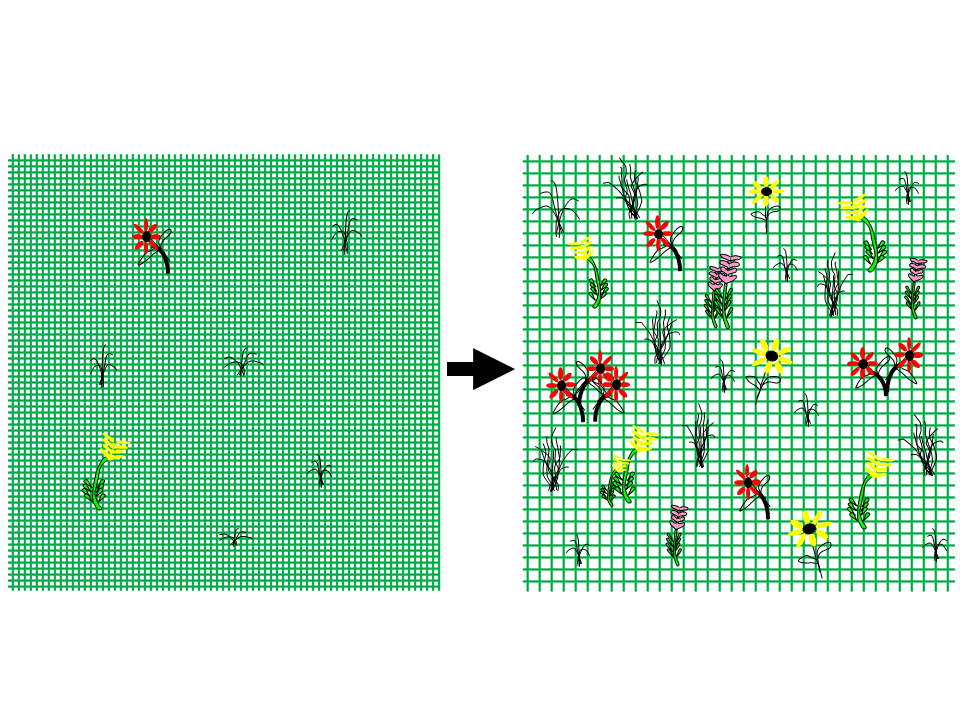
   

Kentucky bluegrass acts as a thick blanket that smothers most other plant species.  In a case like this, we need to manage the prairie in a way that increases the mesh size of that blanket and allows a more diverse plant community to poke through.

Our primary strategy for suppressing Kentucky bluegrass is the periodic application of prescribed fire and grazing.  We can weaken bluegrass by burning prairies when bluegrass is just starting to flower and/or by grazing prairies harder in the spring than in the summer.  We mix those treatments with rest periods within a patch-burn grazing regime.  The result has been a steady increase in plant diversity in most of our degraded prairies.

If we were fighting a different invasive species, we might expect that if plant diversity was increasing, the amount of territory occupied by the invasive species would be decreasing.  With Kentucky bluegrass, however, our bluegrass blanket is getting thinner, but still covers the whole prairie – something that shows up clearly in data I’ve been collecting over the last decade.  Through the use of nested sampling plots of 1m2, 1/10m2, and 1/100m2, I’ve been tracking plant diversity and floristic quality through time, along with changes in the frequency of various plant species (the percentage of plots in which they occur).  Over the last 8-10 years, as plant diversity within 1m2 plots has increased, the frequency of Kentucky bluegrass has stayed about the same.   Even at smaller plot sizes, which are more sensitive to changes in the frequency of very abundant species, bluegrass is still in nearly every plot.

We also have a number of restored (reconstructed) prairies in and around our remnant prairies.  Within restored prairies, plant diversity is in pretty good shape, but Kentucky bluegrass is rapidly invading.  In one particular prairie, Kentucky bluegrass is now in almost 90% of 1m2 plots and more than 50% of 1/100m2 plots.  That sounds bad, but as bluegrass becomes more abundant, plant diversity – and the frequency of other prairie plant species – is actually holding steady.  There are a few small areas in which bluegrass appears to be forming near monocultures, but for the most part, it looks like bluegrass is just filling in around the other plants instead of actually displacing them.  My guess is that some soil conditions provide such ideal growing conditions for bluegrass, it’s going to be king of those areas no matter what we do.  Elsewhere, however, I think our management is preventing it from becoming dominant.

Here’s the take home lesson for me:  When trying to manage for plant diversity in the face of a pervasive species such as Kentucky bluegrass, it’s more important to track plant diversity than to worry about how much territory bluegrass occupies. 

Just consider the data from our prairies… if I concentrated only on how much Kentucky bluegrass is in our prairies, it would look like we’re failing miserably in our management attempts.  We’ve got just as much bluegrass as we ever did in our degraded remnant (unplowed) prairies, and we’re quickly losing ground in some of our restored prairies.  However, my data also shows that plant diversity is increasing in remnant prairies and holding steady in restored prairies.  Since the ultimate goal is to have a diverse plant community, that’s success! 

Click here to see a PDF showing some of the data I mentioned in this post.
Sweet Clover: Ugly but Harmless? Or Dangerous Invasive Species?

Why is sweet clover the target of aggressive control by some prairie managers and largely ignored by others?  After talking to a number of people across the Midwest and Great Plains, I think there are a couple of things happening.  First, the usually biennial sweet clover can be very abundant and showy in the years it blooms, but is harder to find in other years.  I think some prairie managers see those big flushes and mistake abundance for aggressiveness.  However, I also think that some soil/precipitation/latitude(?) conditions may lead to real negative impacts from sweet clover on plant diversity.

One of the lessons that’s been strongly reinforced for me this summer is that it can be difficult to extrapolate successful prairie management/restoration strategies from one region to another.  Just during the last several months, I’ve visited prairie managers in Nebraska, Indiana, Missouri, and South Dakota and I’ve seen tremendous variation between (and even within) those states in terms of which species are invasive and which are not.  It’s dangerous to assume that just because a species like sweet clover isn’t causing problems in one prairie, it won’t cause problems in another.  I hope we’ll eventually learn enough to accurately predict when to worry and when not to, but in the meantime, it behooves prairie managers to carefully evaluate species at their own sites.

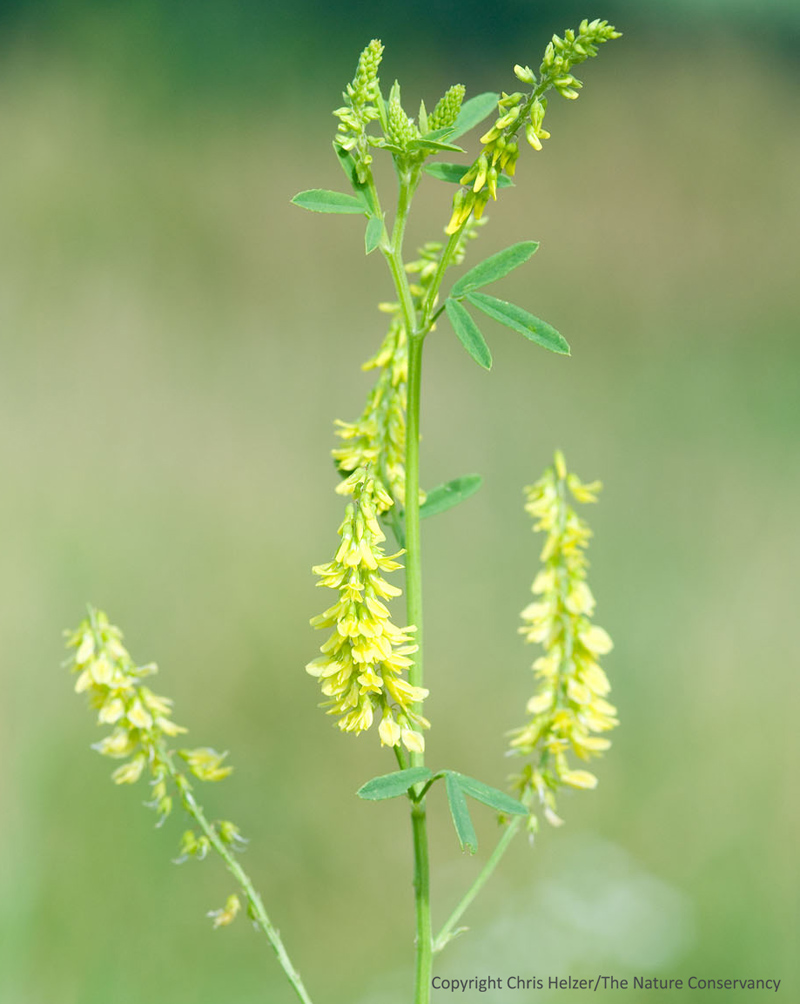
Yellow sweet clover. This exotic species is still planted in some wildlife and ground cover grassland plantings because of its purported wildlife value and cheap seed. However, it appears to be invasive in some places and/or situations.

I’ve been working with prairies along Nebraska’s Platte River for nearly 20 years now, and my observations have led me to conclude that sweet clover is more of a big ugly plant than a true invasive species in those prairies.  Years of data collection on my plant communities support those observations.  That annual monitoring work entails listing the plant species I find in each of about 100 1m2 plots across a prairie.  Those plots are stratified across the prairie so the site is evenly sampled.  Once I have those plotwise species lists, I calculate the floristic quality  (FQI) inside each plot, a calculation that takes into account both the number of species present and the average “conservatism” value of those species.  I can then look at changes in mean floristic quality over time to help me see how the plant community changes over time.  I monitor a few prairies annually, and others on a periodic basis.

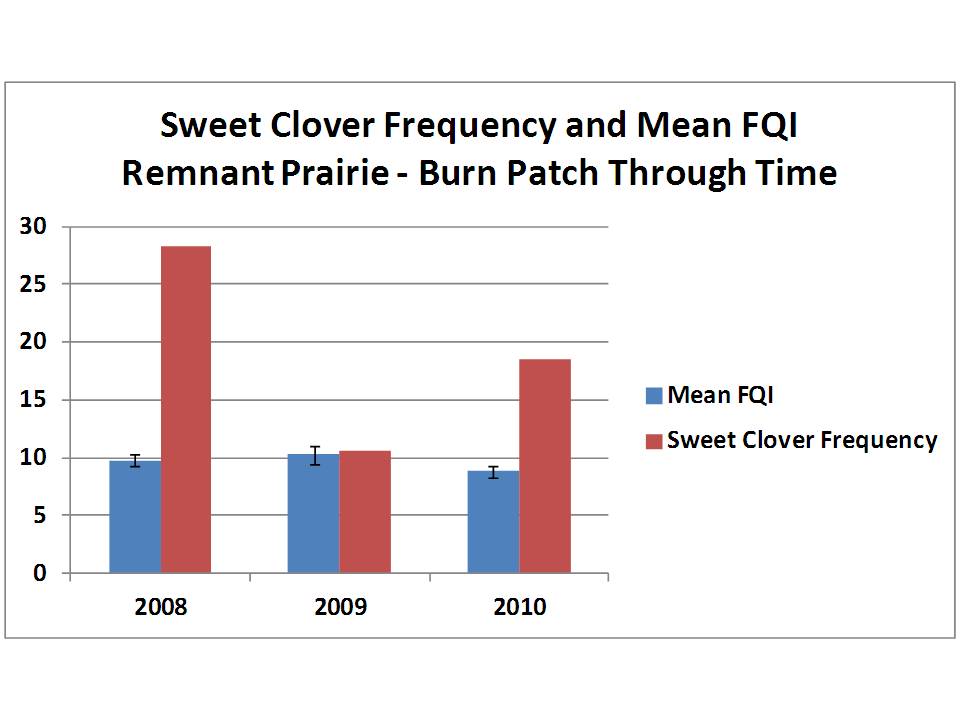
Those data show the same thing I’ve seen observationally – sweet clover changes in abundance from year to year (though not as much as it appears visually), but the species doesn’t increase in abundance over the long term and doesn’t appear to negatively impact floristic quality.  Below are graphs from three sites that show both sweet clover frequency (% of plots occupied by sweet clover) and mean floristic quality.  Two of those sites were annually grazed during the data collection period, and the other was only grazed once – toward the end of the sampling period.  Cattle grazing almost certainly helps control sweet clover because it is one of their favorite plants to eat, but I don’t think sweet clover is causing me problems where I don’t graze either.

What my data don’t show is the flush of tall blooming plants that happens every other year or so.  I’m just counting whether at least once sweet clover plant is present in each of my small plots – not how big it is, or whether or not it’s blooming.  Nevertheless, sweet clover frequency changes from year to year but doesn’t appear to correlate at all with changes in mean floristic quality.

Nine of years of annual data from a 1995 prairie restoration seeding. The site has been under patch-burn grazing during each of the nine years of data collection. Sweet clover is never abundant at this site, but has also not increased over time, even through years of drought and heavy grazing. Error bars for floristic quality indicate 95% confidence intervals.

.

Sweet clover was present in between 22% and 42% of 1m plots in this restored crop field, planted in 2002. Though the sweet clover frequency varied from year to year, the mean floristic quality of the plant community increased between 2004 and 2008 before leveling off after that - apparently independent of sweet clover. Sweet clover data from 2008 was eliminated from this graph because I later questioned whether I'd confused black medick and sweet clover in some plots. This site was not grazed except in 2009.

.

These data are from a remnant mesic prairie under patch-burn grazing. Instead of being stratified across the entire prairie, these data are from a single patch that was burned in 2008, and that same patch was sampled again in 2009 and 2010. It was grazed very hard in 2008. In 2009, no new patch was burned, so it was grazed hard again, but then fenced out in early June. In 2010, the site was not fenced out, but received only light grazing while cattle focused on another portion of the site that was burned. These data are from only about 30 plots per year.

I feel pretty good about ignoring sweet clover and focusing on more invasive species on our prairies.  Both my observations and data support that strategy.  However, as I said earlier, just because the species doesn’t appear to be problematic for me doesn’t mean it isn’t an invasive species in other prairies.  It’d be great if we could compare data similar to what I’m presenting here from a number of sites to see if sweet clover is acting differently in different places.  Without data, it’s hard to know whether or not people are just interpreting the “invasiveness” of sweet clover in different ways.  For now, my answer to the question,  “Is sweet clover really invasive?” is still the same…

Maybe.