Hubbard Fellowship – When is a Gopher not a Gopher?

This post is written by Kim Tri, one of our two Hubbard Fellows for this year.  Kim is an excellent artist, as well as an ecologist, writer, and land steward.  As you can see, her drawings of animals are exceptional.

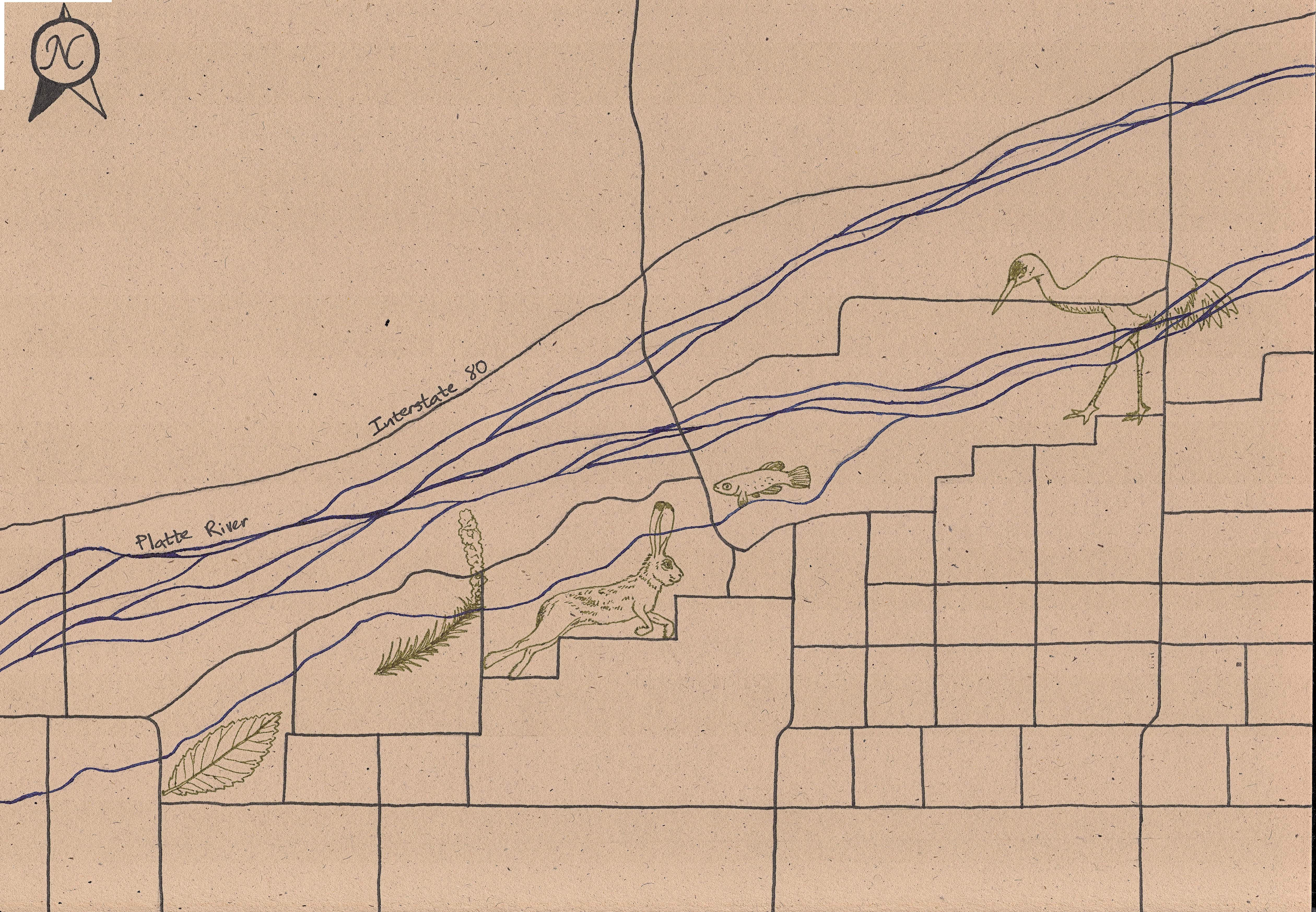
13-

13-lined ground squirrel.  Ink drawing by Kim Tri.


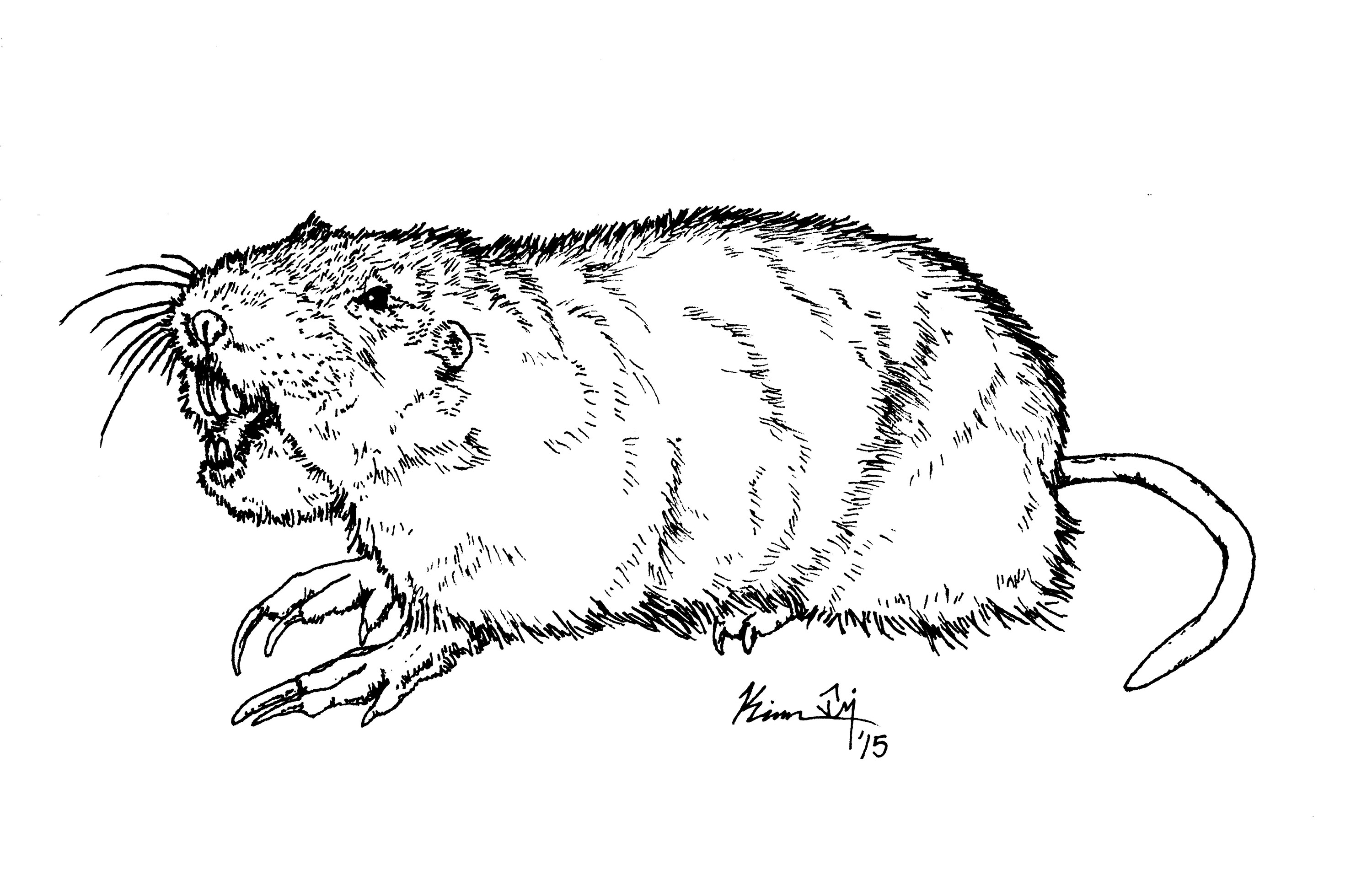
When it’s a streaked gopher!  That is the common name that I grew up with for the thirteen-lined ground squirrel (Ictidomys or Spermophilus tridecemlineatus).  Imagine my disappointment when I found out that actual gophers are 1) not closely related, and 2) look like this:
po

Plains pocket gopher (Geomys bursarius).  Ink drawing by Kim Tri.


Pocket gophers are one of the few animals that I would describe as “ugly.”  Note: I do not use this word to describe pugs, star-nosed moles, aye-ayes, vultures, or a number of animals termed by most people as “ugly.”

As far as I can tell, the misnomer of “streaked gopher” (with streaked inexplicably being pronounced with two syllables) is unique to my family, as I have yet to find anyone who has ever heard of it who is not related to me.  “Striped gopher,” however, is a more common name, especially back in Minnesota, or the Gopher State (the MN Dept. of Natural Resources refers to it as the “Minnesota Gopher” on their website).  It is partially responsible for this unfortunate mascot.  University of Minnesota students will freely admit that mascot of Goldy Gopher was designed by someone who did not actually know what gophers look like.

Both thirteen-lined ground squirrels and pocket gophers are rodents, but the relationship ends there.  I. tridecemlineatus belongs to the family Sciuridae, which includes your familiar tree squirrels and chipmunks, and your less familiar (depending on where you live) ground squirrels, prairie dogs, flying squirrels, and marmots.  Pocket gophers belong to the family Geomyidae, which includes pocket gophers, end of list.  Both animals dig burrows and spend time underground, but since pocket gophers eat mainly roots and tubers, they need rarely come up to the surface and have taken burrowing to the next level.  They have oversize front paws for digging and lips that close behind their massive incisors, so that they can excavate with their chompers without getting a mouthful of dirt.  Their eyes and ears are small and weak because sight and hearing are not very important underground.  Thirteen-lined ground-squirrels, on the other hand, are part of the group of spermophiles, or “seed-lovers,” (though they eat a lot of insects as well) and consequently spend much of their time foraging aboveground and are less specialized for burrowing.  They’ve kept the squirrel’s nimble forepaws as well as good eyesight and hearing for detecting predators and prey alike.

I’ve always been enamored of thirteen-lined ground squirrels.  I mean, look at that face.  Then look at the clever little paws, sleek body, and intricate design.  Growing up, I could watch them sometimes from the kitchen window, and can do the same here.  We share the yard with a family of them, and it delights me to see them.  They build little tunnels through the pile of grass clippings that have accumulated by the walkway and use them as cover while they forage in the backyard.  Their favorite pile seems to be right outside of my window, so I have had plenty of opportunity to watch the little ones playing and growing throughout the summer.  They never paid me much heed, so I just assumed that they couldn’t see me through the window screen.  After spending quite a while standing not very still within a few feet of a foraging ground squirrel, I have since concluded that they simply don’t care about people.  They know that they can be underground before I can even bend down to snatch them.

Disclaimer: I am not bashing pocket gophers.  Their adaptations for burrowing make them pretty cool, at least to me, as do their “pockets”—cheek pouches for carrying food which extend all the way onto their shoulders and can be turned inside out.  I just think they’re ugly.

But, you know, the more I look at them, the more I see some cute in them.  I mean, look at that face.
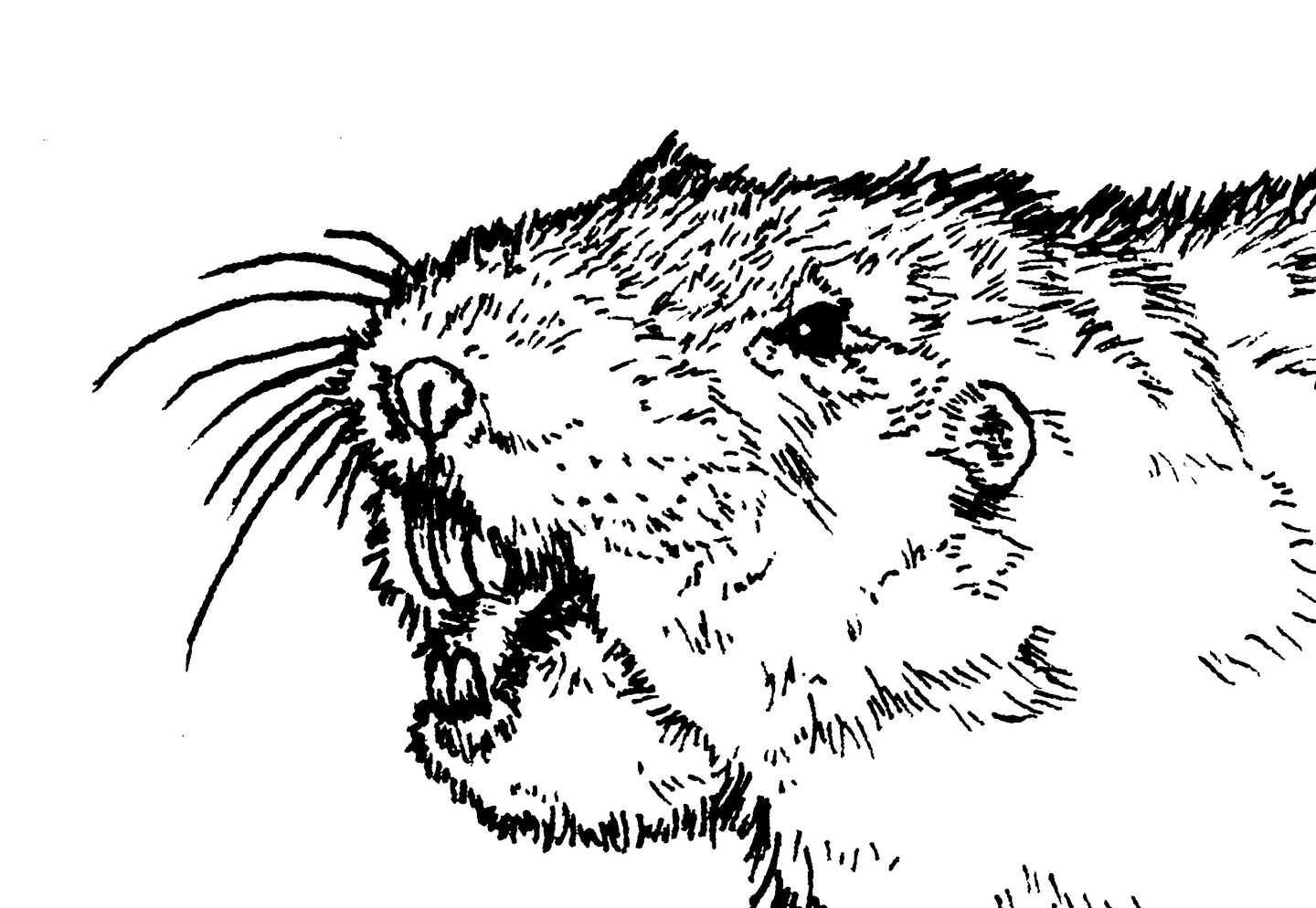
pocket gopher head


P.S. If you want to see how Minnesotans feel about real gophers rather than people in striped gopher costumes, look up Viola Gopher Days, which take place near my home town.  I personally have never been and can’t decide whether I find it grisly or folksy.
Hubbard Fellowship Blog – Up and Down the River

This post is written by Kim Tri, one of our two Hubbard Fellows for this year.  Kim is an excellent artist, as well as an ecologist, writer, and land steward.  You can look forward to seeing more of her writing and artworks soon.

Sometimes, I have to remind myself that it’s in the name: Platte River Prairies, the collection of lands that we conserve.  They are strung out and fragmented, but the Platte is what unifies them.

f

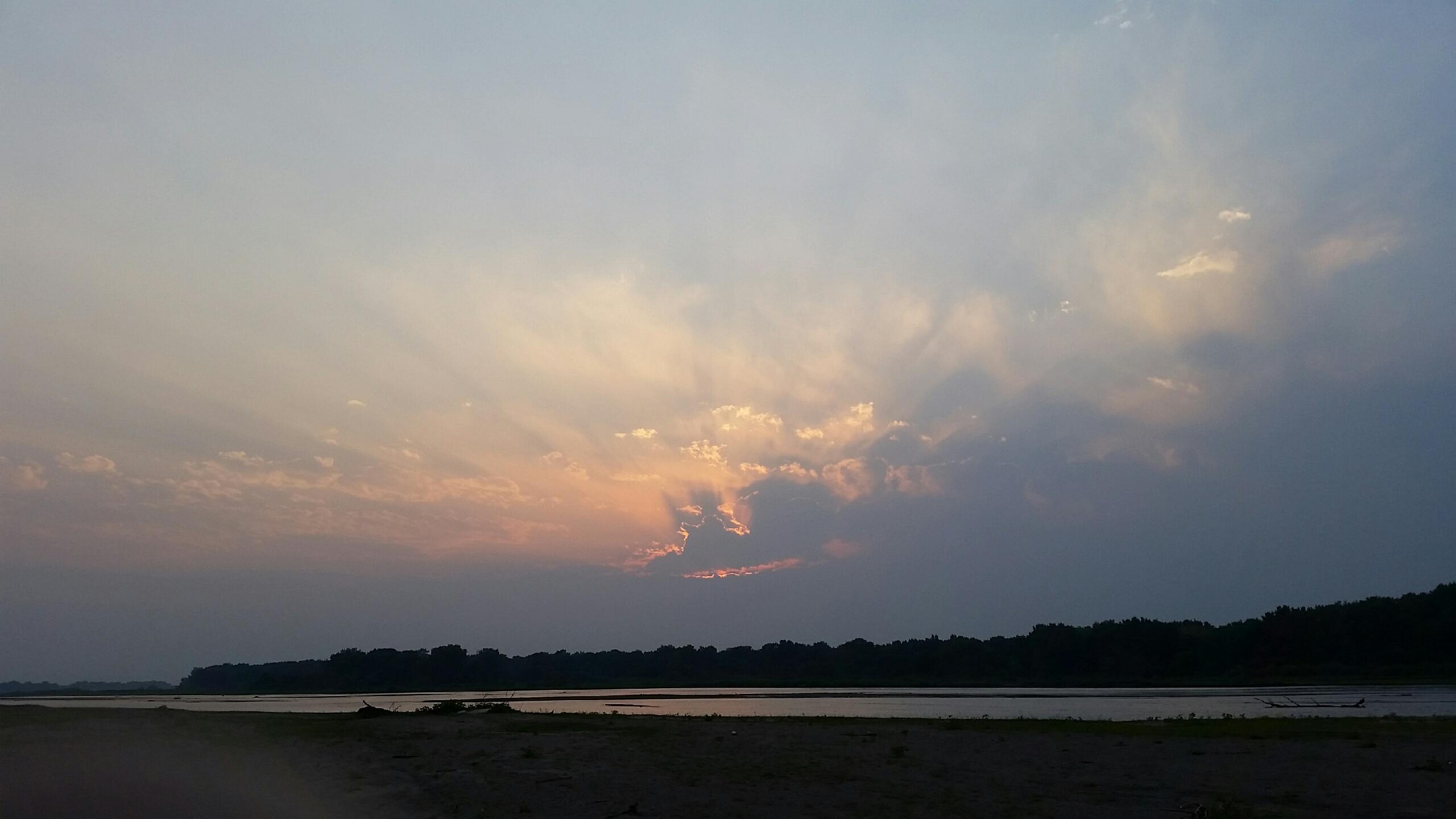
The Platte River at sunset.  Photo by Pat Lundahl

It can be hard to see it sometimes.  The river, altered as it is, follows its own sinuous course, dictated by geology, varying flow rates, and other natural vagaries.  However, the roads we travel to reach our properties along the river follow man-made lines.  Though the river laid down their sandy grades long ago, the roads were built on section lines and survey coordinates, east-west, north-south.  (The exceptions in this area are Interstate 80 and the Lincoln highway, which roughly follow the river and the 19th century Mormon Trail.)  Trying to follow the Platte along the county roads from one property to another involves a confusing handful of miles of zig-and-zag.  These miles take long enough to travel on an ATV that it is easy to lose track of the river and the relative position of different tracts of land in this maze of right angles.

So, to keep myself straight, I build a mental map of the different disconnected pieces of land, re-centered along the river which ties them all together.  It’s not very precise—there are no exact boundary lines and the distances are all approximate, but it helps me visualize the big picture.

g

My mental map of the Platte River Prairies on paper. It covers roughly 14 miles west to east, with the river represented in blue, the roads in black, and collections of our properties in green symbols, which represent unique aspects of these properties. From left to right, the symbols are: Siberian elm leaf (invasive), tall gayfeather, black-tailed jackrabbit, plains topminnow, and sandhill crane. Map by Kim Tri.

Allow me to explain the map briefly.  I chose to represent our properties, or collections of them, with symbols highlighting unique character aspects of the land tracts, rather than exact boundary lines, which aren’t really a part of my mental map.  I’ll explain them from west to east.

Sometimes I think of the Bombeck property as Siberia, because it is way out there and has our worst Siberian elm (a non-native tree) invasion, which I’ve represented with a Siberian elm leaf.  To the east of that is the Miller/Uridil complex, which is represented by a tall gayfeather, since one of the Uridil prairies has an abundance of gayfeather flowers.  The black-tailed jackrabbit to the east of that covers the Derr and Suck properties, since that is almost exclusively where I see jackrabbits when they aren’t dashing across the road between cornfields.  The plains topminnow on the right represents or Sandpit wetland restoration, a restored stream channel that serves as habitat for native (and non-native) fish.  The last symbol to the east is a Sandhill crane, representing the Studnicka and Caveny properties, located next to the Crane Trust, and where we view cranes on their migration stopover on the Platte.

This map gives me a perspective that helps me make sense of the everyday, the right and left turns chasing the treeline that marks the river.  It helps me to see that while our properties may have edges defined by man, the boundaries within which we work are defined by a natural watershed.  And though our lands may not all be connected by land, they are still connected by the Platte.  The water that flows through the Kelly tract—two hours to the west—also flows past the Rulo property along the Missouri river, below the confluence of the two great rivers.

Photo by Pat Lundahl.

Great blue heron and shorebird tracks along a sandbar.  Photo by Pat Lundahl.

The Platte provides the focus of life here.  It feeds the groundwater which fills our wetlands, spawning frogs and toads, watering the sedges and rushes.  It draws much of the wildlife to its banks.  A walk along the river last weekend yielded the tracks of raccoon, deer, bobcat, and otter mixed in with those of the shorebirds.  Here and there were dotted the massive prints of a great blue heron.  In the spring, the sandhill cranes will blot them all out.  We are working to preserve all of this, as well as the tallgrass prairie which the river feeds, and which we walk every day.