Prairie Word of the Day – Disturbance

It’s been too long since the initial installment of what was intended to be a regular feature of this blog – the Prairie Word of the Day.  Since one blog post does not make a series, I figured I’d better at least write one more.  I will try to add more to the series relatively soon. 

If you read this blog or any other source of information about prairie ecology or management, you’re likely to have seen the term “disturbance” used in some context (e.g., “ecological disturbance,” “disturbance regime,” “disturbance in the force”).  Ok, that last one is from a different context, but nevertheless.

Outside of prairie ecology or other ecological conversations, a disturbance is often something that requires contacting the police.  However, in almost every case, prairie managers would appreciate you not calling the police in response to disturbances in a prairie.  So what does the word “disturbance” mean in an ecological context?
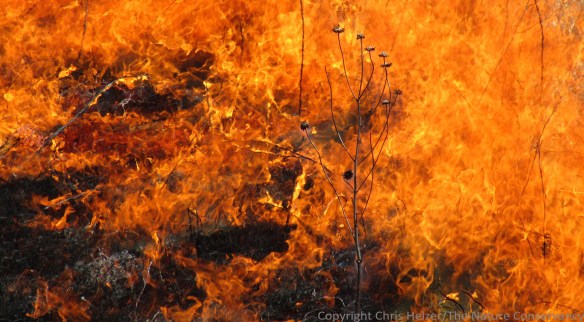
Fire is one of the big three historical disturbances to which prairies are adapted to and rely on.

Fire is one of the big three historical disturbances to which prairies are adapted to and rely on.

It’s probably easiest to think about a disturbance in a prairie as something that disrupts the lives and processes of prairie organisms and creates a shift in the competitive balance among those species.  Historically, the big three disturbances in grasslands were fire, grazing, and drought.  Fire and grazing are still used as management strategies today, along with mowing/haying and, sometimes, herbicide treatments.  Drought (and other significant weather events such as a flood) is not something managers prescribe or apply to a prairie, but it certainly has significant impacts.

Both “natural” disturbances and those prescribed by prairie managers are critically important to the health of prairies, despite the fact that they have significant impacts on species.  In fact, many animals, plants, and other organisms often die as a result of disturbances.  Prairies, however, more than most other ecosystems, are not only well suited to survive disturbances, they are defined by and rely on those disturbances.  Without fire and drought, for example, prairies wouldn’t even exist – they would be woodlands instead (and who wants that??).

Every time a fire burns through a prairie, grazers chomp off much of the vegetation, or an extended drought turns a prairie brown in mid-summer, the competitive balance in a prairie is altered.  Depending upon the timing and intensity of a fire, for example, it’s likely to kill some trees and “top-kill” others, forcing them to restart from buds at or below the surface of the ground.  Fires can also kill or suppress the growth of other plant species, especially those most actively growing at the time of the fire.  At the same time, fires create opportunities for other plants – especially those in direct competition with the ones suppressed or killed.  Plants that thrive best in full sunlight and don’t do well under layers of thatch or beneath tall plants also respond very favorably after a fire.
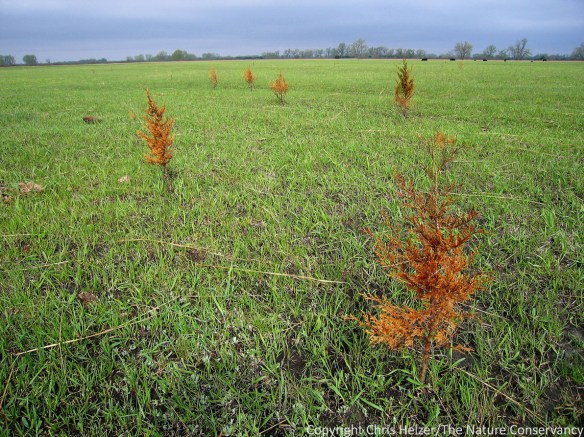
These cedar trees died in a recent fire, but the vegetation around them is regrowing strongly. In fact, the cattle (in the distance to the top right) in this prairie will be attracted to that growth and graze this part of the prairie much harder than unburned parts.

These cedar trees died in a recent fire, but the vegetation around them is regrowing strongly. In fact, the cattle (in the distance to the top right) in this prairie will be attracted to that growth and graze this part of the prairie much harder than unburned parts – adding a second disturbance to the first.

Of course, fires can also kill or injure wildlife or insect species (not to mention microorganisms and other life forms) that are aboveground at the time of the fire and can’t evade the heat and/or smoke.  The season in which a fire burns plays a big role in which organisms are affected.  Dormant season fires can kill insects and other species that overwinter in vegetation or along the surface of the ground, but growing season fires cause even more fatalities because so many more species are active during that time of year.  Even animals that survive the fire itself may have to travel to unburned areas in order to find suitable habitat, and those trips can be hazardous as well.

Despite the immediate negative impacts of fire on individual insects, wildlife, and other species, however, periodic fire usually has longer-term benefits – even for those species that suffer fatalities.  Without fire – or some other disturbance that removes vegetation – prairies can become so overgrown that most species can’t survive there.  Suffocating layers of thatch, encroachment by trees and shrubs, and the potential for diseases and predator populations to build up over time are all conditions that can be found in prairies that go undisturbed for long periods of time.  In addition, if the same habitat and growing conditions prevail year after year in a particular patch of prairie, some species will thrive but others will not – leading to a loss of species diversity and overall prairie health.

Without going into details here, the impacts of drought and grazing on prairie species are similar to those of fire – each event will favor some species over others.  Prairie plants are well adapted to periodic burning, grazing, or drought.  Perennial plants have numerous buds at their base, from which they can grow new shoots after they’ve been burned or cropped off, and most can enter dormancy during a severe drought in order to conserve resources for better days.  Shorter-lived plants often rely on disturbances to create opportunities for them to grow with less competition from nearby perennials.  Those annual and biennial plants produce copious amounts of seed that fall to the ground and wait until the next time conditions favor their germination and growth.

Every vertebrate and invertebrate animal species relies on a particular set of habitat conditions.  Some thrive when vegetation is short and sparse, and others prefer tall dense vegetation.  The highest diversity of animals and insects is usually found where perennial plants have been recently weakened by fire, grazing, and/or drought, and short-lived plants are thriving while those perennials recover.  In any case, habitat conditions are tied to disturbances – some conditions are created during or in response to a disturbance, and others (tall dense vegetation) are created when a disturbance hasn’t occurred for a while.
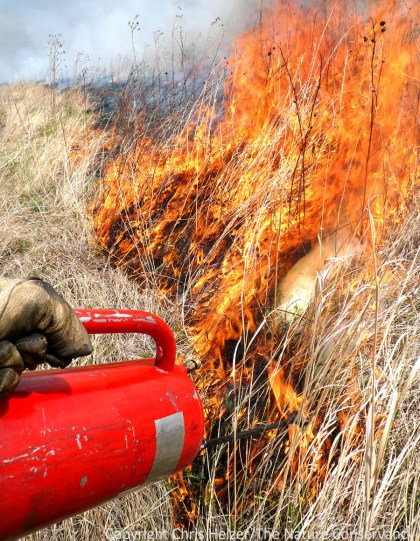
Prescribed fire, along the grazing and mowing, are important ways for prairie managers to introduce disturbances into grasslands in order to maintain prairie health and biological diversity.

Prescribed fire, along the grazing and mowing, are important ways for prairie managers to introduce disturbances into grasslands in order to maintain prairie health and biological diversity.

As prairie managers, our job is to provide habitat and growing conditions for as many prairie species as possible.  We burn, graze, and mow prairies at prescribed intervals (and usually in patches, rather than across an entire prairie) in order to maintain a competitive environment in which all those prairie species can survive.  Whenever we burn a prairie or introduce large grazers to it, we know that some species will be harmed by that action, but that others will flourish because of it.  As long as we allow a patch of prairie to recover between disturbances and create a patchwork of habitats (some recently disturbed and others not), the prairie community will remain diverse and resilient.

Prairie management is complicated, and it can be difficult to make decisions and take actions that you know are going to negatively impact some species.  On the other hand, the other choice is to do nothing.

And that would be disturbing.
From Plant ID to Small Engine Repair – The Complex Life of a Land Steward

It’s been almost 19 years since I started my career with The Nature Conservancy as a land steward.  My job was simple: restore and manage several thousand acres of prairie, wetland, and woodland habitat.  When I started, I felt like I was the luckiest guy on earth.  I was also scared to death.  What if I messed up?  These were extraordinarily complex ecological sites and I was a 25-year old kid with only a college education and a sliver of real world experience.  I had lots of ideas but it was daunting to think about trying those ideas out without knowing they’d work.  Fortunately, Al Steuter, the Director of Science for The Nature Conservancy in Nebraska gave me some advice that helped me tremendously.  In essence, he told me to remember that prairies were incredibly resilient, and that nothing I did in one year (aside from tillage or broadcast herbicides) could ruin them.  That advice was incredibly liberating, and allowed me to start enjoying my work.

I was a very young-looking 25-year-old when I started as a TNC land steward. They weren't sure I should have an actual ATV...

I was a very young-looking 25-year-old when I started as a TNC land steward. They weren’t sure I should have an actual ATV…

Over time, my responsibilities have changed and now, among other things, I serve as advisor to our statewide land management team.  I really like what I do, but land steward was my dream job and I can’t imagine I’ll ever find a better one.  However, as I think about the stewards I know and work with, I’m pretty sure I don’t measure up to today’s standards.

The job description for most land stewards in The Nature Conservancy – at least in the Great Plains – has expanded to the point of almost unattainable proportions.  As a result, it is no exaggeration to say that I am no longer qualified to be a land steward for this organization.  Most land stewards I know work by themselves or with a very small team – often consisting mostly of seasonal employees – and manage thousands of acres of land for biological diversity and wildlife habitat.  As a result, they have to be able to handle whatever challenge presents itself, from plant identification to small engine repair, and everything in between.  To give you an idea of the scope of that work, here is a partial list of what we expect of Nelson Winkel and Evan Suhr, land stewards who work for The Nature Conservancy in Nebraska.

Evan Suhr, Bison roundup at TNC Niobrara Valley Preserve. Nebraska.

Evan Suhr during this fall’s bison roundup at The Nature Conservancy’s Niobrara Valley Preserve. Nebraska.

Ecologist/Natural History Biologist

Evan and Nelson are expected to be able to identify most of the plant and animal species living in the prairies they manage and understand how they interact.  They also have to understand how all those species and interactions respond to various combinations of weather patterns and management treatments.  Obtaining just those skills could easily consume a career.

Research Scientist

Good land stewards always look for ways to test the effectiveness of management strategies so they can keep improving their work – and provide guidance to neighbors and partners facing the same challenges.  Sometimes, that means collaborating with academic scientists on research projects.  More often, it just means setting up an invasive species control or grazing treatment in a way that provides a fair and impartial test of two or more methods.  The results of those tests don’t usually get published in peer-reviewed scientific journals, but in order for the results to be trusted, the tests have to be set up in a scientifically-rigorous way.

Nelson Winkel works to identify a bee during a pollinator workshop with Mike Arduser at TNC's Platte River Prairies, Nebraska.

Nelson Winkel works to identify a bee during a pollinator workshop.  It’s important to understand the biology and ecology of the natural systems you manage.

Ranch Hand

Building and fixing fences, and repairing windmills and solar-powered pumps are frequent tasks for Evan and Nelson.  Even more frequent tasks include manual labor associated with invasive plants – chopping thistles, cutting trees, etc.  Some of those tasks require mainly hard work, but others require specialized knowledge (how to take apart, clean, and reassemble a pump, for example).  In addition, stewards have to stay current on agricultural topics from grazing lease rates to animal husbandry techniques so they can work effectively with Conservancy bison herds or the cattle (and their owners) grazing Conservancy land.

Mechanic

The number of engines involved in land stewardship is astonishing, including those found in trucks, tractors, skidsteer, ATVs, chainsaws, fire equipment, and more.  Land stewards have to be able to maintain all those engines, but also perform at least basic diagnostics and repairs.  When major repairs are needed, they can haul equipment to a professional mechanic, but if they needed professional help for every little mechanical malady, stewards would spend all their time hauling equipment to and from repair shops.  As someone who has never figured out how to correctly adjust a carburetor or do whatever it is you have to do to make a chainsaw actually start correctly when just pulling the cord doesn’t work, I have great admiration for those who have the skill, knowledge base, and intuition to fix engines.

2014 Spring burn at TNC Rulo Bluffs Preserve. Nelson Winkel.

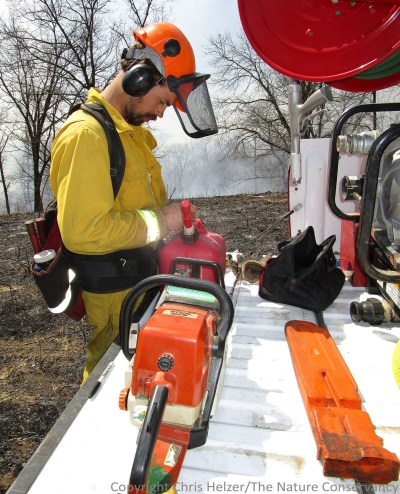
Nelson can operate, maintain, and repair chainsaws.  If a saw goes down during the mop-up operation of a woodland prescribed fire, it’s pretty important that he be able to get it running again.

Plumber/Electrician

Since most land stewardship operations include buildings with plumbing and electrical systems (not to mention electric fences and livestock watering systems), and contracting for repairs in remote areas is usually infeasible because of cost, timeliness, or both, those repairs often fall to land stewards.  Replacing a broken light fixture, finding and repairing a leaky pipe in a house crawlspace, or troubleshooting a short in an electric fence are all tasks that could fall to land steward on any given day.

Biochemist

Much invasive plant control requires the application of herbicide.  The variety of brands and formulations of herbicides can be as overwhelming as the diversity of invasive plant species they help suppress.  Just reading and understanding an herbicide label can be a daunting task, let alone trying to understand how various chemical formulations might affect plants in a way that will kill the ones you want and not the ones you don’t.  Then, once you’ve figured out – for example – whether you should use the amine or ester formulation of a particular chemical (it’s related to risks associated with volatilization on hot days), you still have to calculate the correct amount of each ingredient and calibrate your sprayer.

Nelson Winkel sprays reed canarygrass at TNC Nebraska's Platte River Prairies.

Nelson Winkel sprays reed canarygrass at The Nature Conservancy’s Platte River Prairies.

Fabricator

I am in awe of Nelson’s ability to make specialized tools and equipment for land management work.  Simple welding tasks seem overwhelming to me, let alone building herbicide sprayers, slip-on fire pumper units, and hydraulically-powered augers to dig holes for large fence posts.  Sometimes he builds his own equipment because it’s cheaper than buying it, but other times he does it because it’s not possible to buy something that does what he needs it to do.

Burn Boss

Despite the fact that The Nature Conservancy is a private non-profit organization, becoming qualified to lead a prescribed fire for TNC now requires stewards to work through the NWCG (National Wildfire Coordinating Group) system used by federal agencies that fight wildfires.  Under a best case scenario, it takes several years to take all the courses and get signed off on all the required tasks (including some that necessitate fighting wildfires) to qualify as someone who can lead prescribed fires.  Accomplishing that means spending weeks at a time away from home.  Regardless, prescribed fire is a critically-important component of The Nature Conservancy’s work, so land stewards work through those requirements as best they can.

Nelson Winkel, TNC land manager for Platte River Prairies during a prescribed fire.

Prescribed fire is a big part of prairie management, but becoming qualified as a burn boss takes years worth of training and experience.

Collaborator/Negotiator/Neighbor

Land stewardship doesn’t happen in a vacuum.  All of our properties are nested within land owned by farmers and ranchers.  To be successful, land stewards have to get along with, learn from, and share ideas with those neighbors and other partners.  Often that leads to interesting situations in which a land steward is negotiating a grazing lease with a neighbor who also happens to be on the local fire board and can influence whether or not a burn permit is issued.  Gaining the respect of neighbors and other local conservation partners means taking the time to get to know them, their families, and their personal philosophies on life, conservation, hunting, and football.  Much of that relationship building happens outside of a regular work schedule, but it’s essential – we couldn’t do our work without the support of our neighbors and local communities.  More importantly, building credibility with neighbors and partners is critical because sharing lessons learned from our land management work with others is how we influence conservation beyond the borders of our relatively small land holdings.

……

Perhaps the greatest challenge for land stewards is that despite the amount of work to be done, there are still only 24 hours in a day.  Working as a land steward for The Nature Conservancy is incredibly rewarding but also impossibly complex and difficult – as is working as a land manager for any conservation organization or farm/ranch operation.  I still can’t believe I ever got hired as a land steward, or that I managed a fair amount of success in spite of my shortcomings, especially in terms of mechanical prowess.  It is my privilege to work with stewards like Nelson, Evan, and many others, and I am in awe of the breadth of their knowledge and the extent of their energy.  Not only are they caretakers of their particular natural areas, they are developing, testing, and sharing the techniques the rest of us need in order to conserve the rest of the natural world.