Hubbard Fellowship Post – Kees Catches Lightning (Bugs) in a Bottle

Today’s post is written (and illustrated) by Hubbard Fellow Kees Hood. Kees (pronounced “Case”) came to Nebraska from the Los Angeles, California area. He brought with him a strong interest in grasslands and an even stronger curiosity about the prairies east of the Rocky Mountains.

This past summer, whenever anyone has asked about the Hubbard Fellowship, I’ve inevitably found some reason to steer the conversation to fireflies. My home state of California lacks the mass firefly displays common east of the Rockies, instead being home to a diversity of cryptic flashless or solitary ground-flashing species. The first firefly at PRP began displaying June 12, a lone, blinking light outside my window. Within several weeks, this had built into a spectacular twilight performance, with thousands emerging at dusk to outshine the stars for a few brilliant hours.

I spent many midsummer nights out on the prairie watching fireflies, much to the delight of the local mosquito population. If you watch them carefully, you’ll quickly discover that there is more than one “firefly” – a fact that surprises most people I talk to. Male fireflies have distinctive flash patterns that can be used to differentiate species. Females, watching from the ground or nearby vegetation, pass judgment in a classic case of sexual selection. An adult firefly only has a few weeks to mate, so they must make every night count.

Male Photinus pyralis on some side oats grama. Photo by Kees Hood.

The show begins with the common eastern firefly, Photinus pyralis, that gives a burst of light while flying upward in a “J” motion, hence their nickname  – “big dippers”. They begin about 30 minutes after the sun goes down, when the sky is still fairly bright. Their displays build in intensity before fading out about an hour later. If you’re near a shrubby area, the smallest firefly on the Platte, Photinus curtatus, joins the show with little blinks every 3-5 seconds. It flies within and around shrubby thickets for a short 20-30 minutes before retiring for the night, making it easy to miss.

Photinus curtatus, the little gray firefly. Photo by Kees Hood.

The next act occurs on the edges of wetlands. Two species in the genus Photuris explode into a flashing symphony. One flashes every 2 seconds in a consistent, continuous pattern. The other looses 4-6 rapid flashes in quick succession, roughly every 5 seconds. Along wooded edges, ghostly, hovering lights become brighter over a few seconds before shutting off only to reappear several seconds later. The show becomes more difficult to follow. Hungry female Photuris imitate the females of other fireflies species, luring males to their death and using the extra nutrients for reproduction. By an hour and a half after sunset, the Photuris are at their peak, but the Photinus have begun to fade. The males that fly late into the night seem to fly increasingly erratically, confusing the novice firefly observer. The main show is over by midnight, but stragglers may continue until dawn on warm, humid nights.

Male Photuris firefly, species unknown. Photo by Kees Hood.
Fireflies at the Platte River Prairies on June 22, 2024. If the video link doesn’t work, click on the title of this post to open it online.

We know shockingly little about fireflies, especially in Nebraska. There are several reasons for this. They spend most of their 1-2 year lives as larvae living in leaf litter and soil. This makes them hard to find and almost impossible to study in the wild until they emerge as flashing adults. Many species(especially the genus Photuris) are remarkably hard to tell apart physically. A firefly expert who visited the Platte this past summer recommended against using physical features for the identification of Photuris.

Further complicating identification is the presence of many undescribed species – the riparian rapid flashing species found on the Platte, Niobrara, and Republican rivers potentially being one of them. Ranges for described species are poorly defined. A pinned specimen cannot preserve a flash pattern, and the limited number of firefly experts can only be in so many places at once. Firefly abundance and diversity decreases with aridity, and the Great Plains has received far less firefly research attention than the more speciose southeast.

Top view of another unidentified Photuris firefly showing off its dramatic coloration. Photo by Kees Hood.

There is a widespread perception among scientists and the public that fireflies have been on the decline, a trend that is both difficult to confirm and understand due to a lack of data. The factors implicated in insect declines generally- habitat loss, modern pesticide use, and light pollution – are probably contributing. Beyond these issues, we don’t really have a great idea why they’re declining or how to protect them.

The greatest diversity and density of fireflies are associated with wet meadows and riparian habitat along the Platte. At the Platte River Prairies they appear to be just as abundant in restored wet meadows and prairie as they are in remnant areas, suggesting that protecting and restoring these habitats is a good place for firefly conservation to start.

Fireflies are illustrative of what draws me, and I think many others, to the natural world. There is so much to know about any given species, so much we don’t know, and so much we may never know. Rabbit holes are everywhere in ecology, and you may fall into any given one for a lifetime and feel like you’ve barely scratched the surface.

Photo of the Week – June 1, 2018

I ran into a couple mysteries this week.  I enjoy mysteries, whether they get solved or not, but I’m wondering if maybe we can crowd source answers to both of these.  Stay tuned to the comments section for potential answers, and add your own suggestion if you have one.

First, when I was out at our family prairie last week, I found something interesting along the edge of our wetland.

Mystery #1. Who ate this bullfrog on top of this fencepost and left the remains hanging there afterward?

Something is helping us control our invasive bullfrog population, which I’m grateful for, but I’d like to know who to thank!  What kind of creature would pick up a full sized bullfrog, move it to the top of a nearby fence post and eat it?  The remains of another frog were on the next post over from this one, so it’s not an isolated event.  I’m thinking it has to be a bird, and a large one at that.  Herons like to eat frogs, but as far as I know, they leave the remnants floating in the water.  Do hawks eat frogs?  Owls?  Osprey?

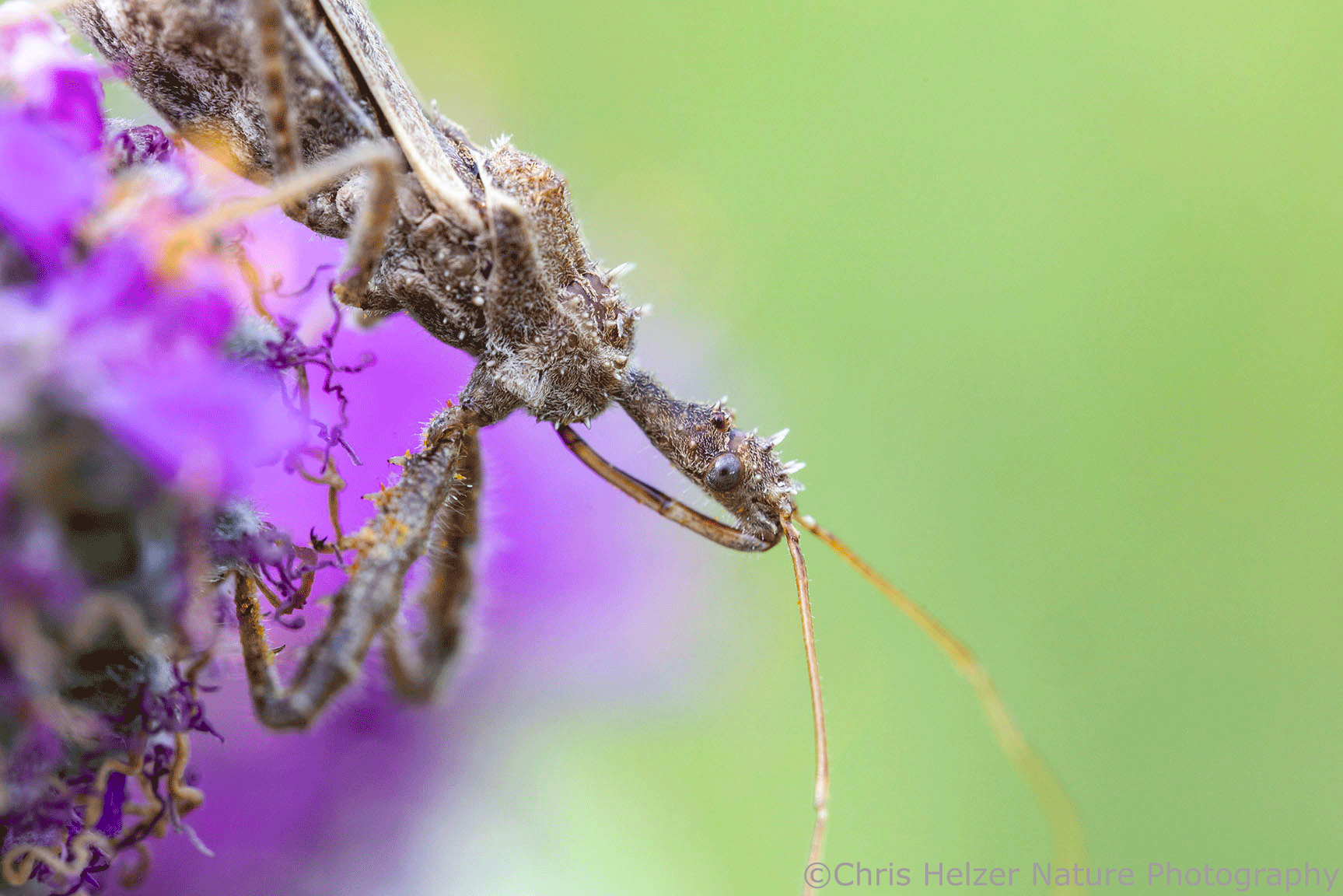
The second mystery is a little different, and I’ve already had help solving part of it.  I’ve been walking past a couple New Jersey tea plants recently (on the way to my square meter photography project site).  Each time, I’ve noticed a particular kind of insect hanging around on and near the flowers.  The way the bugs (because they are clearly Hemipterans – true bugs) are sitting poised and apparently waiting for something, I’ve been assuming they are predators.

This bug, and several more like it, have been hanging around on a couple New Jersey tea plants lately.

I recognized the bugs but didn’t know what they were.  They reminded me of leaf-footed bugs, but instead of the flattened “leaf” structure being on their legs, this bug had them on its antennae.  I submitted the above photo to Bugguide and got a quick response, identifying it as a Euphorbia bug (Chariesterus antennator) – a kind of leaf-footed bug, after all.  That was easy, but my next step was to try to learn more about it, and that’s where I got stuck.

I found information on a couple other leaf-footed bugs, but not the Euphorbia bug.  It appears most leaf-footed bugs are plant feeders, with some doing minor damage to crops or garden plants.  Photos of the Euphorbia bug I can find on the internet often show it on Euphorbia plants (spurges), which makes sense, but I can’t find anything that says it actually feeds on spurge plants themselves.  Maybe that’s a favorite plant, but not its only food source?

So, I want to know what Euphorbia bugs eat.  Are they predators that hang out on plants waiting for opportunities to catch prey?  Or are they plant feeders that may or may not prefer spurge species?  While we’re at it, what do their larvae feed on?  Where do they live?  Is there anything else interesting about them?  Mysteries.

Help?