While driving through central Nebraska last week, I couldn’t help notice all the fuzzy creatures crossing the highway in front of me. They weren’t raccoons, deer, or even voles. They were tiny little caterpillars, and they were moving FAST.

This was a common site along Nebraska highways last week.
I’m not entirely sure why the caterpillars are on the move, or where they are going. Some internet searching turned up some university extension and similar pages that infer that the caterpillars are simply searching for a good place to spend the winter. That could be true, but if so, they sure don’t seem to be doing it in any organized fashion! There were just as many caterpillars crossing the road from left to right as there were from right to left. It made me wonder if they just kept going back and forth… (tiny little brains.)
As I drove, my scientist mind was spinning, despite my best intentions. I kept track of the land cover types on both sides of the road, trying to figure out what kind of habitats the caterpillars might be leaving or heading for. If there was a pattern, I didn’t see it. The caterpillars crossed the road in places where there were soybean fields on both sides as well as places where there were miles of sandhills prairie on both sides. They didn’t seem to be heading from high ground to low or from tall vegetation to short – or vice versa.

Another one.
My photographer brain was also in full gear, which meant I had to keep stopping to take photos of the little buggers. Fortunately, the roads I was traveling were not very well populated with other vehicles, but I still had to be discreet to avoid uncomfortable conversations. Whenever I heard a vehicle coming I just pretended I was stopped to make a phone call or just to admire the view. Otherwise, I would have ended up having conversations something like this:
“You okay?”
“Me? Yeah, I’m fine.”
“Oh. I just wondered why you were lying in the middle of the highway.”
“Um, yeah. I was actually taking a photograph of a caterpillar.”
“A caterpillar.”
“Yeah.”
“In the middle of the highway?”
“Well, yeah. I wanted to know why it was crossing the road.”
“Is that a joke?”
“No, but now that you mention it, it might not be a bad start to one…”
“So you don’t need any help?”
“No, I’m good, but thanks for asking. I’m just trying to get some pictures.”
“In the middle of the highway. On your belly.”
“Well, yeah. You see, I’m a prairie ecologist.”
“Oh! Why didn’t you say so? Carry on then…”
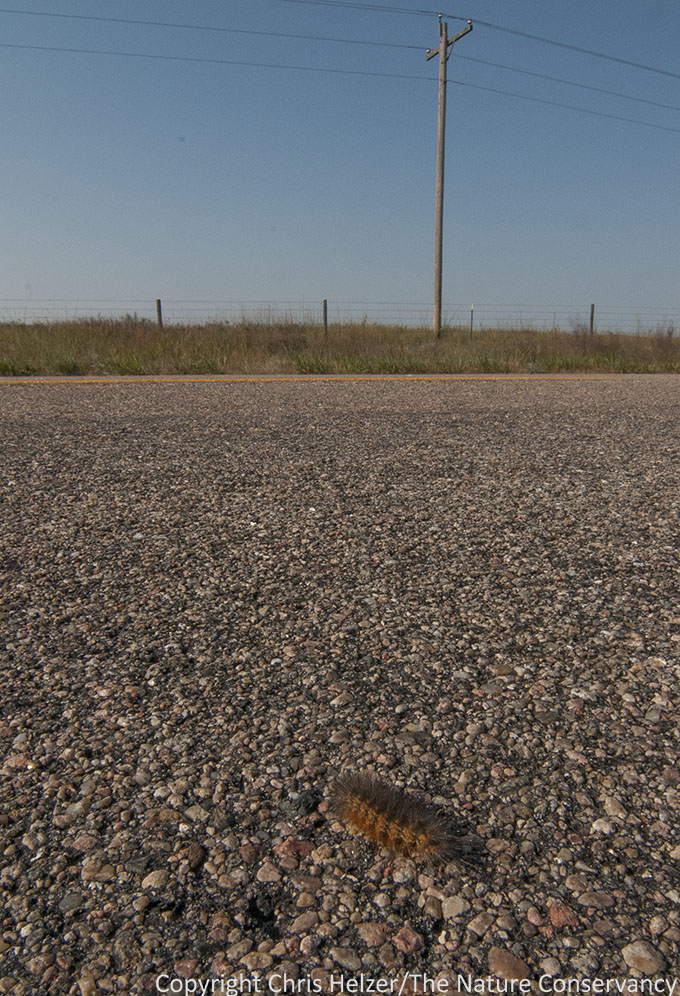
Anyway, I did manage to get some photographs of the commuting caterpillars. I’m glad I did because seeing them up close made me realize there were several different species of them making the crossings. I also (I can’t believe I’m admitting this) timed them to see how fast they were going. What? I was just curious…
I wish the caterpillars well on their journeys. There were surprisingly few smooshed caterpillars on the road, so I’m assuming the majority made it across the road. I hope that means they found a nice place to spend the winter, or whatever they were looking for.
I also hope no one saw me photographing them.

You probably don’t care, but in case you’re wondering, the caterpillars were making the 32 foot trip across the highway in about 80 seconds. If my math is correct, that means they were traveling about 4.8 inches per second. That’s moving right along for a tiny critter with stubby little legs!