It’s Bee Week!

Thanks to a return visit by Mike Arduser of the Missouri Department of Conservation, it’s bee week in the Platte River Prairies.  Mike came out to our sites a year ago to help us start thinking about our prairies from the perspective of bees and other pollinators.  This year, he made a return visit and we’ve given him a full plate of activities.

Mike Arduser (right) talks about bees with Sam Summers and Anne Stine earlier this week.

Mike Arduser (right) talks about bees with Sam Summers and Anne Stine earlier this week.

On Monday, Mike and I spent the day inventorying bees at several of our prairies, assisted by Anne Stine (Hubbard Fellow) and Sam Summers (TNC volunteer).  We are building upon the initial list of 57 bee species we found in 2012.  Several new species have already been added to the list, and more are likely as we continue to look.

We hosted a pollinator ecology workshop on Tuesday, attended by about 40 people – mostly biologists who assist private landowners with habitat projects or who manage conservation lands.  The objectives were to have Mike help us better understand basic pollination ecology and the needs of pollinator species – particularly bees, and to help us better incorporate bee habitat into our prairie restoration and management strategies.  It was a great day, and everyone had their heads buzzing (sorry) with new information and ideas.

At our pollinator workshop on Tuesday, we spent time talking about prairie restoration and management strategies, as well as general pollinator ecology.

At our pollinator workshop on Tuesday, we spent time talking about prairie restoration and management strategies, as well as general pollinator ecology.

On Wednesday and Thursday, Mike is leading a smaller group of us through an intensive bee identification workshop.  I’m looking forward to peering closely at the faces and private parts of bees through microscopes, and learning to differentiate between Melissodes, Colletes, Lasioglossums, and all the other bees in our prairies.

Less than a month ago, we saw Mike at the Grassland Restoration Network workshop in Columbia, Missouri.  He gave a presentation in which he talked about a variety of pollinator-related topics, including some potential ways to use bees to assess the success of prairie restoration projects.  One of Mike’s suggestions was to see what percentage of bee species in a prairie are specialist pollen feeders (oligolectic bees) and compare that percentage between restored (reseeded) and remnant (unplowed) prairies.

Pollen specialist bees feed only on pollen from one to a few flower species, whereas pollen generalists can feed from a wide variety of plant species.  Specialists tend to be less common in small isolated prairies than in larger prairies, in part because they need a certain minimum population size of their host plants, which can be difficult to obtain in small prairies.  Restored prairies might also lack that population size threshold, especially during the early establishment phase of a new seeding.  In addition, restored prairies that are isolated from remnants might be missing specialist bees simply because the bees in those remnants can’t find them.

According to Mike, a couple of recent surveys in Iowa found that about 20% of the bee species in remnant prairies are pollen specialists.  However, some early data from re-seeded Iowa prairies is showing much lower percentages of specialist bees – especially when those sites are isolated from large remnant prairies. If pollen specialists are not easy to attract to restored prairies, comparing the percentage of specialist bees in restored prairies to the percentage in nearby remnant prairies might be an important way to assess restoration success.
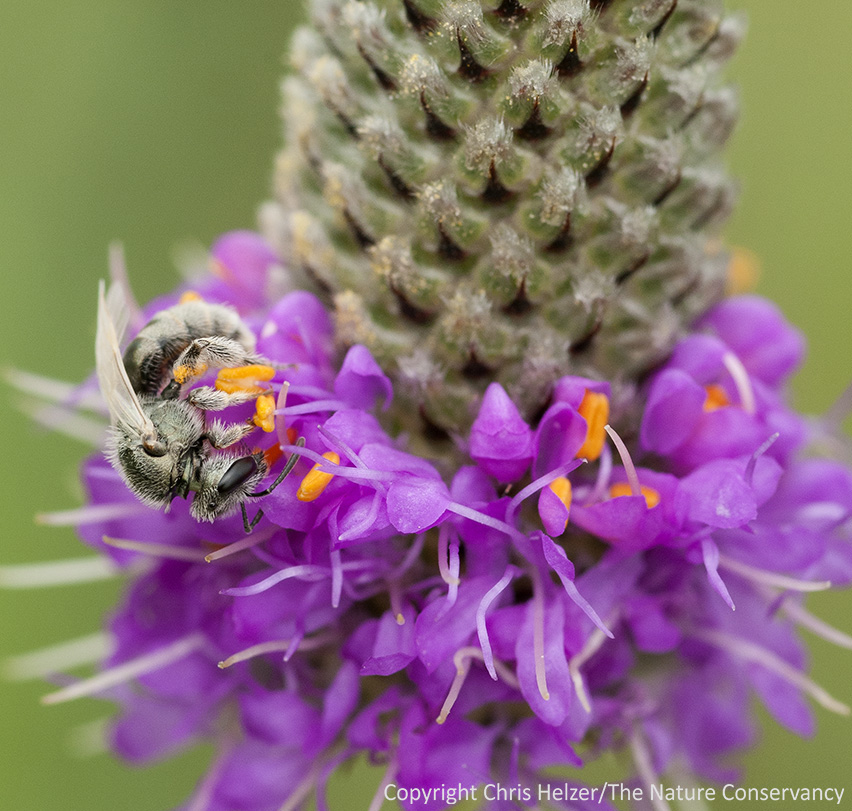
This bee is (probably) Lasioglossum pruinosum, which is a generalist pollen feeder.  It's not suprising to see it in a restored prairie.  Pollen specialist bee species seem to be more sensitive to habitat fragmentation, and may be less likely to occur in restored prairies - especially if those restorations are isolated from large remnants.

This bee is (probably – according to Mike) Lasioglossum pruinosum; a generalist pollen feeder. It’s not suprising to see it in a restored prairie. Pollen specialist bee species, however, seem to be more sensitive to habitat fragmentation, and may also be less likely to occur in restored prairies – especially if those restorations are isolated from large remnants.

Mike suggested that another useful metric could be the number of cleptoparasitic bee species present in a prairie.  Cleptoparasites, or cuckoo bees, are the cowbirds of bees – they lay their eggs in the nests of other bee species.  Because each cleptoparasitic species tends to specialize on the nests of certain species or groups of bees, their presence could another interesting indicator of restoration success.

From our 2012 bee inventory data, I can make some preliminary, and very tentative, conclusions about the number of pollen specialists and cleptoparasites in our prairies.  Of the 38 species we found in remnant prairies last year, 10 (26%) are pollen specialists and only 1 (3%) is a cleptoparasite.  By comparison, of the 47 bee species we found in restored prairies, 12 (26%) are pollen specialists and 7 (13%) are cleptoparasites.

Those data are encouraging, but pretty sketchy because we were really just doing broad inventory work – not collecting data in a way that would allow for a good comparison.  In addition, it clumps all our prairies together, so we can’t look at each one individually.  Anne Stine (one of our two Hubbard Fellows) is going to help remedy that during the next couple months by conducting a short study.  She do some standardized collection of bees from a variety of remnant and restored sites and then compare the percentages of specialists and cleptoparasites between those prairie types.  That should give us a better feel for what’s going on.

In the meantime, it looks like a relatively high percentage of the bee species in our restored prairies are pollen specialists.  That probably reflects positively on both the plant species diversity in those restored prairies and the fact that they are adjacent to remnant prairies – making bee colonization pretty easy.  Since the main objective of our prairie restoration work is to enlarge and reconnect our remnant prairies, those early results are very promising.  …But let’s see what Anne finds before we get too excited.

Now if you’ll excuse me, I have to go learn to tell the difference between Melissodes agilis and Melissodes desponsa.  Wish me luck…
Hubbard Fellowship Blog – Photos by Eliza

Guest Post by Eliza Perry, one of our 2013-14 Hubbard Fellows (all photos are by Eliza Perry).

The past month has been wild. Instead of writing up a succinct summary, I decided to share a few of my favorite photos I’ve managed to capture in the field (our work is rarely camera-friendly).

DSCN0070

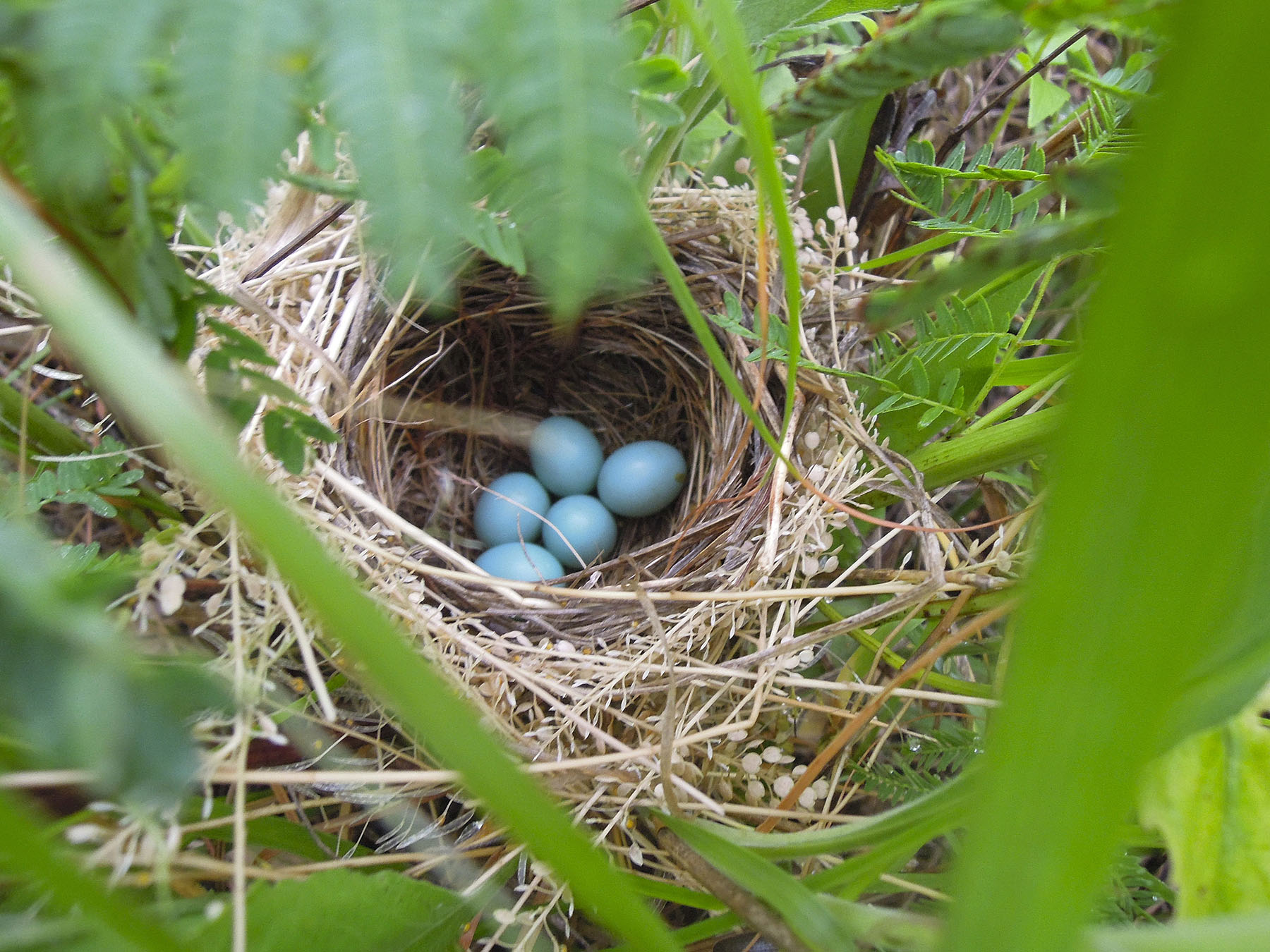
From afar, prairie is a striking landscape with dramatic skies and a vast, quaking floor; up close, however, is a far more interesting view. I had never seen a bird’s nest intentionally woven into grass before working in prairie. This particular nest held five dickcissel eggs. Usually these eggs are accompanied by one or two brown-speckled eggs from a crafty cow bird, who transfer their parental burden onto an unknowing other.

.

DSCN9657

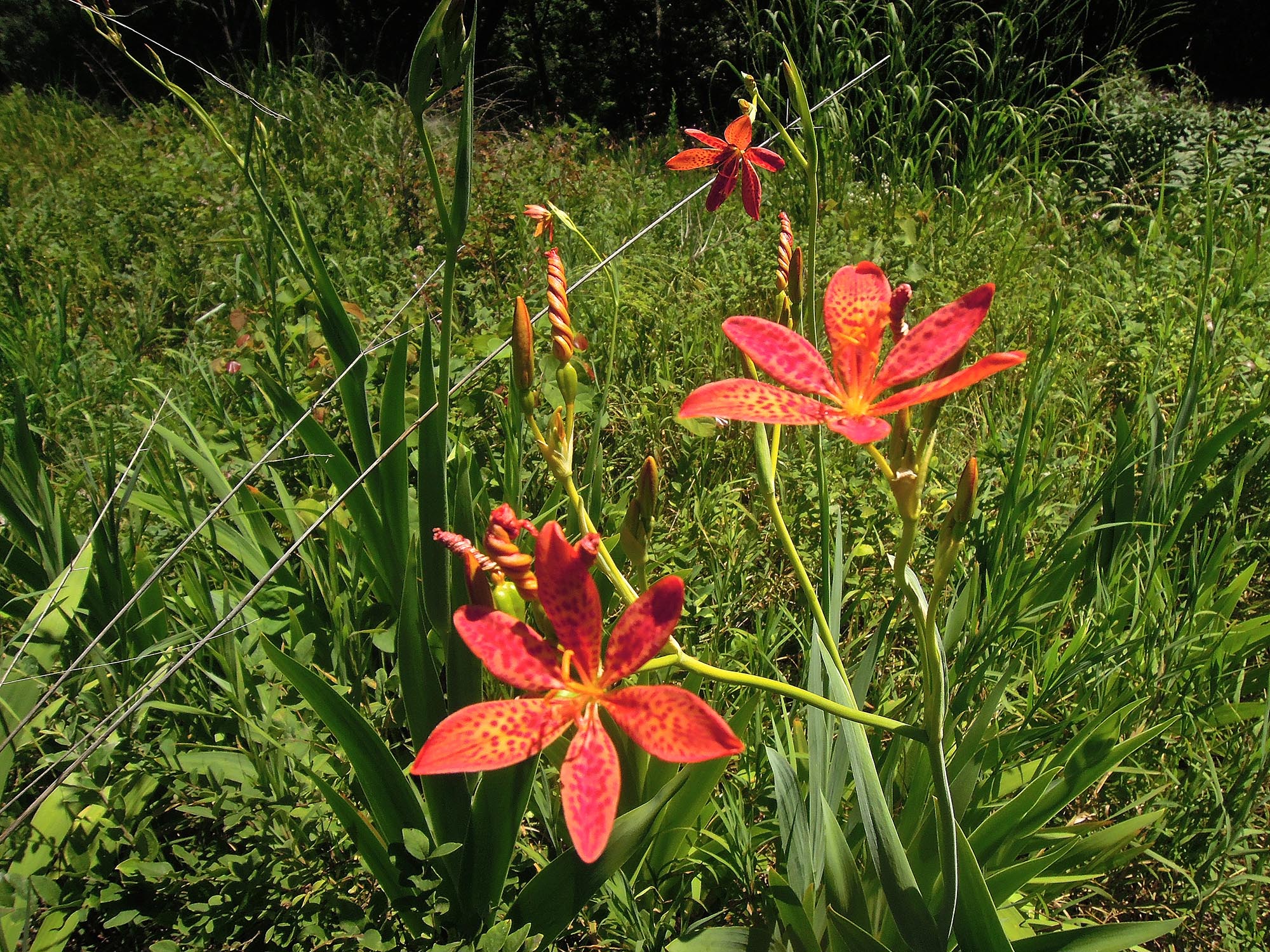
Invasive species control will always bring up concerns about inadvertent damage. I don’t know the name of this beautiful flower, but I noticed it while spot spraying sericea lespedeza at our property in Rulo. We recently purchased a new backpack sprayer that provides dense, targeted coverage over a plant, but even so, my worry is always in how many neighboring plants unintentionally receive a harmful or fatal dose of herbicide. We could see patches of dead vegetation from last year’s sericea treatment.

During my first few days of spot spraying this season, soaking invasives seemed like a bulletproof plan in light of the natural tendency toward “more is better.” Since then, I’ve learned that this method is not only harmful to the surrounding plant community, but more importantly, it is often counter-productive because it can “burn” the plant past its ability to absorb the chemical. The result is a damaged plant with an intact root system and ability to regrow and flower. This is an ongoing challenge, but I have learned to mitigate some of my impact through application technique. For example, one key is maintaining high pressure in the backpack sprayer pump to avoid drippage between sprays.

.

DSCN0073

This photo was taken several weeks ago when most of our sensitive briar (Mimosa quadrivalvus) was at an early stage in blooming. The young flowers caught my attention immediately because to me they look like fireworks. I invent names for most of the forbs I don’t recognize until I can get a handle on their proper common names, and I called these “firework flowers” until relatively recently when I finally accepted them as sensitive briar.

.

DSCN9876

This photo does not adequately capture the plant or structural diversity present in this area. I took it very early on before I understood the significance of either, but as I reviewed the photos I had snapped in the past two months, this one stood out in a different way than it was originally intended to: as an almost comical juxtaposition of cropland and prairie. Of course, agricultural monocultures serve their purpose, but the measures of success and functionality for the two “ecosystems” are so contrary that it makes for an interesting picture to see the two side-by-side. For one, the presence of a “weed” is considered to be the enemy of crop productivity, while prairies are essentially a collection of tenacious (native) weeds. Moreover, monocultures entail the least amount of variety in land management practices by design, while prairies thrive on highly variable land management and substantial disturbance.

.

DSCN9938

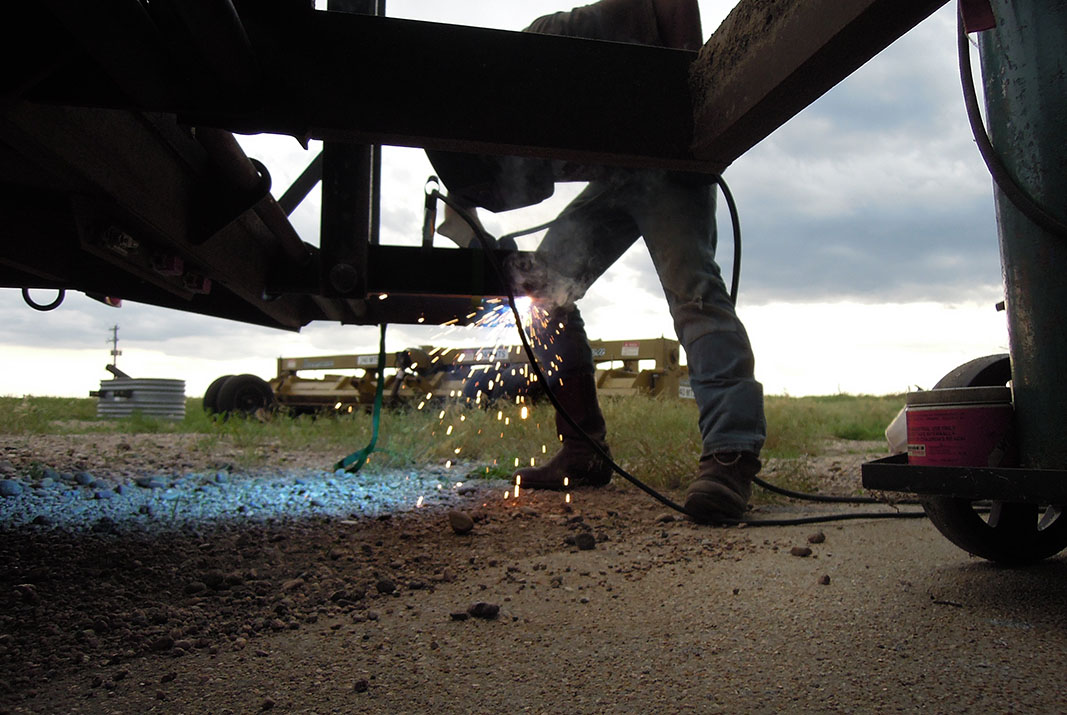
Prairie management involves a lot of equipment and we need to know how to maintain it. Our trailers are particularly important because they allow us to transport heavier equipment like ATVs and skidloaders to properties further away. A few weeks ago, one of our trailers had a small part knocked off. This photo shows Nelson, our land manager, teaching me how to weld it back on. Anne and I are in the process of learning to use all of the exciting hand and power tools in our shop so that we can more effectively help with maintenance and construction projects. Someday I hope we will complete our own.

.

DSCN0176

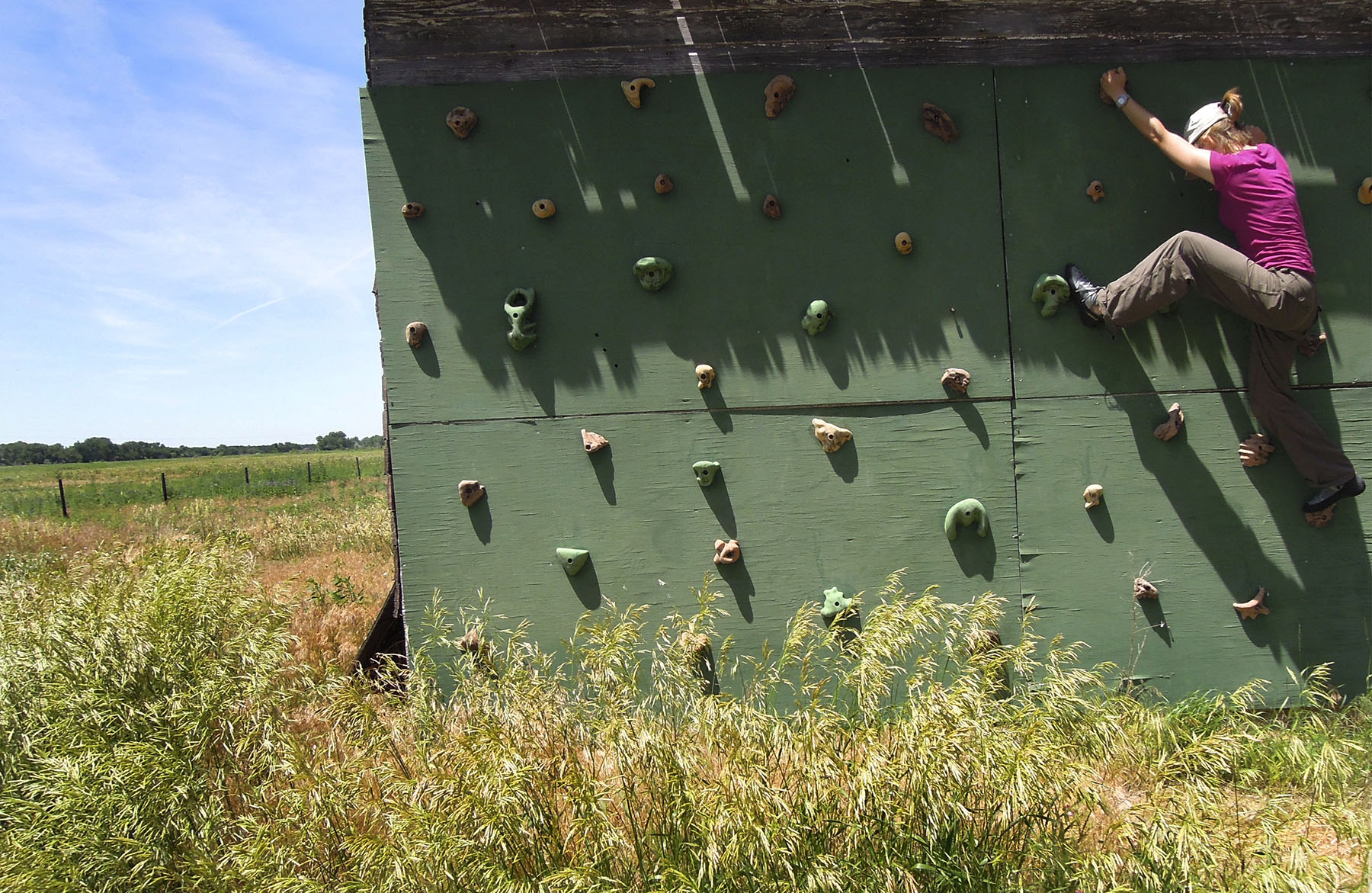
Leave it to Anne to find a climbing wall in the middle of a prairie!

.

DSCN9409

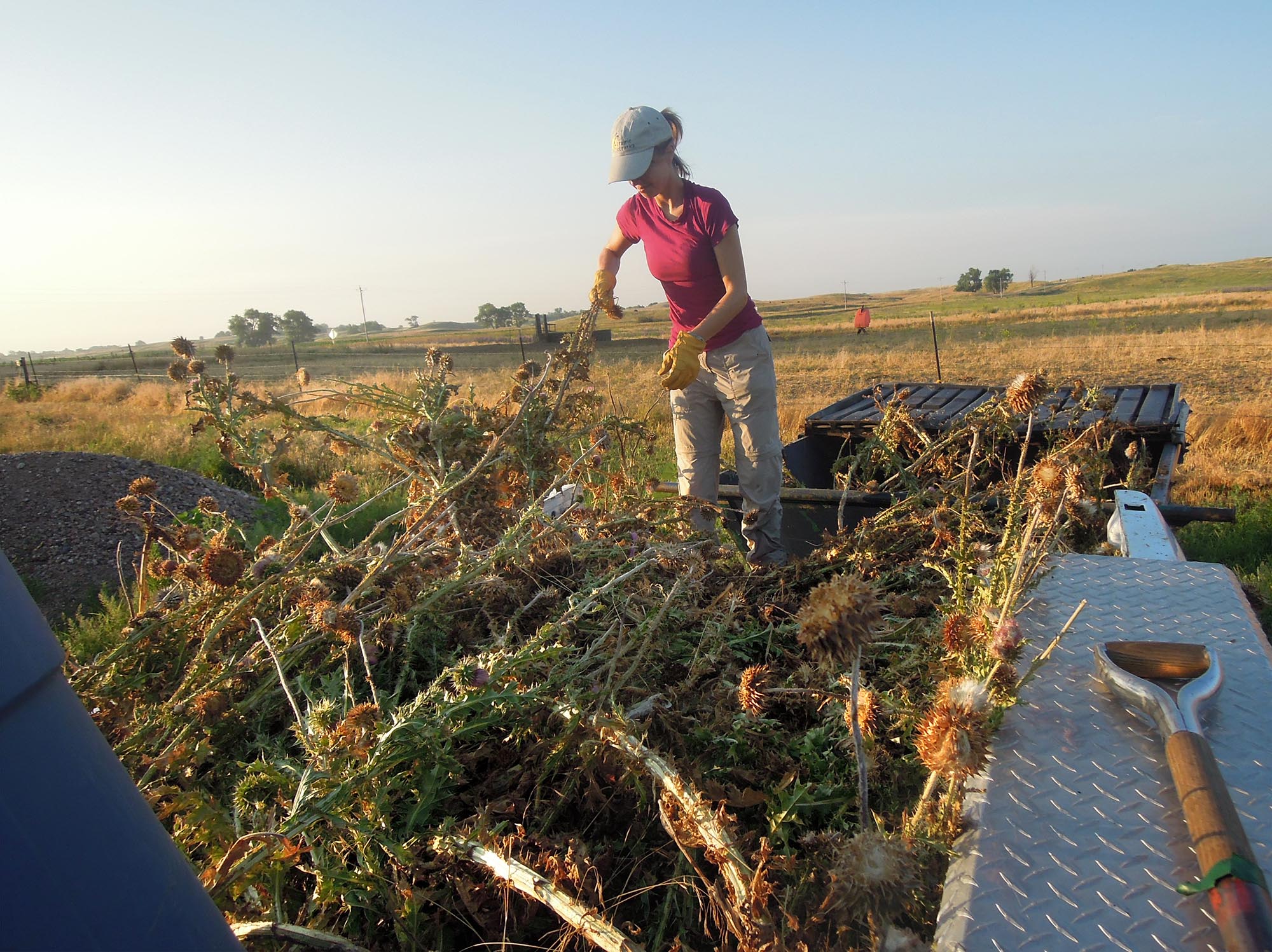
This photo does not do justice to the number of invasive thistles packed into that truck bed. We found a sizeable forest of musk thistles seeding out at the tail end of our thistle season and decided to remove them from the scene entirely because pulling off all of the flowers would have taken a full day. A dumpster brimming with these villains was a satisfying sight after weeks of focusing most of our efforts on eradicating them.

.

DSCN0375

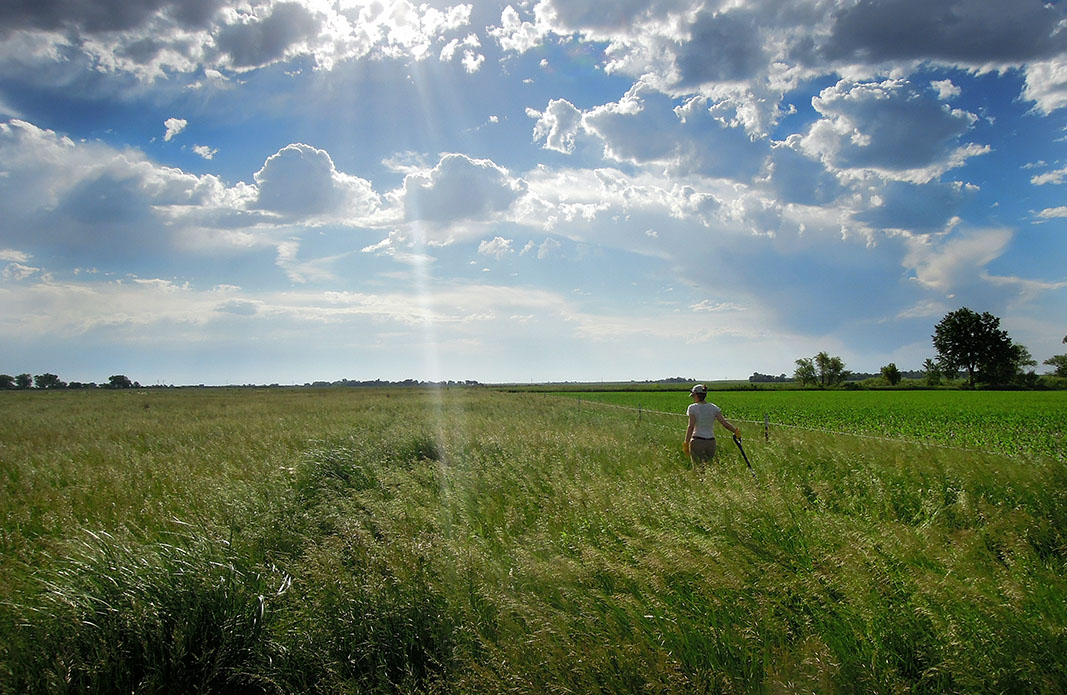
I have moments every single day in this job when I have to stop what I’m doing to relish the fact that scenes like this are my equivalent to an office. I captured one of these moments one afternoon while scouting our Kelly Tract for Canada thistles. Controlling invasives is a daunting task with some species, and I have found myself feeling defeated to the point of forgetting its importance to our conservation objectives, which has been a good lesson for me. As Chris recently described in a blog post, our goal is to strengthen the overall ecological resilience of our properties, which cannot occur without a resilient plant community.

.

DSCN0214

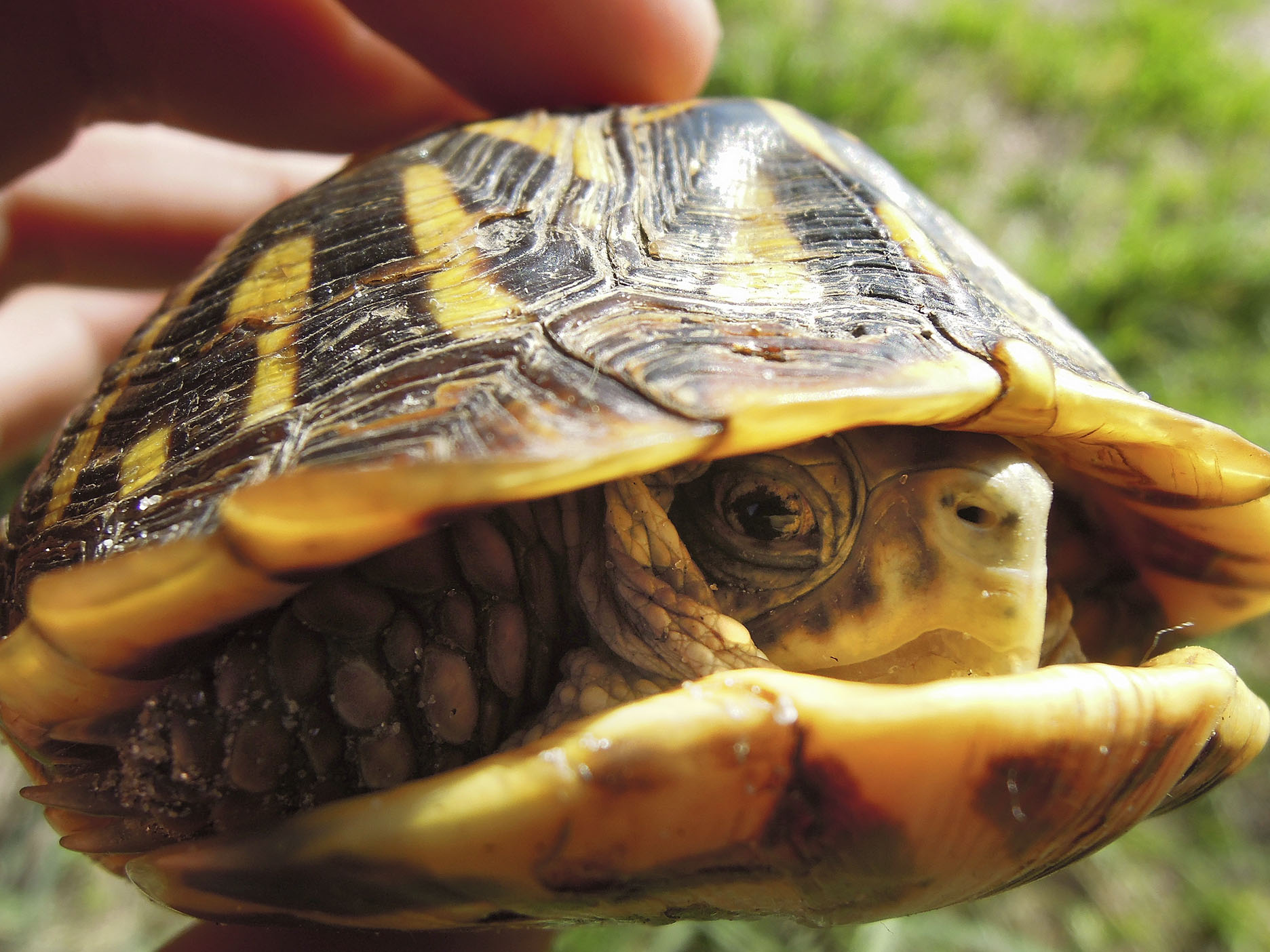
We rescued this little lady from the middle of a highway on our way to Niobrara Valley Preserve. There was a stretch of ten or so miles in which we saw a high number of box turtles crossing the road, and virtually none before or after. While she certainly looked on at us indifferently, I thought I could detect a hint of sass in her expression and did my best to capture it here.

.

DSCN0127

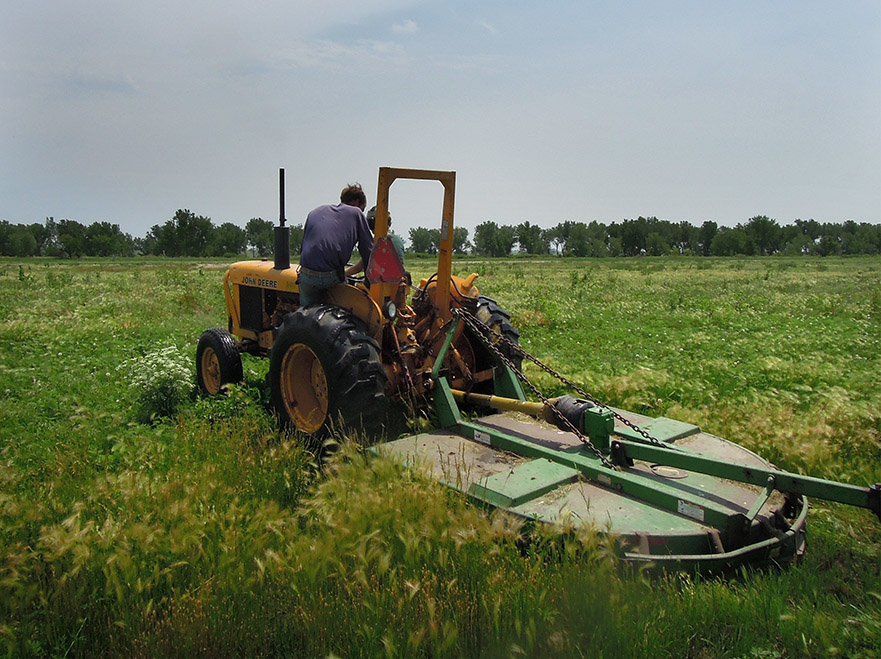
Once Anne had learned how to safely operate this tractor, she proceeded to mow our most recent restoration site for several hours. The key to our success in becoming comfortable using all these new vehicles and tools is, unsurprisingly, practice. Luckily there is no shortage of pastures that need to be mowed, trees that need to be felled, or fences that need to be relocated. Mowing is one of several land management strategies for knocking back invasives by thwarting their growth to prevent or buy time before they seed out. Mowing “burn breaks” is also an essential component of safe prescribed fire burns.