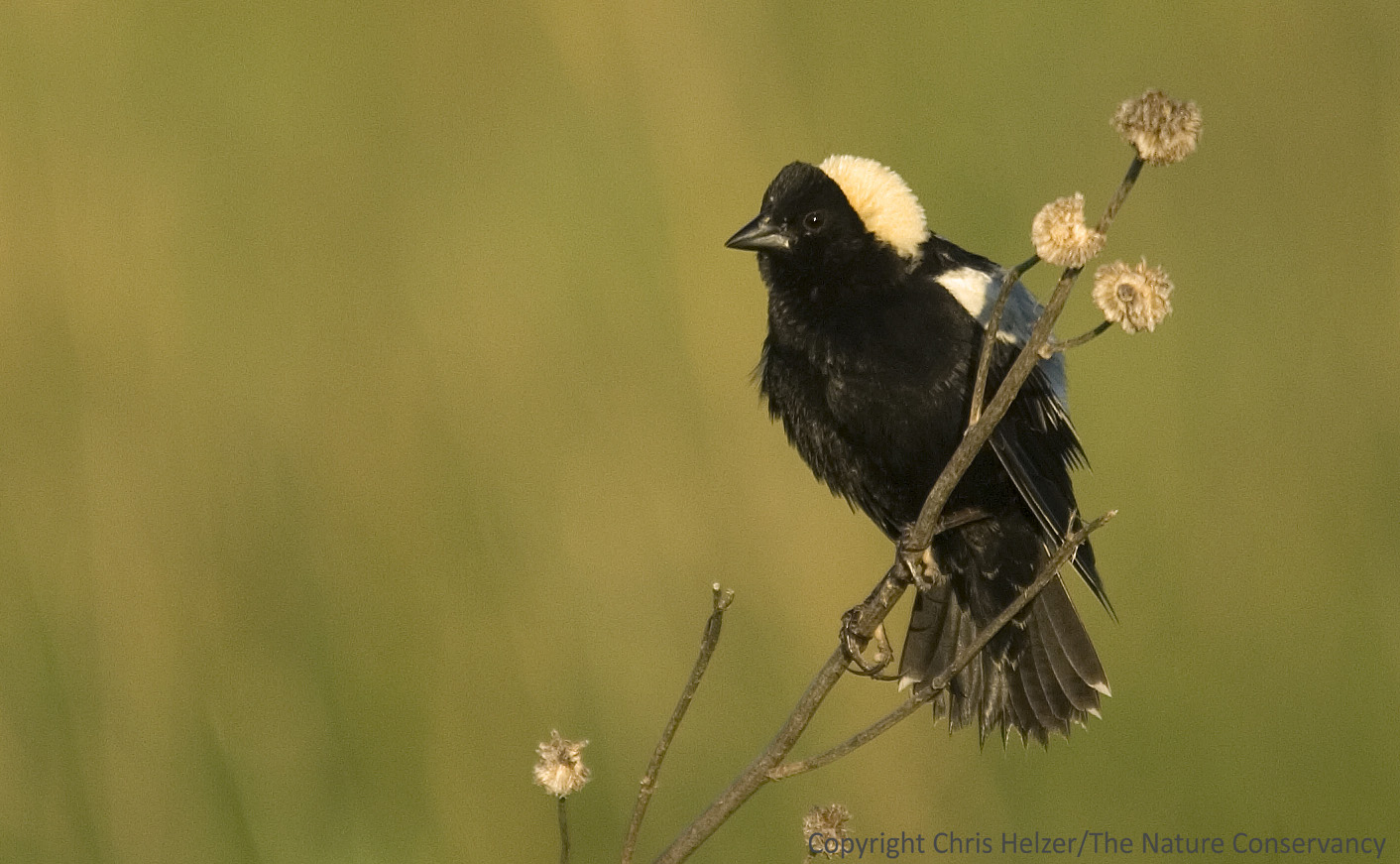
Why Are We Spending So Much Time Studying Birds?

Believe it or not, I really do like birds.

(And thus starts another blog post destined to draw the ire of my ornithologist friends…)

But here’s the thing.  I just read yet another study of grassland birds in which the researchers looked at the relative importance of variables such as habitat structure (tall, medium, and short grass, amount of shrub cover, etc.) and landscape composition (how much grassland is in the landscape).  It was a nicely designed study, but I found myself wondering how much value these kinds of studies are really adding to our ability to do effective grassland conservation.

A dickcissel sings from the top of a Woods' rose in restored Platte River prairie. Compared to most other kinds of animals and plants, we have a pretty solid understanding of the breeding habitat requirements of dickcissels and other grassland breeding birds.

Yes, we still have a lot to learn about grassland birds and their habitat requirements.  The more we learn, the better able to design conservation actions to help birds.  On the other hand, we already know an awful lot about grassland birds relative to other groups of grassland species like snakes, ground squirrels, grasshoppers, leafhoppers, fungi, and nematodes.

It’s kind of like we’re going to high school but only really studying in art class.  Art is important and enjoyable, but focusing only on art is not going to prepare us very well for dealing with the world.

If I was going to design a grassland landscape to maximize bird conservation, I think I could do a pretty good job based on what we know right now.  I’d start with multiple large blocks of prairie (hundreds of acres in size – much bigger, if possible).  Those blocks of prairie would need to include both upland and lowland grassland areas, and be floristically diverse enough to support an abundant supply of insects and seeds.  I’d include some scattered patches of shrubs and small trees in the landscape, but would place them so that there are still large areas of grassland with no woody vegetation at all.  Management would be important, and I would try to ensure that a variety of habitat structures was available each year, including the whole continuum between very short-cropped vegetation and tall dense and/or weedy cover.  It would be great to have those habitat types mixed together such that each block was a decent size (20 acres or more?) but that they were close enough together that birds species requiring more than one cover type during a season can easily move between them.  I’m sure those more up to speed on current literature might add a few tweaks to this landscape design, but I think this covers the more important components.

Sure, there are still a few holes in our knowledge of, especially in terms of their requirements for migratory habitat, but as a whole we’re in pretty good shape.  I would argue that our biggest limitation is not the ability to predict what birds need, but rather our ability to implement the necessary changes on the land.  However, that only applies to birds.  Does anyone feel they could similarly and accurately predict the landscape scale habitat needs of the smooth green snake, Franklin’s ground squirrel, or the long-jawed orbweaver spider? Not me.

A smooth green snake found in the Platte River Prairies, Nebraska. Very little is known about the habitat and/or landscape requirements of species like this one. We don't even really know much about how many there are. They are considered to be rare in most places, but we find them fairly regularly in our prairies - they're just really hard to see!

It would be different if we were confident that a landscape designed for birds would provide for the needs of all other prairie species.  I think we’re far from being able to say that.  Here’s just one reason I’m skeptical:  Grassland bird species are extremely mobile, and most migrate long distances between breeding seasons.  This allows those birds to find the best appropriate habitat (within reason) each year, even if that habitat isn’t where it was the previous breeding season.  Most other grassland species don’t have that kind of mobility, but many (most?) of them have fairly specific habitat structure requirements.  When the habitat structure where those species are living changes, how far can they travel to find appropriate habitat?  What kinds of terrain can they cross?  These are questions with huge implications for how we should be managing prairies and prairie landscapes, but we can’t do anything but make wild guesses because although we know how birds deal with those issues, we don’t know how most other species do.

I explored this issue of birds as indicators for the conservation needs of other species in an earlier post, if you’re interested in reading more.
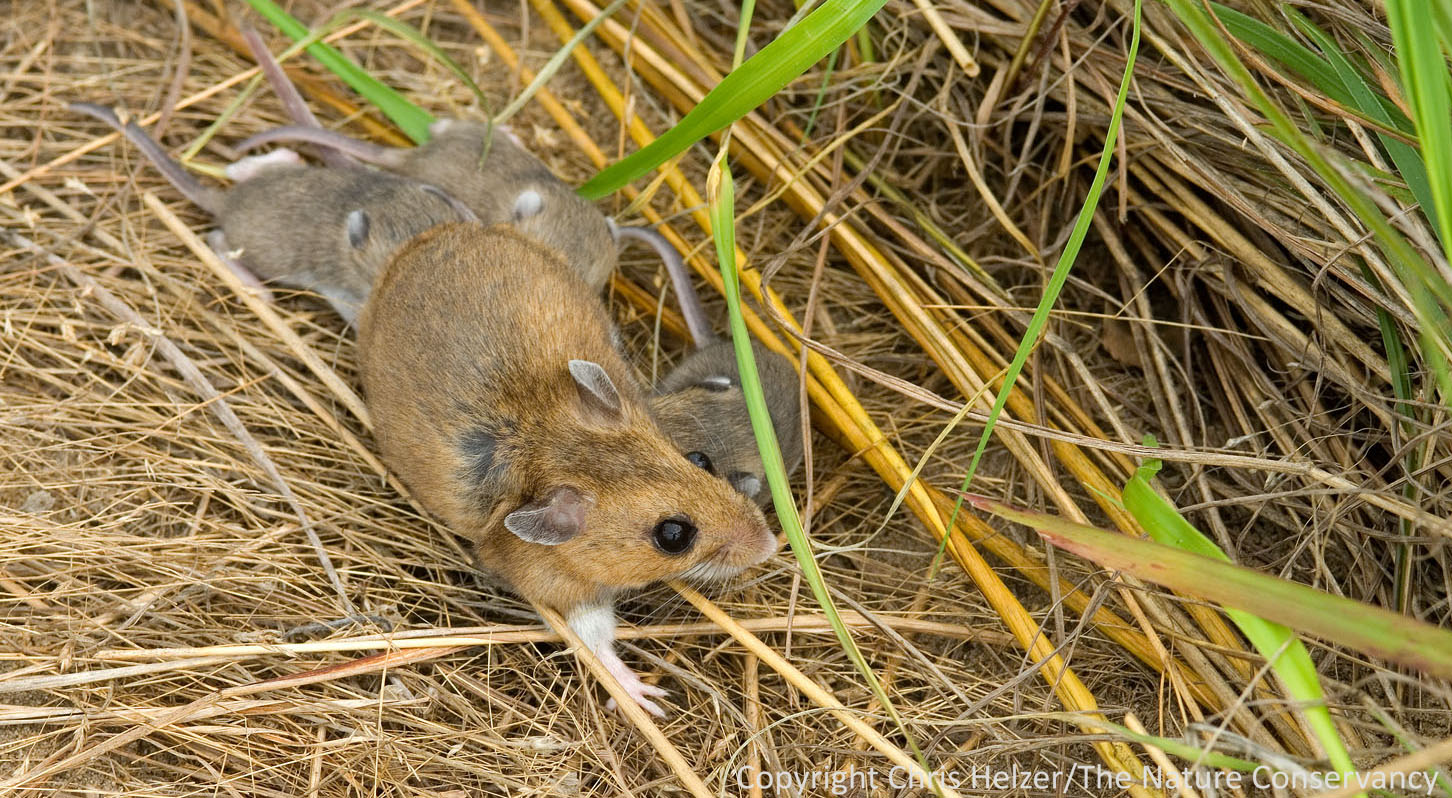
Mice are fairly mobile species (compared to wingless invertebrates, for example) but we still know relatively little about their ability to find the kinds of habitat structure they need. When conditions change, do they travel long distances in search of appropriate habitat? Or do they just hunker down and wait for better times? If they travel, how far can they go, and what challenges do they face?

So why are we still spending so much time studying birds instead of branching out to other species and broader questions?  One big reason is inertia.  Scientists rightly like to build upon previous projects, so because there have already been a lot of studies of birds, there is a lot to build upon.  This makes sense in terms of efficiency (study methods are already designed and tested) and from the standpoint of funding availability (it’s often easier to sell a project that is builds upon what we already know than one that is reaching into the unknown).

A second reason we study birds so much is that they’re relatively easy to see, hear, and identify.  Since most research is done by graduate students and technicians, picking species that can be learned quickly is very helpful.  I should know – I did my own graduate research on grassland birds!  However, since then, I’ve learned that it’s not that hard to pick up on the sampling and identification skills needed to study other organisms, and that with invertebrate species, there are experts that can do the identification for you.

Of course, the biggest reason we study birds so much is that we LIKE birds so much.  If ground beetle watching was as popular as bird watching, prairie research and conservation efforts might look very different!  The irony, of course, is that we’re essentially focusing a very large proportion of our research and conservation effort on only a dozen or so grassland bird species (in any particular landscape).  At least if we were studying ground beetles, we’d be looking at several times that many species – and while I don’t know that much about ground beetles, I’ll bet they would be equally good indicators of the “health” of the prairie ecosystem.

A sedge wren on velvety gaura in the Platte River Prairies. Tiny birds, with cute little tails and aggressive personalities, sedge wrens are great examples of why birds are so compelling to people.

Look, I get it.  We’re not going to turn this battleship on a dime and move all the bird research funding and effort into smooth green snake and ground beetle research within a year or two.  However, I do think it would be really valuable for those doing bird research to incorporate broader community questions into their projects, whenever possible.  Maybe we could start by asking questions about how well birds really do represent the needs of other species?  Would funders of grassland bird research be open to that line of exploration?  It would allow us to build upon what we know about grassland birds by testing those known parameters on other taxa.  If we could figure out where the needs of birds and other species diverge, that’d be a great step forward in terms of defining future research needs.  Are great prairie chicken landscapes also great grasshopper landscapes, or not necessarily?  Do sedge wrens and massasaugas have similar habitat needs, or at least compatible habitat needs?  If not, how do we balance the needs of both species?  Let’s build on what we know about birds, but do it through some comparative analyses with other species.

Because you’ve got to admit – ground beetles are pretty cute too!
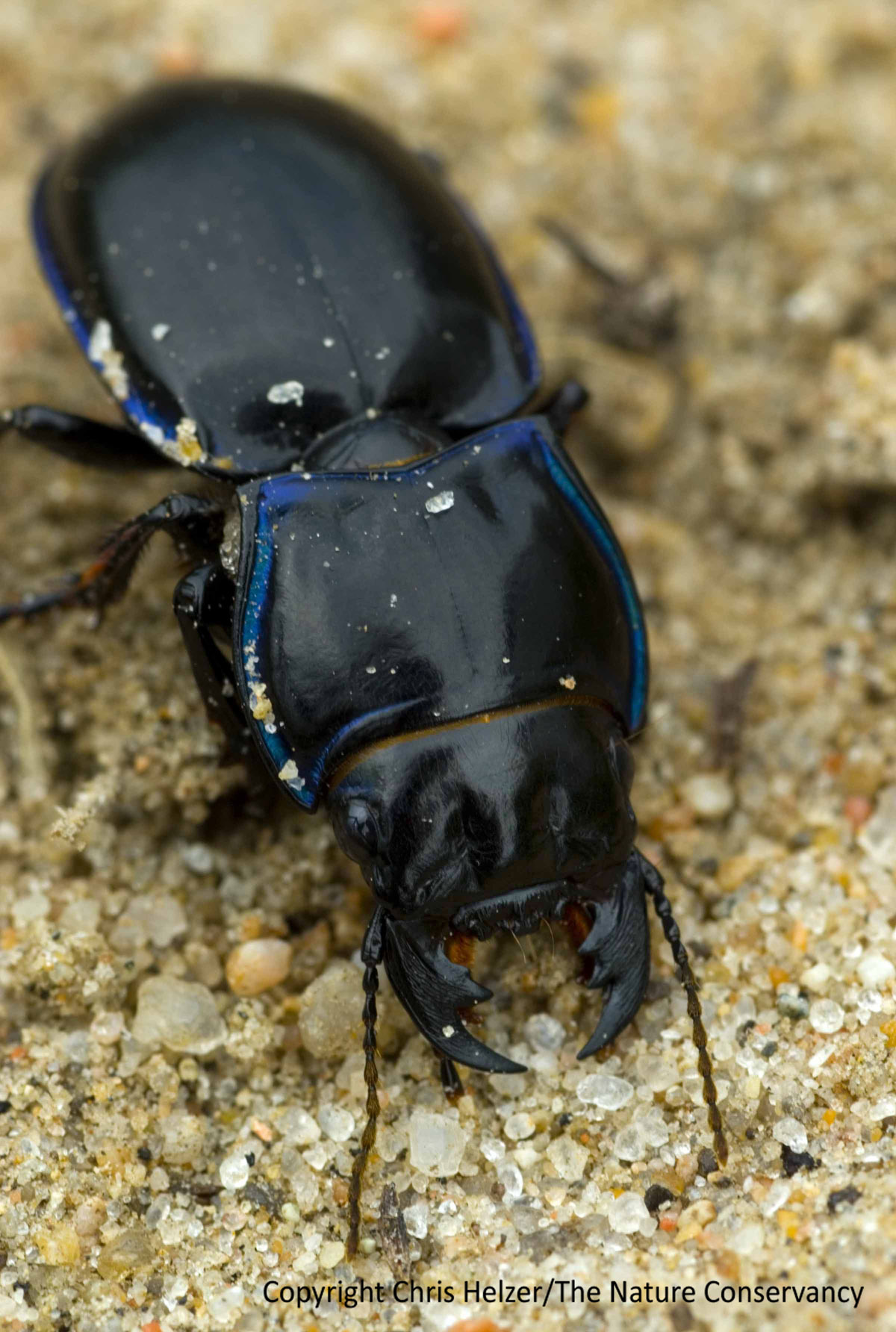
Ground beetles like this one (Pasimachus sp?) are abundant and diverse members of the prairie community. What do we know about their conservation needs? Not much.

Why I Care About Prairies and You Should Too

Lately, I’ve been trying to figure out why I think prairie conservation is so important.  I’m not questioning my conviction – I feel very strongly that prairies are worth my time and effort to conserve – but if I can figure out exactly what it is that makes me care so much, maybe I can be more effective at convincing others to feel the same way.

I can list off all kinds of logical and aesthetic reasons that prairies are important.  Prairies build soil, capture carbon, trap sediment, grow livestock, and support pollinators.  Depending upon our individual preferences, prairies also provide us with flowers to enjoy, birds and butterflies to watch, and/or wildlife to hunt.

The buckeye is one of the more striking-looking butterflies that can be found in prairies.

Those are all very practical reasons to think prairies are important, but I don’t care deeply about prairies because they make soil and grow pretty flowers.  More importantly, those reasons are not enough to make someone stop and reconsider a decision to plow up a prairie to plant corn or broadcast spray 2,4-D just to reduce ragweed abundance.  If prairie conservation is going to succeed, you and I both need to understand and articulate the deeper reasons that we feel prairies are worth saving.

Which brings me to Dr. Seuss.

As I was mulling over why I cared so much about prairies, the story of “Horton Hears a Who” popped into my head.  In case you’re not familiar with the story, Horton the elephant accidentally discovers an entire community (Whoville) living on a speck of dust.  After he finds and starts talking with the Whos, Horton agrees to help protect them from harm.  The other characters in the book don’t believe Horton when he tries to tell them about the Whos, and actually go out of their way to steal and destroy the speck of dust he’s trying to protect.  Only when the Whos are finally successful at making enough noise to be heard do those other characters recognize the existence of the Whos and agree to help protect them.

Dr. Seuss’s intended moral to the story (repeated many times) is “A person’s a person, no matter how small.”  It’s a fine moral, but isn’t what drew me to the story as a metaphor of prairie conservation.  Instead, I was thinking about WHY the other characters in the story finally changed their minds.   The sour kangaroo and the Wickersham brothers didn’t give up their threats to boil the speck of dust in Beezelnut oil because Horton finally came up with the right logical argument to explain why the Whos were worth saving.  They changed their minds because when they finally heard the Whos making noise they recognized and identified with the Whos as fellow living creatures.

Can you see where I’m going with this?  I think the biggest thing that drives me to devote my career (and a fair amount of my free time) to prairie conservation is that I have developed a personal connection to the species that live in grasslands.  Not only do I know those species exist, I can also identify with them and what they’re doing to survive.  By becoming familiar with them, I became fond of them.

When I was in graduate school, I studied grassland nesting birds.  I got to know those bird species well, including where they lived, how they survived there, and what motivated and threatened them.  I saw prairies through their eyes, and that made me want to help make those prairies as hospitable to birds as I could.  Eventually, I began learning about prairie plants and insects as well.  I was fascinated to find that their stories were equally or more interesting than those of birds.  Each species had their own unique set of life strategies that allowed them to survive and interact with the world around them.  As a photographer, I usually learn about new species by taking a photograph of some interesting plant or insect, and then identifying it and researching its life later.  I’ve yet to come upon a prairie species that doesn’t have an amazing life story, which means the process of discovery continues to be fulfilling for me.

Pitcher sage (Salvia azurea) is one of my favorite flowers to photograph because of it's unique color and shape. It also seems to be a favorite haunt of many insect species, judging by the number that always seem to be crawling around on or near the flowers.

As the number of species I’ve gotten to know has increased, so has my commitment to prairie conservation.  Maintaining the resilience and vigor of prairie communities has grown from something that seemed like a good idea into a personal mission.  Now I’m working to protect things I love, not just species I’d read about or knew about only in the abstract.

Be honest, would you be more likely to send money to help people recovering from a natural disaster in a neighboring town or in a town on another continent?  With rare exceptions, we’d all choose the nearby town.  Why is that?  I think it’s because we can more easily identify with the people who live there.  We can imagine ourselves in their places.  We can see the disaster and their plight through their eyes.  It’s not that we don’t care about people on other continents, but they’re naturally a little less real to us.

By the way, forming sympathetic bonds with species can be dangerous when managing prairies.  The more I know about the species living in my prairies, the more I understand the ways in which those species are affected (positively and negatively) by management activities.  Any management treatment has negative impacts on some species, and impacts from activities such as prescribed fire can be quite dramatic.  Caring about individual species to the point where I’m unwilling to do anything to hurt them would paralyze me.  Management is all about tradeoffs, and while my management objectives are to sustain all the species I can, I have to be willing to knock populations of some species down periodically so that others can flourish.  I think the key is to become attached to the species, but not the individuals.  Tricky…     

Why does all this matter?  It matters because we need to recruit as many people to the cause of prairie conservation as we can.  Excluding a tiny minority of prairie enthusiasts, when the general public thinks about nature and conservation they look right past prairies to the mountains, lakes, and forests beyond – even when prairies are in their own backyard.  After all, what’s to care about in prairies?  It’s just grass.

If we’re going to fix that, we’ll need to do more than describe how prairies can help sequester carbon, filter water run-off, or support pollinator populations.   We’ll need to introduce people to the camouflaged looper inchworm that disguises itself with pieces of the flowers it eats – and to the regal fritillary caterpillar which, after hatching from its egg in the fall, sets out on a hike that will end by either finding a violet to feed on or starving to death.  They’ll need to become acquainted with sensitive briar, the sprawling thorny plant with pink koosh ball flowers whose leaves fold up when you touch them.  And who wouldn’t love to meet the bobolink – a little bird that looks like a blackbird after a lobotomy and flies in circles sounding like R2D2 from Star Wars?

The charming and vociferous bobolink.

Through this blog, as well as through numerous presentations, articles, and tours, I spend much of my time sharing what I’ve learned about prairie species with anyone who will listen – hoping that those stories will spur people to explore prairies on their own and start to form their own individual relationships with the species and communities they find.  My photographs and narratives aren’t themselves sufficient to convert people to the cause, but maybe they can at least get some of them to put on their hiking boots and go for a walk.

What about you?  Have you met the citizens of the prairie?  If not, let me help introduce you.  If you have met them, what stories can you tell?  How will you spread your passion about prairies to others?

.

Here are some accounts I’ve written about prairie species I find fascinating.  If you find them interesting too, please share these links with others!

Camouflaged Looper – An inchworm that disguises itself with bits of the flowers it eats.

Yucca Moth – A terrific relationship between a plant and the single species of moth that has the capability to pollinate it.

Submarine Sora – Ever wonder why soras and other rails are so hard to find?

Sensitive Briar – A plant with a koosh ball flower, thorny stems, and leaves that fold up.

Pussytoes – One of the first spring-blooming flowers, and a surprisingly important resource for early season pollinators.

Of Mice and Clover – A great example of the complexity of interactions in prairies.

Crab Spiders – One of the great ambush predators of the world.

Flies – An unbelievably diverse group of insects with a wide range of ecological roles.

Grasshoppers – From their cute little faces to their complex communication strategies, it’s hard to beat grasshoppers.