
About five years ago there was a major rainstorm in early May that dropped 12 inches on our Platte River Prairies within 24 hours, and flooded most of our sites for several days. I wasn’t too worried about most of the prairies (they’re floodplain prairies, after all, and should be used to flooding) but I was concerned about the influx of purple loosestrife from the out-of-bank river and about the fate of a few young prairie restoration seedings. A the same time, I was hoping the big rain would help end the drought we’d been in for more than five years (it didn’t).
As the prairies dried out, I started checking them to see how things looked. I was walking through a 5-year –old prairie seeding looking at the prairie plants, which were looking very good, when I suddenly noticed the ant hills. Everywhere I looked, there were ant hills. I couldn’t take a step without trampling one. I had a quick illogical thought that we’d been invaded by fire ants. Once my brain kicked back into gear, I realized that I was likely seeing the simultaneous rebuilding/repair of all the ant tunnels that had been in place prior to the big rain.

Ant hills in a 5-year-old prairie seeding about 2 weeks after flooding.
Ants are extremely important to prairies as predators and earth movers (and fill other roles as well) and I knew that they were really abundant, but until I saw the density of hills after that flood I didn’t really have a good idea HOW abundant they could be. After all, the hills are the tip of the iceberg, and only indicate the presence of numerous and extensive tunnels beneath the surface. Before writing this post, I contacted James Trager (Missouri Botanical Garden) to see what he could tell me about the phenomenon I’d observed.
James said he thought most the hills were probably made by Lasius neoniger, the “cornfield ant”, which is a very abundant species common to prairies with sandy soil. He also said ants can survive floods by finding refuge in air pockets within their underground nests. That’s something I hadn’t thought about either – all the invertebrates living belowground have to be able to survive saturated soils, especially in floodplain prairies.
I thought about using these photos and story as the basis for a larger post on prairie ants, but decided that it would be redundant. James has already written an excellent and succinct synthesis of the fascinating world of prairie ants. Rather than trying to steal his ideas and re-write them, I’ll simply give you the link to his. If you haven’t read his introduction to prairie ants, it’s well worth the few minutes it’ll take you to read it.
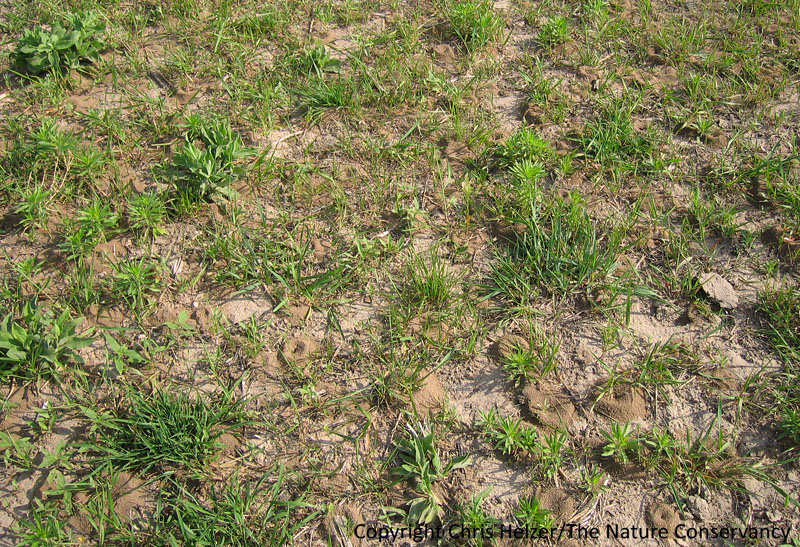
A wider view of the same site. This density of ant hills appeared to exist across the entire 80 acre prairie.
It’s an amazing world, isn’t it?

 The Prairie Ecologist