
It’s burn season on the Platte and our team is foaming at the mouth to get some fire on the ground. Prescribed fire is completely dependent on suitable weather conditions, so almost every day we wake up hopeful to burn, and every day has been a disappointment – until one day last week!
Here’s a play-by-play of what happens on burn day, for those who have never participated in a prescribed fire (like myself, ten months ago).

Photo by Eliza Perry
We are in Go Mode the morning we hope to burn. Many preparations still needed to be made the day of the fire last week. We charged the batteries of each ATV, topped off all the equipment with fuel (water pump engines, drip torches, ATVs), loaded chainsaw gear into the truck, gathered personal protective equipment, and obtained a burn permit from the local fire department. We had freezing temperatures in the morning, so we waited to fill all of our water tanks until it warmed up. We used 2 ATV trailer units with 120 gal, 2 slip-on units with 300 gal, 2 ATV sprayers with 25 gal, and 2 bladder bags with 3 gal, which are used as a back-up water source in the event a hose stops working on the fireline, or as a mop up water source once ignition is complete. Here, Nelson and Anne are filling up our various implements.
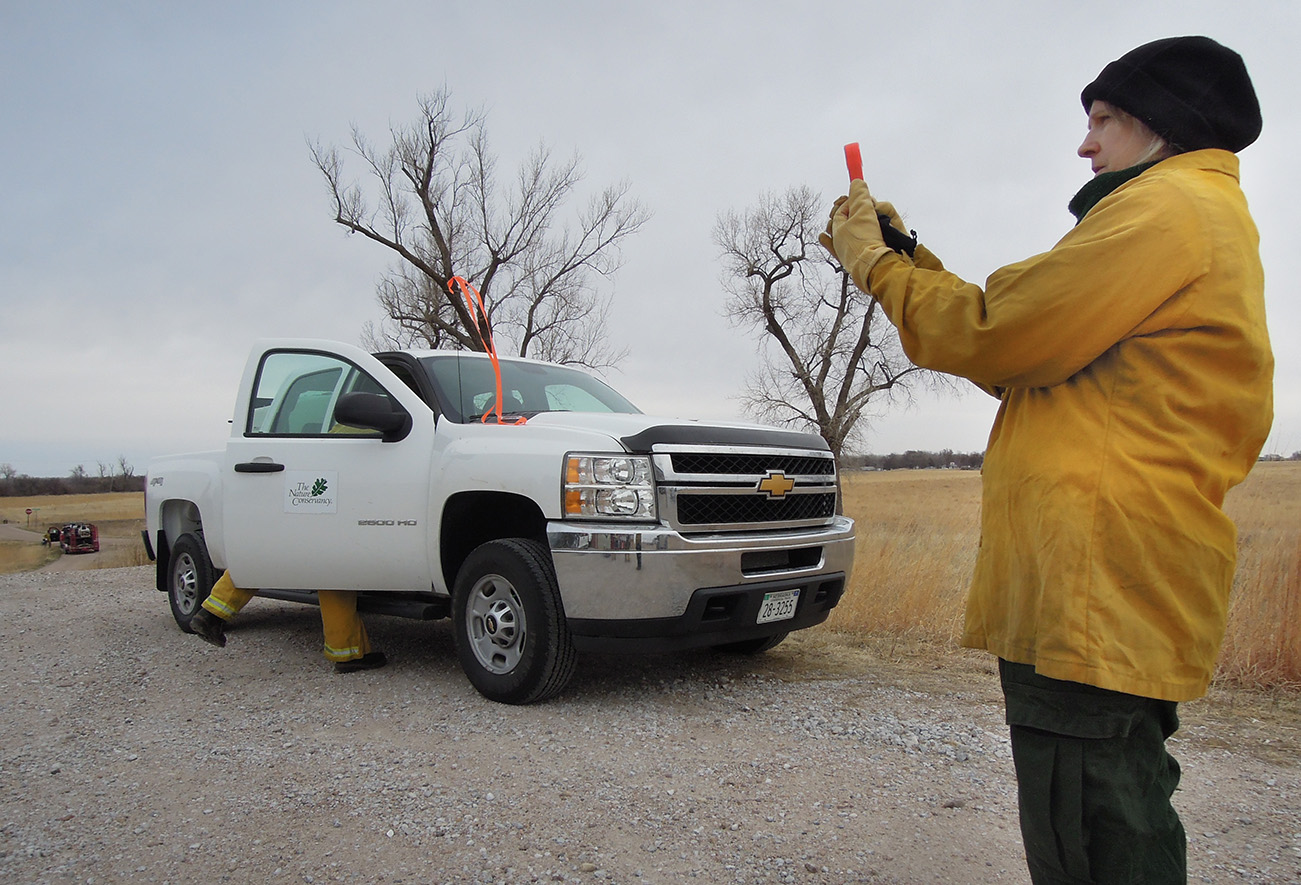
Photo by Eliza Perry
We do weather checks several times before and during the burn. Nelson calls the National Weather Service basically when he wakes up on a potential burn day to get the most accurate, up-to-date and local weather information possible. Here, Mardell Jasnowski is checking the current conditions with a kestrel, a handheld weather kit calibrated to take weather measurements. She’s looking primarily at wind speed and direction, relative humidity, and temperature.
Before every fire, all participants meet for an overview of the burn plan (which area is to be burned and how the burn will proceed), potential hazards at the site, our objectives for the day, participant introductions, and other logistical information, all led by the day’s burn boss. (Quick side note: I remember when I first started, my fourth day on the job coincided with a burn, which was where I first heard the term “burn boss” and to this day I can’t think of a cooler sounding title).
On last week’s burn, we were lucky to have help from the Crane Trust, and pictured here (from right to left) are Jon Westerby, Brice Krohn from the Trust, along with TNC burn boss Chris Helzer. Later in the day, the Trust’s Mark Morten and Bruce Winter came around to offer even more help so we had a big jolly team. We actually burned three units in one day: the Derr House garden (a solid square meter burn!), the Derr House lawn (probably half an acre) and our Derr Pivot property (a 60-acre burn). In this photo, we were going over the first two burns.

I don’t have any pictures from these first two burns, but they really allowed Anne and I to get some experience in a low pressure setting on the more advanced role of ATV fire suppression.
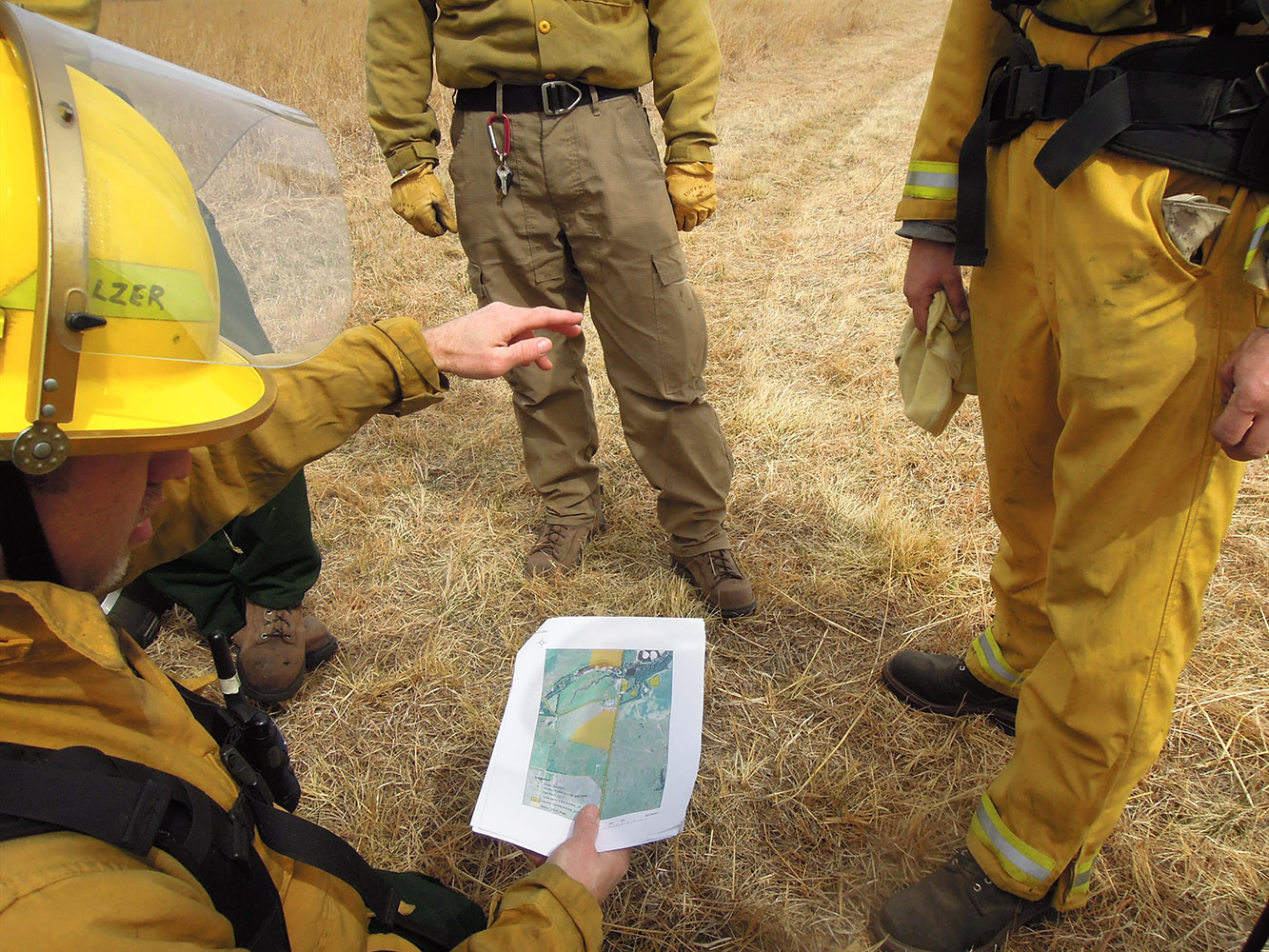
Photo by Eliza Perry
After we burned around the Derr House and relocated all of the vehicles and equipment to the big burn unit of the day, we met in the field to go over every participant’s role, changing weather or equipment failure scenarios, and the burn plan. Chris is holding a map illustrating the burn unit to orient everyone and go through each step of the burn and the contingency plans. The first step is always a weather check and then a small test burn to ascertain the fire’s behavior in the current conditions before we proceed with the burn.

Everyone always asks me, “how do you control a fire?” Well, we first mow and rake lines around the whole unit, creating “firebreaks” that have little fuel in them and thus help stop or slow a fire creeping outside the unit. Then, we “blacken,” or burn the downwind boundary lines of our burn unit, using water to help keep the fire inside the firebreaks – which is what Jon is doing on the ATV at the forefront of this picture. Those blackened areas provide a blockade to keep the fire contained inside the burn unit. And we have people patrolling along these lines at all times, spraying or raking up any fire that creeps into the firebreak, which is what crew boss Nelson Winkel is doing on the ATV behind Jon. On foot in the grass is Anne Stine, working as the igniter for this side of the unit. Everyone at a prescribed burn keeps an eye on blackened areas along with areas that are actively burning because tall flames can throw embers and “jump” outside of the black.
Fires are far more complicated than I’m able to describe in a short blog post, but I hope you can kind of imagine how trained personnel can control them.

Both Anne and I were assigned as igniters for the first time. We were each supervised by the crew boss of our respective sides of the fire – the person who follows behind the igniter to catch any creeping fire and dictates the pace of ignition. My crew boss, Brice, walked me through all of his instructions and explained the fire behavior as it evolved, which was very helpful because it’s one thing to read about convection columns and another to witness their effects on the rate of spread and direction of the fire and smoke. He also taught me how to “read the fuels” to identify where to ignite. Being the igniter takes a level of intuition and experience lighting fuels to achieve the desired effect. For beginners like me, it was just about listening to instructions, but the more experience I get the better I’ll be able to judge for myself how to best accomplish our burn objectives.

Anne using a drip torch for the first time! Drip torches dispense (“drip”) a mix of regular gas and diesel, allowing for a controlled application of flammable fuel. You can see she is igniting the tall grass adjacent to the burn break and she is probably walking right on top of the wetline. Crew boss Nelson follows behind with 120 gallons of water. Anne is also holding a hand tool. In the event nearby water resources need to locate elsewhere temporarily, it’s nice to know the igniter is not completely defenseless should a fire creep somewhere unwanted, which is what that hand tool is for.

A dust whirl! I can’t explain why these happen. Though they are super cool looking, they can be indicative of changing weather conditions.
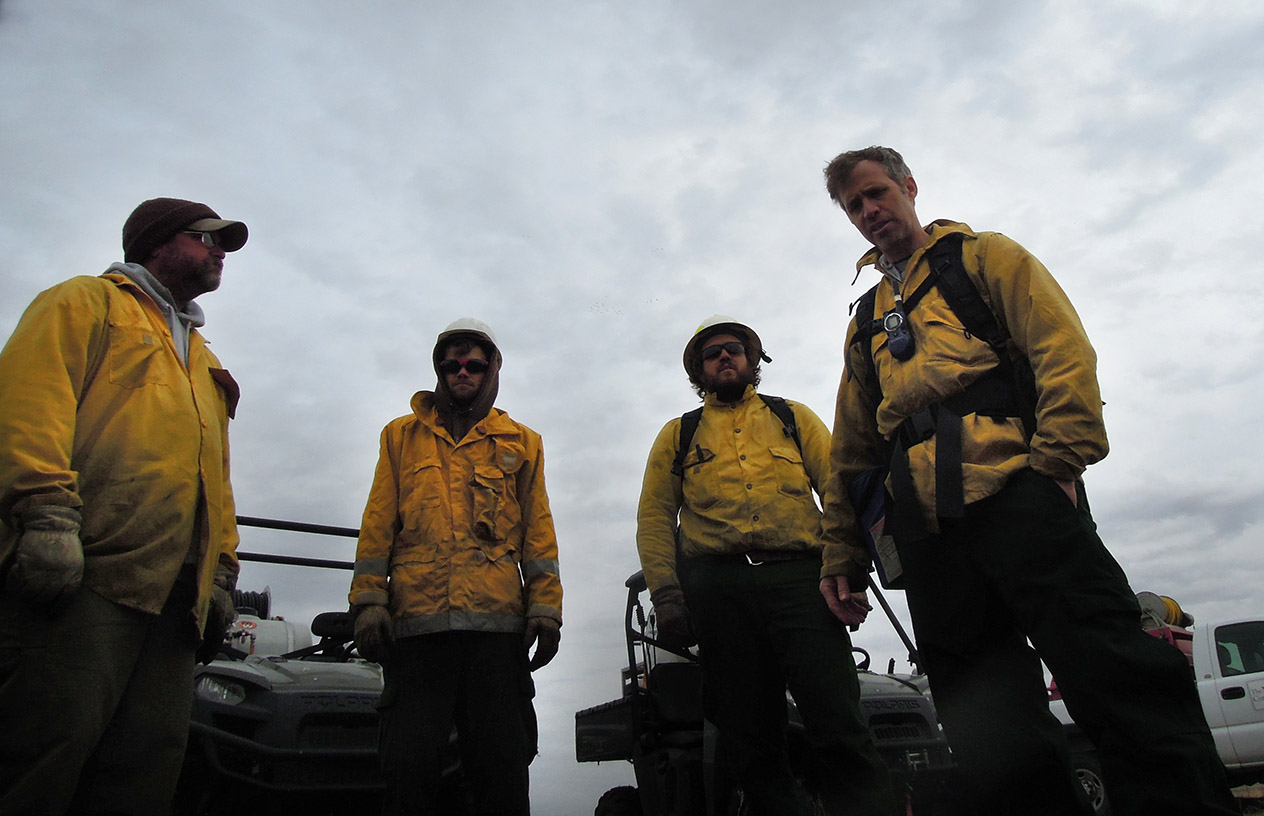
Photo by Eliza Perry
After ignition is completed, the burn boss calls for a meeting to debrief the day. Each participant says a little about their experience, what went well, and what could use some improvement. From left to right, firefighters Bruce, Mark, Jon and Chris.
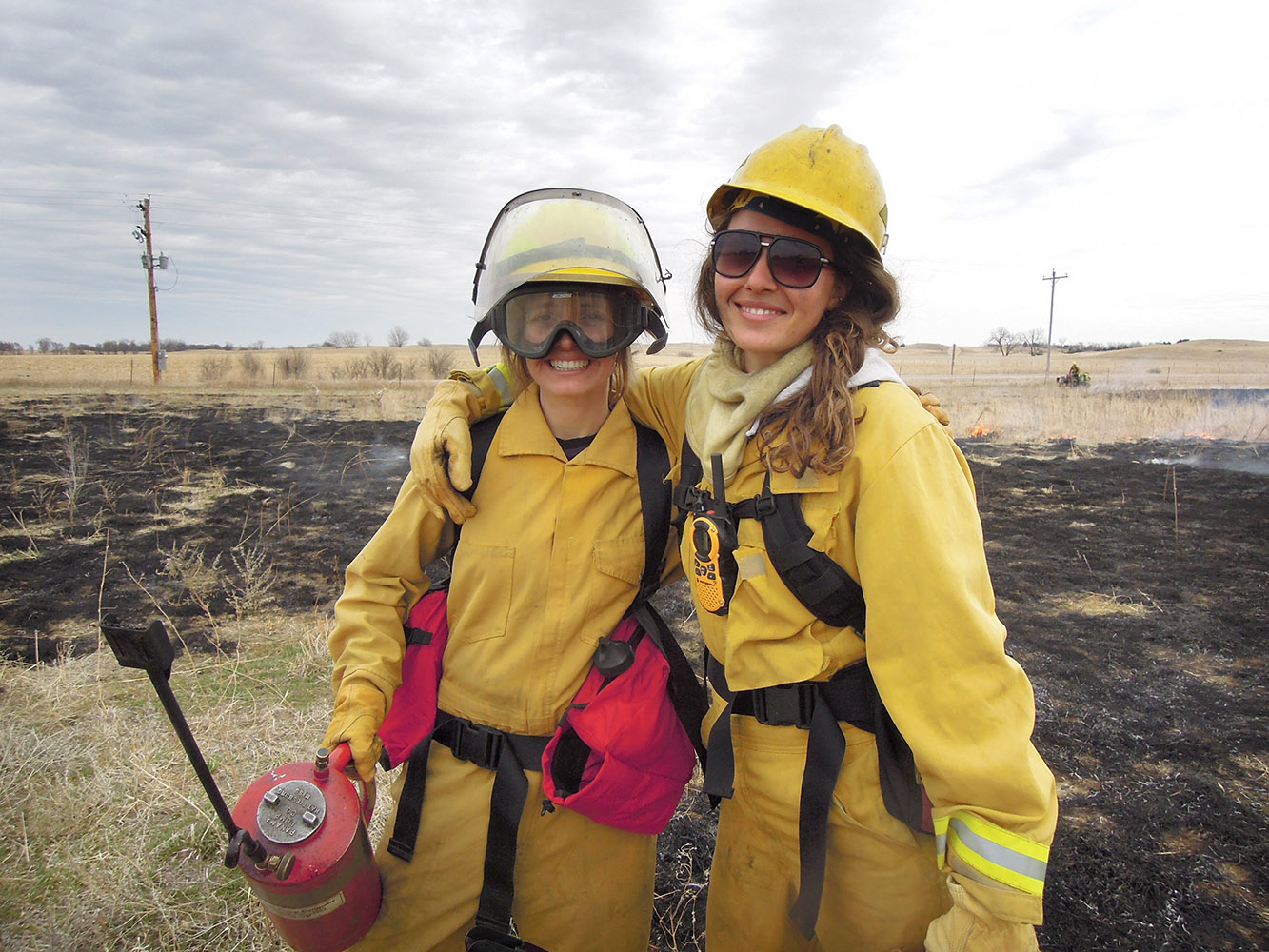
Photo by Mardell Jasnowski
Hubbard Fellows Anne Stine (left) and Eliza Perry (right) after a fun day of burning!
.


