
Successfully controlling invasive species may be the most difficult (and important) part of prairie management. There are few things more frustrating than the realization that, despite your best efforts, there are more (insert your species here) than there were the year before. Because of the immensity of the challenge, it’s crucial to make your control efforts as efficient and effective as possible.
I sometimes think of invasive species control like the game “Whac-a-mole”. It often feels like I hit one weed just to see another one pop up somewhere else. Of course, there are two differences between Whac-a-mole and real invasive species control. First, Whac-a-mole is a just game, and losing doesn’t mean anything. Second, if Whac-a-mole was really like invasive species control, the moles would be multiplying and spreading across the county!
Every invasive species is different, and each requires its own specific control technique. However, there are some broad strategies that can apply to almost every situation, and can increase the effectiveness of your attack. The most important may be the “work from the edges” approach. When faced with a major infestation of a particular weed (or any other kind of invasive) it’s often tempting to wade into the biggest thickest part of the infestation and start killing everything you can. It makes you feel good and you can stand back and see that you’ve done something. Unfortunately, that’s often the least efficient approach. To continue the analogy, you’re just hitting the biggest and slowest mole, while letting the others continue to spread.

Two examples of working from the edge to control invasive species. In example A, the invasive species is radiating outward from older larger populations. In example B, the species is moving in one direction. In both cases, initial control efforts should be targeted at the new small populations first.
Working from the edges of an infestation toward the middle, or toward the source, has a couple of advantages. First, by focusing on the edges of a spreading infestation, you’re protecting the portions of your prairie that aren’t yet invaded. Keeping those areas clean has to be the highest priority. Second, newly-established plants are often the easiest to eliminate. Young plants are less likely than older plants to have developed an extensive root system or a large seed bank. Often, if you can successfully kill a new plant it stays dead (the mole doesn’t pop back up).
Once you have the outlying plants taken care of, you can start working toward the center (or the source) of the infestation. However, it’s usually more important to spend adequate time making sure every plant you kill stays dead than it is to move quickly to kill everything. It may be more valuable to spend your time re-checking and re-treating the plants that you worked on last week than attacking new ones. Even when you move to the next set of plants, be sure to continue checking up on the ones you’ve controlled in the past to make sure they don’t pop back up. When you feel comfortable that you’ve got the outlying plants eliminated, a quick periodic sweep of those areas can be sufficient, and you can start enjoying the third advantage of working from the edges – now that you’ve got the edges taken care of, you can focus all of your energy on the main part of the infestation without constantly looking over your shoulder.
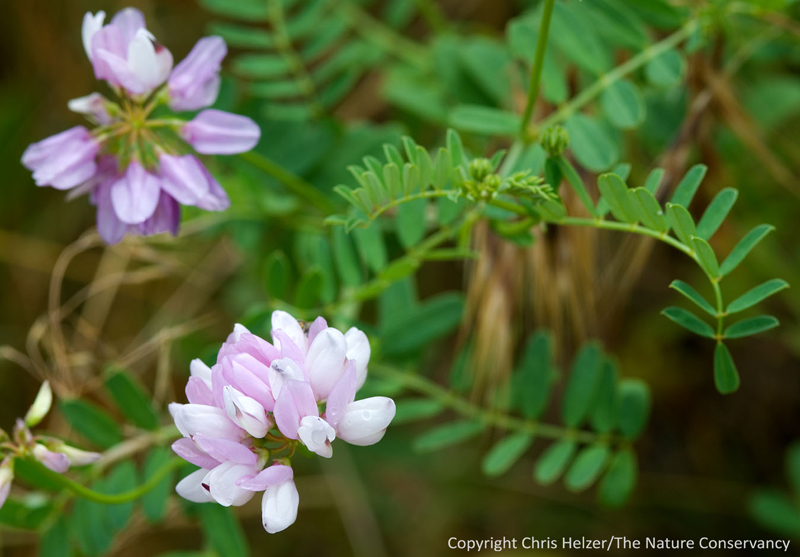
Crown vetch is an example of an invasive species that can be very difficult to control. Repeated herbicide treatments are usually necessary, especially on well-established populations. Crown vetch tends to grow in large clumps, so working from the edge can mean both starting on the edge of each clump as well as working on the smallest clumps first.
Working from the edges applies to invasive species control at multiple scales. At the prairie scale, it applies to the control of a species with multiple populations across the prairie – (focus on the newer populations first). Within a prairie, it can also apply to the attack of a single weed patch (get the edges under control so the patch doesn’t continue to grow). In both cases, the first objective is to keep the problem from getting worse. If that’s successful, the next objective is to start shrinking the existing population(s) without letting new ones get started.
In some cases, it can be worthwhile to do a quick-and-dirty attack on the more established portions of an infestation even while you’re working to systematically eliminate the plants at the edges. For example, you may want to quickly mow through patches of older plants as they’re flowering, preventing them from producing seeds. While you’re not killing those plants, you’re improving the likelihood that you’ll be able to contain the overall infestation by slowing its rate of spread. (Just be sure to clean off the mower, your shoes, or anything else that might otherwise spread the seeds anyway!) A similar strategy can be used when only a subset of the older population is reproducing. When controlling invasive trees, for example, younger trees (or male trees) may not be producing seeds. If only a small percentage of the trees are reproducing, taking the time to find and kill those may be worth the effort, even if they’re in the middle of the infestation. Then you can return to the edges, knowing that your chances of containment have improved.

While it is a native species, eastern red cedar can be an aggressive plant in prairies, especially in the absence of regular fire. Focusing early control efforts on mature female trees that are producing berries can be a good way to help slow the spread of trees while you work to contain the overall infestation.
Here’s a real example from one of our prairies: We’re fighting Canada thistle in a large floodplain prairie (well over 1,000 acres). The worst part of the infestation is in a wet and shrubby area where control (and access) is very difficult. The remainder of the property has widely scattered patches of thistles. We’re able to spot-spray all of those scattered populations each year, and have been slowly reducing the number and size of those patches. However, we don’t yet have the resources to hit the scattered patches AND attack the really bad area – especially because the time window for effective control is relatively short each season. We do what we can to hit the plants near the edges of that main population to help keep it from spreading, but we’re mainly trying to keep the rest of the property from being overrun. Ideally, we’d be mowing the flowering heads off of the plants in the large population, but we can’t get equipment into that area. As we continue to eliminate the small scattered populations, we’ll have more time to start working into the large population and begin shrinking it a little each year. It’s not the best situation, but it’s the real situation, and we’re trying to make the best of it.
In some cases, an effective attack – with consistent follow-up – can eliminate an invasive species from a prairie, and you might just have to conduct an annual patrol to ensure that it’s still gone. In other cases, containment of the worst area(s) may be the best case scenario, and you may have to plan to conduct perennial search-and-destroy missions to prevent new populations from starting. In still other cases, an invasive species may be so entrenched across an entire prairie that you just have to try to suppress its vigor and allow as many other species to survive as possible. And, of course, you’re likely to have all three of these situations happening simultaneously in the same prairie, so it’s important to have clear objectives and strategies for each invasive species you’re dealing with.
Regardless of the invasive species or its level of infestation, an efficient and effective attack strategy is critically important. Not only will it improve your chances of success, it will also help maintain your sanity – it’s much less frustrating to know that you’re making gradual progress in your control than to attack sporadically, only to see plants or populations pop back up behind you.
Makes you wonder why Whac-a-mole was such a popular game, doesn’t it?


