
At the Platte River Prairies, we conduct prescribed burns for various purposes. Some fires are intended to kill eastern red cedar trees or to suppress cool-season invasive grasses. Other fires are aimed at removing thatch and old vegetative growth – creating lush regrowth that concentrates cattle grazing in one portion of a prairie. For each objective, we prescribe a certain set of outcomes that need to be met in order for a burn to be successful, and a parallel set of conditions (especially timing and weather conditions) that will get us to those outcomes. If we’re just trying to remove most of the old dead growth from a prairie, we don’t need the same kind of fire intensity as when we’re trying to kill cedar trees. If we’re targeting cool-season grasses (and won’t be following up with grazing), we try to burn about the time those grasses are starting to flower.
On the last day of March this year, we assembled a crew that combined our staff with employees from the Central Platte Natural Resources District and got ready to burn some hilly sand prairie. Our objective was to remove at least 75% of the thatch and old growth from the burned area so subsequent cattle grazing would be focused in that burned patch while the remainder of the prairie went largely ungrazed. The forecast had predicted pretty high relative humidity readings, but we thought we’d be ok as long as we didn’t have overnight fog or mist. Unfortunately, on the morning of the fire, the grass litter along the ground was more damp than we’d hoped and since the sun was hidden behind clouds it didn’t seem likely that litter would dry much. After considerable discussion and delay, we finally decided to conduct a test fire in the downwind corner of the burn unit to see what kind of burn results we’d get before deciding whether or not to burn the entire 70 acre unit. We also figured it was an opportunity to learn more about how fire behaves under humid conditions. At 1 pm, it was 46 degrees F, 71% relative humidity, and we had winds at about 10 mph.

Nelson Winkel, our land steward, had to work pretty hard to get the grass ignited. While it looks like there’s a lot of fire here, watch the video below to get a better picture of how the fire was actually burning. The flames would flare up when they hit a patch of grass with dry leaves, but the damp litter layer kept the flames from moving very quickly or burning all the way to the soil surface. (If the video doesn’t work, click on the title of this post to open it in a browser or follow this link: https://www.youtube.com/watch?v=p3Dh2OqzmEk)
The test fire was definitely instructive. The upper portions of grass plants were sufficiently dry that they burned fairly well, but the dampness along the ground made the fire creep along very slowly, even when pushed by the wind. Following along behind the fire, I was kicking away ash to find that quite a bit of litter was still unburned and covering the soil. After we burned an area about 40 x 40 feet, we extinguished the fire and had a group discussion. The grass was burning well enough that we could probably burn the unit, and much of the area inside the firebreaks would ignite and turn black. On the crests of the hills where vegetation was dominated by bunchgrasses and there was considerable bare ground beneath plants, we’d probably get a pretty complete burn. However, in lower areas where there was more dense vegetation, including some cool-season invasive grasses, we didn’t feel like it would burn very completely at all. In total, we didn’t think we’d reach our goal of removing litter from 75% of the area. Importantly, the areas that wouldn’t burn well (and thus wouldn’t attract grazing) were the ones we most wanted cattle to graze (to suppress invasive grass growth). After talking through our options with the whole crew, we decided to postpone the burn until we had a day with better conditions.

You can see from this photo that while most of the dry standing vegetation burned, much of the litter/thatch remained behind.

Here’s our group, deep in discussion about objectives, results, and whether or not to continue with the fire.
It’s never an easy decision to call off a burn when you’ve got crew and equipment on site. As a burn boss, I’ve had to do that multiple times, but usually when we’re worried about safety because the weather conditions are too far on the hot, dry and/or windy side. In this case, there were no extraordinary safety concerns, but every fire comes with risks to people and property. It never makes sense to burn and not achieve the desired result. We needed near complete consumption of the dead vegetation to attract cattle grazing and carry out our management plan for that season. Since we weren’t going to achieve that, we didn’t burn.
As it turned out, we only had to wait four days for another opportunity to burn that unit. On April 4, most of the same crew members assembled and we set up to try it again. Our weather conditions at 11 am weren’t all that different from our previous attempt (46 degrees F, 65% RH, and 12-15 mph winds) but the grass litter was much drier, and while the sky was cloudy, the clouds were more patchy and the sun was even popping through once in a while.
Our downwind firebreaks were two gravel roads, so it didn’t take long to get those lines lit and blacked out. At that point, however, I walked out into the black to see how much litter consumption we were getting. While it was much better than the previous week, there were still some unburned patches. Since we had solid firebreaks, we paused ignition to wait for everything to warm up and dry out just a little more. About a half hour later, relative humidity had dropped nearly 10% and the temperature had risen about 5%. We restarted ignition and pretty quickly finished up the rest of the fire.
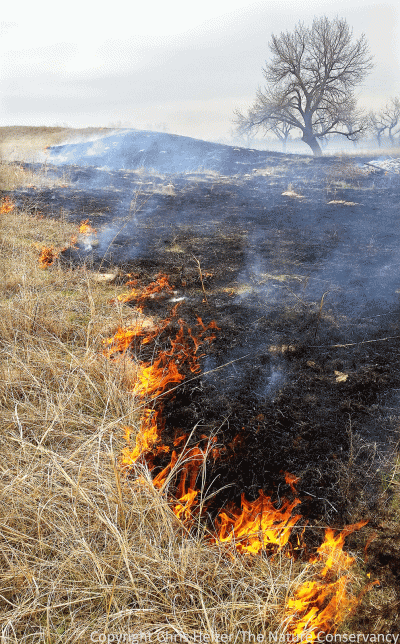
On our second attempt, we had much better fire behavior. Here, a fire is backing uphill through vegetation and getting pretty complete consumption.

Nelson is walking through the black in a low spot where not all the litter was burning well. This was while we were waiting for the humidity to drop a little more.
Here are a couple timelapse videos of the lighting of the “flanking head fires” toward the end of the burn. They are a little jumpy (sorry) because I was just hand-holding my phone and taking repeated photos, but it shows how different the fire behavior was from the slow creeping fire of our first attempt 5 days earlier. If you can’t see the videos, click on the title of this post to open it in a web browser or click on these links: Video 1, Video 2.

Here is what the burn unit looked like right after the fire. You can see lots of pocket gopher mounds scattered through the black, but also a few small unburned patches. Those unburned areas are perfectly fine with us, and actually provide some valuable areas of refuge for animals (in addition to the 2/3 of this prairie we didn’t burn and other prairies across the road in three directions.)
I’m glad we waited for more favorable conditions to burn this unit. We wouldn’t have accomplished what we needed to on the first day, and though it was hard to turn down a potential burn opportunity and assembled crew, I think we made the right call. As it happened, we didn’t have to wait long for a better day, and we got what we wanted out of that fire. At the same time, I’m also glad we decided to try a test fire on the first day. It turned into a good learning experience and fodder for fruitful discussion among the crew. The whole situation was a good reminder that while we can achieve many important objectives through prescribed burning, it isn’t a toy we play with for fun. Instead, we want to burn only when we can do so safely, and when we can achieve clear and specific objectives.
If you want to learn more about how we combine prescribed fire and grazing to manage for habitat and species diversity, you can read more here.


 The Prairie Ecologist