I came across this photo yesterday while looking through some images from last summer. The photo caught my eye and I thought maybe I’d write a short natural history blurb about it and use that as my “Photo of the Week”. My first task was to figure out what kind of butterfly is in the photo. No problem. I’ve got field guides and the internet. How hard could it be?
A small butterfly uses its long tongue to extract nectar from common milkweed at our family prairie near Stockham, Nebraska. If you click on the photo you can look at a larger version of the image and get a better look at the tongue.
I’m no butterfly expert, but I spent parts of a few summers learning butterflies back in the late 1990’s and have held on to much of my knowledge from that time. I can usually identify the more common butterflies by sight and narrow others down enough that I can pretty quickly use a field guide to finish the job. Skippers can cause me some problems, but they can be difficult even for seasoned butterfly biologists. (Skippers are like the sparrows of the butterfly fauna – little brown fuzzy jobs that all look about the same.)
My first thought was that the butterfly was a pearl crescent. That’s a common butterfly species around here and it looks much like the critter in the photo. I looked it up, but the spots on the underside of the wing don’t quite match up. The butterfly in the photo has more white patches than those in the field guides and online.
Next, I looked at the Gorgone’s checkerspot, another species we see quite a bit here. No luck there either. The patterns on the underside of the wings are really different from the butterfly in my photo. I looked at the “Butterflies of Nebraska” and “BugGuide” websites and browsed through a number of other choices, including some species that only show up occasionally in the state. Still no luck. Frustrated, I left for a meeting, figuring I’d try again later.
By complete coincidence, my meeting today was about pollinator monitoring strategies, and the first two people I ran into were both butterfly experts. Aha! Since we had a few minutes before the meeting started, I grabbed my laptop and pulled up the photo in question. They both stared at it, but neither gave me a quick answer. I felt both better (it’s not just me!) and worse (come on, man, this isn’t supposed to be this HARD!).
After some hemming and hawing, the conclusion was that it’s probably some kind of crescent (Phyciodes sp.) but they couldn’t do any better than that. To be fair, neither of them had access to field guides and it was a surprise question. Still… One of the biologists pointed out that not only do male and female crescents have different patterns, there can also be significant differences in patterns between different generations within the same summer. What??
As a result of all this, I’m stuck not being able to tell you much natural history about this pretty little butterfly other than it’s probably some kind of crescent. Interesting, huh? About 30 minutes of my poking around in books and online, two butterfly experts looking at my photo with me, and that’s the best we’ve got. Well, that and one unarguable conclusion:
This post was written by Eric Chien, one of our Hubbard Fellows. Eric comes from Minnesota and brings great energy to our prairie stewardship work. He’s also very bright, and an engaging writer, as you’ll see in this and other posts.
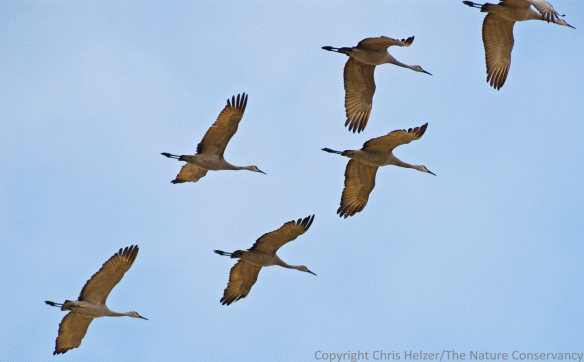
I recall vividly the moment I was swept up by prairies; when what had only been a textbook description of geography was sparked into a fidelity to place. The view of sandhill cranes swirling over a starkly beautiful late-spring prairie had an immediate impact on me. It was the first time I felt what I was seeing.
Sandhill cranes.
I have been recalling this moment lately because I have been thinking a lot about impactful experiences. I was there that blustery Spring morning for work. There was no one there to interpret or inspire. No learning objective or deliberate takeaway. Yet, that experience sits amongst the foundation of where I am now and the path I continue to take. Impactful, emotionally rich experiences are the touchstone for action and commitment, and in prairies, in relation to other landscapes, they seem a little harder to come by. Prairies just don’t give themselves up easily. Identifying those places, characters, and moments that bridge the gap between knowing and caring could be a powerful tool for the achievement of conservation goals, and enriched human lives.
I have often struggled to facilitate powerful prairie experiences for others. Deep appreciation always seems to end up relying on the context of my own knowledge and memories, and thus unapproachable to my companions. One of the few places where prairies do not play hard to get is the Niobrara Valley Preserve (NVP). It has long been a place that confers experiences capable of tying together people and prairies. Its reference list is long and diverse. Somewhere within the consistent transfer of emotional weight that NVP delivers is an important guide and mold for reaching others.
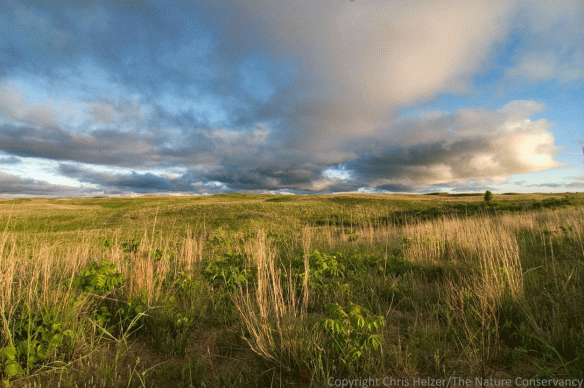
Sandhills prairie at The Nature Conservancy’s Niobrara Valley Preserve in northern Nebraska.
On a recent evening, I found myself sitting quietly beneath a cedar in Niobrara River valley prairie at dusk. Within minutes of my settling in, a small group of bison had quietly foraged their way down from the hills, and into this football field prairie flanked by oak-cedar woodland and the river. They were unhurried, only the occasional soft grunts accompanied the sound of little bluestem, cured wine red, being clipped off. I felt lucky that from the 12,000 acres of prairie on which they could wander, this small group had happened to choose this minute pasture for the evening. They were soon joined by a large flock of Merriam’s Turkeys. Their white tipped tail fans flashed as they scratched at the ground, flipped bison paddies, and bantered with purrs and clucks. A young whitetail buck also joined the evening stage. You can see him inquisitively wander towards me in the video below.
Before it became too dark I walked up and out of the river valley, cresting the hills, and was confronted with the stretching upland prairie of the Sandhills. A spooked pair of young bison bulls thundered off the river ridge and into the hills out of sight. I walked the sandy, two track back to the bunkhouses in the dark. These are not uncommon moments at NVP. The source of gravitas in these experiences may seem obvious, filled with charismatic wildlife, but I think it is more than that. The widely shared appreciation of NVP says a lot about where we are coming from in prairie conservation and where we want to be.
Young bison bulls at The Niobrara Valley Preserve.
Conservationists will accurately tell you that a 54,000 acre preserve is still far from a whole system. The Nature Conservancy does not control the entire Niobrara River Watershed, our bison herds need to be fenced in, and invasive plants still find their way onto the preserve. However, it is one of an elite few locales that feels whole. I believe it is this sense of wholeness that beckons people to deeply connect with it in a way that is difficult in most other prairie landscapes. When I am showing people prairies, I often find myself asking them to imagine. Imagine if this highly diverse, visually stunning, 80 acres of prairie stretched to the horizon. Imagine if a herd of bison lay hidden behind that low swale. Imagine if you did not know what else might be out there. At NVP, one does not have to imagine, and in that lies its power to move us.
Large, intact, productive grasslands, like the Niobrara Valley Preserve let us transcend the conservation context in which much of our work takes place. We can escape the long road of restoration in the human dominated landscape, characterized by fragmented, degrading, homogenous, biologically depauperate prairies. We can see the prairies and landscapes we are driving at. As prairie professionals and conservationists, we should and do spend most of our time on this long road, but as we seek to bring others into the fold we should strive to impart them with a vision. Head off the question about why prairies are important; the one that often seems to accompany a trip to some isolated remnant in a sea of cropland. Take them to somewhere where the importance of prairies is unspoken and self-evident. Seek to move our potential prairie allies from “is that all?” to “what else is out there?”. I know that is harder for us here in the prairie than for those sharing other ecosystems. It is especially hard in the eastern tallgrass prairie where we have been left with nearly no truly large prairies. That said, the hard work of many (Nachusa Grasslands IL, Midewin National Tallgrass Prairie IL, Glacial Ridge National Wildlife Refuge MN, Kankakee Sands IL/IN) has made it more of a possibility than ever.
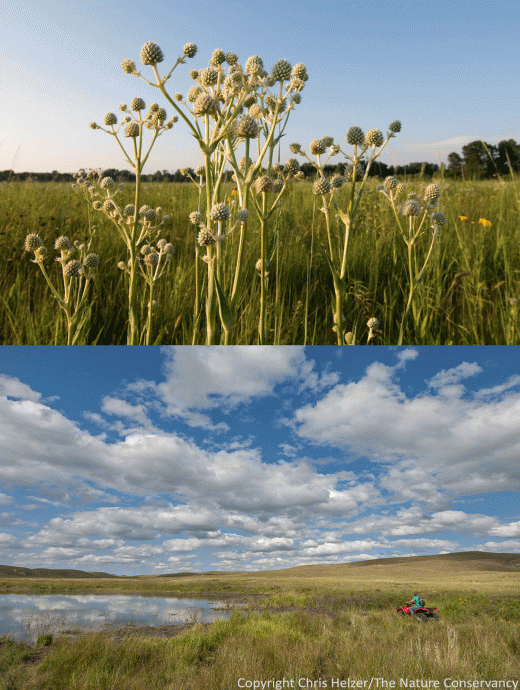
For some, the beauty found in small prairie patches is sufficiently captivating. For others, it is the sweeping sea of grass that triggers a love of prairie.
There will always be those who will come to prairies more subtly; those who are innately curious about the details of plant communities, who can discern and explore the intricacies of prairie ecology that happen at the smallest of scales. I will happily continue to walk with anyone who shows enthusiasm for finding fritillary caterpillars on rare prairie violets. Prairie conservation and restoration by necessity has been built on the backs and through the sweat of those who can delight in our valuable remnants, and push forward from there. Let’s also begin to work from the other direction. Recognize that there are those who will only come to prairies through experiences of grand space and wildlife. Bring them to the end, let them see what else prairies can be. After that we can walk them back to where we are, and begin the work of the return journey to wholeness with the expanded support of more “prairie people.”



 The Prairie Ecologist