Hubbard Fellowship Blog – The Sky is My Mountain

This post was written by Eric Chien, one of our Hubbard Fellows.  Eric comes from Minnesota and brings great energy to our prairie stewardship work.  He’s also very bright, and an engaging writer, as you’ll see in this and other posts.

The sky is my mountain. I recently heard Jeff Walk from Illinois Nature Conservancy articulate this notion of prairie geography. If westerners are defined by their mountains, those of us from the Midwest and Great Plains are defined by our skies. Prairies are open horizons. Even on the most heavily plowed landscapes, the ghosts of prairies loom as long as the land stretches toward an expansive sky.

Sky

Flat land compensates the viewer with tremendous skies.

All landscapes affect the prejudices about comfort and beauty of those born to them. I know someone who moved to Minnesota from the West for a job and was gone within the week, overcome by the flatness of the land. That might be a little dramatic, but I can understand the uneasiness. For me claustrophobia and paranoia rises in deeply wooded landscapes that lack the promise of a lake or field offering a glimpse beyond the trees. I think we all have that affinity for particular aesthetics to some degree, and because of that I think we can all empathize with the plight of prairie wildlife.

Unlike humans, most prairie wildlife lacks the flexibility to adapt to the uneasiness brought on by changes in their natal landscapes. Prairie chickens may be the most well known of the prairie wildlife terrorized when the land loses the sky, but they are almost certainly not the only ones. One needs only to watch the predatory efficacy of hawks and owls from their perches high atop the crowns of trees to understand why the development of tall vertical structure results in the extirpation of prairie species. There are more trees than ever closing off the sky, threatening to fundamentally alter the ecology, composition, and aesthetics of our prairies.

Historical records from the mid-late 1800’s in Nebraska’s Lower Platte River Valley (to the east of our Platte River Prairies) suggest trees occurred as widely scattered individuals and small clusters; a far cry from the ubiquitous shelterbelts and heavily wooded groves that cloak what almost certainly was formerly prairie. Trees and the changes they have already wrought and continue to promise are why most of our field season at the Platte River Prairies has played out to the whine of chainsaws.

The small row of trees on the horizon may seem insignificant, but the removal of those trees would visually reconnect three chunks of prairie; potentially having pronounced effects on grassland bird nesting occurrences and brood rearing success. Photo by Eric Chien.

The small row of trees on the horizon may seem insignificant, but the removal of those trees would visually reconnect three chunks of prairie; potentially having pronounced effects on grassland bird nesting occurrences and brood rearing success. Photo by Eric Chien.


I am haunted by trees. Back on June 8th, Katherine and I picked up chainsaws and walked into a grove of cottonwoods along a creek bottom. On September 23rd, another 10ft tall Siberian elm twirled to the ground. In between, we spent hundreds of more hours felling, bucking, and stacking trees. Always to the backdrop of more deep green tree lines on the near horizon; a reminder of how far trees have come, and how far prairie stewards have to go.
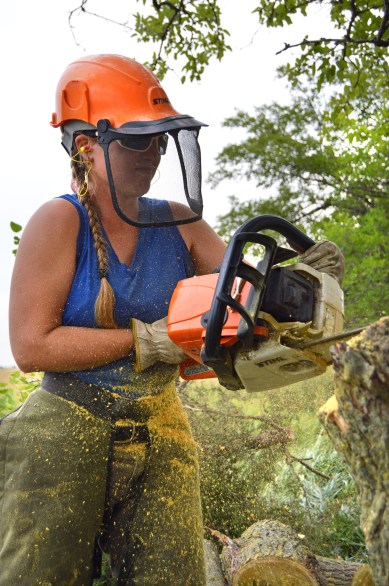
Katharine Hogan (Hubbard Fellow) wields a chainsaw

Katharine Hogan (Hubbard Fellow), technician Calla Olson, and I spent several days extracting a row of large twisting mulberry trees from between two stretches of fence. Photo by Eric Chien

Looking down the fence line of this tree removal project illustrates the process. Sawyers fell, limb, and buck trees, while a tractor follows behind and piles material into burn piles within the interior of the prairie. Photo by Eric Chien
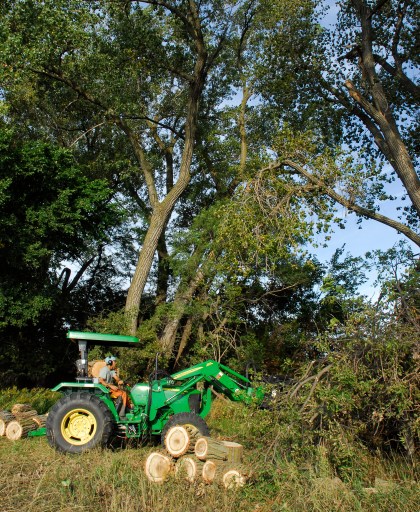
Looking down the fence line of this tree removal project illustrates the process. Sawyers fell, limb, and buck trees, while a tractor follows behind and piles material into burn piles within the interior of the prairie. Photo by Eric Chien

The most time intensive portion of tree removal, and thus limiting factor, is the organization and removal of downed tree material. Left on the ground, mature trees rarely burn up well in prescribed fires, and the skeletons impede maneuvering within the area during future management actions. Photo by Eric Chien

The most time intensive portion of tree removal, and thus limiting factor, is the organization and removal of downed tree material. Left on the ground, mature trees rarely burn up well in prescribed fires, and the skeletons impede maneuvering within the area during future management actions. Photo by Eric Chien

Despite the specter of an advancing forest, I love tree cutting. I like to think of tree control on the prairie as the big game hunting version of plant management. Removing mature trees demands thorough planning, and constant attention to one’s surroundings.  To date, I am not aware of an incidence of death by reed canary grass. Put that focus factor together with the fact that there are few prairie management activities with as immediately noticeable impact as the removal of dramatic woody encroachment, and it is a task ready made for those of us brain dead from spraying, and still cultivating patience for observing the effects of our work. Walking through a completed tree removal, or thinning, noting the full sunlight, and the unrestrained wind, gives me the same feeling as looking at a maturing prairie restoration. I think in many ways it is an equally profound change in the land; a taking back of the sky, and a return of a prairie.
The Enigmatic Stick Insect

I’m pretty good at spotting insects.  When I walk around prairies with a camera, I’m usually looking down, scanning for small creatures.  Just as I imagine a building inspector develops search images for signs of mold, fire hazards, and shoddy construction, my search images help me pick out grasshoppers, spiders, caterpillars, and stink bugs.  Despite that, I rarely see stick insects (aka walking sticks).

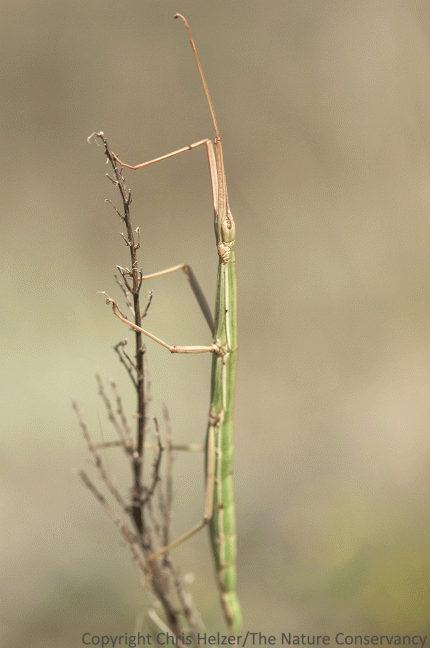
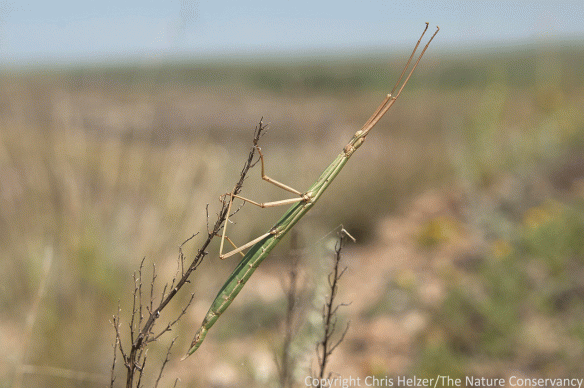
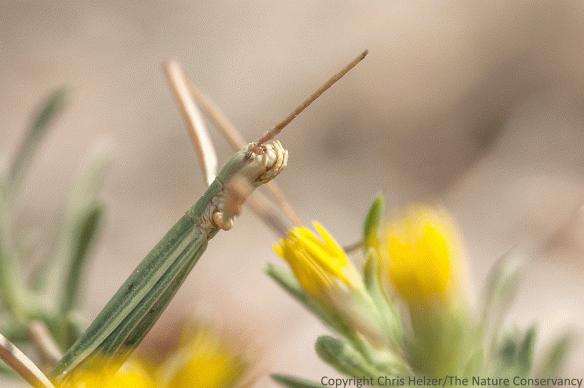
Although not extremely obvious, this stick insect (walking stick) is more visible than it usually is because I put it on this plant so I could photograph it. Garden County, Nebraska.

This stick insect (walking stick) is more visible than usual because I put it on that plant so I could photograph it. Garden County, Nebraska.

I don’t think stick insects are all that uncommon.  In fact, about 12 years or so ago, I was using a pull-behind seed stripper to harvest seed from lemon scurfpea (Psoralidium lanceolatum) in one of our Platte River Prairies.  The machine essentially uses a street sweeper brush to strip seeds from plants into a hopper.  Of course, the brush often captures insects along with the seed.  After maybe 10-15 minutes of running the machine, I stopped to check the harvest and was astonished to see hundreds of stick insects swarming about in the hopper.  As the machine was harvesting seeds, I had been constantly scanning ahead of it to be sure there were no seed heads of invasive plants and to pick out the best patches to harvest.  Regardless, I didn’t see a single stick insect until they ended up in the hopper.  I’ve not seen that phenomenon again, but I often wonder if there are hundreds of stick insects hidden all around me as I walk through prairies.  That may be true, but I feel lucky every time I actually see one.

Earlier this year, I was photographing bison and saw a couple stick insects riding on the back of one of those big furry animals.  Later in the summer, I found one riding along on my own back. I gently put it on a nearby plant and photographed it for a while, grateful for the unexpected opportunity.

A close up of the head of the stick insect, showing the palps around the mouthparts that I assume help to maneuver leaves into position to be eaten.

A closer view of the head of the stick insect, showing the palps around the mouthparts that I assume help to maneuver leaves into position to be eaten.  Also, even the eye is striped, contributing to the camouflage.

Stick insects are in the order Phasmida, along with leaf insects, and there are about 3,000 species of Phasmids worldwide.  There is a lot of general information about stick and leaf insects, but I found it hard to know which details fit the stick insects I see in Nebraska prairies.  I’d love to hear from others who know more about the ecology and behavior of these creatures.

Here are a few basic facts:

Stick insects are leaf eaters.  In some cases, they can cause widespread defoliation of trees, making them pests to those who like those trees.  (Or potential heroes to those of us working to limit the number of trees in our prairies!)

Like praying mantids, stick insects can often be seen swaying back and forth on their legs.  Some scientists think this might help with their camouflage, giving the impression that they are moving in the breeze.  Others think it’s a strategy to help them pick out objects against their background (they are triangulating).

The other major information presented by most sources is that at least some species of stick insects are known for copulating – or at least staying in that position – for days, weeks, or even months at a time.  It may be that the female benefits from having the smaller male on her back to act as a shield from predators, or maybe the two of them are just more cumbersome for a predator to deal with.  There are other theories about the behavior as well, but I don’t feel qualified to sort through them for you.

One last photo of the stick insect before I left it alone to go find something to eat and a place to be better hidden.

One last photo of the stick insect before I left it alone to go find something to eat and a place to be better hidden.

As I’ve said numerous times, I’m not an expert on insects and other small invertebrates – I’m just an enthusiast.  If there are experts out there who can tell us about the stick insects of prairies, or the one specifically featured in the above photos, please chime in.  I’m sure there are fascinating stories to learn.