Past performance is not necessarily indicative of future results.
I’m no expert in financial investing, but I’d like to retire someday, so I muddle along the best I can. As I skim through various financial statements and investment newsletters, I often see some variation of the disclaimer above. The concise statement emphasizes that while history is important, many factors change over time, and we shouldn’t simply assume that what happened previously should drive what we do now.
I was thinking about this statement and its implications while attending the North American Prairie Conference last month. During presentations and hallway discussions, the topic of history came up frequently. How often did prairies burn prior to European settlement? Were bison only abundant in eastern tallgrass prairies after human populations crashed during the smallpox catastrophe? What was the role of big native ungulates like elk in suppressing woody plants?

We have reasonably good data on the historic fire frequency in prairies around the U.S. How should that information drive today’s prairie management?
Questions like those are fascinating to contemplate, and important to our understanding of how prairies have changed over time. Which of us wouldn’t jump at the opportunity to step into a time machine and go see North American prairies in the 1400’s or other historic times? Wouldn’t it be fantastic to somehow find and pore over hundreds of years of data on bison population numbers, plant species composition, elk feeding patterns, and lots of other grassland phenomena? While, that kind historic data is very limited, mining what we do have is fascinating and instructive.
However, just as with stock market investments, we can’t just look to the past to guide what we should do in the future. The business world has evolved over time. Simply investing today in the same corporate stocks that were profitable 30 or 60 years ago wouldn’t make a lot of sense. Instead, we need investment strategies that fit today’s world. Many companies disappeared over time because their products became obsolete. Those that are still around, like General Electric, Nokia, and IBM, reinvented themselves. Why? The business landscape changed and they changed with it.
The prairie landscape has changed too. Row crop agriculture and other human developments have replaced grassland across huge swaths of our country, leaving many prairies relatively small and isolated. Trees and shrubs have flourished in landscapes where they were once scarce, and woody encroachment into small prairies now comes from all directions. Many new species of plants and animals have found their way into North America, and some have become very aggressive. Significant amounts of nitrogen from industrial and agricultural sources now enter grasslands by both air and water, changing soil chemistry to favor some plants over others. Finally, prairies have endured a century or two of impacts from factors such as fire suppression, livestock grazing, haying, and broadcast herbicide use. Today’s remaining prairies don’t look or function as they did a century or two ago.

Prairies today exist within landscapes that are dramatically different from what they looked like historically. Row crop agriculture has replaced grassland across much of the Midwest and Great Plains, and trees, invasive species, and many other factors threaten the remaining patches of prairie.
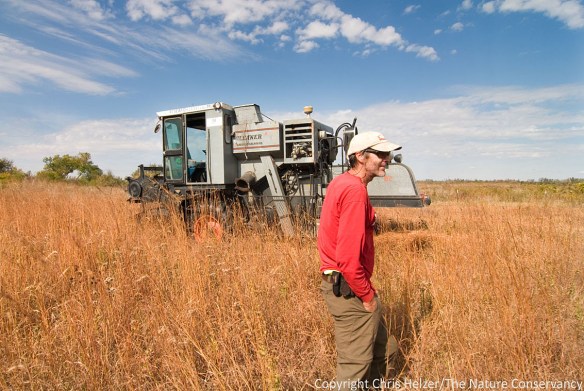
Big changes to prairies and surrounding landscapes mean that land managers face equally big challenges as we try to sustain biological diversity and ecological function. For most managers, invasive species suppression is our most time consuming and expensive task. Because of that, we are always searching for new ideas, strategies, and technologies to help us be more effective and efficient. The herbicides we use to kill invasive plants were not part of the prairie ecosystem a couple hundred years ago, but I can’t imagine trying to do our job without them. Similarly, brush mowers and the tractors that pull them are certainly not historically accurate, but they are invaluable when creating firebreaks or mowing down large patches of encroaching brush.
Today, land managers’ decisions about when to burn a prairie should be based on the myriad management objectives we face rather than on what the historic average fire frequency might have been at that site. In many prairies, managers struggle to weigh the benefits of frequent fire to control brush and other invasive species against the potential impacts of frequent fire on vulnerable insects, reptiles, and other species. Looking at historic fire patterns can help us understand how prairies developed, but today’s fire patterns need to address current challenges and help us sustain our imperiled grasslands.
Similarly, studying the historical population abundance of bison or elk can teach us about how those species influenced prairie communities long ago, but decisions about grazing as a contemporary management strategy need to be made based on today’s objectives and needs. I wrote last week about the introduction of bison into the Nachusa Grasslands in Illinois, and attempts to capture the impacts of bison grazing at that site. I’m sure the staff at Nachusa have been in numerous discussions about what historic bison populations were like in what is now northern Illinois. The decision to bring bison in, however, was not based on history, but rather on defined needs for habitat structure and plant community management. Nachusa staff are hoping to see more diverse grassland bird communities, for example, and positive effects on a wide variety of mammals, reptiles, and invertebrates. They also hope bison will help maintain high plant diversity. In particular, they hope to increase the long-term survival of relatively short-lived plant species that often disappear over time in restored prairie.

Bison and cattle grazing can be useful in meeting some prairie objectives, but is not appropriate for all sites.
Here in Nebraska, The Nature Conservancy uses both cattle and bison to achieve prairie management objectives. Grazing strategies are designed with specific objectives in mind, and we collect as much data as we can to evaluate the impacts of grazing on plant and animal communities. Grazing helps us suppress the vigor of both non-native invasive grasses and aggressive native grasses and foster a more diverse plant community. Plant species that would otherwise be outcompeted by dominant grasses can usually maintain strong populations under various combinations of intensive grazing and long rest periods. Both cattle and bison can also help us create a wide variety of habitat conditions, including large areas of both short/sparse and tall/rank vegetation and other areas where patches of short and tall vegetation are intermixed.
Just as with fire, mowing, and herbicide use, the value of grazing as a prairie management tool needs to be evaluated not by its historic role in local grasslands but on its potential utility today. In many prairies, grazing is not feasible or does not fit with management objectives. For example, grazing is unlikely to make sense in small isolated prairies where wildlife/insect diversity is limited more by habitat quantity than habitat structure, and where plant composition objectives can be met through other means. At larger sites, however, grazing may allow managers to provide more habitat variety and/or manipulate plant competition in positive ways. Regardless, decisions about whether or not to graze should be based upon how grazing might help address current management challenges, not upon historic populations of bison or elk.
Prairie management is complicated and we have a lot left to learn. We can’t afford to be overly conservative or rely too much on what happened long ago. Imagination and experimentation are crucial components of adaptation, and we desperately need to keep adapting to new challenges if prairies are going to survive. Companies like General Electric, Nokia and IBM rightly celebrate their history, but they also have to innovate and evolve to keep up with the changing landscape. Prairie managers need to innovate and evolve to keep up with changing landscapes too. Let’s learn what we can from the past but keep looking for new ideas and tactics so we can keep prairies healthy and vibrant well into the future.
After all, prairie conservation is worth the investment, right?