My Little Buddy

What would you do if a big hairy bug landed on your hand?  Smash it?  Flick it off?  Hop and and down, flail your arms, and make loud high pitched noises?

Well, you COULD do one of those things.  OR, you you could lift your hand slowly toward your eyes, examine the minute details of the bug’s multi-faceted eyes, and admire the design of its predatory body.

Robber fly  TNC Platte River Prairies, Nebraska.

A robber fly on my hand.  The Nature Conservancy’s Platte River Prairies, Nebraska.

I was finishing some vegetation monitoring last week when a robber fly landed on my hand.  Since I didn’t figure it would stay long, I stopped what I was doing and took a closer look.  After ten seconds or so, I decided I’d try to take a photo of it, so I carefully pulled my phone out of my pocket (the only camera I had with me) and snapped a couple photos.

The fly was still sitting still, so I tried some closer shots and got some decent quality (for a phone) close-up images of the fly.  After a couple minutes, I really needed to finish the last couple sampling plots, so I carefully went about that work while trying not to move my left hand faster than necessary.  The fly stayed on my hand for about 10 minutes!  Just as I finished the last plot and decided to head back to the truck where my actual camera was, the fly apparently decided it had better things to do and took off.
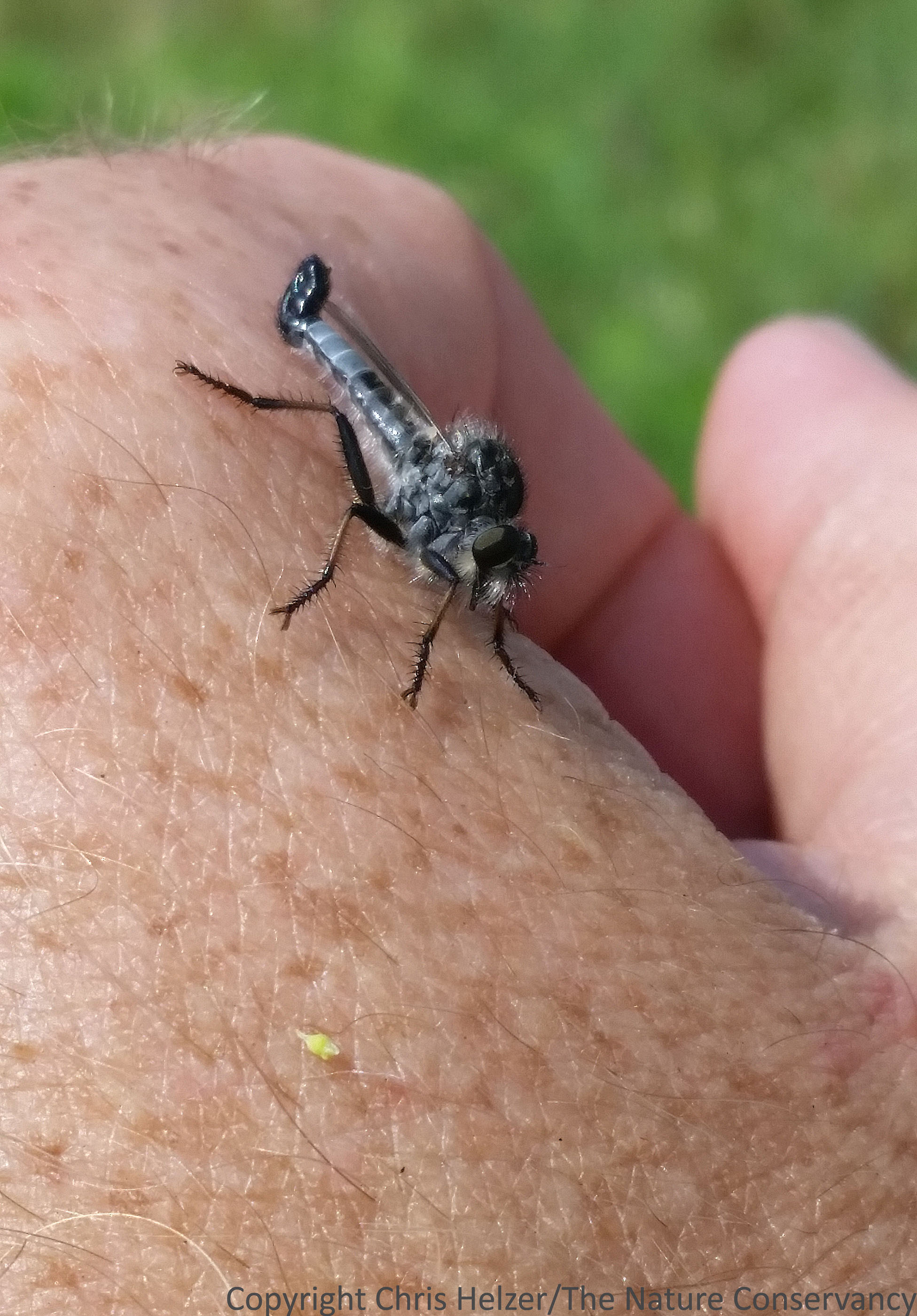
Robber fly  TNC Platte River Prairies, Nebraska.

The robber fly stuck around long enough for photos.

I’m not sure why my little buddy decided to land and hang out on my hand for as long as it did.  My previous experience with robber flies is that they are very difficult to get close to, and even more difficult to photograph.  This one, however, seemed very comfortable sitting on my hand, even as I moved around and continued my work.  For a brief moment, a second robber fly (looked like the same species) landed next to my buddy, but it flew off again almost immediately.

If you’re not familiar with robber flies, they are true flies – just like house flies, horse flies and roughly 37,000 other species of flies in North America.  They have the short simple antennae, sucking mouthparts, and greatly reduced club-like hind wings that distinguish flies from bees, beetles, bugs, and all other kinds of insects. However, robber flies are predatory, which may not fit your mental image of flies, (though there are actually quite a few different predatory flies).  The robber flies I see in our prairies are mostly fuzzy long-bodied predators that often perch on a tall plant, watching for prey to fly past.  When they spot a likely target, they dart out after it, capture it (they hope) and return to a perch to eat it.

I could come up with all kinds of unrealistic and anthropomorphic reasons the robber fly stayed on my hand for so long, but the truth is that I have no idea.  Maybe it just needed a rest, and was too tired to be picky about where it landed (any port in a storm?).  If so, I’m sure glad it picked me to hang out with.

…and not someone who might have responded differently to a big fuzzy bug landing on their hand…
Life on a Weedy Plant

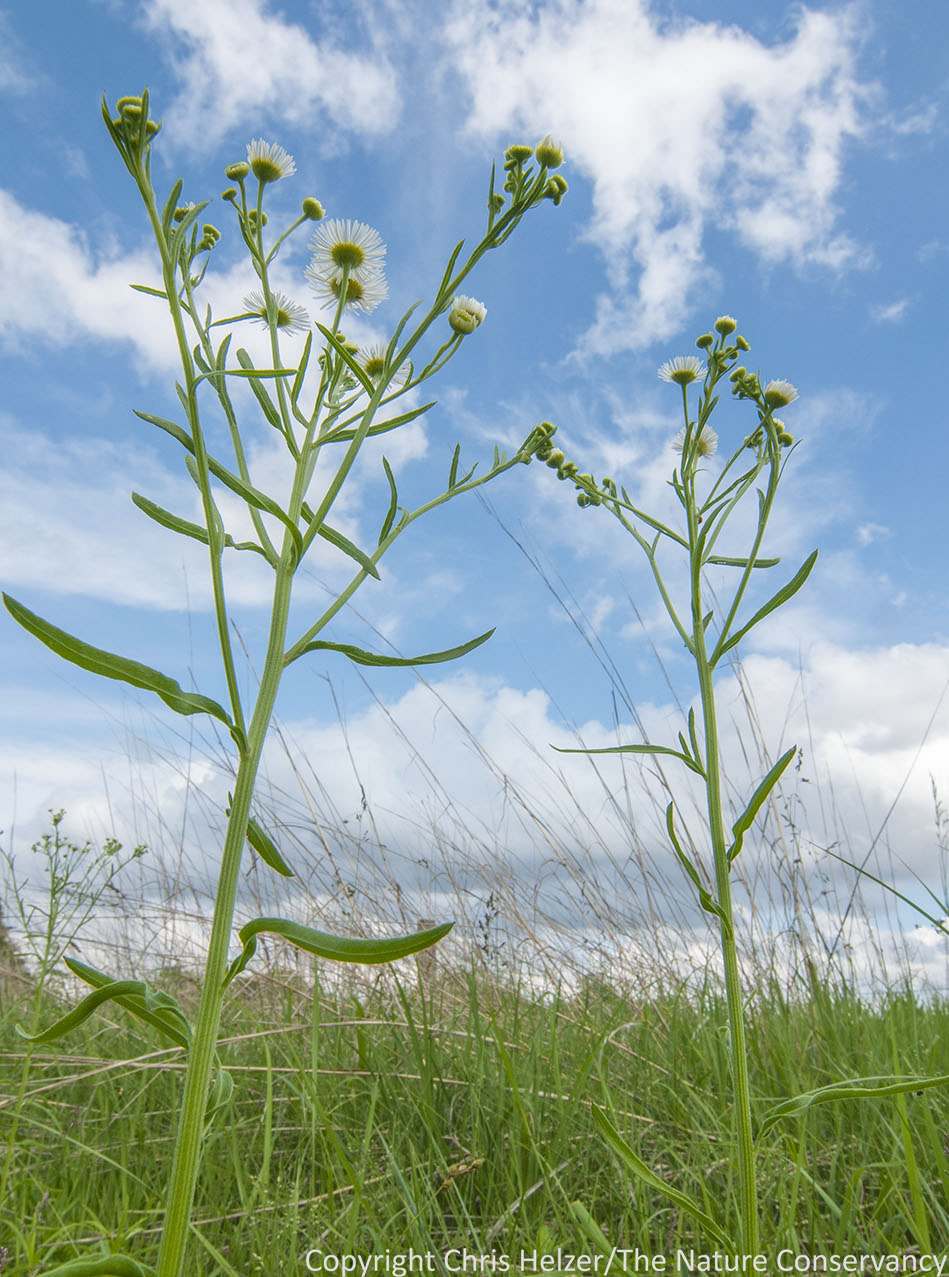
Daisy fleabane (Erigeron strigosus) is considered by many people to be a weed.  It’s a biennial with very pretty, albeit small, daisy-like flowers that flourishes when the dominant plants around it have been weakened.  As a prairie manager, I’ve always appreciated daisy fleabane as an indicator that we’ve created conditions for new wildflowers (short- and long-lived) to insert themselves between the grasses in our sites.

Daisy fleabane (erigeron strigosus).  Lincoln Creek Prairie.  Aurora, Nebraska.

Daisy fleabane reaches toward the sky. Lincoln Creek Prairie. Aurora, Nebraska.

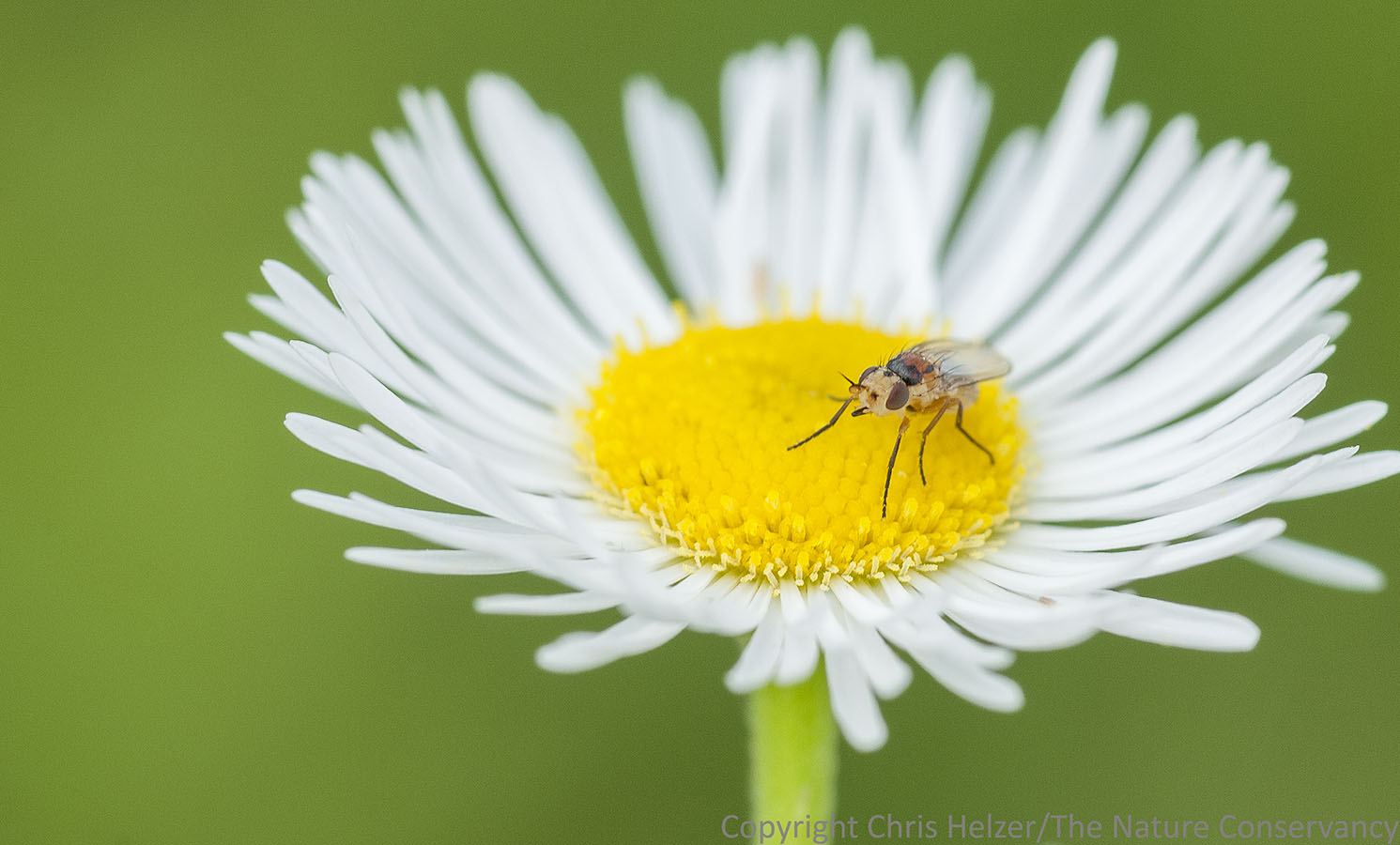
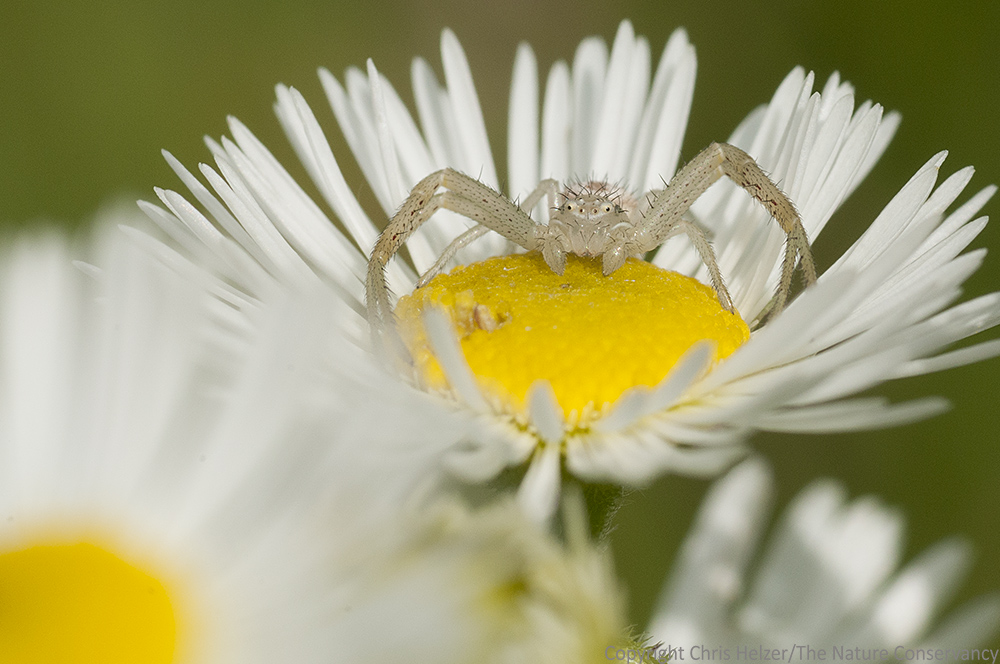
Last Friday evening, I took my camera for a walk in a small prairie here in town and found quite a few daisy fleabane plants growing along the trail.  I wasn’t the only one enjoying them – I saw numerous small bees and flies feeding on the pollen, and a few crab spiders hoping one of those pollinators waiting to ambush those same small pollinators.

Daisy fleabane (erigeron strigosus).  Lincoln Creek Prairie.  Aurora, Nebraska.

Daisy fleabane flowers and small fly.

Fly on Daisy fleabane (erigeron strigosus).  Lincoln Creek Prairie.  Aurora, Nebraska.

A closer look at the fly.

The first crab spider I noticed slipped over the edge of the flower to hide when it spotted me coming toward it.  I turned away to photograph something else nearby.  When I looked back, the spider was back on the flower.  I adjusted my position very slightly and the spider slipped back to its hiding place.  Argh.  Stubbornly, I decided I was going to photograph that spider if I had to wait all evening to do so.  I didn’t have to wait quite that long, but it felt like it.  I got my tripod positioned so that I could take the photo when/if the spider reappeared.  Holding perfectly still, (with sweat running down my nose and mosquitoes feeding on my neck) I stayed in position for at least 5-10 minutes until the spider finally showed itself again.  Got it!

Crab spider on daisy fleabane.  Lincoln Creek Prairie.  Aurora, Nebraska.

This spider photo is nice enough, but will always be memorable to me because of the effort it took to get it.  I hate to think how many mosquitoes got a free meal while I sat still waiting for my little spider buddy to make itself available for a photo…

A little further up the trail, I saw another crab spider that had caught a fly.  I figured it too would make a run for cover when I got close, so I came in low and slow.  I’m not sure it would have mattered – this spider showed none of the anxiety of the first one, and sat very still while I set up the tripod and waited for the breeze to pause long enough to get a good shot.  Maybe this spider was too distracted by its meal to care about me (though that’s not been my experience in the past).   I wasn’t sure whether to be grateful to the second spider for its cooperation or mad at the first one for all the mosquito bites on my neck.

Crab spider on daisy fleabane.  Lincoln Creek Prairie.  Aurora, Nebraska.

This crab spider seemed happy to have its photo taken with its hunting trophy.

I can understand why people might think of daisy fleabane as a weedy little plant, but its just filling an important role.  When the grasses are weak, something has to take advantage of the temporarily available resources around and between them.  There are numerous species that can do that, including a few that can cause real problems if they become established.  Given the choices, I’m always happy to see the pretty little daisy flowers and the diverse tiny creatures they attract.