
Mob grazing is attracting a lot of attention lately, especially among people who are fans of other intensive rotational grazing systems. Usually, mob grazing is an extreme form of rotational grazing, in which high numbers of cattle are grazed in very small areas – for very short periods of time. Often, cattle are given a new area to graze daily (or more frequently) and formerly grazed areas are allowed to rest for several months or more before being grazed again. The intensity of grazing in individual paddocks varies by the rancher or grazier running the system. In some cases, that intensity can be very high. Proponents list off multiple benefits to the land from mob grazing, including increased soil organic matter, weed control, and “grass health”.

Mob grazing in central Nebraska. Cattle are just being moved from the paddock on the left to the one on the right. These cattle were being moved multiple times per day.
My purpose for this post is not to make any kind of final judgement on mob grazing, but to point out a few things that concern me from a prairie conservation perspective – and perhaps slow down the mob grazing bandwagon just a bit. Those of you who have followed my blog for any length of time are aware that I’m generally a fan of using grazing as a tool for prairie management. There is abundant data showing benefits of grazing to wildlife habitat and plant species diversity, both on my own sites and others. I don’t advocate grazing for all prairies, but I do think prairie managers should look at grazing with an open mind, and consider how it might help them achieve specific objectives.
In the case of mob grazing, however, I’m very concerned about what I’ve seen in my (limited) personal experience, and even more concerned that I’ve been unable to find ANY published research on the topic. I think there are good reasons to cautious before buying into anything supported only by testimonials, so I’m nervous about how strongly mob grazing is being promoted. To be clear, I’m approaching this from a prairie conservation perspective, not a graziers perspective, so my thoughts should be taken in that context.
Impacts on Soil Organic Matter
Returning to the purported benefits of mob grazing, let’s look at soil organic matter first. While there are various explanations of how mob grazing affects organic matter in the soil, the general idea seems to be that mob grazing cattle eat about 60 percent of the standing vegetation and stomp the remaining 40 percent into the soil. Thus, soil organic matter increases and becomes more productive. This has never jived with my understanding of soil organic matter (soil carbon) production, so I checked with four prominent scientists around the country who study soil nutrient cycling, including soil carbon. When I asked them if the claims from mob grazing advocates made sense, their response was unanimous and strikingly blunt. To quote one of them, “That’s totally bogus”.
In reality, soil organic matter is formed mainly by belowground processes, including root decomposition, root exudates, and mycorrhizal carbon inputs. In prairies, a substantial percentage of plant roots are abandoned to decompose each year and replaced with new roots. Those old roots provide organic matter in abundance, and more importantly, that organic matter becomes a stable part of the soil profile – and is added to and enhanced by the other two processes listed above. My panel of experts said that stomping vegetation into the soil might provide a slight and temporary increase in organic matter near the soil surface, but that it would be unstable and wouldn’t last long. It’s the stable supply of organic matter deeper in the soil profile that actually drives plant productivity, and that supply comes from plant roots themselves. In fact, the experts suggested that the kind of vegetation stomping I asked them about was likely to have fairly negative consequences. They thought that soil compaction and disruption of soil structure as a result from heavy trampling would probably decrease -not increase – plant productivity. None of this means soil organic matter can’t increase under mob grazing, but any increase would be due to the same belowground processes listed above.
As an aside, I’ve heard some rotational grazing proponents talk about why fire is a bad thing in grasslands because it burns up vegetation that would otherwise be incorporated into the soil – thus, fire decreases organic matter in soil. This is clearly not the case, and has been thoroughly dismissed by multiple researchers who have shown stable or increasing levels of soil carbon under frequent fire.
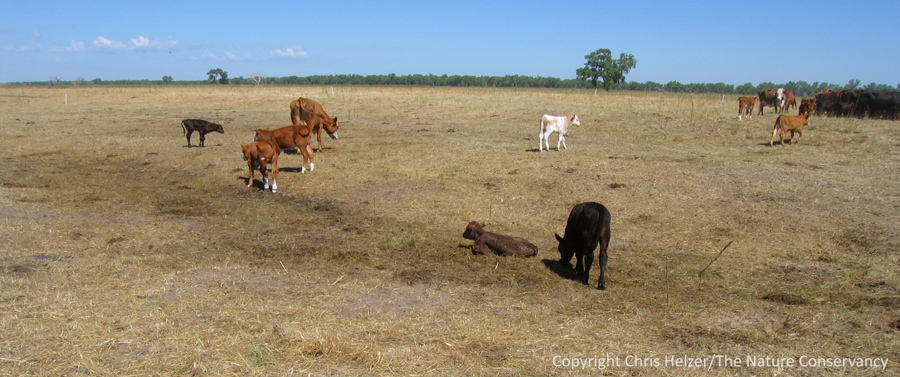
Some proponents of mob grazing say that this kind of heavy impact adds organic matter to the soil. Scientists who study soil and organic matter disagree, and suggest it’s likely doing more harm than good. To be fair, not all mob grazing is this intensive.
Impacts on Weeds
A second purported benefit of mob grazing is weed control. First, of course, we need to define what a “weed” is. As has been discussed in this blog before, it’s a very subjective term. Generally, there are two categories of plants that people consider to be weeds; opportunistic plants that take advantage of weakened dominant plants (e.g. ragweeds, annual grasses, and other short-lived rapidly-reproducing plants), and truly invasive species that are non-native to a particular ecosystem and become dominant to the expense of other species. Let’s look at each of those two in the context of mob grazing.
If opportunistic plants are the weeds of concern, it seems unlikely that mob grazing would help suppress them. Mob grazing proponents say that the high grazing intensity makes cattle eat – or stomp – all plants in the paddock, thus removing the weeds that cattle wouldn’t normally eat. Unfortunately, while that might be true in the short-term, it’s the recovery from that grazing that’s more important. Opportunistic plants are successful because they can recover from intense disturbances faster than others. Big strong grasses are the biggest competitors to those “weeds”, and those grasses are greatly weakened by severe defoliation. Until those grasses and other major perennials recover their dominance of the plant community again, opportunistic plants run rampant. If the time until the next grazing bout allows those grasses to fully recover their vigor, those opportunistic plants will eventually fade – but only until the next grazing bout. In other words pulses of intensive grazing will result in flushes in opportunistic plant abundance as well. I would argue that most opportunistic plant species are non-threatening in any regard, but if suppressing them is an objective, the smart strategy is to strengthen the surrounding plant community.
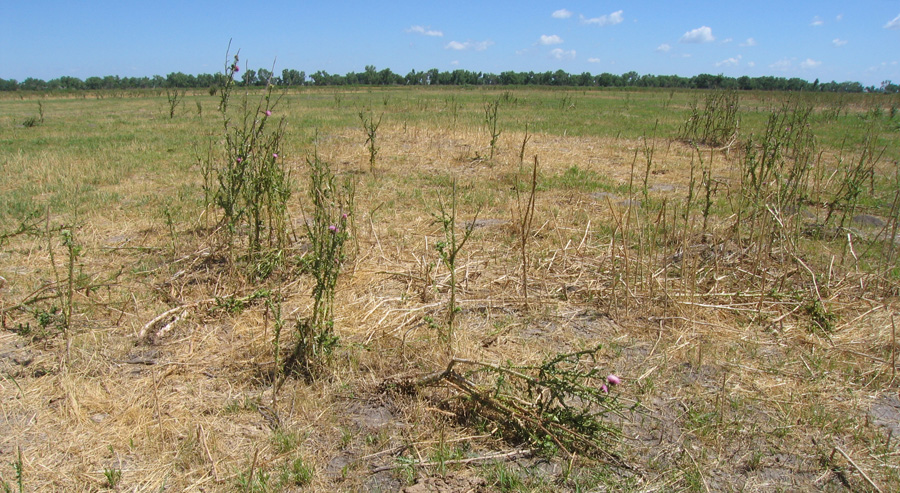
In this pasture, mob grazing was being used as a tool for controlling musk thistle. The heavy grazing intensity did get the cattle to eat some (but not all) of the thistles. (Continued on next photo)
.
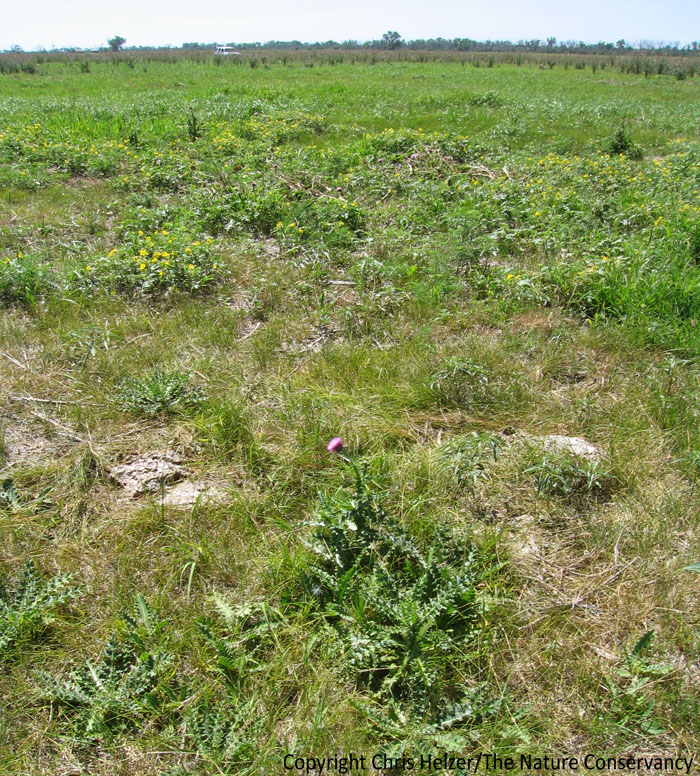
Although heavy grazing intensity can get cattle to eat at least some musk thistles, areas like this one that are a couple weeks into the recovery from that grazing tell the real story. The severe weakening of dominant grasses opened up space for opportunistic plants (like these numerous musk thistle rosettes) – and the grazing led to the exact opposite of the desired impact. Fields of blooming thistles can be seen in the background of this photo where they’ve had sufficient time since grazing to reach maturity.
It is possible to reduce the abundance of opportunistic plants in pasture through periodic moderate grazing. Mob grazing that moves animals through paddocks quickly enough that the lower leaves of grasses are left ungrazed, could actually stimulate the matrix of grass to thicken, due to increased growth of rhizomes and tillers (stems). Higher density of grass that chokes out other plants might be seen as beneficial from a grazing standpoint if grass is the only thing the grazier wants – especially in tame grass pastures. However, from a plant diversity and wildlife habitat standpoint in native praireis (the perspective I’m coming from) it’s certainly not a good thing.
In the case of truly invasive plant species, the story is a little more complicated because every invasive species has its own unique strategy for becoming dominant. In most cases, the invasive plant has been released from pests and pathogens that suppressed it in its native habitat, and the plant species in the community being invaded have not had time to develop strategies to combat it. In some cases, concentrating cattle grazing into a relatively small area can lead to the defoliation of an invasive species that would otherwise avoid being grazed. If that ability to remain ungrazed while surrounding plants are weakened by grazing is the primary way that invasive plant gains dominance, that defoliation could reduce its spread. However, in most cases, the story is much more complicated, and invasive plants use a more diverse mixture of advantages and strategies to force their way into plant communities. Weakening the surrounding plant community through something like mob grazing is likely to increase the spread of invasive plants rather than decrease it. I would use extreme caution when testing mob grazing as a tool for controlling invasive plants.
Impacts on “Grass Health”
When I first heard the claim that mob grazing increases grass health, my initial response was, “I didn’t know the grass was sick!” It’s hard to glean from the various claims what the specific benefits to grass health are, or how that health is defined. I also have a hard time understanding why mob grazing would provide any benefits to grass plants that other kinds of grazing systems don’t – as long as those other grazing systems include a mixture of grazing and rest periods. As with all other plants, I think its important that grasses are allowed to flower and produce seed periodically, and mob grazing may do that (depending upon the length of the recovery period) – but many other grazing systems do the same, without some of the potential risks I see from mob grazing. In some cases, I think grass health refers mostly to soil organic matter, which I addressed earlier. Until I hear more specifics about how mob grazing affects grass health, I can’t really respond more.
Other Benefits – Livestock and Wildlife
I’m not sure how this system can be good for livestock performance – especially when paddocks are grazed very intensively. Forcing a cow to eat plants it wouldn’t normally eat seems to override the cow’s effective inherent ability to optimize its own diet. Why would it benefit a cow to eat plants – or plant parts – that are not the best available choices within a larger pasture? I have the same concern with some other rotational systems, but this takes it to an extreme. In order to gain weight, cattle test and refine their forage intake on a daily basis, constantly adjusting what they eat based on the phenology of the plants. Under extreme mob grazing, cattle have to eat the least palatable plant species and plant parts along with the good stuff. I don’t understand the logic of that strategy, and, in fact, even some proponents of mob grazing admit some “inconsistency” in livestock weight gains. The only research project I know of that has started looking at weight gains and other aspects of mob grazing has found very poor livestock performance during its first season (2011). Again, I’m not saying that cattle can’t gain weight in mob grazing systems, only that I think people should be cautious about accepting that claim.
An additional benefit promoted by mob grazing advocates is that the system increases the carrying capacity of pastures. This is a tricky claim to evaluate, because it depends upon your definition of carrying capacity. On the one hand, it’s surely possible to increase the number of cattle in a pasture, and claim that the carrying capacity of the pasture is now higher – though you can do the same with any grazing system. On the other hand, a more formal range science definition of carrying capacity is “the maximum animal numbers which can graze each year on a given area of grassland for a specific number of days without inducing a downward trend in forage production, forage quality, or soil.” In other words, carrying capacity isn’t just the number of cows you can put in a pasture, it’s the number of cows that doesn’t degrade that pasture over time. This latter definition can only be evaluated by long-term data, which doesn’t currently exist for mob grazing systems.
From a wildlife perspective, it’s hard to say what the impacts of mob grazing would be. Much depends upon the size of the grazing area, the intensity of grazing, and the length of recovery time. Clearly, very intense grazing that stomps vegetation into the soil will have extremely negative impacts on any nesting birds or invertebrates in that immediate area. On the other hand, the majority of the site is always in a recovery phase with no active grazing, so there should be a nice diverse mixture of habitat conditions available. My guess is that mob grazing could be beneficial for many wildlife species – in terms of habitat structure – depending upon how it’s set up.
A bigger issue is that of plant diversity and overall ecological resilience. While I think that many people overstate the potential negative impact of cattle grazing on “sensitive” prairie plants, including some rare wildflowers, the impacts from mob grazing on those plants could be a legitimate concern. I think all prairie plants can put up with some degree of defoliation, even when it’s repeated multiple times over a season or two, but I think we would need some careful study of how intensive mob grazing impacts could affect prairie communities before introducing it as a potential management tool. The potential soil impacts of more extreme versions of mob grazing are particularly concerning. I’m sure historic prairies were exposed to high concentrations of bison grazing, but I have a very hard time believing that bison stuck around one place and grazed so intensively that they forced themselves to eat substandard forage. Until I see some well-supported research on the recovery of plant communities, I’m not comfortable exposing native prairies to that kind of severe disturbance.
The Upshot
I’m not against grazing in prairies, and I’m not even against mob grazing per se. There may be circumstances under which mob grazing, or some variation of it, could be used to achieve certain objectives. In tame grass pastures, for example, where tilled land has been converted into forage grasses and the sole purpose of the site is to feed cattle, mob grazing might be worth a try. In those kinds of pastures, the native plant and soil communies have already been severely altered, so out-of-the-box experiments have a relatively low risk of making things worse. I still don’t buy most of the claims about the purported benefits to livestock, grasses, or soils, but as long as cattle producers test the system with eyes wide open, who am I to say they shouldn’t?
However, in native prairies and rangeland, I think the potential risks of the more extreme versions of mob grazing far outweigh any purported benefits, at least until there is some actual research that says otherwise. We have abundant evidence that many aspects of native prairie plant and soil communities do not recover well from tillage, and mob grazing impacts can come uncomfortably close to those of tillage, in my opinion. There are countless other options for using grazing – even intensive grazing – to suppress dominant grasses, control invasive species, create wildlife habitat structure, and achieve other objectives. I strongly support active experimentation with grazing techniques that could help us with our numerous prairie conservation challenges, but with grazing, as with anything else, it IS possible to have too much of a good thing.
.
For those interested, here are two links to relevant research papers on soil carbon (organic matter) and fire/grazing, followed by three non-scientific reports on mob grazing.
Kitchen et al, 2009. (Effects of fire on mowing on soil carbon and other factors.)
Johnson and Matchett, 2001. (Effects of fire and grazing on belowground processes)

 The Prairie Ecologist