An Early Attempt to Evaluate Prairie Restoration Success by Looking at Insect Use.

Back in February, I wrote a post that laid out some ideas about how to measure success when using prairie restoration (reconstruction) to stitch fragmented remnant prairies back together.  One of the main needs is to see whether species from the remnant are also using the restored prairie.  If I’m trying to make a small remnant prairie function as a larger prairie by adding restored prairie around it, the species in the remnant must be able to expand into and travel through the restored habitat.

I just got some data from a couple of volunteer amateur entomologists that apply to that kind of evaluation, so I thought I’d share what they found.  First, let me be clear that these are amateurs (“enthusiasts” may be a better term than “entomologists” – though they are much better at insect identification than I am!) and that these are not research data.  However, what they found was very interesting, and will make a good launching point for future work.

Four species of tiger beetles were among the insects found during the 2009 inventory work.

INTRODUCTION

In early 2009, I was approached by Chris Aubushon and Connie McCartney, who live in Grand Island, Nebraska – near our Platte River prairies.  Chris and Connie were initially just looking for new sites to hunt for insects, but as we talked, we developed a bigger idea.  They volunteered to come out once a month for during the 2009 growing season and collect as many insects as they could from 6 sites and to identify what they could.  The six sites were really three sites where I had a restored prairie next to a remnant prairie, and they collected insects from both the remnant and restored portions of those sites.
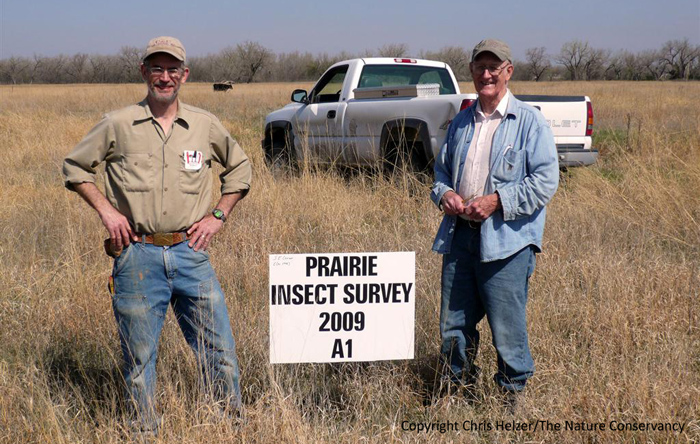
Chris Aubushon (left) and Connie McCartney (right) setting up plots for their insect inventory project in early spring 2009.

Again, this was not a research project, but Chris and Connie – and some helpers – did come out once a month for 5 months and collect a lot of insects.   They restricted their sampling to one 100 foot by 100 foot plot at each of the 6 sites, and used a combination of sweep netting and pitfall traps to catch the insects.

RESULTS

Chris and Connie were able to identify 136 species from those five months of collecting.  They also found (but didn’t identify to species) approximately 33 species of spiders.  When I got the list of species from Chris, I sent it to several friends of mine who are knowledgeable about insects to get their impressions.  The consensus among those entomologists was that the insects on the list were almost exclusively common species that are habitat generalists.  In other words, the list doesn’t include many rare species, or species tied to particularly “good” quality prairies.  Instead, Chris and Connie mostly caught insect species that can be found just about anywhere.   That doesn’t diminish their efforts, but it’s important to remember as you interpret the breakdown of results.

Of the 136 species caught, 28 were seen at only one site.  Interestingly, 8 of those 28 species were found only in remnant prairie, while 20 were found only in restored prairie.  (I don’t think it is necessarily important, but of the 20 species found only in restored habitat, half were beetles.)  Two species – a firefly and a burying beetle were found at two different sites that were not adjacent to each other.  In each case, they were found in one restored prairie plot and one remnant prairie plot.
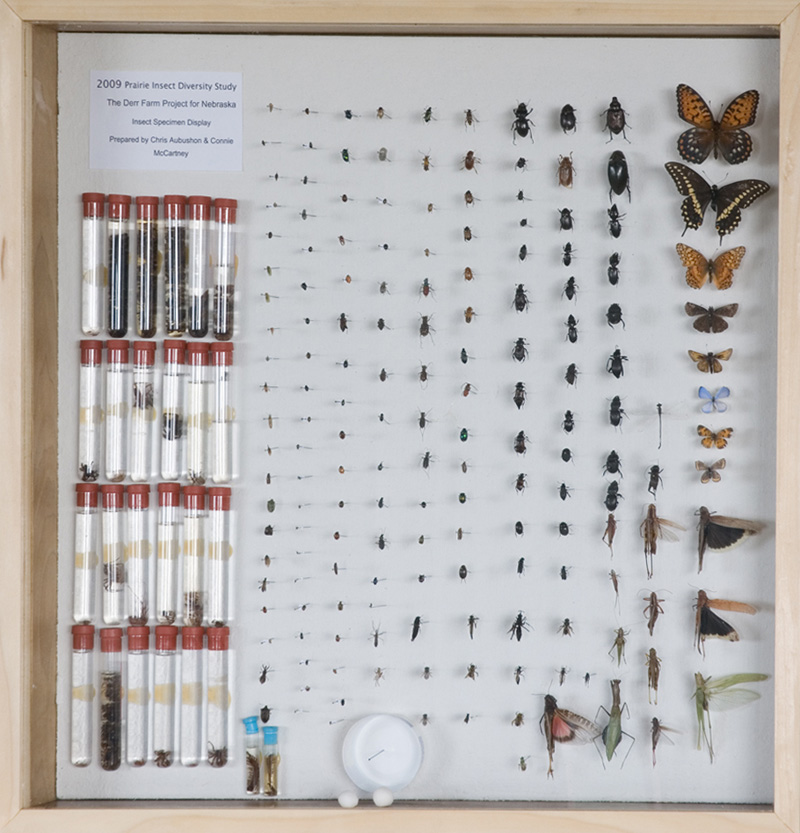
The reference insect collection from Chris and Connie's work in 2009.

All of the remaining species (106 of them) were found in both halves of at least one remnant/restored prairie pair.  In other words, except for the two species mentioned above, every other species of insect found in more than one place was seen in both the restored and remnant portion of at least one prairie.  Remembering that these are all generalist species, I’m still surprised – and encouraged – by those results.  I had expected to see at least a few insect speces that were found in remnant prairies but that weren’t yet making the jump into the adjacent restored prairies.  In fact, I was kind of counting on seeing that so that I could design some follow-up data collection to figure out what the obstacles might be that were preventing them from using restored prairie.

CONCLUSIONS

So what have I learned?  First, the prairie restoration work we’ve been doing appears to provide adequate habitat for the most common and widespread insect species in our remnant prairies.  At least for those species, the restoration work we’re doing is successfully increasing the size and connectivity of fragmented remnant prairies.

Second, I’ve learned that I need to recruit a lot more entomologists to come collect insects from our prairies because every time I do, I learn something.  A little more than a decade ago, I worked with Kristine Nemec on her graduate school project to compare insects between remnant and restored prairies along the Platte River in Nebraska.  For her project, she inventoried insects in 3 restored and 3 remnant (degraded) prairies, but the restorations and remnants weren’t adjacent to each other.  Nevertheless, among grasshoppers, katydids, leafhoppers, planthoppers, and treehoppers, she found very few species that were found in remnant prairies but not restored prairies.  She also found very similar numbers of species between remnant and restored prairie for each of the insect groups she looked at.  You can see a brief summary of some of her thesis findings here. Nemec Results

Third, I’ve learned that the next steps in our efforts to evaluate insect use of our restored prairies will be harder.  We probably need to start by identifying species of insects in our remnant prairies that may not utilize nearby restored prairie – based on what we (meaning people besides me) know about their life history.  Then we need to do some targeted sampling to see whether they are or are not using those restored prairies.  It’d be even better if we could actually track individual insect movement to see if they cross the boundary between remnant and restored prairie.   (That should be easy, right?)  Broad sampling like we’ve done so far is useful, and a good first step, but now we need to hone in on a few target species and see what we can learn about them.  Species that rely on a particular plant species or that are tied to soil organic matter levels may be examples of those we need to study.

To sum up, there’s plenty of work to do.  To this point, we haven’t found any glaring problems with our restored prairies that are so severe that common insect species are restricted from using them.  That’s pretty nice to know, but it’s just the tip of the research iceberg.  Now we need to dive in and start working on the rest.

I’m extremely grateful to Chris Aubushon and Connie McCartney for all of their hard work collecting, sorting, and identifying insects for this project.  It was an amazing effort – and done for the simple love of exploration of the natural world.  Thank you.

I’m also grateful to James Trager, M.J. Hatfield, and Ted MacRae for helping me to interpret the results of the project.  Their comments and insight helped me tremendously as I worked to understand what conclusions I could and couldn’t pull from these data.
Why Every Prairie Really is Unique – and Why it Matters.

Confirmation that every prairie has its own unique composition of plant and insect species, and discussion about why that’s important for conservation.

Several years ago, I helped assemble a group of partners to begin some pilot research on what kinds of impacts habitat fragmentation may be having on the tallgrass prairies in southeastern Nebraska.  While those prairies are greatly fragmented compared to the extensive Nebraska Sandhills or Kansas Flint Hills prairies, there are still many blocks of hundreds to thousands of acres of prairie embedded within a matrix of cropland.  Those grassland complexes include a mixture of hayed prairies, grazed prairies, and Conservation Reserve Program (CRP) fields.  As conservation organizations consider the best ways to ensure continued survival of those important grasslands, many of the most pressing questions revolve around whether or not the prairie landscape is intact enough to support a functional ecosystem.

We still have a long way to go before we know much about the “functioning” of the southeast prairies, but we have collected enough data to know one thing:  every one of those prairies is unique.  While that not exactly earth shattering news, especially to biologists who have inventoried numerous prairies, it’s really very important.  To be more specific about what we’ve found, each prairie appears to have its own individual “signature” of plant and insect species compositions.  In other words, each has a mixture of species that is similar to, but also very different from, other prairies – even among prairies that are managed much the same way and that appear very similar from a distance.

For example, over the last couple of years we have done vegetation surveys in 24 hayed prairies as part of a couple of insect research projects.  We selected the 24 sites because we believed they were very similar to each other in plant community but varied in size and degree of isolation.  In other words, we tried to pick sites with identical plant communities.  Boy did we fail.  To be fair, the graduate student that selected the sites did so by driving gravel roads in April and May, and one hayed prairie looks a lot like another from the road at that time of year.  But we did try…

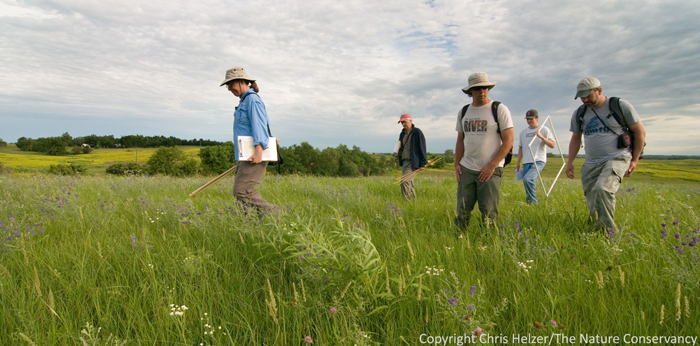
Staff from the Illinois Natural History Survey assisting with vegetation inventories in hayed prairies. Southeast Nebraska - Pawnee County.

There were some strong similarities among the prairies.  Most of them had had abundant cool-season grasses, but also strong representation from warm-season native grasses.  In addition, all of them had a good diversity of plant species – most averaged between 20 and 25 plant species per square meter.  Many of the more common wildflowers were found in all, or nearly all, of the prairies, and in similar amounts – including species like stiff sunflower (Helianthus pauciflorus), heath aster (Aster ericoides), black-eyed Susan (Rudbeckia hirta), pussytoes (Antennaria neglecta), and wild alfalfa (Psoralidium tenuiflorum).  Finally, the majority of the prairies had apparently been inter-seeded at some time in the past with non-native legumes such as red clover, sweet clover, and others, and those species were moderately to very abundant in those prairies – although not to the extent that they seemed to have an impact on overall plant diversity.

However, the differences among the prairies were as obvious as the similarities.  For example, of the 24 prairies, prairie phlox (Phlox pilosa) only appeared within our sampling plots (50 1m2 plots at each site) in three of them – but it was very abundant at those three sites.  Why is it abundant at a few sites and rare or missing from others?  Prairie blazing star (Liatris pycnostachya) showed a similar pattern.  Other important wildflower species – those considered to be among the core species of tallgrass prairie plant communities – only appeared in the data from about half of the sites.  Those species included compass plant (Silphium laciniatum), purple prairie clover (Dalea purpurea), hoary puccoon (Lithospermum canescens), and wild strawberry (Fragaria virginiana), among others.  To be clear, these data don’t indicate whether or not species were absent from an entire site – only that they were absent from the 50 1m2 plots we sampled from at each. Regardless, we saw significant differences in the relative abundance of those species from site to site.  Other important species that varied wildly in abundance among the prairies included prairie dropseed (Sporobolus heterolepis) and eastern gamagrass (Tripsacum dactyloides).  Those two species were in most of the prairies, but appeared in nearly 100% of the plots in some prairies and in only one or two plots in others.

Prior to initiating our research project that used those 24 hayed prairies, we did some broader surveys of prairies that included both hayed and grazed prairies to assess the degree of variety within plant and insect species at those sites.  (The grazed prairies, by the way, reflected many different kinds and intensities of grazing, but are lumped together here for simplicity.)  Because it was pilot data, we did some quick inventories of plants at each site, trying to list all the species we could find.  Not surprisingly, there were some stark differences between grazed and hayed prairies in their plant compositions.  In a few cases that variation could be explained by site conditions (such as rocky or steep terrain) because those conditions clearly made grazing more feasible than haying – in those cases plant species may have been responding to the site rather than the management.  In most cases, however, it was clear that the plants were responding to management.  Plant species like false gromwell (Onosmodium molle), tall boneset (Eupatorium altissimum), partridge pea (Chamaecrista fasciculata), and hoary vervain (Verbena stricta) have life strategies that allow them to thrive under grazing because they are less palatable to grazers than their neighbors and/or can respond more quickly to the space opened up by grazing.  Those and other similar species were found almost exclusively at grazed sites.  On the other hand, there were species like New Jersey tea (Ceanothus herbaceus) and golden alexander (Zizea aurea) that were found much more often at hayed sites than grazed.  While the majority of plant species were found across the entire range of site types, their relative abundances showed that most responded much better to either the hayed or grazed conditions.

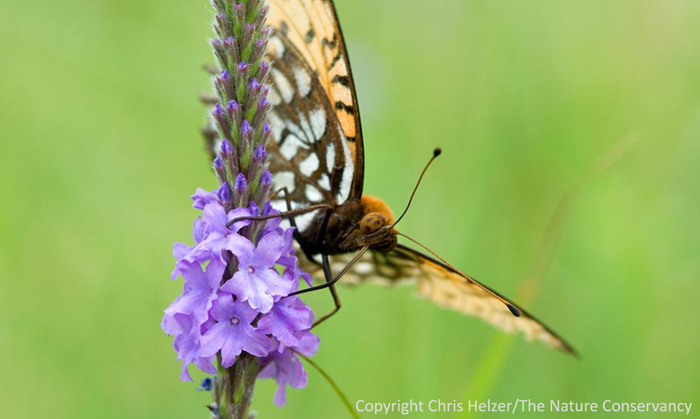
Hoary vervain is a wildflower found mostly in grazed prairies in southeastern Nebraska, and one that is extremely important to pollinators, including regal fritillary butterflies.

Within those same grazed and hayed prairies, we also did some sweep netting of insects.  We targeted our sweeping so that we collected insects off of the same plant species across all of the sites (using a couple different plant species).  We wanted to see whether the insect communities using a particular plant species were essentially the same at all of the prairies.  They’re not.  What we found was that the insect data were even more chaotic looking than the plant data.  Very few insect species were found at all, or even the majority of sites.  That’s likely due to the relatively small amount of sampling we did.  But even with our small samples, it was clear that a large number of species were abundant at one site but absent from many others.  The other strong pattern was that the total abundance of insects was often quite a bit higher – among many species – at the sites we’d considered to be “lower quality” based on our plant data.

There are a number of reasonable – even obvious – explanations for these variations among prairies, including soil type, topography, past management, random chance, etc.  But more important are the lessons that come from recognizing those differences.  First, I think the differences demonstrate the importance of management.  Surely some of the differences between the vegetation composition in those 24 hayed prairies stem from variations between sites relative to the timing and frequency of annual haying, the consistency of timing and frequency over many years, and whether or not the prairies are fertilized.  Later season haying, for example, allows more (and different) plant species to complete their life cycle prior to cutting than early season haying (or twice-annual haying).  Completing their life cycle now and then is critical for the long-term survival of plants because it allows them to reproduce and store energy for the coming winter.

The existence of a combination of hayed and grazed prairies within the landscape is also important.  Because there are plant species (and likely insect species) that do better under grazing management than haying management, and vice versa, having both types of management within a neighborhood can maintain more biological diversity than either of the management types alone.  Of course, managing each of those prairies with a combination of fire, grazing, and perhaps haying, might allow even more plant and insect species to persist on each prairie – although the local abundances of some species might go down because they would lose the consistent management that had allowed them to become dominant.

From a conservation standpoint, one big lesson is that it’s not sufficient to simply rank prairies by floristic quality, size, or other measurements, and act to “protect” the best of those.  In order to conserve the complete diversity of life in the southeastern Nebraska prairies, we need to keep as many of the remaining prairies as we possibly can.  While the grazed sites might look less attractive to a botanist driving by compared to hayed prairies full of compass plant and blazing star flowers, the aesthetic preferences of botanists don’t necessarily reflect the biological needs of ecosystems.  While there was surprising variation between the hayed prairies we looked at, a very significant degree of biological diversity would be lost if the grazed prairies were plowed up.

Even if it were the desired strategy, there’s no way conservation organizations would or could buy up a significant number of the grasslands in southeastern Nebraska, so working collaboratively with the landowners of those prairies is of the utmost importance.  Relying on private landowners to conserve prairies has been a tough pill for many conservation organizations to swallow – including the one that employs me – but during the last several decades most have recognized that need.    The next trick is to refine our skill at working with those landowners without coming across as know-it-all biologists.  The most successful private lands liaisons from the conservation community have been those who listen well, recognize the importance and value of individual landowners’ priorities (remembering that it is THEIR land), and build relationships on mutual trust.  Through those relationships, we can alert landowners to aspects of their prairies and management options they might not be aware of, but the decisions about how to manage their sites still have to be left to the landowner.  Clearly, that will result in some prairies being managed in ways that make some of us uncomfortable, but we don’t want all the prairies to look the same anyway, right?